Historians have traditionally regarded the Ottoman Empire's failed second siege of Vienna in 1683 as a turning point in the empire's long history, bringing to an end centuries of military success and expansion.
After the siege, Habsburg forces, aligned with Poland, Venice and Romanov Russia, launched attacks against the Ottomans across Eurasia. They took Budapest and most of Transylvania by 1686, and two years later pushed the Ottoman border hundreds of kilometres south, beyond the confluence of the Sava and Danube rivers, taking Belgrade in the process.
The Treaty of Karlowitz of 1699 that finally brought an end to the seventeen-year-old ‘Great Turkish War' is traditionally understood as a marker of Ottoman imperial decline, since Istanbul lost unprecedented amounts of territory and subject populations in Hungary, Croatia, Romania and parts of Bosnia to the Habsburgs and were forced to accept borders imposed upon them by their rivals. The Habsburg reconquista of Christian lands dealt a huge blow to the Ottoman ideology of the ever-expanding Islamic frontier. Like the halting of expansion in other dynamic imperial ventures in history, the ‘closed' frontier meant that opportunities for ambitious, able-bodied men of all faiths to make a career under the Ottoman banner were henceforth significantly restricted.Military historians have devoted a lot of attention to the siege of Vienna, depicting it as a decisive Habsburg victory that saved Western civilisation and triggered Ottoman decline. Nevertheless, from the Ottoman perspective, Istanbul succeeded in consolidating its military strength in south-eastern Europe, and the Habsburgs never again constituted an existential threat to the empire. Throughout the eighteenth and nineteenth centuries the Ottomans likewise managed to defend themselves against the rising power of imperial Russia. The Ottoman military machine therefore proved capable of defending the empire, militarily as well as through tactful diplomacy, even if the days of large-scale conquest were over. One of the most profound effects of the Great Turkish War on Ottoman society, however, was that for the first time the Catholic Habsburgs managed to incite Orthodox Christian warrior populations like the Serbs, many of them integral to the Ottoman forces that laid siege to Vienna, to rise up against their Muslim rulers en masse, thereby sabotaging the Ottoman war efforts from within as well as pillaging, terrorising and demoralising the Muslim population in Rumeli (the Ottoman Balkans).
The threat of Christian uprisings in the Ottoman Empire had always been latent given that Ottoman Christians constituted the majority or significant part of the population in the provinces of Rumeli and Anatolia. But Ottoman rivals, like the Habsburgs and the Venetians, consistently failed to foment uprisings among the largely Orthodox Christian populations prior to the eighteenth century. They were unwilling to commit sufficient military and financial assistance unless the Orthodox Christians agreed to accept papal or imperial supremacy and sovereignty. In general, they regarded the much smaller Ottoman Catholic Christian population, such as the Catholic Albanians along the Adriatic coast, as the only viable agents and provocateurs of large-scale Christian dissent within Ottoman society.1 In any case, until 1683 Istanbul continued to provide Orthodox Christian warrior populations with opportunities for accumulating wealth, social mobility and distinguishing themselves as conquering imperial warriors alongside their Muslim comrades.[322] [323] But Vienna's successful incitement of Orthodox Christian warrior populations, like the Serbs, to rise up collectively against Istanbul in the 1680s marked the beginning of what would become a recurring pattern of interimperial, Eurasian politics and intrigue in which first the Habsburgs but then the Russians, French and British would incite other subject Christian populations of the empire to rise up against the Ottomans with devastating effects.
Prior to the eighteenth century what distinguished the Ottomans from their rivals was that they were the first early modern ‘European' state to establish a largely professional standing army comprised of janissary infantry and sipdhi cavalry. Established already in the fourteenth century, the janissaries were a force comprised of boys taken as levies largely from Christian families in the Balkans, converted to Islam and trained to ensure their exclusive loyalty to the Ottoman dynasty.
The sipahi, in contrast, were cavalrymen - sometimes Christians - much larger in number who were awarded fiefs (timdrs) throughout the empire and allowed to collect taxes in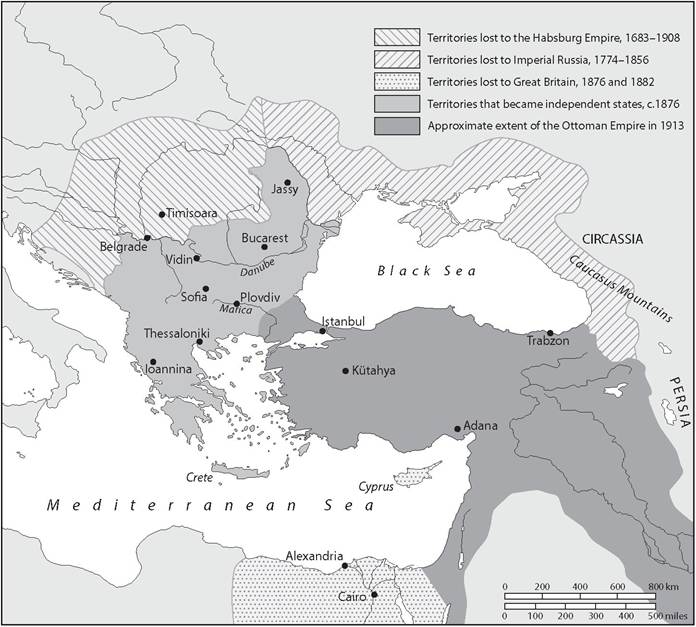
Map io.i The Ottoman Empire, 1660-1913.
these lands in order to raise, arm and provision a retinue of fighting cavalry whose numbers were determined by the size, resources and revenues of the lands they were granted. Auxiliary, irregular troops were also raised to aid the standing armies, skirmish across imperial borders, secure roads and mountain passes, and provide garrison support. Prior to the eighteenth century a large portion of these troops - if not the majority in places across Rumeli - were comprised of Christian warrior populations like the Serbs, Hungarians, Greeks and Vlachs.
The janissaries and sipahis made up the bulk of the Ottoman ‘asken (military-administrative) class, along with higher-ranking imperial officials and bureaucrats as well as religious scholars, whereas the Ottoman irregular forces, Muslim and Christian warriors alike, traditionally hailed from the re‘dyd (literally ‘flock') subject classes that neither enjoyed the same status nor were exempted from paying taxes. During the sixteenth century the imperial war machine could muster over 100,000 combined janissary and cavalry forces supported by tens of thousands of irregular warriors; however, as European rivals began centralising their governments and creating larger fiscal bases to train and pay much larger standing armies to match the Ottomans, Istanbul reduced the size of the sipahi class in order to increase musket-bearing troops on account of revolutionary changes in warfare by the mid seventeenth century. The concomitant loss of control over the growing size and discipline of the janissary forces consequently reduced the Ottoman capacity to organise warfare.[324]
The Ottomans responded to these challenges by radically increasing the number of their musket-bearing irregular forces, who were much more willing to embrace these technological changes at a fraction of the cost of the janissaries, in order to match the larger forces the Habsburgs, and especially the Russians, could muster.
As recruiting more men became the prerequisite of eighteenth-century warfare and required much more cash than in previous centuries, the Ottomans responded by converting the farmland of the timdr system into much more lucrative lifetime tax farms (malikdne) for which local notables (a‘ydn) paid large lump sums of cash, providing the government with the revenue needed to defend the empire.[325] They consequently came to dominate provincial governance. Notables likewise were employed as military contractors, raising large retinues of irregular warrior troops for the Ottoman war effort. Irregular warriors were organised in companies (bolüks) of fifty men, and they were given monthly salaries, paid in two or six months' lump sums, daily rations (yevmiye) and signing-on bonuses (bah§i§)5But what gets lost in the historiography of this transformation and privatisation in the eighteenth-century Ottoman fiscal-military state is the extent to which the Great Turkish War profoundly altered the confessional and even ethnic make-up of the Ottoman army. The recurring defection of Ottoman Orthodox Christian warrior populations like the Serbs, followed by the retaliation of Muslims against them once the Habsburg forces were pushed out of the Balkans starting in the 1690s, constituted a sea change in the nature of Ottoman imperial sovereignty, subjecthood and social relations on the ground. Not only would Istanbul henceforth bar Christian warriors from serving in the army, but it was forced to outsource imperial governance, military recruitment and policing activities to pastoral Muslim warrior populations from the southern and, later, northern parts of the empire - the Albanians, Tatars, Circassians and Kurds - on unprecedented levels.
The Ottoman state, however, lacked both the resources and the will to pay them or offer them sufficient access to power, which meant that these new agents of empire were difficult to control. More importantly, the administration little understood the nature of the honour, vendetta and feuding cultures that bound pastoral communities like the Albanians, coming from the Dinaric Alps in the western Balkans, or steppe warriors, like the Tatar refugees who fled to Rumeli upon the Russians' annexation of the Crimea in 1783 to bolster the Muslim population along the new Danubian borderland.
There was a logic to leaving broader security and policing responsibilities to local ‘para-military', pastoral warrior units: they required less resources from the centre; they were extremely mobile and could be mobilised rapidly for war theatres thousands of kilometres away at a fraction of the cost of the empire's standing forces; and they were sustained beyond their short-term contracts by peacetime crossborder pillaging, slave-taking and kidnapping runs, as well as feuding, ensuring that service to the Ottoman state was profitable. This was especially true during wartime ‘states of exception' when these men could prey upon nonMuslim groups like the Serbs, who lost their status as protected Ottoman subjects (i.e. zimmi; dhimmi, ‘peoples of the book') when they sided with the pro-Habsburg and, later, pro-Russian insurgencies in Ottoman society.5 Virginia Aksan, ‘Mobilization of Warrior Populations in the Ottoman Context, 17501850', in Erik-Jan Zürcher (ed.), FightingforaLiving: A Comparative Study ofMilitary Labour, 1500-2000 (Amsterdam: Amsterdam University Press, 2013), pp. 333-45.
In effect, after 1683 the Ottoman state sanctioned continual guerrilla warfare and terror - hit-and-run pillaging, ransoming, enslavement, arson and presumably rape - against non-Muslim Ottoman subject populations that frequently supported or outright joined the armies of Ottoman imperial rivals like the Habsburgs and Russians during the frequent eighteenthcentury wars. The problem was that this type of vindicatory violence persisted during times of peace, well after the Ottomans signed armistices ending inter-imperial wars with their rivals and undermined the possibility of restoring the rule of law when Muslims and non-Muslims had to live together peacefully again. This frontier policy worked for a time, as the Ottoman imperial palace could disavow this localised violence as acts of banditry by ‘mountain' or ‘Albanian bandits'; but by the turn of the nineteenth century it spiralled out of control in ways overlooked by military historians. It generated confessional and increasingly ethnic enmities while concomitantly fostering large-scale organised crime. This chapter will sketch for the first time the nature and repertoire of the violence stemming from Istanbul's massive privatisation of military and policing powers, and its deleterious impact on inter-confessional and ethnic relations in Ottoman society.