The Athenian Empire
The 1,000-odd poleis communities of the ancient Greeks, centered on the Aegean and extending into the Black Sea and western Mediterranean, formed the largest city-state culture in world history.[374] Located on the western fringes of the sphere of Near Eastern tributary empires, it had developed free of imperial control.
Most of these poleis were small. Athens had long been one of the largest in terms of territory, covering some 2,500 square kilometers, but did not enjoy a dominant position in Greece prior to the fifth century bce. The most successful hegemonic power in the region was Sparta, which by the sixth century bce had not only turned much of the population of the southern Peloponnese into either helots (serfs/collective slaves) or dependent allies, but had also incorporated most of the remainder of the peninsula into an alliance system under its sole leadership. The latter did not amount to a conventional empire: only called upon in times of war and free of tributary obligations, it is best defined as a hegemonic arrangement.Athenian military capacity and expansionism greatly increased in the late sixth and early fifth centuries bce in response to a series of exogenous shocks. The first of these was a Spartan intervention (511-506 bce) that culminated in a temporary occupation of Athens by Spartan forces in 508 bce at a time of internal conflict, in which Sparta supported one faction with the goal of incorporating Athens into its alliance system. Ending in retreat, this abortive intervention appears to have been instrumental in precipitating institutional restructuring across Athenian territory that fostered internal cohesion and increased the potential for mobilization by creating more inclusive conscription and voting districts. These reforms not only laid the foundations for gradual democratization in the following generations but also improved Athenian war-making capabilities.
In the following, the expansion of military operations and citizen rights proceeded in tandem, mutually reinforcing one another. Investment in naval assets, fortuitously aided by the discovery of local silver deposits, was sped up by conflict with the neighboring city-state of Aegina, a long-time regional rival, and especially the threat of invasion by the Achaemenid Persian Empire (see Chapter 4 in this volume). The latter, the dominant power in western Eurasia at the time that had already established and defended control over the Greek city-states on the west coast of Asia Minor (Ionia), administered a second shock in the form of a naval invasion of Attica in 490 bce. Rebuffed by the Athenian citizen militia, this event prompted another round of political reforms that bolstered citizen “voice” and focused electoral competition on military functions (represented by the office of strategos). The third and most dramatic shock was the capture and destruction of the city of Athens by Persian forces in both 480 and 479 bce, which the citizenry survived only via mass evacuation. The Persian threat was staved off by two measures: the intense mobilization of both middling and poorer elements of the Athenian population (for service in the army and navy, respectively), and successful alliance-building across mainland Greece for the purpose of pooling military resources against the invaders.
These repeated Persian incursions provided a powerful incentive not only for Athens to build up its military but also for smaller city-states to seek protection through alliance. This incentive was reinforced by the continued presence of the Persian Empire and the latent threat it represented and especially by the secession of the Ionian city-states from Persian rule in the wake of Persian defeat in Greece, which increased the potential for further conflict. Athens, by then endowed with the largest navy in Greece, was in the best position to capitalize on this increased demand for protection and inter-polis cooperation.
Its support for the Ionian cities moreover created open-ended protection commitments vis-à-v is the Persian Empire. As a result, Athens came to lead an alliance (known in modern parlance as the Delian League) that was ostensibly committed to defense against renewed Persian encroachment but effectively also engaged in proactive offensive operations that sought gains from plunder. Athens's allies, mostly island or coastal poleis in the Aegean and Ionia, contributed either military forces or monetary payments, the latter being stored on the island of Delos where consultative meetings among allies were held.Over time, this hegemonic alliance system morphed into a more overtly imperial structure under Athenian control.[375] The 470s and 460s bce witnessed raids for plunder, forcible reincorporation of several secessionary member states, and renewed military engagement with the Persian Empire. These activities once again fed back into institutional change in Athens, where an expansion of popular political participation in the late 460s was swiftly followed by an unprecedented expansion of military operations as bargaining between elites and the citizen body facilitating mobilization for war-making.
In the 450s bce, Athenian forces operated across the eastern Mediterranean, challenging Persia in Egypt, Phoenicia, and Cyprus, striking Greek rivals in the near- abroad, and launching raids against the Spartan alliance system in the Peloponnese. At this time, membership in the Athenian alliance rose into the 150s or 170s. The league's treasury was transferred to Athens and consultative meetings ceased. With few remaining exceptions, allies were required to make annual payments to Athens instead of contributing military forces, a process that helped sustain Athens's war machine and strengthened its growing monopoly on organized violence. Athenian democratization continued apace, ensuring state payments to a large share of the adult male citizenry and providing opportunities for colonial settlement and enrichment in the territories of subjugated city-states.
Even though attempts to expand into central Greece failed, the Athenian maritime empire was successfully maintained and revolts were squashed even as conflict with Persia—the ostensible rationale of the alliance system—subsided in the mid-fifth century bce. By then, tribute had become the main benefit accruing to Athens, income that was solely controlled by Athenian institutions and annually paraded in procession.These payments by subordinate city-states permitted the accumulation of a large financial reserve at Athens that was available to fund military ventures against rebellious allies or external competitors. Athens's increasingly central position in the Aegean attracted immigration which boosted the size of the citizenry via enfranchisement and of the resident alien (“metic”) population. This in turn raised the military mobilization capacities of the Athenian state: able-bodied adult male citizens and resident aliens alike owed military service, and increased state income allowed for the compensation of poorer Athenians (supplemented by hired slaves) serving as rowers. Manpower and monetary resources were of critical importance: mass mobilization created a strong link between numbers and military power; and the labor-intensive use of oar-propelled war ships required both manpower and training, and thus paid mobilization of sub-elite elements of the population. While hostile sources may have exaggerated the connection between war, democracy, and naval service, the fundamental linkage of popular participation, the fleet, and empire is hard to deny.
By the 430s bce, the total Athenian population (including metics and slaves) may have reached 300,000, including perhaps as many as 60,000 adult male citizens. The size of the empire as a whole is unclear but may have reached one and a half million or so. As far as we can tell, tribute by allies exceeded Athenian state income from domestic sources. The resultant system required continuing inflows to be maintained, simultaneously rewarding and burdening Athenians.
Athens had become the mobilization-intensive core of an imperial system of control and exploitation of a tributary periphery.Athenian-style imperial power was characterized by tensions between increasing efforts at standardization and centralization on the one hand and abiding institutional segmentation on the other. Ian Morris has interpreted a variety of Athenian measures as attempts to convert what had begun as a hegemony into a “Greater Athenian state.” These included monopolization of the (key) means of coercion, that is, naval assets, as all remaining allied contingents were gradually discontinued and replaced by tributary dues; centralized tribute collection; standardization of coinage, weights, and measures (by extending Athenian norms to subject polities); interference in the constitutions of subject city-states; centralization of legal processes by moving certain trials to Athens; promotion of Athens as a cultural capital; and religious politics emphasizing joint Ionian ancestry.11
Yet at the same time, a strict institutional separation between the imperial core and the tributary periphery was maintained and even reinforced. The only political forum shared by Athenians and their allies, the Delian meetings, was discontinued in the mid-fifth century bce as imperial control was solidified. This coincided with more restrictive citizenship laws that curbed enfranchisement and thus insulated the Athenian citizenry, which formed the demographic and political core of the empire, from subordinate populations. Institutional separation stemmed not merely from the participatory features that were common in many historical city-state cultures and could be hard to reconcile with wider integration, but was continuously
11
Morris 2009.
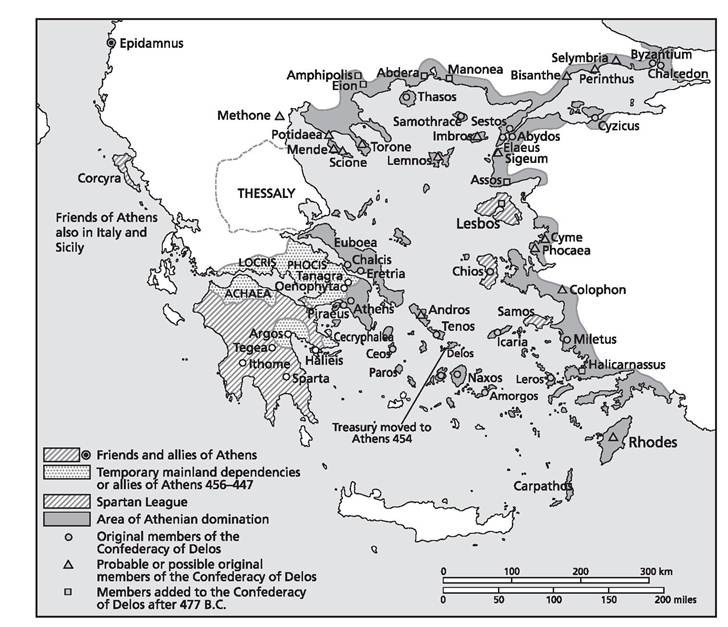
Map 5.1. The Athenian Empire.
Source: Morris 2013, 281. Copyright: Oxford University Press.
policed by the increasingly democratic institutions of the ruling city-state that defined the Athenian citizenry—whether resident in Attica or in overseas settlements (cleruchies)—as a body both closed and special.
Athenian political institutions were wholly self-contained: the assembly met in Athens and only adult male citizens could participate and serve on the Council of the 500 (the main executive body) and in the law courts.The biggest structural weakness of this system was that it impeded the formation of an empire-wide ruling class drawn from the elites of both the metropole and the subject communities, which was otherwise a typical feature of pre-modern states (see Chapters 1 and 5 in Volume I). As Athenian elite actors were increasingly constrained by democratic institutions that by definition did not extend beyond the core polity, no effective trans-polis top tier could be formed. Athenian rule was rooted in a dilemma: inasmuch as Athenian imperialism and democratization within the core were interrelated and reinforced one another, the same forces that made Athens competitive as an imperial core—mass mobilization driven by internal cohesion and participation—obstructed its ability to create a stable empirewide ruling class through the co-optation of allied local elites.
Thus, one and the same feature simultaneously drove and curtailed Athens's imperial capacities. To the extent that allied city-states were also endowed with democratic regimes, elite co-optation became even less feasible. There is no good reason to believe that the 700 Athenian officials (archai) dispatched to supervise the allied states were a workable substitute for a “Gellnerian” ruling class. It thus seems that it was not the nature of the Greek polis per se that limited and undermined imperial state formation but the Athenian political system that had, in turn, coevolved with the empire, both underpinning and undermining it in the process.[376]
The main strategies for ensuring cooperation that were available in this particular environment were a mixture of economic integration and ideological appeals alongside Athens's growing monopoly on the concentrated means of military coercion. In the absence of an emergent ruling class with vested interests in the success of the empire, the latter was the most potent determinant of imperial control. This arrangement, while stable in the absence of significant challenges, was consequently exceptionally vulnerable to serious military setbacks. This vulnerability grew particularly problematic as Athenian imperialism prompted countervailing consolidation efforts in the same region: examples include the Thebes-led Boeotian League in central Greece, the Chalcidian League in the northern Aegean, Syracuse's response to Athenian intervention, and Sparta's replication of certain features of Athenian war-making to fight Athens. All this served to erode Athens's comparative advantage in the provision of violence.
Its empire came under growing pressure during conflict with Sparta and its allies, known as the Peloponnesian War (431-404 bce). The great costs associated with large-scale naval operations quickly depleted reserves and necessitated considerable tribute increases. Military casualties, coupled with the effects of a severe epidemic, significantly reduced Athenian citizen numbers. An ambitious invasion of Syracuse on Sicily for the purpose of obtaining additional resources failed (415413 bce) and triggered both rebellions and intensified conflict with Sparta. Tribute was reorganized as a tax on commerce which reportedly raised overall revenue. The pressures of ever costlier war resulted in an oligarchic coup in 411, but democratic restoration sustained war-making as well as expanded state payments to the poor. This is best understood as bargaining with the naval element on which the survival of the Athenian Empire critically depended, given the challenge posed by Sparta's development of a navy sponsored by the Persian Empire. Even so, casualties had depleted the Athenian recruitment base to the extent that its navy increasingly had to rely on subjects and mercenaries. The system had been stretched to the demographic limits of the core polity: by this time, there may have been fewer than half as many adult male citizens as at the beginning of the war. Athens's imperial structure collapsed in the wake of naval defeat in 405/404 bce, resulting in the defection of almost all allied city-states and renewed internal political strife.
However, the rapid restoration of democratic institutions supported a renewal of imperial ambitions, this time by the creation of a navy that was sustained by internal redistribution made possible by taxation of the wealthy.[377] After initial unilateral predatory operations, more equitable alliance-building was undertaken from the 380s bce onward. In 377, a charter for a new alliance system was issued, providing for financial contributions by all allied city-states under overall Athenian leadership that was contained by consensus-building formal meetings. This was reminiscent of conditions a century earlier, when Athens had still lacked the wherewithal for open oppression and relied on consensual pooling of resources for military action. This allowed the creation of a large Athenian navy that experienced strong growth from the 370s to 350 bce. Once again, expansion of military mobilization was accompanied, and arguably facilitated, by a large expansion of public welfare provisions within the citizen core.
This second Athenian Empire came under increasingly strong pressure from the 350s onward, with setbacks and fiscal depletion offset by more intense and costly mobilization efforts, which for the first time drew on mercenaries on a large scale to meet demand for manpower. Defeat by the increasingly powerful regional empire of the Macedonians to the north forced Athens to submit to their hegemonic control in 338 bce but the following period of peace (until 323 bce) allowed another massive buildup of naval assets. Only decisive military defeat by the Macedonians in 322 bce ended Athens's overseas ventures.
Throughout this period, over the course of almost two centuries, we observe a close intertwining of political and military mobilization, and concurrent expansion of redistributive and military spending. While in the first-fifth-century empire, the financial burden of war was largely placed on subordinate city-states, the second-fourth-century iteration was more reliant on internal redistribution, a process facilitated by ongoing economic growth. While both empires experienced coercion-extraction cycles in response to competitive pressures, the first empire conformed more closely to traditional modes of imperial exploitation of a tributary periphery, whereas the second one made greater demands on domestic financial resources. Their shared key characteristic was that money was raised with the explicit aim to prepare for and wage war. Intermittent periods of peace allowed the accumulation of cash reserves which were subsequently depleted by military ventures.
Even in the absence of actual warfare, both in the fifth and fourth centuries bce Athens sought to maintain naval forces that were exceptionally large by regional standards. Much of this was driven by the interdependence of military mobilization and popular entitlements that took many forms, from voting rights to ostensibly civilian subsidies (for juries, assemblies, and spectacles).[378] This interaction owed much to the internal structure of a city-state that paired growing capacity for collective action with access to capital. Driven by participatory democracy and capitalizing on an environment that created a demand for protection, Athenian empire-building was undermined by the failure to build an imperial ruling class and thwarted by push-back from rival coalitions.
More on the topic The Athenian Empire:
- The Origins of the Roman Empire
- One Empire, One Peace: The Rise of Rome to the Pax Romana’s Decline
- The Carthaginian Empire
- The Locus of Power: Kings and Queens, the Royal Court, and the Elites
- The Lighthouse of the Mediterranean, 350 BC–100 BC
- 4 THE FIRST WORLD WARS AND THE ‘CLASSICAL’ AGE 494 BCE–404 BCE
- Fagan Garrett G., Fibiger Linda, Hudson Mark, Trundle Matthew (eds.). The Cambridge World History of Violence. Volume 1: The Prehistoric and Ancient Worlds. Cambridge University Press,2020. — 756 p., 2020
- The Last Mediterranean, 1950–2010
- Holding the Line Women, Ritual and the Protection of Rome[795]
- The Pre-capitalist Origins of Ruskin’s Thought