4 THE FIRST WORLD WARS AND THE ‘CLASSICAL’ AGE 494 BCE–404 BCE
It is entirely characteristic of the Greek world of independent city-states that during the very years when the Persians were preparing to move against them, both Sparta and Athens were engaged in bitter fighting on their respective doorsteps.
In the summer of 494 BCE, at the same moment that the Persians crushed the last Greek resistance on the eastern side of the Aegean, the Spartans came the nearest they had done, yet, to knocking out the only rival that still stood out against them in the Peloponnese. This was Argos, the inheritor of the Mycenaean kingdoms of Mycenae and Tiryns, whose conical hill surmounted by a medieval castle is still a conspicuous landmark, not far from today’s Nafplio. Spartan troops under King Cleomenes failed to take the city but killed most of its men of fighting age by setting fire to a wood in which they had taken refuge.Athens at the same time had been locked for several decades in conflict with neighbouring Thebes to the north and with the island of Aegina to the south. Thebes, today a small market town, is less than an hour’s drive from central Athens. Aegina can be reached in an even shorter time from the port of Piraeus. And yet in the early fifth century BCE, this island was home to a prosperous and proudly independent seafaring people, who were viciously at odds with the gentlemen farmers of Attica. Deadly though these local struggles were, their scale was tiny when set beside the looming threat from the largest empire in the world.1
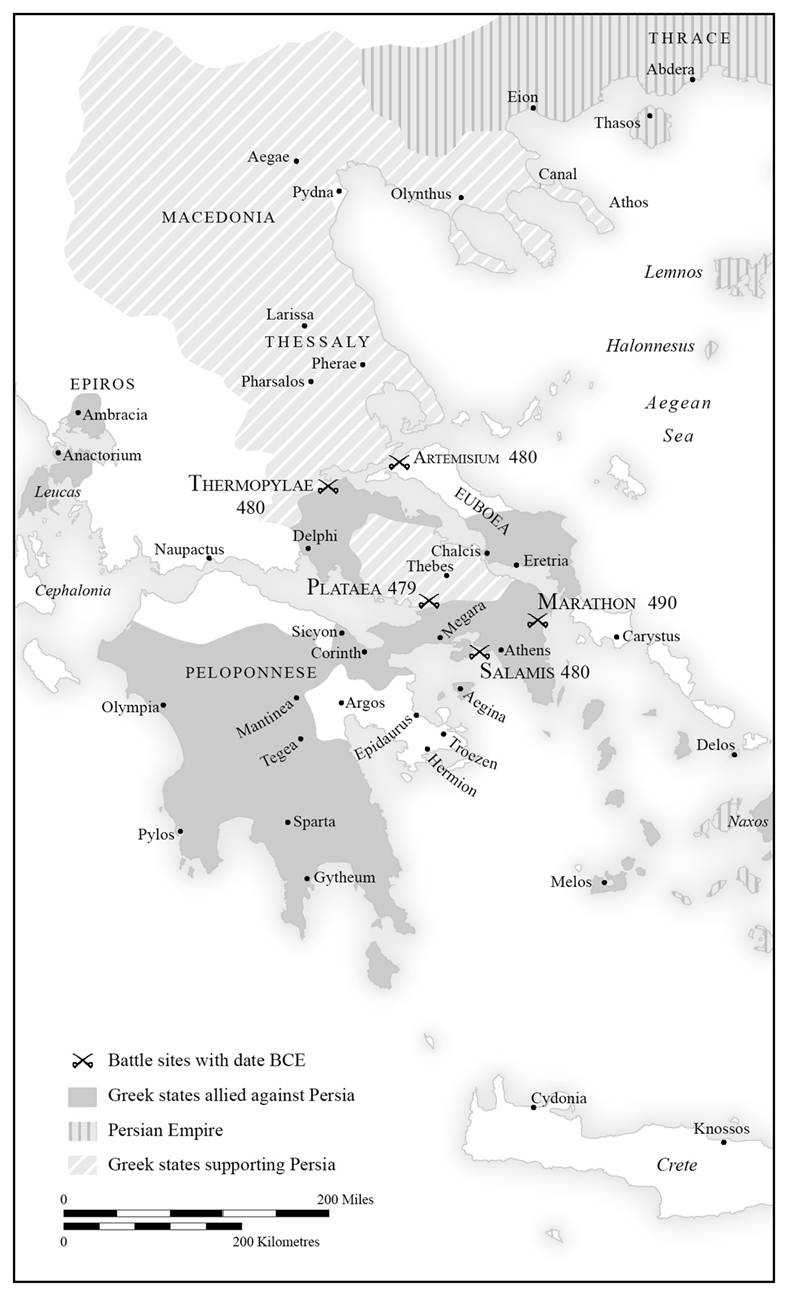
4. The Persian Wars (490 BCE–479 BCE)
As the fateful year of 490 BCE approached, both Athens and Sparta were also riven by internal dissensions. In the case of Sparta, these were serious enough to rock the very foundations of the state.
The two kings, who according to Spartan custom ruled jointly, Cleomenes and Demaratus, had been at one another’s throats for over twenty years. In 491 BCE, in effect, each moved to depose the other. The upshot was that Demaratus fled to Persian-controlled Anatolia. There, he was rewarded with a gift of lands and a position of trust by Darius. Within a year, Cleomenes had allegedly gone mad and is supposed to have committed suicide in prison, although it is more probable that he was murdered.2 In Athens, tensions were not quite so high but still sufficient to threaten the stability of the state’s new and still very experimental democracy. Memories of the deposed tyrants ran deep—and were perhaps also deliberately blackened by those who had most to lose should they return. Hippias was still alive; like his Spartan counterpart Demaratus, he was thriving under the protection of the Great King of Persia. For both cities, a Persian victory would be likely to bring back their own discredited rulers as compliant satraps.In the same year, 491 BCE, Darius sent envoys to all the Greek city-states on the western side of the Aegean, inviting them to send the ritual gift of earth and water that would bind them as his vassals. Most complied. But at Athens the Persian emissaries ‘were thrown into the pit like criminals. At Sparta they were pushed into a well—and told that if they wanted earth and water for the king, to get them from there’.3
After this defiance, a Persian fleet set sail from Anatolia in 490 BCE. In command were the satraps Datis and Artaphernes. From Samos in the eastern Aegean, the ships headed west, through the archipelago. Eretria and Athens, the cities that had taken part in the Ionian Revolt, were among the first targets. Eretria was destroyed after a short siege. It was then to be the turn of Athens. The Persians were guided by local knowledge obligingly provided by Hippias, the former tyrant, who travelled along with them as an honoured guest.
The expedition landed in the wide sandy bay of Marathon, on the coast of Attica nearest to Euboea. The plain of Marathon was ideal terrain for the Persian cavalry. Against them stood the Athenian citizen army, drawn up in a phalanx and supported by a small contingent from the Boeotian town of Plataea. When they knew that the Persian landing was imminent, the Athenians had sent a runner to Sparta to appeal for reinforcements. Pheidippides, the runner, covered the distance of almost 150 miles in under two days—despite which the Spartans found a pretext to delay their arrival until after the battle was over.4Commanded by a general named Miltiades, who had seen service against the Persians during the Ionian Revolt, the Athenian hoplites charged the much larger Persian force at a run. By day’s end, the Persians had retreated in disarray to their ships and were desperately pushing out to sea. Precisely 192 Athenians lost their lives in the battle, according to Herodotus. They were buried with full honours under a mound which today rises some forty feet above the plain of Marathon. A smaller number of Plataean dead were similarly honoured. An exact count of the Persian forces and their losses will never be known. Herodotus claimed six thousand four hundred were killed.
But the Persian fleet had escaped intact. The ships were already on their way round Cape Sounion. They could be expected to reach Phaleron, at that time the port of Athens, the next day. The entire Athenian army was camped at Marathon. If the Persians were to reach Athens first, there would be no one to stop them taking the city. There was nothing for it but a forced march over the shoulder of Mount Pentelikon, back to Athens. The hoplites covered the distance, reckoned at twenty-six miles by the shortest route, presumably still carrying their full kit, and arrived before the fleet was yet in sight. It was in emulation of this feat that the marathon race, named after the battle site, would be devised and run for the first time when the Olympic Games were revived in Athens in 1896.5
By the time the Persian ships reached Phaleron, it was too late for a surprise attack on Athens.
They lay at anchor offshore for a few days, no doubt gazing at the temples crowning the Acropolis, clearly visible in the distance, and watching the manoeuvres of the Athenian hoplites on the plain between. Then Datis gave the order, and the ships set sail, back to the Anatolian coast. The first attempt by the Persian Empire to extend itself into the western side of the Aegean had ended ignominiously.It would take the Persians a full ten years to regroup and try again. Quite how the Spartan dual monarchy and the Athenian emerging democracy made use of the respite is a little mysterious. Sparta had two new, untried kings, who would have had their hands full rebuilding trust in the system after the debacle of 491–490 BCE. Leotychidas II had to live down the awkward fact that his predecessor and kinsman Demaratus was still alive and well, living in Anatolia as the guest of the Great King of Persia. Leonidas I, married to the daughter of the disgraced Cleomenes, would become a household name only at the very end of his ten-year reign. Along with the citizens’ committees to which they were to some extent accountable, the Spartan kings would have been as watchful as ever of the domestic threat posed by the enslaved helots at home and their still defiant neighbours in Argos.6
In Athens, the new democratic institutions were struggling to cope with renewed internal tensions. A remarkable innovation, seemingly intended as a kind of safety valve, was tried out for the first time two years after the victory at Marathon. On a given day, every citizen was invited to inscribe on a discarded piece of broken pot the name of someone he wanted to see exiled from the city for the next ten years. The practice became known as ‘ostracism’, from the Greek word for the sherd on which the names were written or painted (ostrakon). Many of these primitive voting slips survive today, along with the evidence that vote rigging goes all the way back to the invention of the popular ballot itself.
Out of a hoard of nearly two hundred sherds on which the same name was written, archaeologists have identified the handwriting of only fourteen individuals.7 More striking still is the identity of the intended victim. It is one of the most famous names in all Greek history: Themistocles.Described as ‘a man of heroic features, as well as heroic temperament’, Themistocles was not above manipulating the system of ostracism to clear the ground of rivals and reach the highest elected offices of the Athenian state. His own turn to fall victim would come later. But it was fortunate for Athens that this was the man who emerged, during the 480s BCE, to become one of the most far-sighted and effective political and military leaders that the city would ever have. It was Themistocles who persuaded the Athenians to settle their long-running differences with Aegina, to build a new fortified port at Piraeus (where several natural harbours were more defensible than the wide beach at Phaleron), and to raise a fleet of armed warships to match. All this happened between 483 and 481 BCE.8
By this time, Darius had died and had been succeeded as Great King by one of his sons, Xerxes. In 483 BCE, Xerxes turned his attention to his father’s unfinished business in the west. This time, nothing was to be left to chance. The new invasion would be an amphibious operation. To prepare the way for the foot soldiers, a bridge was formed across the strait of the Dardanelles by lashing together hundreds of boats to link Asia to Europe. To ensure a safe passage for the ships in the notoriously stormy waters of the northern Aegean, a canal was dug through the isthmus that separates the promontory of Mount Athos from the mainland. The total strength of the expedition was reckoned by the Greeks at three million men under arms. Modern scholars dismiss these numbers as fantasy, as they also do Herodotus’s implausibly exact figure of 2,641,610. But the number of warships, given as just over one thousand two hundred, has some corroboration and is enough to give a sense of war being mounted on a scale never before seen in the small world of the Greek city-states.9
As Darius had done before him, Xerxes sent emissaries ahead of the expedition.
Cities and regions that voluntarily accepted Persian rule would not be molested. This time, too, most complied. But those that were determined to resist began to work on a concerted plan of action. A defensive league was formed, under the leadership of Sparta. Envoys were even sent to the distant Greek cities of Sicily and south Italy. But as luck would have it, this was just the time when that other predator, Carthage, was flexing its muscles in the western Mediterranean. In 480 BCE, decisive battles would be fought in Sicily, too, against the Carthaginians. So there was no help to be had from that quarter.10In the end, only thirty-one city-states, out of several hundred that existed on the western side of the Aegean, formed the alliance that prepared to stand against Xerxes. Of these, no more than three were of significant size or strength: Sparta, Athens, and Corinth; Thebes would notoriously join the other side when it came to the final battle. Of the remainder, seven were based on small islands in the Aegean. The rest were about evenly split between small communities (some of them tiny) in the northern Peloponnese and the southern part of the Greek mainland, with a few outliers on the coasts of Macedonia and Epiros farther north.11 Once it was known that the Persians were on their way, tension arose among the allies. Should the main line of defence be drawn at the Isthmus of Corinth, as the Spartans proposed? The Spartans had always been half-hearted about extending their influence north of the isthmus. And Spartan strategy was always based on land warfare. This was what their highly trained, full-time army of hoplites did best. It took an Athenian to point out that there was no point in fortifying the isthmus if the Persian fleet was left intact to sail round and take the infantrymen from the rear. And so it was agreed. A stand would be made farther north.
A first attempt to hold the coastal pass leading from Macedonia southward into Thessaly was abandoned—which was just as well, because Xerxes led his troops by an inland route instead. From Thessaly, the only way for an army to enter southern Greece was through the narrow pass known as Thermopylae, where the crags of Mount Oeta fell almost sheer to the sea, opposite the tip of Euboea. The name means ‘hot gates’, referring to a fortified position which contained thermal springs. Today, the sea has receded several miles, so it requires an effort of imagination for the visitor to grasp its strategic importance at the time. But back in 480 BCE, according to Herodotus, the passage between the mountainside and the sea was the equivalent of fifty feet wide, narrowing at some points to only the width of a cart track.12
The Spartans and their land-based allies dug in at one end of the pass, while a fleet led by the Athenians gathered a few miles to seaward. Neither the weight of Xerxes’s infantry nor his cavalry could make any headway against the Spartan hoplites until a local Greek came forward and offered to show his men a way across the mountain to take the defenders from the rear. After this betrayal, the greater part of the army still had time to make its escape to the south. But Leonidas, the Spartan king, elected to stay, along with the remnant of his three hundred best fighters and a small contingent from Boeotia, to cover the retreat of the rest and fight to the end. The battle of Thermopylae, fought in August 480 BCE, has ever afterwards been remembered for the heroic self-sacrifice of Leonidas and the ‘Three Hundred’. At the time, for Sparta and the few allied Greek states still resisting the Persian advance, it was a catastrophic defeat, because it left the route open to Athens, the Isthmus of Corinth, and beyond it, the Peloponnese.
During the days of the battle in the pass, several engagements took place at sea. These were indecisive. The invaders lost more ships to a sudden storm off the coast of Euboea than to action by the newly tested Athenian navy. As autumn drew on, Xerxes’s forces began to converge, by land and sea, on Attica. In the face of this advance, the Athenians abandoned their city. Only a few diehards held out, sheltering in the sanctuary of the Acropolis. But then some enterprising Persians scaled the cliffs, opened the gates to the main force, ‘and slaughtered those in the sanctuary’. Herodotus goes on, ‘Having left not one of them alive, they stripped the temple of its treasures and burnt everything on the Acropolis.’13 Many of the damaged sculptures, belonging to the old temple of the goddess Athena that was destroyed by the Persians on that occasion, and later buried in the rubble, can today be seen in the Acropolis Museum in Athens.
The Athenians had lost their city. In the eyes of their Peloponnesian allies, that meant also their right to command the allied fleet. It was time to fall back on the Isthmus of Corinth and defend the Peloponnese. But the Athenians still had two hundred warships at sea. Themistocles threatened to put the remnants of his people aboard and sail away with them to Italy. How, then, would the Peloponnese be defended? And so the decision was taken to engage the enemy at once, in a sea battle. Themistocles tricked the Persian commanders into thinking their huge fleet could trap the ships of the Greek allies in the narrow channel that separates the island of Salamis from the mainland of Attica. In the event, it was the invaders who became trapped, as the Greek captains were able to exploit the limited sea room to their advantage. The more unwieldy Persian galleys ended up ramming each other, while the Greek allies kept discipline. The battle lasted all day, with King Xerxes watching from the shore. When it was over, the remains of the Persian fleet limped back to its base at Phaleron.14
Salamis was the turning point. But it was not yet the end of the war. Xerxes himself returned to Persia, leaving his second in command, Mardonius, to last out the winter in Boeotia and try to put new momentum into the campaign come the spring. Before Mardonius left Attica, he sacked and burnt for a second time whatever had been left standing in Athens. The final battle was fought in September 479 BCE, near the Boeotian town of Plataea. Herodotus lists more than a dozen small Greek city-states whose troops fought alongside the Spartans and Athenians at Plataea. It was a long and closely fought battle. Mardonius was killed. The Persian retreat turned into a rout. On the same day, if Herodotus is to be believed, on the other side of the Aegean a Greek fleet under the surviving Spartan king, Leotychidas, went into battle against the Persians, who had been guarding their rear. At Mycale, near the island of Samos, the Greek forces won that battle, too.15
The ‘Persian Wars’, as the two campaigns of 490 BCE and 480–479 BCE have been known ever since, were over. Another thirty years would pass before the threat of a third would finally lift. But by the autumn of 479 BCE, the Greek-speaking world had been transformed out of all recognition. And although none of those who had fought could have had any inkling of this, the repercussions of what they had done would still be reverberating around the entire world two and a half thousand years later.
The Persian Wars have often, since, become a fixed point of reference and comparison. During the Middle Ages, when the Byzantine capital, Constantinople, was repeatedly threatened by Muslims from the east, and even after it had finally fallen to the Ottoman Turks in 1453, historians writing in Greek would regularly describe the enemy not as ‘Arabs’ or ‘Turks’ but as ‘Persians’. Even though they were fighting for very different things, it would be self-evident to every Byzantine Christian that the struggles of their empire against the forces of Islam were a continuation of the struggles of Athens and Sparta in the fifth century BCE.
In modern times, those ancient battles have been invested with a significance that goes far beyond the limits of the Greek-speaking world. In hindsight, the Persian Wars have come to be seen as the first great conflict between a ‘civilised’ west and a ‘barbarous’ east.16 The British philosopher and imperial civil servant John Stuart Mill, reviewing an influential history of ancient Greek civilisation, wrote in 1846:
The true ancestors of the European nations are not those from whose blood they are sprung, but those from whom they derive the richest portion of their inheritance. The battle of Marathon even as an event in English history is more important than the battle of Hastings.17
It is often said that after the last of Mardonius’s troops fled across the Aegean in their ships, or trudged across the bridge of boats that Xerxes had built to span the Dardanelles, the Persians would never again return to threaten the West. But this is a remarkably narrow understanding of the geopolitical history of the European continent. The truth is that Europe has been successfully invaded from the east many times since the Persian Wars—just not, as it happens, by direct descendants of the ancient Medes and Persians. It is not true, then, that the future history of Europe was secured by the Greeks at Marathon, Salamis, and Plataea in the first decades of the fifth century BCE. There must be something else.
The answer lies not in anything that was done on the battlefield but in the way the story came to be told afterwards. It was Greeks who told the story. Why else should these wars still, after so long, be called Persian? It was once again the invention of the alphabet that enabled the Greeks to tell the story in the way that they did and for it to be preserved ever after. For centuries before this time, victorious rulers had been proclaiming their achievements in writing—in ancient Mesopotamia, Egypt, Assyria, indeed in Persia. But the Greek world was different. This was in part because of the new writing system itself, in part because of the peculiar organisation of the Greek city-states. There was no supreme ruler to decree how victory should be commemorated, just as there was no top-down system to control the process. Nobody had a monopoly over the written word. Of all those Greeks who wrote down what they knew and what they thought about the Persian Wars, while the events were still within living memory, two were lucky enough to have their words spread and endure—to the extent that we can still read what they wrote today.
First into action was an Athenian by the name of Aeschylus. Aeschylus, as his epitaph tells us, had fought in the citizen army that defeated Darius’s forces at Marathon. He had probably been an eyewitness of the battle of Salamis as well, although, aged about forty-five by that time, he may have been too old for combat. In 472 BCE, just eight years after the battle, Aeschylus’s play The Persians was put on as part of the annual festival held in Athens in honour of the god Dionysus. What we still call ‘drama’ was nothing new in the Greek world at this time. From obscure beginnings during the previous century, the acting out of well-known stories in front of the assembled citizens had become an established part of religious rituals in several city-states, and nowhere more so than in Athens. Aeschylus wrote altogether about seventy plays. Only seven of these survive today. But the earliest of these to be written, making it the oldest Greek drama still in existence, was The Persians.
Aeschylus sets his drama at Susa, the Persian capital. The elders of the royal court are expecting any day to hear of victories over the Greeks. Instead, a messenger brings news of the disaster at Salamis. The ghost of the dead Darius lends dramatic effect. Then Xerxes himself arrives, humbled and in rags, to general lamentation (following the convention of the time, the play is after all presented as a ‘tragedy’). The Persians not only preserves what is thought to be a firsthand account of the battle of Salamis. It also brings into being an entire moral and geopolitical universe that had not existed until the Greeks began to take stock, during the decade that followed the victories of 480 and 479 BCE.
The play presents Xerxes’s overweening pride as an affront to nature and the gods. His punishment at the hands of the Greeks not only was deserved but also affirmed what was probably already a traditional Greek way of thinking about man’s place in the world: pride goes before a fall.18 But this is not all. Athens is presented in the play as the gateway to Hellas: if Xerxes had not been defeated by the Athenians, all Hellas would have been his. The Athenians of course come out of it well, in Aeschylus’s rendering. But what his play celebrates, for the first time, is Hellas as a land and Hellenes as a distinct people. There is even a bond between the two: the ‘land of the Hellenes’ itself fights alongside its people, the chorus of noble Persians is informed. How can this be, they demand to know? ‘It slays by hunger all those who are too numerous for it’ comes the terse response, thereby articulating a permanent demographic reality as well as making powerful propaganda.19
And those Hellenes, small in number though they were by comparison with the might of Persia, are presented as fighting for something that, again, had probably never been articulated before but that would resonate down the centuries ever afterwards: their liberty. The Persians ask, baffled, How can such small forces stand up to them? What drives their soldiers into battle if they are free to speak their own minds and act on their own initiative? Why wouldn’t they just run away? The answer comes in the ‘great cry’ that supposedly went up from the Greek ships at Salamis:
Sons of Hellenes, onward,
set free your fatherland, set free
your children, wives, the homes of your ancestral gods,
and your forefathers’ graves. For all of these the fight is on!20
By 472 BCE, the Greeks had acquired a cause that was not just the cause of any one city or region. Retrospectively, it was a cause fit to die for. And an audience of Athenian theatre-goers, people whose ancestors had always been accustomed to put their own city first, was ready to hear that, this time, they had been fighting for something larger. Now they knew that they were not Athenians only but also Hellenes—unified by a shared identity and this common ideal: freedom. And because the play was popular at the time and was still being talked about and revived in Athens some seventy years later, we can be sure that the new way for Athenians to think about themselves had caught on.21
Aeschylus was the first. But a play is not history. What really set the seal on the way the Persian Wars would ever afterwards be remembered was another of those Greek inventions: the invention of history. To make this one possible, the new system of alphabetic writing had to make another leap forward and away from the traditional art of oral storytelling. This was the leap from verse into prose. A narrative written in prose would still, for several centuries after this, be more often read aloud to an audience than read on the page. But the divorce from the traditional techniques for remembering and delivering a story before an audience meant that any amount of information could be stored in a document that, for the first time, need not be memorised but could be retrieved whenever necessary.
This is where Herodotus of Halicarnassus comes into his own. He was not the first Greek writer to try his hand at prose. But he is the first whose work has come down to us complete. And so far as we can tell, it was his idea to use what was still quite an experimental medium, prose, for a new purpose. Herodotus was born within a few years of the battle of Salamis, perhaps in 484 BCE. Halicarnassus, today the fishing village and tourist resort of Bodrum in southwestern Turkey, was at the time part of the Persian Empire, so Herodotus began life as a subject of King Xerxes. If we are to believe his own account, he travelled widely, taking in most parts of the known world of his time. Later, he may have settled in Athens. Sometime around 450 BCE, he embarked on what he called the ‘demonstration of an enquiry’. The task would occupy him for the rest of his life. The subject of this enquiry was to be ‘what people had done’ in the recent wars, its purpose to commemorate for all time the actions of both sides, along with the causes of the conflict.22 The Greek word meaning ‘enquiry’ in Herodotus’s Ionic dialect of Greek at the time was historie.
Herodotus’s prose narrative is every bit as monumental in size and ambitious in scope as the Homeric poems. There are plenty of indications that the inventor of the new genre was looking over his shoulder at the venerated epics of the Trojan War and its aftermath. But unlike the elusive Homer, Herodotus the enquirer is a frequent presence in his own narrative—probing, prodding, weighing up one implausible explanation against another, and often genially withholding judgement, leaving it to the rational reader, or hearer, to decide. And for most of what he says, we have nobody else’s word to compare with his. Historians working today on other parts of the ancient Mediterranean world often express frustration that they have only Herodotus, writing in Greek, from the Greek point of view, to rely on.23
Right from the beginning, Herodotus prepares us for a war between continents: Europe and Asia. On one side of the Hellespont and the Aegean Sea stand the Greeks; on the other, the Persian Empire. The idea of Europe as the seat of a civilisation that we now call ‘European’, and opposed to the ‘barbarism’ of Asia, has its origin in the pages of Herodotus. The Greek word barbaros at first just meant a foreigner who spoke a different language. It barely appears before the time of the Persian Wars. Afterwards, it was on everyone’s lips, and of none more often than of Herodotus. The people of Asia (other than the Greeks who had settled all round its seaward edge) were barbaroi. This is the first time that the name ‘Europe’ acquires a geopolitical meaning. Indeed, in these pages, we can see the modern geopolitics of ‘East’ and ‘West’ being born. Throughout the nine books that follow, the clash between the ‘barbarians’ of Asia and the ‘Hellenes’ of Europe is played out.24
Herodotus rarely misses an opportunity to urge upon his hearers a sense of unity as Greeks in the face of a common enemy. But the details of his narrative constantly show up the opposite. With what must surely be deliberate irony, he puts into the mouth of the Persian general Mardonius this rueful piece of self-knowledge about his own people:
The Greeks are pugnacious enough, and start fights on the spur of the moment without sense or judgement to justify them.… Now surely, as they all talk the same language, they ought to be able to find a better way of settling their differences: by negotiation, for instance, or an interchange of views—indeed by anything rather than fighting.25
Not only were the Greek city-states notoriously at one another’s throats, Herodotus knew perfectly well that the great majority of them had submitted to the Persians without a fight. This would have been common knowledge at the time when he was writing, and he makes no attempt to play it down. He acknowledges, too, that many of the ships and their crews that fought on the Persian side had been conscripted from Greek cities such as his own, in Anatolia. Themistocles, Herodotus tells us, had entertained hopes of persuading these Ionian Greek conscripts to turn against their masters, or at least to fight only half-heartedly. But he records no mass desertions. Of the mainland states, he tells us that Thebes actually sent troops to fight alongside the invaders at the battle of Plataea. Argos, the only surviving rival to Sparta in the Peloponnese, had maintained an ambiguous neutrality throughout but helpfully alerted Mardonius when Spartan troops were on their way to confront him in the same battle. Herodotus no doubt intended his narrative as an object lesson—on what Greeks could achieve when they settled their differences and acted together. But thanks to his candour, we know that in reality the resistance of ‘Hellas’ to the ‘barbarians’ had been a very patchwork affair, nothing like a united front.26
All the more impressive, then, the way Herodotus tells it, was the determination and the success against the odds of those who did resist. In yet another of the dramatic dialogues that enliven his history, the historian for the first time fleshes out the new understanding of what it meant to be Greek. While the alliance is forming that will confront the Persians at the final battle in 479 BCE, Mardonius sends an embassy to the displaced Athenians. They can have their city back, he tells them, on condition that they submit to Xerxes. As told by Herodotus, it is a collective Athenian voice that rousingly rebuffs this offer. For good measure, the Athenians go on to explain for the benefit of their Spartan allies the reason for their solidarity at a time when self-interest might have tempted them to abandon the struggle. First of all, they say, they must avenge the destruction of their city and its temples. ‘Politics’ (the affairs of the city-state) still come first. But, secondly, the Athenians go on:
there is the totality of the Greeks, made up of one blood and one language, and the sanctuaries of the gods which are shared, and sacrifices and practices carried out in the same way. All of these we Athenians would never betray.
The single Greek word Hellenikon which I have translated as ‘totality of the Greeks’ is often rendered in modern translations as ‘Greek nation’. There has been much discussion of this passage as an early statement of what today we could call ‘ethnic’ or ‘national’ identity. All the more reason to look carefully at what Herodotus actually says. Elsewhere in his story, he uses the same word in contexts where it clearly refers to the Greeks, or the Greek city-states, all together.27 It is not an abstract word, like nation, race, or the still more conceptual Greekness or Hellenicity of a later age. Here, it must mean very specifically all those people who share the things that are now spelled out by the Athenians in this imagined speech: genetic inheritance and language most immediately, and then, connected more loosely by Herodotus’s syntax in Greek, what we would now term ‘culture’.
By the time Herodotus wrote those words, probably in the late 430s BCE, the ‘totality of the Greeks’, in whose name the victory over Persia had been secured, was about to tear itself apart in a second great conflict, the repercussions of which are also still with us to this day. In truth, what Herodotus called the Hellenikon had never stood together, not even against the Persians. But the narrative of a common stand against invasion and the threat of tyranny, by an underdog fighting with great tenacity and at the cost of great sacrifice, was one that would go on to inspire many others in centuries to come—whether or not they thought of themselves as sharing the same ‘blood’, language, or culture as the Greeks of the fifth century BCE.
The period of almost fifty years that begins after the battle of Plataea in 479 BCE is generally reckoned to mark the high point of the civilisation that we now call ‘classical Greece’. History books often give the impression that this, too, came about as a direct result of the Persian Wars. If it hadn’t been for that cataclysmic upheaval, it’s a reasonable guess that none of it would have happened in quite the way that it did. On the other hand, much of what was radically new in the Greek world after 479 BCE can be traced back to developments that had already been under way before the first Persian expedition set out. And the new achievements would spread out far and wide across the whole of that world. Whatever was going on, it was not limited to the thirty-one or so states that had actively resisted the invaders. So we might do better to think of the Persian Wars as a catalyst, rather than as a cause, of what came afterwards.
Between about 520 and the 440s BCE, lyric poets were bringing together words, music, dance, and ceremony to celebrate public occasions with ever more dazzling complexity. The career of Pindar, from Thebes, began in the decade before the battle of Marathon and continued for almost half a century afterwards. Pindar’s ‘odes’ have been imitated by poets writing in many different languages, from that time to this. An ode, originally, was any kind of song. As it happens, the ‘songs’ of Pindar that have been preserved through the manuscript tradition are those that celebrated victors in the four ‘panhellenic’ contests, of which the most famous were the Olympic Games. The words, of course, are all that have been preserved, so we can only guess at the total multimedia experience that must have been involved.
Plays and performances, too, an artform that would later be especially associated with Athens, went back well before the Persian Wars. But almost all that we know about Greek drama dates from the decades that followed. Aeschylus continued to write plays for the best part of twenty years after the success of The Persians. He was followed by the tragedians Sophocles and Euripides, and the comic dramatist Aristophanes, among dozens of others whose works survive only in fragmentary form. Several complete plays by all four have remained in circulation ever since their lifetimes and have been frequently revived in theatres since the nineteenth century.
Tragedy, the genre that had been co-opted by Aeschylus to capture the new euphoria after the battle of Salamis, was more usually devoted to subjects drawn from mythology. But very often, Athenian dramatists would give a topical twist to their reenactment of a well-known story. According to Aristotle, writing a century after the heyday of ‘classical’ drama, the nature of tragedy was ‘by means of pity and fear to bring about the purging of such emotions’.28 Comedy was more overtly topical. On the comic stage it was a regular occurrence for prominent citizens and political issues to be caricatured, often with a hefty dose of obscenity as well as bravura. Among extravagant whimsies brought onto the Athenian stage, one that is still with us today is Cloud-Cuckooland (Nephelokokkygia)—still invoked, as it was then, to mean a never-never land of politicians’ promises.
The main festival at which plays were staged in Athens was known as the Great Dionysia, held in spring each year. Somewhere between fifteen and twenty thousand spectators packed into the sanctuary of Dionysus on the slope below the walls of the Acropolis for several days on end to watch new plays performed one after the other, from dawn until dusk. The marble-lined Theatre of Dionysus, that occupies the space today, would not be built until the next century. Actors wore masks—so that even those in the audience close enough to have been able to make out facial expressions would have had to rely, instead, on observing the actors’ gestures and, above all, on listening to every nuance of the words they spoke.
Action (the literal meaning of the Greek word drama) consisted only of dialogue or, on occasion, a monologue addressed to the audience. Almost everything that happens in a Greek tragedy or comedy happens offstage and is conveyed to the characters, as well as to the audience, by a lengthy report. A frequent exception to this rule was the appearance of a god or goddess, lowered from a gantry onto the stage, to wrap things up at the end. This type of intervention is still known by the Latin phrase deus ex machina, which translates the Greek for ‘god from the machine’.
All parts were played by men, even though many of the most important dramatic roles were female. These ranged from goddesses and powerful figures of legend, such as Helen of Troy or the ‘barbarian’ enchantress Medea, to the fictional Lysistrata, who leads the Athenian women in a sex strike in order to force their menfolk to make peace, not war, in the comedy by Aristophanes named after her (performed in 411 BCE). A large part in both tragedy and comedy was played by the ‘chorus’ (the word actually means ‘dance’), a group of actors who would sing and dance in a circular space, called the ‘orchestra’, in front of the stage. No less than the ceremonial odes of Pindar, Greek drama was a multimedia, multisensory experience, only one part of which we can even begin to recapture. Like so much else in the classical Greek world, writing plays was an intensely competitive business. Prizes were awarded by judges chosen by lot, so in effect the dramatists were competing for the approval of a public made up of their fellow citizens.
The Greek world after 479 BCE looked different, too. In the sanctuary at Olympia, a new temple, dedicated to Zeus, was built between 471 and 456 BCE. On the pediments, bodies carved from stone convey a sense of movement. The western pediment, now exhibited in the state-of-the-art new museum at Olympia, shows a scene from mythology. Brutish Greek tribesmen called Lapiths battle with centaurs (half-man, half-horse) to disrupt a wedding feast. In the centre a young god, probably Apollo, naked except for a cloak held over one shoulder and the opposite arm, with an expression of serene determination stretches out the other arm to quell the tumult. The message, if there is one, may not be quite as simple as Greek sweet reason overcoming subhuman barbarism. But it is there for the beholder, who might well have wished to see it that way when the temple was newly built. Some of the figures in this scene and elsewhere among the surviving sculptures of the Temple of Zeus at Olympia have been admired especially for their nuances of individual expression, including tension, fatigue, and pain.29
Life-size or slightly larger replica human beings were on the move in the fifth-century BCE Greek world in another sense, too. At the same time as sculptors were learning how to represent bodies in motion, the statues they made began to descend from the pediments of temples and to move out of cemeteries and sacred spaces into the everyday world of the city. Beginning in the fifth century BCE, and indeed continuing into the early Middle Ages, Greek civic spaces would become crowded with look-alike people made of stone and, increasingly, of bronze.30 Because bronze has always been a valuable commodity, it is rare for a bronze statue to survive from the ancient world. Those that do most often come from ancient shipwrecks or were buried in antiquity, to be dug up by archaeologists in chance finds.
Our best clue to how these human-like figures would have looked in Greek cities in the years immediately after the Persian Wars comes from two stunning bronzes salvaged from the sea off the Italian town of Riace in Calabria in 1972. Slightly larger than life-size, they represent naked warriors with thick, curly hair and beards. Different materials and an inlay of semiprecious stones still give a shocking vividness to their staring eyes and preserve a strong colour contrast in lips, teeth, and nipples. Originally, the figures would have carried weapons, but these have not survived. The pair may well have formed part of a group, possibly even designed as a victory memorial for the Persian Wars, although of course there is no direct evidence for this. The two bronze men share a similar pose. But this is very different from the stiff full-frontal pose of the kouroi of the previous century. Unlike earlier statues and in common with most later ones, these warriors do not look directly at the viewer. They may not be true portraits, but they are individual human beings, each absorbed in his own world, a world that unsettlingly peeps into ours.31
Sculptors by this time had acquired the technical means and had developed enough understanding of human anatomy to create the likeness of real individuals. But this would turn out to be a ‘road not taken’. How and why this came about has been revealed by the painstaking study of that most domesticated of the visual arts, the paintings produced on high-quality tableware destined for use within the home. Paradoxical though it may seem, just as sculptors were learning to capture bodies in motion, their peers working in two dimensions were cultivating, instead, stillness and composure in the human figures that they represented. By 450 BCE, a marked change had come about both in the style and the subjects chosen to decorate fine bowls, plates, and cups.
Instead of vivid scenes of battle, painters depict the young warrior, identifiable by his shield, saying farewell to his grieving wife and parents. Sexually explicit images disappear almost completely. Athletes exercising or competing naked in the gymnasium are caught in moments of stillness, to be admired for their beauty and composure, rather than actively competing as before.32 Often described as idealist, rather than realist or naturalist, this was the perfect art for the citizen-state of the classical period. In this way, the aloof serenity of Apollo quelling the riot on the pediment of the Temple of Zeus at Olympia enters the home of every Greek—and also of the many customers of Athenian potters among the Etruscans of Italy, where so much of this intimate tableware would be unearthed by modern archaeologists.33
All these new trends would come together spectacularly when the Athenians began to rebuild their citadel, the Acropolis. They had waited more than thirty years since the Persian destruction. Then, starting in 447 BCE, no expense was to be spared. A massive complex of buildings called the Propylaea was designed as a ceremonial entrance to the sacred space. It cannot be an accident that the colonnade lining the entryway exactly frames the view of the distant site where the battle of Salamis had been won back in 480 BCE. The rebuilt Acropolis was to be the permanent memorial to that victory.34 Inside, new temples arose, built out of marble quarried from nearby Mount Pentelikon. First to be completed, and largest of all, was the temple dedicated to the city’s patron goddess, Athena the Virgin (Parthenos). The Parthenon, as it has been known ever since, was finished in just fifteen years. Now an empty shell, after its heart was blown out by a Venetian cannonball in 1687, its columns and pediments still dominate the skyline of central Athens. Usually framed against a sky of brilliant blue, with the humped back of Mount Hymettus in the background, the image of the Parthenon on the Acropolis of Athens must be the most widely recognised ‘trademark’ of Greece and Greek civilisation—just as it was in the century when it was built. And, of course, it was built to impress.35
As at Olympia, the pediments at either end of the building were decorated with sculptures. Less usual, and even more famous today, is the frieze in sculpted marble relief that ran round the top of the inner wall of the building, beneath the roof, some sixty feet above a viewer standing on the ground. Originally 160 metres long, the largest surviving portions of this frieze are exhibited in the British Museum in London and in the Acropolis Museum in Athens, which opened in 2009. It depicts a procession on foot, on horseback, and in chariots and culminates in an offering made in the presence of Athena, Zeus, and other gods and goddesses of Olympus, who are seated on simple thrones.
Opinions still differ as to what exactly is represented. But whatever its meaning in detail, there is no mistaking the solemn, collaborative sense of purpose of the celebrants (despite the liveliness of the horses) and the subordinate place of several hundred human figures as they approach, with deference and awe, their own larger-scale likenesses, the Olympians. For all the admiration that their ‘classical’ white marble has aroused in modern times, we should not forget that these sculptures, and probably large parts of the building that housed them, too, would originally have been painted in bright colours. And until they were taken down and placed in a museum, at eye level with most viewers, no one could have appreciated their finer points but the gods.
During the same decades, while on the Acropolis the Parthenon and other public buildings were rising, down at street level the philosopher Socrates would engage his fellow citizens in dialogues about the nature and purpose of human life. Socrates had been born in Athens in 469 BCE. His career would span the entire second half of the century. What we now call ‘moral philosophy’ begins with these dialogues, as they would later be reconstructed, often in highly fictionalised form, by his disciples Plato and Xenophon. In these seemingly artless conversations, the questioning of the cosmos that had begun more than a century earlier in Anatolia comes down to earth. For Socrates, the goal of all human beings was arete. Usually translated as ‘goodness’ or ‘virtue’, the Greek word has a sharper edge than these equivalents which derive from the Christian tradition. Arete also has the meaning of ‘excellence’. It implies an element of competition, that was entirely characteristic of the Greek city-states of Socrates’s time. In one of the few passages in which we probably do hear his words unalloyed, Socrates is reported as saying that it is ‘the greatest good to man’ to ‘engage in discourse about arete’. The alternative—an ‘unexamined life’—Socrates goes on, is ‘not livable for a human being’.36
One of those who engaged with Socrates was Protagoras of Abdera, one of many itinerant philosophers, called ‘sophists’, who visited Athens during this time. Protagoras is credited with the doctrine that ‘man is the measure of all things’. If we all live in a cosmos that is regulated by ‘measures’, as Heraclitus had believed, then it must follow that we ourselves are part of that universal ‘order’ or ‘arrangement’. Similar thought processes were leading at the same time in a different part of the Greek-speaking world to the first systematic examination of the human body, what makes it work, and how its processes can be put right when we fall ill. On the island of Kos, in the eastern Aegean, the ‘father of medicine’, Hippocrates, was a contemporary of Socrates. He, too, is known to us only indirectly through the works of others. As a result, we cannot be sure which of the medical discoveries recorded against his name were really his.37 But we know that the Greek world of the late fifth century BCE was becoming more than ever centred on the human. Among the pithy moral maxims that were probably first inscribed on a column in the Temple of Apollo at Delphi at about this time, the most famous of all must surely be Gnothi seauton: know your own self.
Ever since the end of the wars against Persia, the lifting of the external threat had not necessarily brought peace. Until the middle of the fifth century BCE, Greek forces continued to confront the Persian enemy, in Anatolia during the 460s BCE and in Egypt (less successfully) in the next decade. Sparta had withdrawn from the joint expedition to Anatolia after only a year, back in 478 BCE. From that time on, it had been left to the Athenians to organise an alliance of the liberated Greek cities to keep up the pressure against Persia.
Willing allies at the start, these states soon found themselves committed to doing the bidding of the Athenians, as well as contributing ships and, increasingly, money to a common treasury. At first, this was housed in the sanctuary of Apollo at Delos, neutral ground more or less at the geographical centre of the new alliance. For this reason, the alliance has become known to modern historians as the ‘Delian League’. Then in 454 or 453 BCE the Athenians unilaterally moved what had become a massive accumulation of wealth to their own city. One of the reasons for starting work on building the Parthenon shortly afterwards was to create a secure home for it. But it was the contributions of the allies that, to a large extent, paid for the building along with the rest of the programme that over the next half century would turn the Acropolis and the Agora below into the glorious statement of self-assertion whose ruins we still admire today. What had started out as a defensive alliance against a return of the Persians had turned into Athenian rule over most of the Aegean.
Modern historians regularly use the word empire to describe this extension of Athenian power during the fifth century BCE. At the time, there was no equivalent word in Greek, so unprecedented did it seem that one Greek city-state should lord it over others (even though the Spartans had already achieved something similar in their immediate sphere of influence, the Peloponnese). In the earliest account of these events that we have, the History written by the Athenian Thucydides during the last three decades of the century, the Athenians are reported as justifying their ‘rule’ over other Greeks in terms that often make modern readers uncomfortable:
We did not establish this rule by force.… We have done nothing surprising or contrary to human nature in accepting rule over others when it was offered to us and refusing to give it up, under the domination of the three most powerful motives—prestige, fear, and self-interest.… It has always been the way of the world that the weaker is kept down by the stronger.38
The Athenian empire was based on naval supremacy. This was the direct legacy of Themistocles’s initiative to invest in the ships that had gone on to win the battle of Salamis. Sparta, by contrast, concentrated its power on land. As the century wore on, the Delian League was matched by the ‘Peloponnesian League’, led by Sparta. Of the entire peninsula, only Argos still held out doggedly against Spartan domination. The two leagues first clashed in 460 BCE, as each tried to expand its influence over the neutral territories that lay between them. Athens came off the worse. In 446 BCE, the Athenians agreed to give up the gains they had made on the mainland in return for keeping their maritime ‘empire’ intact. The peace agreement signed in that year was supposed to last for thirty years. It would hold for only half that long, during which time the rival power blocs eyed one another warily, each consolidating its grip over the allies it controlled.
In the meantime, during the 460s BCE, Athenian democracy had been radically overhauled. Exactly how the system had worked before this and, indeed, many details about these changes remain obscure. But it seems to have been only at this time that the word demokratia came to be coined and the fully fledged democracy began to function in the form that we know from later sources. The entire citizen body of some thirty thousand adult males was sovereign. In practice, around five to six thousand seem regularly to have attended the Assembly (Ekklesia), which met approximately once a month in the open air on the low hill facing the Acropolis, called the Pnyx. Executive authority was devolved to the Boule, or Council, of five hundred, chosen by lot each year from the total number of eligible citizens. Up to fifteen hundred officials, including the members of the Council, were chosen annually to fulfil all the offices of the state. Only those in the highest offices, in charge of finance and decisions on the battlefield, were elected. All the rest were picked at random by the drawing of lots.
This was very different from a modern democracy, in which the people elect representatives to make decisions on their behalf. In ancient Athens, the most important decisions were taken by a show of hands in the full Assembly. Every male citizen had the right to attend. And all officeholders, whether chosen by lot or elected, were held closely to account. It really was power (kratos) to the people (demos).39 And the idea of increasing the wealth and power of their state appealed to the people enormously. The modern idea that democracies do not fight aggressive wars is certainly not borne out by the story of Athens in the fifth century BCE. Smaller states that were either conquered or brought within the Athenian sphere of influence would often be told to adopt a version of the same system themselves. The paradox of ‘people power’ being imposed by powerful outsiders, from above, in situations where it may not be wholly welcome, goes right back to the first decades when democracy began to spread from Athens across the Aegean.
It was under this system that Athenian political life, including the building programme on the Acropolis, came to be dominated by the charismatic orator Pericles, from the 450s until his death in 429 BCE. So influential was Pericles that he has often been hailed as the greatest Athenian statesman of all time, while Athens at its heyday is as often called ‘Periclean’. It says a great deal for his personality and talents that Pericles managed to exercise as much influence as he did—since, like every other official, he had to be elected to office every year. The fact that he was, and over such a long period, gave continuity to a system that did not inherently value either experience in office or what we would today call efficiency.40 Thucydides puts into the mouth of Pericles these often-quoted words in praise of Athenian democracy, supposedly delivered at the end of the year 431 BCE on an occasion when the historian had in all probability been present:
We have a system of government that does not take its cues from the laws of neighboring states; we set the example and do not imitate others. That system goes by the name of democracy because it is administered on behalf of the many and not the few. Everyone enjoys equality before the law on matters of civil disputes. As to personal reputation, whoever wins esteem for some reason can advance in public affairs—not by turn, but through merit.41
This democratic Athens, for most of the second half of the fifth century BCE, was ready, sometimes even eager, to take risks. The Spartans, by contrast, holding rigidly to a system that had changed little over several centuries and permanently fearful of the threat from the helots, were by nature risk averse. Sparta still could field the most formidable citizen army in the Greek-speaking world. But qualifications for maintaining full citizenship were so strict, and so demanding, that fewer fighting men were available whose loyalty could be truly relied on. And when it came to resources, the Spartans never learned to be as unscrupulous as their Athenian rivals in extracting what was in effect protection money from the other members of the Peloponnesian League.42
Despite having led the resistance against the Persians in 480 and 479 BCE, the Spartans seem to have been the least inclined, or perhaps the least able, of all the Greeks to enjoy the fruits of their victory. No great new public buildings, no flowering of the arts or crafts, no poetry, history, philosophy, or scientific enquiry arose in Sparta during the fifth century BCE. By the 430s, if anything, the two great powers within the small world of the Greek city-states had come to define themselves by their differences from one another.
War broke out between them in 431 BCE. The Spartans started it, using a variety of pretexts. But the real reason, as Thucydides shrewdly noted, writing not long afterwards, was ‘the growth of Athenian power and Spartan fear of it… when they could see much of Greece already subject to Athens’.43 The war lasted much longer than the Persian campaigns—for twenty-seven years, on and off. Thucydides tells us at the beginning of his narrative that the conflict would spread to the entire Greek world, and even beyond—making it, for its time, the equivalent of a world war.44 But what led to this second Greek war of the fifth century BCE being seen as truly global is once again not so much what happened on the battlefield but the way the story came to be told afterwards. The Peloponnesian War, as it is known today, is one case where history was not written by the victors. The Athenians lost. But Thucydides’s meticulous, judicious account of causes and effects, of strategies and decision-making, of human brutality and human capacity for error has never ceased to be read since shortly after the war came to an end.45
It started out as a war of attrition. Each summer, Spartan hoplites would march northwards through the mountain passes of the Peloponnese, cross the Isthmus of Corinth, and invade Attica. They would stay for up to six weeks, burning and looting the crops, while the Athenians would be driven back inside their defensive walls. But, thanks to the initiatives taken by Themistocles in preparation for the second Persian invasion, the new port at Piraeus was linked directly to the city by two parallel lines of fortification, known as the Long Walls. This meant there was nothing the Spartans could do to prevent their enemies from being supplied by sea. Athens already relied on grain brought from the hinterland of the Hellespont and the Black Sea coast. For as long as their fleet ruled the seas, the people of Athens could still be fed.
It was probably as a consequence of overcrowding inside the city during the summer heat that plague broke out in 430 BCE. Over four years, as many as a quarter of the total population may have died from the plague. The veteran Pericles was among its victims. It was the first pandemic in recorded history. Thucydides, who himself became infected, treats his readers to a clinical and harrowing account of its symptoms and its effects on the population:
The most dreadful aspects of the whole affliction were the despair into which people fell when they realized they had contracted the disease… and the cross-infection of those who cared for others: they died like sheep, and this was the greatest cause of mortality. When people were afraid to visit one another, the victims died in isolation.… The greatest pity for the dying and the distressed was shown by those who had had the disease and recovered. They had experience of what it was like and were now confident for themselves, as the plague did not attack the same person twice, or at least not fatally.46
While the Spartans were trying to throttle their enemy on land, the Athenians did the same by sea. They never came as close to Sparta itself as the Spartans did to Athens. But they did manage to gain a toehold in the southwest of the Peloponnese, an especially sensitive spot for the Spartans, ever alert to the risk that the local helots there might rise against them. By 421 BCE, after ten years of campaigning in theatres all over mainland Greece and the Aegean, a stalemate was reached. Peace terms were agreed. It was to prove a phoney peace.
In the years 416 and 415 BCE, Athens had recovered sufficiently to embark on two of the most notorious episodes of the war—while still technically observing the armistice and defensive treaty with Sparta. The first was directed against the island of Melos in the Cyclades. Melos was a rare case of an Aegean island that had never joined the Athenian alliance and still remained loyal to Sparta. While the islanders waited in vain for a Spartan expedition to arrive and relieve them, the Athenians laid siege to their chief town. Thucydides presents at length the negotiations between the two sides. The passage in his history has ever since been known as the ‘Melian Dialogue’, and it has much in common with a scene from a tragic drama. It is here that the historian sets out most fully, and most chillingly, the foundations of what we now call Realpolitik. Just like a tragic dramatist, Thucydides himself declines to comment on the views expressed. When the Melians finally surrendered, without conditions, in January 415 BCE:
Of the Melian population the Athenians executed all the grown men who came into their hands and enslaved the children and women. Later they colonized the place themselves, sending out five hundred settlers of their own.47
Three months later, back in Athens, the tragedy by Euripides, The Trojan Women, was staged at the Great Dionysia. The play focuses on the plight of female survivors of a deadly war and the cruelty of the victors. Whether the Athenian audience saw in this a moral condemnation of their own recent behaviour we do not know. The fate of Melos was by no means the only atrocity recorded by Thucydides during a war that increasingly brutalised all who participated in it. But thanks to the Melian Dialogue, it is the one that has remained the most remembered, ever afterwards.
The same year, 415 BCE, saw the Athenians overreaching themselves again. And this time it was they themselves who would pay the price. In June, an expedition set out from Piraeus that consisted of 134 warships, an unknown number of troopships carrying more than five thousand hoplites, with a small contingent of cavalry, and thirty supply ships. It was, says Thucydides, ‘at that time the costliest and most magnificent Greek armada ever to sail from a single city’. It would be followed by a second, in response to a desperate plea for reinforcements, a year later.48 Their destination was Syracuse, the most powerful Greek city of Sicily. Rather than attack the Spartan enemy on their own ground, and persuaded by the charismatic young general Alcibiades, the Athenian Assembly had voted to broaden the conflict by opening up a new front far to the west. There were, possibly, wealth and resources to be won that would tip the balance of power in favour of Athens. By the logic of the warmonger, in all times and places, Alcibiades had argued that ‘if we do not rule others, others will rule us’.49
After a two-year campaign it ended in disaster. The entire fleet was lost. In the last of a series of land battles in Sicily, Athenian hoplites, tormented by thirst, fought among themselves to gulp down river water that was running with the blood of their comrades, while the enemy hacked and shot arrows at them from either bank. Some seven thousand survivors were taken prisoner and held for months in terrible conditions in stone quarries on the outskirts of Syracuse that can still be seen by visitors today. Other survivors of the defeated army fled into the Sicilian countryside and eventually made their way back to Athens to tell the tale. Two of the Athenian generals who surrendered were put to death by their captors. Alcibiades, one of the most colourful characters of his times, had already deserted the troops he was supposed to be leading, later to give his services to the kings of Sparta.
Astonishingly, despite the magnitude of their defeat, the Athenians set to work immediately building a new fleet. But the framework of their democracy had been weakened by the disaster. In 411, a group of oligarchs staged a coup d’etat. That, too, would prove unstable, and democracy would be restored the next year. Two events had already happened that would decisively change the course of the war. In March 413 BCE, while the final stages of the Athenian collapse in the west were still unfolding, the Spartans returned to Attica. But this time, instead of merely disrupting the harvest and stealing the produce, as they had done before, they thought to fortify an outpost within the territory of Attica itself. Now the Athenians really were penned up behind their walls, and not just for a few weeks each summer but throughout the year. And then, the following summer, the Spartans revoked their long-standing hostility to the common enemy Persia and made a deal with representatives of the new Great King, Darius II.
So much, one might think, for the much-vaunted superiority of the Hellene over the barbarian and the collective self-confidence of the Greeks in the decades after Salamis and Plataea. The reality was that both sides had been trying to open negotiations with the Persians right from the first years of the Peloponnesian War. Up to this time, the Persians had kept these approaches at arm’s length. For as long as the rival Greek city-states were doing their own dirty work for them, there was no incentive for the Persians to intervene. But after the collapse of Athenian sea power in the Sicilian campaign, Darius saw an advantage to be gained from supporting the Spartans.
According to the text of the treaty signed in 412 BCE, as reported by Thucydides, Sparta not only pledged itself to fight alongside the Persians for the defeat of Athens but acknowledged that ‘All the territory and all the cities which are in the King’s possession, or were in the possession of the King’s forefathers, shall belong to the King.’ In other words, all those Greeks living on the eastern side of the Aegean, who had been liberated at the end of the Persian Wars by the combined efforts of Athens and Sparta, were now to be returned by Sparta to the Persians. From the beginning, the Spartans had claimed to be fighting to ‘liberate Hellas’ from the overweening power of Athens. That claim was looking very threadbare now.50
At the same time, the Athenians were still trying to woo the old enemy to their side. Hopes of help from Persia lingered in Athens until 407 BCE. But in that year, Darius sent his son Cyrus to Anatolia as the new satrap. Cyrus worked closely with the new naval commander by the name of Lysander sent out by Sparta. Lysander was evidently an able strategist and, unusually for Sparta, of relatively humble birth. The Spartan state by this time had ships of its own. But it was the war fleet of the Persians, manned by Phoenician sailors and under the command of Cyrus, that gave this new alliance a commanding position in the Aegean.51
Even so, the Athenians were still putting up a convincing fight at sea. The battle of Arginusae, fought in 406 BCE in the strait between the island of Lesbos and the mainland of what is now Turkey, would be described later by the historian Diodorus of Sicily, writing in Greek, as ‘the greatest naval battle in history of Greeks against Greeks’.52 It was a resounding triumph for the Athenians. But victory was soured when a storm prevented the rescue of survivors from the ships that had been lost in the battle, or proper burial for the dead. On their return to Athens, six of the eight commanders were collectively put on trial by the Assembly for this negligence, condemned to death, and executed. It was not the finest hour of the recently restored Athenian democracy.
The Spartans and their Persian allies determined to cut off the supply of grain and other foodstuffs to Athens through the straits leading from the Black Sea to the Aegean. Another sea battle, fought the following year at Aegospotami in the Dardanelles, all but wiped out the Athenian fleet. The news reached Athens at night. The well-to-do Athenian Xenophon, who was probably in the city at the time, would later capture the moment:
A sound of wailing arose and extended first from Piraeus, then along the Long Walls until it reached the city. That night no one slept. They mourned for the lost, but more still for their own fate. They thought that they themselves would now be dealt with as they had dealt with others.53
For several months, during the winter of 405–404 BCE, Athens and Piraeus were besieged by land and sea. In the spring, forced into starvation, the Assembly voted to accept the terms of peace laid down by Sparta. Thanks in part to the moderation of Lysander, then in command of Spartan forces on the ground, the Athenians would not have to share the fate that they themselves had meted out to the Melians and others. Their lives would be spared. But they must never again possess a war fleet of more than twelve ships. All Athenians who had been exiled (prominent among them being the oligarchs who had seized power in 411 BCE) were to be recalled. The Long Walls and the defences around Piraeus were to be destroyed. And Athens was henceforth to obey the will of Sparta in all military matters.
This part of the story is not told by Thucydides. His history breaks off in 411 BCE, although we have his word for it that he had seen the war through to the end and intended to tell the story in full. Instead, we have to rely on Xenophon, who is less judicious and far less reliable—and who, by the time he came to write up these events, had transferred his own loyalty to the winning Spartan side. It was in this spirit, and probably oblivious to the bitter irony of his words when set alongside the victorious conclusion of that other great conflict seventy-five years before, that Xenophon brings down the curtain on the Greek tragedy that was the Peloponnesian War:
After this, Lysander sailed into Piraeus, the exiles returned, and the walls were pulled down among scenes of great enthusiasm and to the music of flute girls. It was thought that this day was the beginning of liberty for Hellas.54