3 INVENTING POLITICS, DISCOVERING THE COSMOS c. 720 BCE–494 BCE
Greeks were now taking to the seas as never before. From all over the Greek-speaking world, ships powered by sails and banks of rowers were heading westwards and southwards across the Mediterranean.
Others passed through the straits of the Dardanelles and the Bosphorus and into the Black Sea. Once upon a time, according to legends which may go back to Mycenaean times, Greeks had first ventured into such remote seaways during the age of heroes. Jason, with his crew of Argonauts, had braved giants and monsters to bring back the Golden Fleece from today’s Georgia. Odysseus, in the Odyssey, had travelled to fabulous lands in the west, often identified as Sicily and even, perhaps, the Strait of Gibraltar. But always, in those old stories, however far you travelled, your ultimate purpose was to return to your starting point—enriched if possible, but in any case to arrive home with a whole skin. The longing for nostos, the Homeric word for homecoming, was already deeply embedded as a concept in the Greek language—hence ‘nostalgia’, which means just that.These new voyages were different. For most of those who embarked, there was to be no return. But this was not a repeat of the mass migrations of the ‘dark age’, either. People left their native land in small groups, determined to carve out new homes for themselves in distant lands. The Greek word for this kind of settlement abroad was apoikia. The word is closer in meaning to the English expression ‘a home from home’ than to the usual translation, ‘colony’. These early Greek settlers were different from later Roman colonists, and still more from their successors in the age of European colonialism. Empire building would find a place in the Greek story in due course, but this was not it.
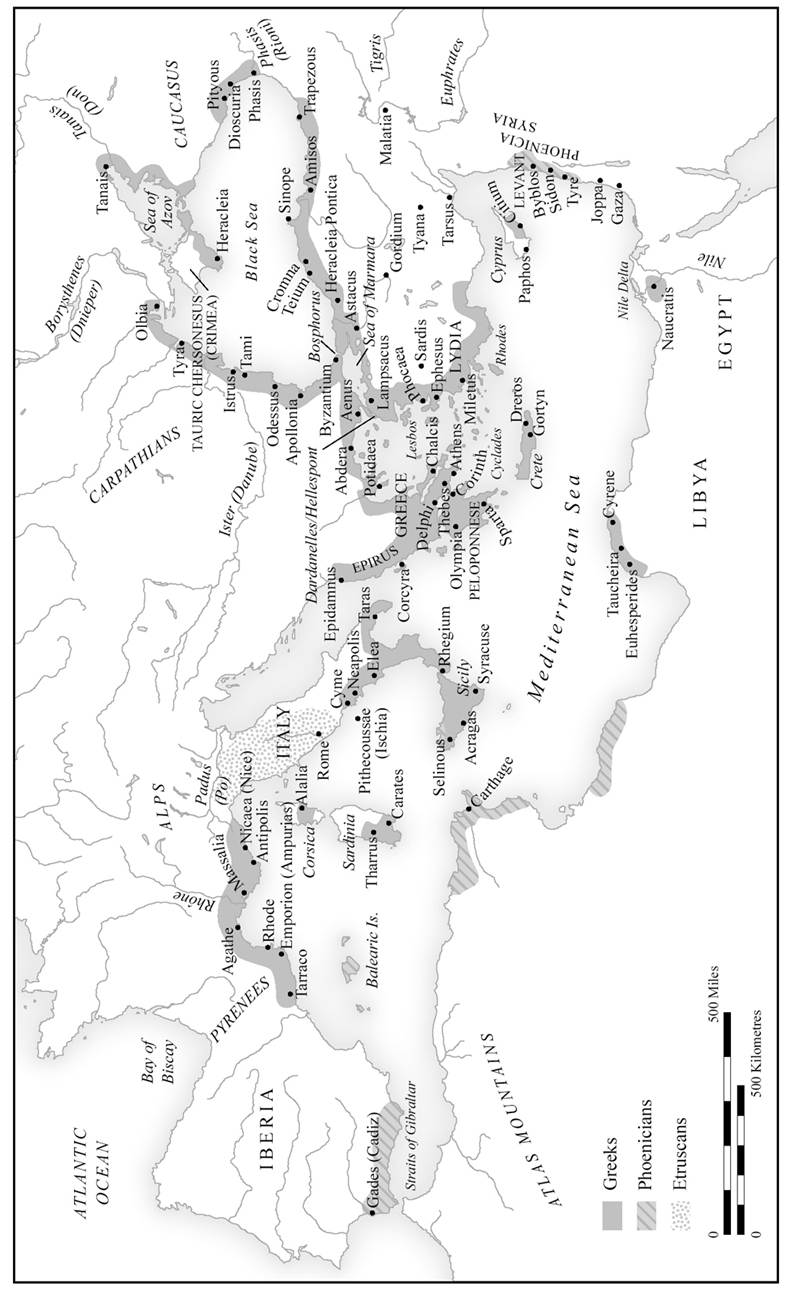
3.
‘Like ants or frogs around a pond’: Greek settlements in the seventh and sixth centuries BCE
New Greek settlements sprang up all round the coasts of Sicily and southern Italy. Others formed a line along the southern shore of Europe, from Catalonia to just short of the French-Italian border. Modern names of towns and cities often still preserve the memory of their origins in a Greek settlement: in Italy, Naples (Neapolis) and Taranto (Taras) among many others; in Catalonia, Empuries, or Ampurias (Emporion); in France, Marseille (Massalia), Antibes (Antipolis), and Nice (Nicaea). On the coast of North Africa, there was Cyrene in what is now eastern Libya, Naucratis on the Nile delta of Egypt. To the east, beyond the Dardanelles, there were Greek communities to be found on all the shores of the Sea of Marmara and almost all the way round the Black Sea, including the Sea of Azov. All of these were in existence by around 600 BCE.1
Two centuries later, the philosopher Plato could put into the mouth of his teacher, Socrates, the assertion that ‘we [Greeks] live between the River Phasis and the Pillars of Hercules… making our homes around the sea just as ants or frogs do around a pond’.2 The River Phasis, now called the Rioni, flows through Georgia into the Black Sea near its easternmost point. The Pillars of Hercules were the Strait of Gibraltar. It was some pond.
As Plato had noticed, when Greeks left their homeland to establish communities abroad, they hardly ever ventured very far from the sea. (This has often been the case in the modern world, too.) Just like the Mycenaeans and Minoans before them, the Greeks of the ‘age of experiment’ had the sea in their blood. It was the sea, and their evident mastery of shipbuilding and navigation, that enabled so many groups of emigrants to keep in touch with one another and to prosper by moving goods from one part of that huge extended coastline to another. Even such notoriously stay-at-home landlubbers among Greek speakers as the Spartans, when they briefly joined in at the end of the eighth century, followed the same pattern as everyone else.
At this time, it has been said, ‘a new town was founded in south Italy or Sicily about every other year’ by Greek settlers.3What made them do it?
Various explanations have been offered, at different times and from different perspectives. Perhaps the strongest reason for this unusual pattern of migration was simply: because they could. Plato’s analogy from the natural world brings to mind a different sense of the word colony from the historical one. Species, such as Plato’s ‘ants or frogs’, colonise territory and maintain themselves there as long as no predators threaten to dislodge them. The analogy is surprisingly exact for what was happening all around the shores of the Mediterranean at this time. The only large, centralised, developed state with a Mediterranean coastline was Egypt. When Greeks went there, as they did both as mercenaries and as merchants, they did so by invitation of the pharaoh. That made the single Greek ‘colony’ in Egypt, Naucratis, a special case, the exception that proves the rule. Anywhere else on the coasts of the Mediterranean, the Sea of Marmara, the Black Sea, or the Sea of Azov, you could beach your ship wherever you could find a sandy shore, put up your tent, and start building your settlement, without having to ask permission of anyone.
Sometimes the founders of new Greek settlements abroad would have to fight to establish their territory or to maintain it afterwards. But this happened surprisingly rarely, at least in the early stages. In the west, the earliest foundations seem not even to have been fortified. Instead, by moving into the marginal space between sea and hinterland, the new arrivals became the entrepreneurs—middlemen or intermediaries—whose presence and whose skills would enable goods, people, and technological know-how to pass from one part of the Mediterranean basin to another. For the time being, the newcomers could bask with impunity. In the absence of any serious predator, they became part of a new and thriving human ecology for the whole region.4
The Greeks were not alone in fanning out across the seas at this time.
The Phoenicians had been setting out from their homeland on the Levant coast for longer and would reach even farther, as far as Cadiz beyond the Strait of Gibraltar. The Etruscans of the Italian peninsula also established settlements beyond their own shores. By the year 500 BCE, more than half the entire coastline of the Mediterranean would be dotted with the settlements of one or other of these three peoples. And it would be these rival settlers, rather than the native populations of each hinterland, that for several centuries would prove to be the Greeks’ strongest competitors.5All these new settlements naturally started out from small beginnings. More often than not, the dots they represent on the map do not even join up. Travel from one to another was invariably by sea, not by land. It may have been in these circumstances, rather than back home on the Greek mainland or on the coasts and islands of the Aegean, that Greeks first began to organise their communities in an entirely new way, one that would go on to command immense prestige throughout the Greek-speaking world for a millennium and whose legacy is still with us today. The Greek word for this kind of community was polis (poleis in the plural), usually translated as ‘city-state’.
Typically, a polis would consist of an urban space, laid out around a sanctuary and an open area near the centre called an agora. The essential element of the sanctuary was one or more altars to the patron deity or deities of the city. Soon, more elaborate buildings would be built as the homes of these gods and goddesses. The Greek temple, built at first of wood and later of stone, with its rows of columns and pitched roof ending in a pediment at either end, was another innovation of the eighth century BCE. Many still stand as ruins today, and their architectural design would be copied again and again in later centuries. The agora was at first a meeting place for the citizens to assemble and only later took on the sense of ‘market’ (still the everyday meaning of the word in Greek).
The city would be surrounded by an agricultural hinterland of varying size. Farming, trade, and the spoils of war were the principal sources of wealth.6 City and hinterland together were ruled from the urban centre. Together, they formed the equivalent of a political state, as we understand the term today. The hinterland might include any number of villages or smaller settlements. But there was, more or less by definition, in each state only one ‘city’.It seems to have been a function of their size that in these city-states no institution or social group was consistently strong enough to impose its will on the rest. For the same reason, there was no given pecking order among city-states either. There was no equivalent to the Egyptian pharaoh or the ‘Great King’ of Assyria or, later, of Persia to rule by god-given right, whether within the limits of a single state or as overlord with authority over many. Later traditions held that poleis such as Athens and Thebes had once been ruled by hereditary monarchs. But in historical times, of all the Greek city-states, this was only ever true of Sparta, which was an exceptional case in many other ways, too. As for a single ruler with power to command all Greeks, that had only ever been possible in the distant, legendary past, when Agamemnon was supposed to have led the expedition against Troy. And even Agamemnon, according to Homer in the Iliad, had had a fractious time of it, his supremacy seemingly only a temporary response to circumstances and not immune to challenge or reproach from his peers.
In the absence of the principle of hereditary rule, the only other force that might have exerted a compelling authority over a polis would have been religion. The terrifying power of the Olympian gods was everywhere manifest in nature—in random ‘acts of God’, such as lightning strikes or earthquakes, for instance. When gods gave orders to humans, whether through oracles or omens, nobody doubted that they had to be obeyed.
Offerings and sacrifices to the gods, and rituals both private and public, were an obligatory part of everyday life, as much for individuals as for whole communities. But in the ancient Greek world there was no religious hierarchy to dictate or regulate practice or belief. There was no equivalent to the role of prophet, such as had already emerged in early Judaism or would later in Islam. No section of Greek society, not even the priesthood, could command authority on behalf of the divine realm to compare with the power of popes or bishops or institutions such as the Inquisition during the Christian Middle Ages.So, when a group of people came together to organise themselves into a polis, there was no one to tell them how to do it. They had to work it out for themselves. Suddenly, everything was up for negotiation and argument. And this is what Greeks began to do all over the Greek-speaking world both abroad and at home: to argue, to dispute with one another, to compete to find the best solutions that would work for the community as a whole, and then to persuade their peers to adopt them. Out of that combination of reasoned argument with persuasion would be born the world’s first politics (literally, ‘the affairs of the polis’).
The philosopher Aristotle, looking back from the perspective of some four hundred years later in the 330s and 320s BCE, would tell his students in Athens that the polis represented both the natural and the best way for human beings to organise themselves into a functioning community. It existed to ensure for its citizens ‘a perfect and independent life’, ‘that is to say, for them to live happily and well’.7 In the minds of the ancient Greeks, it was the concept of the citizen that defined the state, rather than the other way round. Aristotle was clear that the polis was ‘not a community of place’. Nor was it merely a means for people to come together for ‘the reciprocal exercise of justice and exchange’. These things were consequences of the existence of the polis, not the reason for it, still less its essence. In official documents and proclamations, a polis would always define itself not by the name of the city but by the collective name for its citizens: ‘the Athenians’, ‘the Spartans’, ‘the Thebans’, and so on. For all these reasons it has been proposed in our own time that a better description than ‘city-state’ would be ‘citizen-state’.8
On the other hand, the Greek word polis, in its everyday sense, has always meant simply ‘town or city’. It is true that many of the elements of urban life as we know it today had not really developed in these early days. Even the largest poleis were very small by the standards of modern towns, let alone cities or states. Size was never a defining criterion; the smallest is said to have contained just 190 inhabitants.9 But to belong to a polis, whether small or large, has always in Greek been tantamount to what a later age would call civilisation itself. Aristotle taught his students that anyone who lived far from cities or who had lived in times before the polis came into being must be like ‘the man reviled by Homer for being “Out of all brotherhood, outlawed, homeless”’.10
It may be that the true essence of the polis, and what made it possible, was neither the place nor its people but the rules that were created specifically for each place and that bound all the citizens who lived there. It can be no accident that one of the earliest public uses of the alphabet in the ancient Greek world was to make laws. These were literally set in stone or bronze, inscribed in public places where all could see them—even if only a minority would have been able to read what they said. Probably the oldest that survives is a fragment preserved at the site of Dreros, in northeastern Crete, dating from about 650 BCE. Revealingly, the text from Dreros does not ‘lay down the law’ in the sense that we might expect today. A great deal of early Greek legislation was about who had the right to exercise particular forms of authority and in what circumstances. Preoccupations such as these would dominate the turbulent and often fast-changing lives of most poleis for the next three hundred years.11
Laws were created for just about every city-state and differed greatly from one polis to another. Because systems everywhere were being devised from the ground up, other rules also varied enormously. Names of months, systems for reckoning historical time, weights, measures, coins (when coinage was introduced from Anatolia in about 600 BCE), definitions of citizens’ duties and privileges were different wherever you went. A modern traveller would have been bewildered passing through the boundaries of so many separate jurisdictions. And yet the nature of all these rules was remarkably consistent in all of them.
Out of these systems of rules emerged forms of government. Every polis had its own constitution, and every constitution was different in points of detail. One of the tasks Aristotle gave his students was to collect and write up some 150 of these that were in force in their own day (only the one for Athens survives). But from at least the first half of the fifth century BCE, the possible forms of government available to a polis could be reduced to three broad types: rule by one man, rule by the many, or rule by the few.12 The standard Greek terms for these would soon become established as, respectively, tyrannis, demokratia, and oligarchia. Precise meanings have changed a good deal in the intervening two and a half millennia, but all three are immediately recognisable in the political vocabulary of our own time.
Back in the preclassical age of experiment, when all of them were first being tried out, tyranny meant rule by a single strongman, more of a dictator than necessarily a tyrant in the modern sense. Even tyrants could be assiduous legislators, sometimes indeed quite progressive by the standards of their time. By and large, they would abide by their own laws, having once made them, and often respected those that they had inherited. In an oligarchy, power was held by a self-chosen elite group, based on birth and wealth; in a democracy, by the mass of the male citizenry. Irrespective of the actual system of government, by the end of the sixth century BCE, the principle had become generally accepted that every citizen was equal before the law.13
Despite all this, we should not suppose that the ancient polis, as it began to develop from the seventh century BCE onwards, was everything that Aristotle and others would later claim for it, particularly when viewed by the moral and political standards of today. No ancient Greek state was ever prepared to give full privileges of citizenship to women or more than the most basic protections to slaves. This meant that those who were entitled to take part in public affairs could never make up more than between a quarter and a half of the total adult population. Everywhere, the buying and selling of human beings as merchandise was an accepted part of civilised life. Wars between states, more often than not, may have been fought not so much with the aim of seizing land but of acquiring human capital—in the form of captives who could then be put to work as slaves.14 These grim realities were widespread, if not universal, at the time. But they seem never seriously to have been questioned by the Greeks of the age of experiment, who made it their business to question so much else about the world in which they lived and which they were shaping around them.
These were not the only limitations to the ancient polis as the system worked in practice. Its growth was piecemeal and never spread to the whole of the Greek-speaking world. So far as we can tell, every new settlement founded abroad from the end of the eighth century onwards soon adopted the polis model if it had not done so from the beginning. But many parts of the Greek mainland lagged behind. These were organised much more loosely into a type of state known as ethnos (ethne in the plural). This word had a range of meanings in the ancient language but did not yet signify what we could call ‘ethnic’ differences because all these communities were Greek-speaking. An ethnos has been described as ‘a survival of the tribal system into historical times: a population scattered thinly over a territory without urban centres’.15 Aristotle was not alone among ancient writers in regarding ethne as backward, precisely because they lacked the fabric and institutions that defined the polis. For this reason we know much less about how they ran their affairs.
In the southern half of Greece, most ethne would in due course coalesce into distinct poleis over the coming centuries. The farther north you went, the less likely that was to happen. One ethnos that never did adopt the polis system was Macedonia. There, hereditary monarchs belonging to a single dynasty would slowly consolidate their rule over an inland kingdom much larger than any city-state. The time would come for the kings of Macedonia to make their mark on world history, as Aristotle and his contemporaries had good cause to know. But in the meantime, it was the new kind of social organisation represented by the polis that would define the Greek world.
Among some one thousand five hundred Greek city-states that ever existed, at various times over a whole millennium, the most famous were Sparta and Athens. Neither was a typical polis. Sparta was not really a city at all but a collection of settlements along the banks of the Eurotas River, in the shadow of Mount Taygetos. Sparta ruled over the territory known as Laconia, or Lacedaemon, as well as neighbouring Messenia on the far side of the Taygetos range, which had once been part of the dominion of the Mycenaean kings of Pylos. All this added up to a Spartan state much larger than the hinterland of many other poleis put together, comprising roughly the southern half of the Peloponnese.
The people of Messenia, together with a portion of the native population of Laconia, were known as ‘helots’, a word which literally means ‘captives’. The helots were the descendants of the indigenous inhabitants, who according to tradition had been enslaved by the incoming Spartans, presumably during the upheavals of the dark age. In historical times, the helots lived in a state of permanent subjection, working in effect as agricultural serfs. Thanks to slave labour on this scale, Sparta was the only city-state whose citizens were able to devote themselves full-time to soldiery. Indeed, a Spartan citizen was forbidden from exercising any sort of productive profession. Sparta has ever since been remembered as an intensely corporate, militarised society. One reason for this specialisation was an understandable fear among their ruling class that one day their oppressed subjects, who may have outnumbered them by as many as seven to one, would rise up and take their revenge—as indeed would come to pass eventually.16
Athens, by contrast, was first and foremost a city. Then, as now, the urban space was dominated by the imposing rock known as the Acropolis (the Greek word literally means ‘high city’, and in ancient times just meant a citadel). Athens controlled a hinterland much smaller than Sparta’s and smaller even than the modern administrative region which has revived its ancient name, Attica (or Attiki in modern Greek). But in Athens, unlike in Sparta, every adult male born within the bounds of the state was a full citizen. Much of the menial work in and around the city was still done by slaves, either captured in war or bought in slave markets. But citizens farmed their own land, or else they earned their living as craftsmen or traders.17
In a Greek city-state, the law was supreme. And in this, at least, Sparta and Athens were no exception. Reverence for man-made laws that had been handed down from legendary figures of the past was as strong in the mind of an Athenian or a Spartan citizen as his awe (or dread) of the gods. The Athenian lawgiver Draco has bequeathed to us the word draconian; Lycurgus of Sparta most probably never existed, but his name would remain inseparably attached to the rigid Spartan system of laws. Beyond that common ground, the constitutional systems of the two states were about as different as it was possible to be.
Sparta was the only Greek polis to retain a traditional, hereditary monarchy. Even more unusual was that two kings, belonging to separate dynasties, always ruled together. Exactly where the balance of power lay in Sparta between the kings, at one end of the spectrum, and citizens’ assemblies, at the other, is not entirely clear. Women in Sparta had a higher social status and more of a voice than women in most other city-states; unlike in Athens, they could even own property, though they had no voice in citizen assemblies. But in every other respect, Spartan society was intensely conservative. Having established their laws and their constitution in (probably) the seventh century BCE, the Spartans would resolutely stick to them for centuries thereafter. Whenever they looked beyond their own borders, the form of government they liked to see in neighbouring states was oligarchy. But the Spartans’ own system was like no other.18
In Athens, on the other hand, the balance of power was continually shifting, and the Athenian constitution had to evolve to keep pace. By 500 BCE, Athens had experienced each of the three possible types of government that the polis system had thrown up: oligarchy at first, tyranny in the second half of the sixth century, and then finally an early form of democracy. The precise mechanisms that enabled the mass of the people (demos) to take power (kratos) have been much discussed. The information that has come down to us is incomplete and often distorted by later biases.
The last tyrant of Athens, Hippias, was expelled in 510 BCE—by an army from Sparta which seems to have been trying to meddle in internal Athenian politics. In the ensuing turmoil, one of the rival factions in Athens promised ‘power to the people’ in return for popular support. Quite how or why it worked we do not know for sure. But the fact is that it did. Cleisthenes, the leader of the winning faction, went on to introduce a far-reaching set of reforms. Another half century would pass before the Athenian constitution would become fully democratic and the word itself was coined. But however opaque its origins, the world’s first functioning democracy is usually said to have been created in Athens during the years 508–507 BCE.19
Every polis, from Athens and Sparta down to the smallest, was fiercely jealous of its autonomy. The Greek word autonomia was coined in the fifth century BCE and originally referred to the freedom of the state to make its own laws. It also meant that no state could legislate beyond its own borders without encroaching on the autonomy of another. Relations among independent, self-governing poleis were as much open to competition, negotiation, and argument as were those among citizens and groups within each one of them. But the Greeks of the ancient world never did find a satisfactory way to regulate these relationships, one that would have been comparable to the invention of ‘politics’ within the polis.
On the occasions when city-states did work together, it was usually in temporary alliances for mutual self-protection. To justify these arrangements, Greeks liked to appeal to shared ancestry. But the evidence suggests that most, if not all, stories about distant ancestors were invented after the fact. Settlements that could trace their foundation back to a ‘mother city’ (metropolis) in the Greek heartland might draw on that city in later times for support—or commonly, in practice, vice versa. But this only highlights the remarkable degree of independence enjoyed by even small and far-flung poleis. There was never any expectation that a mother city would exercise any form of political control over ‘its own’ foundations abroad; whenever a metropolis tried, it usually ended badly. That is one more reason why the term colony, with its associations of wars of independence and twentieth-century decolonisation, is so badly suited to describe a Greek apoikia.20
A looser basis for alliances could sometimes be the three main dialects (strictly speaking, groups of dialects) that made up the Greek-speaking world. Western Greek dialects (also, confusingly, spoken throughout the southern Aegean, including Crete and the southernmost parts of the Anatolian coast) were known as Doric. On the eastern side of the Aegean, but also in Athens, the Ionic group was spoken. Aeolic was spoken farther north, mainly in the northern Aegean islands, the northern Aegean coast of what is now Turkey, and the Greek coast and its hinterland from Thessaly southwards as far as Boeotia. A convenient mythology identified the speakers of each dialect as the descendants of a common ancestor and gave them collective names: Dorians, Ionians, and Aeolians. It was among Ionic speakers that the first attempt at building a political confederacy was made, perhaps as early as the seventh century BCE. A sanctuary called the Panionion (meaning ‘All-Ionian’, or ‘Of All Ionians’) served as a meeting point for representatives from a dozen city-states in western Anatolia. Not to be outdone, the Aeolians farther north seem to have set up something similar.21 On the other side of the Aegean, the Spartans would often exploit their supposed kinship with other Doric-speaking states to claim a leading role among them.
Despite these partial exceptions, the default position for every city-state was complete autonomy for its citizen body, at all times and at all costs. Citizens expected they would have to fight to maintain it. ‘The battlements of a polis are its fighting men,’ memorably declared the poet Alcaeus, writing on the island of Lesbos in the late seventh century BCE. And Aristotle, three hundred years later, though he accepted that human beings could be enslaved, could not imagine the same for a polis. ‘It would be unthinkable,’ he said, ‘to give the name of polis to something that was by nature enslaved, since a polis is independent and the condition of a slave is not.’22
And so, as rival states fought to maintain their much-prized freedom from each other, the polis system brought about a revolution in the Greek way of war. Homer’s heroes had fought in chaotic hand-to-hand encounters between self-declared champions, who drove to and from the field in chariots. In the new kind of warfare, lines of heavily armoured infantrymen, known as ‘hoplites’, faced each other in phalanxes (we still use the same word). Each member of the phalanx was protected on one side by the shield of his neighbour. If you fought in a phalanx, your survival in battle would depend on the man next to you (unless you were unfortunate enough to be on the end of the line). It was a tactic that would dismay enemies whose forces were very much larger. And it worked because hoplite armies were above all citizen armies. At the same time, new, larger, and faster ships were being designed and built. These were crewed by banks of oarsmen who had literally to pull together in order to ram an enemy. Once again, in battle the survival of one depended on the combined actions of all.23
For hundreds of years, war was endemic among Greek city-states. Mutual suspicion was the norm. ‘Autonomy’ was the prize. These were all-or-nothing, zero-sum struggles, with no quarter given. And yet all these people spoke the same language. The differences among dialects were never enough to make one speaker incomprehensible to another. They all feared and begged favours from the same gods and in much the same ways (though there were plenty of local variations, too). By the sixth century BCE, the quarrelsome family of immortals described by Homer had expanded to become the ‘twelve Olympians’, whose names and attributes were now widespread, if not yet quite universal throughout the Greek-speaking world.
Zeus was king and often called the ‘father’ of the others—although Poseidon was his brother and Hera, his queen, was also his sister. Apart from Zeus, each had a special sphere of influence: Poseidon ruled over the sea and was responsible for earthquakes. Athena was the goddess of wisdom, Aphrodite of sexual love, Apollo of light and poetry, though the arrows fired from his bow were notoriously deadly. Ares personified war, Dionysus the emotions and intoxication, Hermes trickery. A city would boast a patron deity, in some ways the equivalent of a patron saint in later times; the best-known case is Athena as the protectress of Athens. But sometimes the worship of particular gods would become attached to places that were, politically speaking, in the middle of nowhere. And this is how a network grew up of religious sanctuaries that drew worshippers from every corner of the Greek world, in the process cutting right across the fragmented world of the poleis and the more loosely organised ethne.24
One of these was on the tiny island of Delos in the middle of the Cyclades, the birthplace, according to legend, of Apollo and his twin sister, the virgin huntress Artemis. Another, perched on a steep mountainside on the flank of the Parnassus massif in central Greece, was at Delphi. There, Apollo would answer the questions put to him by mortals through his infallible but often inscrutable oracle. Olympia, the third, lay on the bank of a shallow river among the wooded hills of the northwest Peloponnese and was dedicated to Zeus, the king of Olympus. From small beginnings, religious centres at all three would expand their influence over several centuries.25
Regular festivals dedicated to the gods worshipped at each of these sanctuaries provided a mechanism for the elites of city-states that most of the rest of the time were at war with one another to meet, argue and negotiate, display their prowess, and vie for prestige.26 This was the origin of the ritualised tests of physical strength and skill that would become the forerunners of modern athletics (needless to say, another Greek word, from a root meaning originally ‘to struggle’ or ‘to compete’). The games held every four years at Olympia were said to have been established in the year 776 BCE (according to our system of counting). From that time on, the Olympic Games would be a regular fixture in the ancient world for over a thousand years.
During the period of the Games, and for an interval on either side, an ‘Olympic truce’ was declared so that competitors and sponsors could travel freely. All states that sent competitors were obliged to respect this truce—the clearest indication, surely, that the organisers recognised these festivals as a benign surrogate for war.27 Competitors and spectators travelled by sea from the ends of the Mediterranean and the Black Sea and by land from the mountainous hinterland as far north as Macedonia—then an outlandish place in the eyes of other Greeks. Numbers may have been modest at first. But when the stadium at Olympia was enlarged in the fifth century BCE, it could accommodate a crowd of forty thousand.
By that time, athletic contests had been established as part of regular religious festivals at other sanctuaries too. One of these, at Delphi, was known as the Pythian Games. Another was at Isthmia near Corinth, on the isthmus that joins the Peloponnese to the rest of the Greek peninsula; the fourth, at Nemea in the northern Peloponnese.28 A Greek-speaking world was emerging that was at once thoroughly interconnected and deeply fragmented. What kept it fragmented was the autonomy of each polis. Delos, Delphi, and Olympia were the nodes through which connections were channelled.
It was from these religious centres, too, and hesitantly at first, that there began to spread the first stirrings of a shared sense of identity as ‘Hellenes’. Originally, this had been the name of a small group living in the kingdom of the legendary Achilles. The name ‘Hellas’, which in the Iliad had defined a region within that small kingdom, expanded in meaning to cover everywhere that Hellenes, that is to say, Greek speakers, lived. But this kind of collective consciousness was most probably still in its infancy as late as 500 BCE. And in any case, it was a far cry from anything that could be called political cooperation, let alone unity.29
While the age of experiment lasted, Greeks were discovering themselves and their place in the world in a variety of other ways, too. New generations of poets composed and performed verses that for the first time brought into the public domain intimate aspects of what it feels like to be human. We know the work of these poets only through quotations by later writers or from chance finds of papyri in the Egyptian desert—which show that some of these poets, at least, were still being read a millennium after their lifetime. So far as we can tell, their poems were mostly short and designed to be sung to the accompaniment of a musical instrument. This is why both the poems and their composers have come to be known as ‘lyric’, from the plucked lyre. Many of these poets evoke the joys of wine, the effects of age on hope and desire, the cattiness of envy, and the trading of insults—everyday concerns caught in language of sudden immediacy. In the middle of the seventh century BCE, Archilochus, from the island of Paros in the Cyclades, captured in elegant verse the anatomical details as well as the sensations involved in what sounds like a session of group sex.30
Most famous of all was Sappho of Lesbos. Her life seems to have spanned the decades on either side of the year 600 BCE. She it was whose evocations of love and sex between women and girls long ago gave the world the word lesbian. In many Greek city-states, male homosexuality, particularly between middle-aged men and adolescent boys, was an accepted adjunct to the education curriculum and often praised ahead of heterosexual love.31 In Lesbos, the same applied to women. But it was not the local attitude to homosexuality, whether female or male, that made the island of Lesbos exceptional in the ancient Greek world. It was not even, probably, the fact that it was possible for women and young girls to come together in some kind of social setting, just as men did. What was extraordinary was that the poems Sappho composed and sang made it into writing, and so established a literary reputation that ever since has far outstripped the circle of her actual readers.
Sappho’s poems radiate a sense of joyous self-discovery. For once, the preoccupations of warriors, male athletes, and the competing male citizens of the polis are put roundly in their place:
Some think a fleet, a troop of horse
or soldiery the finest sight
in all the world; but I say, what one loves.
Observing a young girl flirting with a man, Sappho is so taken with the girl’s beauty that she vicariously shares in the physiological response of her lover:
speech fails me,
my tongue is paralysed, at once
a light fire runs beneath my skin,
my eyes are blinded, and my ears drumming,
the sweat pours down me, and I shake
all over, sallower than grass:
I feel as if I’m not far off dying.32
Still, for all the startling intimacy of these poems, written more than two and a half millennia ago, there is nothing in early Greek lyric of the private introspection that we often associate with ‘lyrical’ poetry in later times. So far as we can tell, these poets performed their works before an audience. Often this would be a close-knit group, gathered in a private house to eat and drink together, in what was called a symposium. Other occasions were more public, sometimes involving a whole choir of performers. Even if the circle of listeners was quite small, the physical presence of others and the act of performance were essential to the poem’s conception and composition. So, too, must have been the responses, though of course these have not been recorded. The presence in the poems of real individuals, who may well have been part of the audience and who even had a ‘right of reply’ in their turn, anchors the intimate and the personal in an immediate, tangible community of equals.
In the visual arts, beginning a little before the lifetime of Sappho, Greek towns and cities became peopled with stone or bronze replicas of their citizens. Life-sized or slightly larger statues started appearing in great numbers in sanctuaries and graveyards all over the Greek-speaking world. A similar figure, erected inside a temple to represent the god or goddess worshipped there, might be up to four times natural size. But most represented ordinary citizens. In graveyards, the stone effigies of the dead stood tall, stark naked if they had been men, decorously draped if they had been women. Every one of them stared straight ahead at the viewer, as they still do in museums today, every one of them still smiling the same enigmatic smile, and always, eternally young.
The technology and the techniques of execution came from Egypt. The Egyptians had been raising monumental statues in their temples and royal palaces for centuries. But even if the earliest Greek statues ‘look’ Egyptian, the uses to which Greek sculptors put the newly learned technology were all their own. Human statues in ancient Egypt were made to overawe the viewer with the power of the pharaoh. But there was no one with that kind of status in a Greek polis. Not even a ‘tyrant’ could impose himself on his fellow citizens so blatantly. Greek gods, too, looked quite different from the strange hybrid forms of Egyptian gods: part human, part animal or bird. When the gods and goddesses of Mount Olympus began to take form in stone or bronze, they were always entirely human—just as they are described in the Homeric epics. Greeks worshipped superior beings who looked and behaved just like immortal versions of themselves. And their better-off citizens were prepared to go to great trouble and expense to have their own selves, and their loved ones, represented in the same way.33
Today, the statues that represent citizens are known respectively by the ancient Greek words for a boy or young man (kouros, plural kouroi) and for a girl or young woman (kore, plural korai). The poses are unnatural, the proportions derived as much from geometry as from anatomy. Even the famous ‘archaic smile’ has been explained in terms of the ‘difficulties of carving the transition from mouth to cheek’.34 Whether they were carved from shining white marble or from duller limestone or sandstone, the finish included paint for hair, eyes, and the drapery of the korai in colours that by modern standards would probably seem garish. Quite how the flesh of the naked males would have appeared is harder to tell. According to a very ancient convention, begun by the Egyptians and followed by the Minoans and Mycenaeans in their time, men’s skin was represented by a reddish-brown pigment, women’s by white. The assumption, in later times, that ancient Greek art had established an ideal of the white male body is sometimes still repeated. But it is not based in fact.
Neither the sculptors of this period nor the patrons who commissioned them as yet had any great interest in trying to reproduce the likeness of an individual—any more than the lyric poets spoke of truly private experience. On the other hand, behind the standardised poses and the fixed, enigmatic smiles, there is something individual about many of those creations. This is where the new technology of stone- and bronze-working meets the only slightly older technology of alphabetic writing. An early male figurine from Thebes, cast in bronze and evidently commissioned as an offering meant to stand in a temple courtyard, bears the words, in verse, carved into its legs:
Manticlus dedicated me to the far-shooter, silver-bowed god [i.e., Apollo],
As a tithe. Phoebus [Apollo], provide a gift in return.
There is something touchingly transactional about this attempt to negotiate with the divine, which the modern term piety doesn’t come near to capturing. You give the god an expensive present—and you don’t just hope or pray, you ask him outright for a favour in return.35
In a graveyard, it was the statue itself, and not the dead person it was supposed to represent, who was imagined as speaking in the inscription: ‘Marker of Phrasikleia. I shall ever be called maiden, the gods allotting me this title in place of marriage: Aristion of Paros made me.’ It is the absence of a loved person that the ‘marker’ perpetuates. The statue itself, standing dignified and holding between her breasts what appears to be a flower, perhaps the virginity that was never ‘plucked’, both speaks to us and looks at us.36
By the end of the sixth century BCE, then, Greeks were using both words and images to put down markers of who they were. And it wasn’t only in solemn, public spaces that this was happening. Within the home, too, citizens were getting used to seeing images of their own kind reproduced—on the plates, cups, and mixing bowls that they handled daily. During the sixth century BCE, work produced by the potters and vase painters of two Greek cities, first Corinth and then Athens, was in demand all over the Greek-speaking world and even beyond. Some of the images displayed on these prized objects were of monsters or of fantastic hybrids, creatures of legend such as satyrs (half-man, half-goat), Egyptian sphinxes (a human face on the body of a lion), and centaurs (half-man, half-horse). But mostly they were images of male humans. Women are not absent but tend to appear only in the guise of goddesses or famous characters from legend. And the same dress code used on statues was usually, though not invariably, applied on painted pots.37 It was the image of the Greek male, painted in profile with jutting chin, beard, and not infrequently, erect penis, too, that by the end of the century had become part of the furniture, in daily use all over the Mediterranean and Black Sea coasts.
This was an artform so taken for granted by everyone who ever dined and drank at a symposium that it earned barely a single mention in the work of any ancient Greek author.38 For us today, these paintings in their thousands, recovered whole from graves or painstakingly reassembled by archaeologists from broken household crockery, offer fascinating glimpses into what it must have felt like to be Greek in the sixth century BCE and into the ways that Greek speakers of that time saw and thought about themselves.
In these images, naked athletes show off their prowess, flexing their muscles or wrestling an opponent to the ground, just as they did daily in exercise grounds in cities and sanctuaries all over the Greek-speaking world. Soldiers appear in full armour, topped by the forbidding bronze helmet of a type that survives in many museum exhibits today, with the prominent nose guard that leaves only narrow spaces for the wearer to see out. Another favourite type of scene shows animals being brought to sacrifice in a sacred grove or in front of a temple. Drinking vessels often show diners reclining and enjoying food, wine, and conversation at a symposium, the setting in which many of these objects would have been used.
More surprising to modern tastes, and shocking to earlier generations of classicists, are the scenes of courtship and sex. Some show gifts being offered as a preliminary to a tryst. Usually, these feature an older man and a younger man, though sometimes girls appear as well. Others depict sex acts between men, often with sufficient realism to suggest that the participants are thoroughly enjoying themselves.39 It seems that the activities celebrated by poets such as Archilochus were in vogue as subjects to be represented on household crockery for use in smart homes. This was another way in which Greek society of this early period liked to look at itself—and successfully promoted the resulting images among not just its own members but outsiders too.
Greeks at this time were also looking outward at the world around them. The study of ‘Nature’ (Physis, giving us our word physics) would lay the foundation for much of modern science. Egyptians and Babylonians had already, for centuries, been probing the mysteries of the heavens and investigating the properties of numbers and shapes. Greeks who lived in cities on the Anatolian coast probably had the best access to these older discoveries. One of these cities, Miletus, was the home of the first Greeks to make a systematic study of them. Beginning about 600 BCE, Thales, Anaximenes, and Anaximander, all from Miletus, began to expound theories and discoveries of their own to explain the visible universe.
Before long, they and their successors in many different parts of the Greek world would come to be known by the Greek term philosophoi, which literally means ‘lovers of wisdom’. They were the first philosophers. But they were also, because ‘wisdom’ was not compartmentalised in those days, the first scientists and the first mathematicians. Exactly how much they learned from the older civilisations of the Near and Middle East is debated today. What is not in doubt is that they invented an entirely new method, which lies at the root of all these disciplines as they have developed ever since. The method derives directly from the politics of the polis. In the same way that citizens argued about what we still call ‘policy’, philosophers constructed logical arguments that started from the evidence of the visible world in order to probe underlying causes. And in this way was born the concept, central to all mathematics and science, of proof.40
It can be hard to reconstruct in detail what these early philosophers thought and what they achieved; their writings have been preserved only in fragments, through the quotations of other, much later writers, who usually had their own philosophical axe to grind. The little we know about their careers shows that many of them took full advantage of the general mobility at the time. Pythagoras of Samos, in the later sixth century BCE, went all the way to Croton, in today’s Calabria, to found what would become known as a ‘school’ of mathematics. Xenophanes, originally from Colophon, an Ionian city not far from Ephesus on the Aegean coast of Anatolia, is said to have travelled all over the Greek world from about 570 BCE during a life that spanned almost a century. Xenophanes was a poet as much as a philosopher and it is not clear how systematic his thinking may have been. He was the first Greek we know of to break with the traditional stories about the gods of Olympus and to argue instead that ‘there is one god, greatest among gods and men, similar to mortals neither in shape nor in thought’. It was a very human error, he declared, to suppose that the gods look like ourselves: if cows, horses, or lions could draw shapes, he posited, they would draw their gods in the shape of cows, horses, or lions.41
Back on the Anatolian coast, Heraclitus of Ephesus was active during the decades either side of 500 BCE. He may have been the first to articulate the idea that the universe can be explained in terms of fixed laws, the natural equivalent of the laws that governed the Greek city-state. According to Heraclitus, the cosmos in which we all live had been created by ‘none of the gods or men… but it always was and is and shall be: an ever-living fire, kindling in measures and going out in measures’. This is the earliest known use of the Greek word cosmos in the sense that it still has in many languages today, equivalent to ‘the universe’. The original meaning of the word is ‘order’ or ‘arrangement’.42 Implicit in what Heraclitus says, then, is the idea that the natural universe is rationally ordered, even though no rational being created it. And its processes are governed by ‘measures’—meaning, in Greek as in English today, a regularity that is capable of being measured. Modern science begins with Heraclitus of Ephesus.
For as long as no serious predator existed to threaten them, the ‘ants or frogs’ remained perfectly content to thrive, prosper, and fight among themselves around their pond. This state of affairs lasted for almost two hundred years. But in the middle of the sixth century BCE, predators for the first time appeared on the scene. In the east, Croesus, the fabulously rich king of Lydia, from his capital at Sardis expanded the bounds of his kingdom until it drew in all the Greek settlements of western Anatolia during the decade between 560 and 550 BCE. In the west, Carthage, originally a Phoenician settlement in what is now Tunisia, had become the nucleus of a powerful local kingdom and was beginning to threaten the Greek cities of Sicily.43 But those threats were as nothing compared to the sudden emergence of the empire of the Medes and Persians under its king, Kurash, known in Greek as Cyrus, who came to the throne in 559 BCE.
During a reign of thirty years, Cyrus extended Persian control from the Aegean Sea to the Caspian and far to the east into modern Afghanistan and Pakistan. His successor, Cambyses II, would conquer Egypt, the two-and-a-half-thousand-year-old kingdom of the pharaohs, to create the largest, most centralised empire the world had yet seen. And after Cyrus defeated the Lydians under Croesus in 546 BCE, one by one the Greek cities of Anatolia were brought under Persian rule.44 A whole slice of the shore around the pond had been gobbled up. What were the Greek communities to do?
One solution was to remember past mobility and up sticks once more. According to the historian Herodotus, writing in Athens about a century after the events he describes, the people of the coastal city of Phocaea (today’s Foça, in the Izmir province of Turkey), under cover of night:
launched their galleys, put aboard their women and children and moveable property, including the statues and other sacred objects from their temples—everything, in fact, except paintings, and images made of bronze or marble—and sailed for Chios.… They also dropped a lump of iron into the sea and swore never to return to Phocaea until it floated up again.
The nearby island of Chios was only a temporary stopping place. The fleeing Phocaeans went on to build a new city, far away in Corsica. But after several decades, under mounting pressure from Carthaginians and Etruscans, they had to abandon it and moved to the toe of Italy instead, where many Greek settlements were already thriving. In the new world of the late sixth century BCE, the free-and-easy mobility of an earlier time was no longer a reliable solution.
Herodotus devotes several pages to the defiance of the Phocaeans. But he notes only one other example. Everywhere else, the Greek cities of Anatolia submitted to their new overlords.45 Persian rule was devolved to regional potentates known as ‘satraps’ (soon to become a dirty word in Greek, as it still is to this day). The satraps, in turn, were content to allow the Greek city-states to manage their internal affairs, provided they stayed loyal. The Greeks who benefited the most from this arrangement seem to have been the elites. Prominent men and leading families vied with one another to secure the backing of the satrap, or of the Great King himself, in order to exercise the role of tyrant in their city. Some humbler Greeks even migrated in the opposite direction from the Phocaeans, to wind up as labourers or artisans in the Persian capital, Persepolis.46
First to wake up to the new threat, on the western side of the Aegean, was Sparta. At some point in the 540s BCE, while the Persians under Cyrus were seizing one Greek city-state in western Anatolia after another, the Spartans sent a delegation to the Great King: if he didn’t desist at once, they would take it upon themselves to intervene to protect their fellow Greeks. As the story is told by Herodotus, Cyrus had never heard of Sparta and had to prevail on his Greek subjects to explain who these people were who thought they could threaten him. In any case, nothing more came of it. For the next half century, the Spartans concentrated their military efforts against other Greek city-states on their own side of the Aegean.47
By the final decade of the sixth century BCE, a combination of military conquest and asymmetrical treaties had brought most of the Peloponnese under the domination of Sparta. Spartan phalanxes began to venture across the Isthmus of Corinth. This was how the last tyrant of Athens, Hippias, came to be expelled from the city by a Spartan army. Two years later, the democratic reforms begun by Cleisthenes were proving even less to the liking of the Spartans than the tyrant had been. In 506, the Spartan hoplites were back at the gates of Athens, this time demanding the expulsion of Cleisthenes. In a moment of desperation, the Athenians turned to the new rising power in the east. The Great King of the Medes and Persians was now Daryaush, known to the Greeks as Darius I. Would he help them out?
It is once again Herodotus who tells the story. The satrap who interviewed the Athenian envoys was as bemused as Cyrus two generations earlier had been by the Spartans. The answer was only to be expected: ‘If the Athenians would signify their submission by the usual gift of earth and water, then Darius would make a pact with them; otherwise, they had better go home.’ By the time the envoys returned to Athens, having made the necessary act of submission, the Spartan troops had gone home, too. With the immediate threat withdrawn, the city’s democratic rulers were not best pleased to be told what their envoys had done in their name. But nobody ever got round to rescinding the formal acknowledgement of Persian overlordship.48
Then, in 499 BCE, after almost half a century of subjection, revolt broke out in Miletus. Its immediate target was probably not so much the Persians directly as those local Greek elites who relied on Persian favour. Other Ionian cities of the Anatolian seaboard joined in. Thus began the one brief moment of glory for the confederacy known as the Panionion. The Ionians sent desperate messages for help to the free city-states on the western side of the Aegean. Sparta refused. But the Athenians offered a small contingent, even though Athens was not yet a naval power, had few ships to spare, and was still, technically, a Persian vassal. Support also came from the tiny city-state of Eretria in southern Euboea. Once the rebels and their allies had assembled at Miletus, they sailed north along the coast to Ephesus, disembarked, and marched upcountry to Sardis, the former capital of the Lydian kingdom and the present seat of the local Persian satrap. They failed to take the fortress but instead set fire to the city before retreating to the coast. There they were routed by a Persian counterattack. This was enough for the Athenians and the Eretrians, who abandoned the campaign and sailed for home.49
It seems that the rebels were poorly led and had no clearly defined objectives. Even so, the Ionians carried on, without external help, for five years. Defeat came finally in the sea battle of Lade, off Miletus, when the combined navies of the rebel city-states faced an even larger fleet of warships mustered by the Persians from their Phoenician subjects. The reprisals ordered by the Persian king, Darius, were horrific. As Herodotus tells the tale:
Once the towns were in their hands, the best-looking boys were chosen for castration and made into eunuchs; the most beautiful girls were dragged from their homes and sent to Darius’ court, and the towns themselves, temples and all, were burnt to the ground.
The last item is amply confirmed by the archaeological record, which shows that parts of Miletus were destroyed so thoroughly that they were never rebuilt.50 By the time the ‘Ionian Revolt’ was over, in the summer of 494 BCE, Darius had thoroughly consolidated his grip on western Anatolia and was beginning to look farther afield. Already, Persian power was reaching across the Hellespont and would soon extend westwards through Thrace and into Macedonia.
The Athenians and Eretrians had achieved nothing by their intervention—other than to make themselves noticed. According to an anecdote reported by Herodotus, when news of the burning of Sardis reached Darius, he had first to ask who the Athenians were. On being told, the story continues, the Great King of the Medes and Persians reached immediately for his bow and shot an arrow into the air, crying aloud, ‘Grant, O God, that I may punish the Athenians.’ Like so many of Herodotus’s stories, this one is probably too good to be true. The same can be said of the sequel—that from that time onwards, Darius had a servant repeat to him three times before he sat down to dinner each day, ‘Master, remember the Athenians.’51 But by 494 BCE, the new predator on their doorstep most definitely had the Greek city-states to the west of the Aegean in his sights.
More on the topic 3 INVENTING POLITICS, DISCOVERING THE COSMOS c. 720 BCE–494 BCE:
- CONTENTS
- Jason Bruner
- This chapter examines the origins and early history of violence in the Japanese islands, focusing on the Jomon (c. 14,500-900 bce) and Yayoi (c. 900 bce-250 ce) periods.1
- Athenian Society and Democracy in the Classical Period 479-336 BCE