2 ‘HOMER’S WORLD, NOT OURS’ c. 1180 BCE–c. 720 BCE
After the Palace of Nestor burned to the ground, no one ever again returned to build and live on the hilltop where it had stood. Only the name, Pylos, remained in memory—in due course to be transferred to a different place, some miles away on the coast.
At Knossos, in Crete, the story was much the same. Here the name remained, but the new town that would grow up, in centuries to come, would never encroach on the ruins of the former palace. Mycenae and Tiryns, with their massive ‘cyclopean’ walls, continued to dominate the landscape of the Argolid. But at the highest points within their citadels, nothing remained but fire-gutted ruins. At both sites, humbler dwellings clustered in their shadows. All over the Mycenaean world, it would have been impossible to escape from the traces of the past. Ruined, deserted palaces and public buildings must have seemed like an ever-present reproach to the current generations that no longer possessed the means, or perhaps even the will, to build anything more than rudimentary shelters. Stone-built houses that still stood were used to bury the dead, while the living made do with makeshift mud huts. It must have been like living in a ‘ghost world’.1Within a single generation, in the towns and villages that had made up the kingdom of Pylos, as much as 90 per cent of the population may have been lost. Whether from famine, from disease, or from warfare, people would have died by the thousand if this estimate is anywhere near accurate. Not all regions fared quite so badly. But long-term trends show that the sudden, catastrophic drop in population observed in the southwestern Peloponnese was no temporary blip. Over the next two hundred years, at a cautious estimate, the population throughout the Greek mainland fell to no more than half of what it had been in Mycenaean times.2
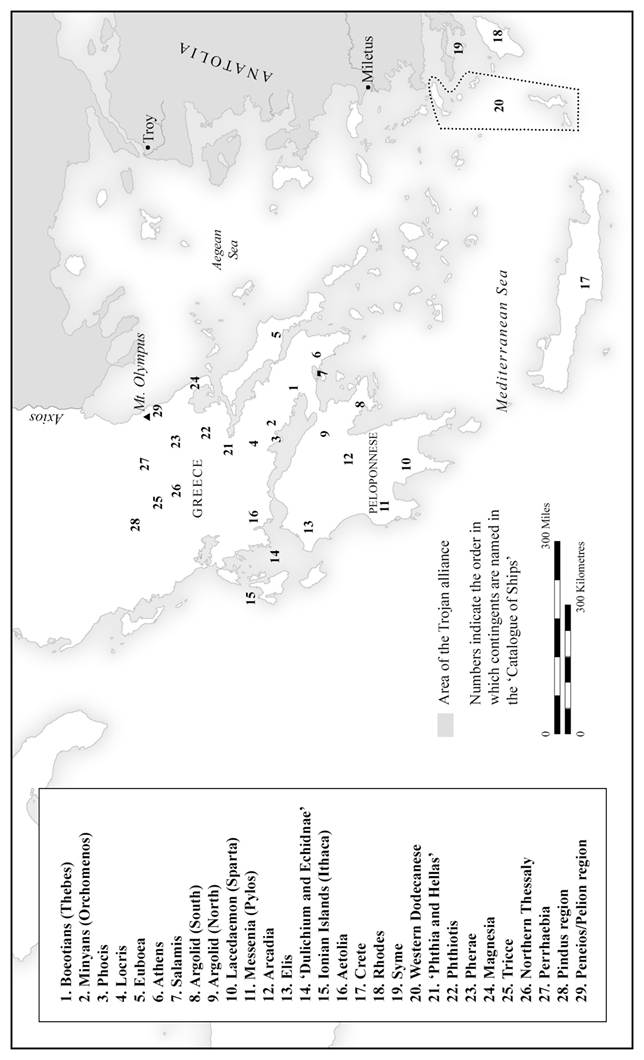
2.
The geopolitical world of the Iliad
Many of those who survived abandoned their homes to find the means of subsistence elsewhere. Some took to the mountains of the interior of the Peloponnese to try to eke out a living from marginal land that had probably never been cultivated before. Others headed overseas while ships were still serviceable and crews could be found to take them. In this way, new settlements were established on islands in the Aegean and Ionian Seas, and farther afield in Cyprus. In Crete, but not on the mainland, coastal sites were abandoned and people moved inland, to higher ground.3 Here and elsewhere in the eastern Mediterranean, where seaborne invaders brought disruption at this time, the threat may have been caused by displaced Greeks fleeing from disaster at home or even turning to piracy.
For those who remained where they were, life returned to the subsistence level of the days before the rise of the Mycenaean palaces. Once again people lived on smallholdings and in scattered settlements, growing and harvesting their crops and herding their sheep and goats. Everywhere, the Greek-speaking world fragmented into a patchwork of local communities. Not only had trade links across the Mediterranean all but vanished, but even those Greek communities that were relatively thriving seem not to have been on speaking—or at least on trading—terms with one another. No wonder, then, that the archaeologists who first began to uncover the Mycenaean civilisation in the nineteenth century chose to describe the centuries that followed its demise as a ‘dark age’.
Today, thanks to excavations carried out during the last fifty years, we know that the ‘darkness’ was not quite uniform. Athens seems to have been spared the worst. The citadel of the Acropolis was probably never completely abandoned. And the first signs of recovery there can be detected as early as 1000 BCE. Not far from Athens, at about the same time, on the coast of Euboea on the other side of a narrow strait, something more surprising was happening at the site known by its modern name of Lefkandi.
There, not long after 1000 BCE, the only building of any size to be put up anywhere in the Greek mainland in four hundred years, so far as we know, seems to have been designed to house the grave of a local ‘hero’. The cremated remains of the man were accompanied by the body of a woman, decked out in sumptuous jewellery and accompanied by the knife most probably used to kill her. The remains of four horses, dispatched at the same time, were found in the next chamber. Even more unusually for this period, the people of Lefkandi during the tenth century BCE were benefiting from renewed links with the eastern Mediterranean. Archaeologists speak of a revival of trade. But at Lefkandi, it appears that the transactions were all in the one direction. Precious objects buried with the ‘hero of Lefkandi’ came from places as distant as Cyprus and Babylon. But there is no sign in the archaeological record elsewhere to indicate that local goods made in Euboea were being exported. Perhaps the Greeks of Lefkandi were still living as mercenaries, or as piratical raiders, two hundred years after the Mycenaean collapse?4Everywhere, the centuries of darkness were a time of profound and irreversible change. People coped as best they could. There is no clear pattern or evidence of purpose in most of the changes that we can observe. About 1050 BCE, the new technology of smelting iron was first developed in Cyprus. From there it quickly spread throughout the eastern Mediterranean. The period of human development that archaeologists and prehistorians call the Iron Age had begun. The weapons that accompanied the hero of Lefkandi to the underworld were made not of bronze but of iron. Elsewhere, few communities had enough to spare that they could afford to bury anything much at all with their dead. In the Greek-speaking world, one of the most far-reaching technological changes in human history seems at first to have passed most people by.5
By 800 BCE, the darkness was beginning to lift.
Populations were no longer declining. Indeed, they had begun to rise. Craftsmen were once again creating objects that were of more than essential utility. Communities began to exchange goods with one another again. Trading links were revived. Greek speakers once more found themselves rubbing shoulders with rival traders who spoke other languages. In one direction were the people they called Phoenicians, who traded from the cities of Byblos, Tyre, and Sidon on the eastern Mediterranean seaboard that would later be known as the Levant; in the other, the Etruscans of central Italy.Greeks were once again on the move in large numbers. This time they were no longer fleeing chaos and collapse at home but seeking new and better opportunities across the sea. Later Greek accounts present a picture of an extraordinarily mobile population, both within and beyond the heartland of the Greek peninsula. Much about these mass movements of people remains obscure and the object of scholarly debate. There were still no written records. But of two things we can be reasonably certain. First, there was no significant influx of newcomers from outside the region. The idea of a series of invasions by ‘Dorians’ from farther north in the Balkans, that looms large in many twentieth-century history books, has not been confirmed by archaeology. All the ancient sources agree that those they call Dorians were Greek speakers and had migrated from no farther north than central Greece. In times to come, during later collapses, successive waves of new arrivals would leave permanent traces in all later forms of the Greek language: Latin-speaking Romans, Slavs, French- and Italian-speaking Crusaders, Albanians, Turks. Nothing like this happened during or after the post-Mycenaean dark age.
Secondly, during the ninth and eighth centuries BCE, the centre of gravity of the Greek-speaking world shifted eastwards. By the middle of the eighth century BCE, we find Greek communities firmly established right across the islands of the Aegean, all the way down the Aegean coast of Anatolia, from the ruined site of Troy in the north down to Lycia in the southwest corner and far to the east in Cyprus.
In anticipation of developments to come much later, some Greek speakers were reaching out in other directions too: northwards to form pockets on the coast of Macedonia, and westwards to Italy.As Greeks became more geographically dispersed, their world was becoming more fragmented than ever. By the time the dark age came to an end, even the Greek language had split to form several distinct regional dialects.6 We know this, as we know so much else about the Greek world from that time to this, thanks to the very first of those Greek inventions whose effects are still with us all over the world today: the alphabet.
The alphabetic revolution was every bit as transformative as the digital revolution of our own time. The invention would create its own version of an ‘information age’ for the ancient world—at a slower pace, to be sure, but with equally long-term effects for the ways that humans communicate with one another across space and time. The conceptual shift that made it possible was even simpler than the application of binary mathematics to electrical circuits. Indeed, it is so simple, and so much taken for granted throughout much of the world today, that we need to pause for a moment to grasp what was so revolutionary about it.
The basic technology of writing had been known for at least two thousand years already—nothing new about that. By the time the Greeks were beginning to emerge from their dark age, writing systems had proliferated all over the Middle East. In one corner of the Greek-speaking world, in Cyprus, Greek itself was still being written in a script closely related to Linear B. The Mycenaean writing system had long ago been forgotten, but the ‘Cypriot syllabary’, its close cousin, would remain in use in Cyprus right through the dark age and until long after it had ended.7 Both these older systems for writing Greek share the same drawback. A syllabary is a system in which each syllable of the language is represented by its own sign.
(One of the first Greek words to be recognised in Linear B was represented by the four characters: ti-ri-po-de, meaning ‘two tripods’.) To make this work, you need around ninety characters. To learn to write in Linear B or the Cypriot syllabary meant acquiring a specialist skill. And the resulting written record still left a good deal of guesswork for the reader, as any expert on Linear B will tell you.Instead, the Greeks looked elsewhere. The writing system that eventually caught their attention had been developed during the previous centuries by the Phoenicians living on the Levantine seaboard. The language of the Phoenicians, and the script they used to write it, belonged to the Semitic family that also includes Hebrew. The Phoenician script was in effect a syllabary. But by leaving out the vowels, it had the great advantage of reducing the number of signs to just over twenty. Here was the beginning of a system that anyone could learn. The Semitic signs were given names that served as mnemonics for the respective sounds: alf, bet, and so on. This is why, when the Greeks adapted this system for their own use, they called it the ‘alphabet’.
But there was one vital difference between the Phoenician system and its adaptation by the Greeks. And here we aren’t talking any more about ‘the Greeks’ in general. This can only have been the initiative of a single individual, because it happened only once, at a single point in space and time. As well as borrowing the symbols of the Phoenician script to represent similar-sounding consonants in Greek, this individual picked out four other symbols that represented Semitic consonants not needed in Greek and invented one new one, so as to represent the five basic vowel sounds that are still found in most alphabets today. Suddenly, it was possible, using hardly any more signs than the Phoenicians did, to write down fully and accurately the actual sounds of speech.8 From now on, the ‘winged words’ addressed to each other by heroes on the battlefield, or by gods decreeing human destinies, even unspoken thoughts or the fleeting contents of the imagination, could be brought down to earth, preserved and transmitted far beyond the time and place of the original utterance. And within a few years, all over the sea routes that were once again being plied by Greek traders, this is what happened.
It wasn’t just Greeks who adopted the new system. The alphabet was soon being adapted to write Phrygian, an Indo-European language of western Anatolia distantly related to Greek, and Etruscan, the largely undeciphered language of the Romans’ northern neighbours in Italy. The invention was still new when Rome itself was founded, according to tradition in 753 BCE. Soon the Romans, too, would adopt a version of it to write their own language, Latin. The actual form of the letters used in each region and to write each of these languages varied enormously, particularly during the early centuries. The distinct Greek and Roman alphabets, as we know them today, would not become standardised until much later. But none of these was a separate invention. We can be sure of this, because the basic system and the equivalence between the Phoenician and the alphabetic signs remained everywhere the same.9 This single invention—the addition to the existing Phoenician system of separate symbols to represent vowel sounds—lies at the root of the ‘roman’ alphabet in use all over the world today, as well as the Greek.
Exactly when and where the invention took place are the subject of much speculation. We will probably never know. If recent redating of some of the earliest inscriptions is correct, it must have happened between 850 and 825 BCE. This is a little earlier than the generally accepted date of the early eighth century. As for where, it must have been a place where Greek and Phoenician traders rubbed shoulders. One possibility is Crete. A Phoenician trading post had been established on the south coast of the island during the ninth century BCE, and a sample of Phoenician writing has been found in a tomb at Knossos, dating from the same period. Or it could have happened at Lefkandi, or another port town in southern Euboea, since the area was a centre for Greek trading networks at the time. Ancient traditions name Thebes, nearby on the mainland, and also link the first ‘Phoenician letters’ with the city’s legendary founder, Cadmus. Other candidates that have been proposed lie at opposite ends of the Greek world at the time: either Cyprus or one of the Greek outposts in southern Italy.10
Wherever it started, to borrow a metaphor from the digital age, it very quickly went viral. At places hundreds of miles apart, owners of decorated drinking cups began to scratch messages onto their glazed surfaces. Often it was no more than the owner’s name that was written, or a brief phrase of the type ‘I belong to Philion’. Even this is revealing. There’s no point in writing your name on a treasured possession if nobody but you can read it. Not long after the year 750 BCE, at the trading settlement of Pithecoussae on the island of Ischia in the Bay of Naples, the owner of a high-value painted cup went further and etched into its surface three lines of verse:
Nestor’s hearty-drinking cup am I.
He who drinks this cup will soon take fire
with fair-crowned Aphrodite’s hot desire.11
The anonymous writer playfully links together the joys of drink and sex (Aphrodite being the goddess of carnal love). And the use of verse links the very new technology of alphabetic writing with the rhythm and the mythological subject matter of what must have been a centuries-old tradition of storytelling in Greek before this time.
Within a few decades, makers of fine pots would begin to add captions to the images that they painted on them. This was done deliberately, before the clay was sent to the kiln for firing, and therefore as part of the manufacture. Once again, to make it worth anyone’s while, there must have been an assumption that if you could afford to own such an object, you and your friends would be able to make the connection between word and image. Literacy would still not become widespread for several centuries. But writing was no longer the preserve of a specialised craft guild of scribes. Aptly it has been said that ‘The early alphabet likes to declare ownership or belonging, and it speaks in the first person’. There had been nothing like this in the Mycenaean world, or anywhere else in the ancient Near East.12
Over the next few centuries, the alphabet would bring into existence the forms of communication that we know today as history, philosophy, and literature. All of these depend on the preservation and transmission of the spoken word by means of writing. The alphabet was now unleashing the full potential of the written word to generate and to replicate messages beyond the control of any single authority, be it political, religious, or commercial. This potential first manifested itself, on a scale that we still call epic for this very reason, in two monumental poems whose written versions are almost as old as the alphabet itself, and in all probability began to take the shape in which we read them today not long after the year 800 BCE.13
The Iliad and the Odyssey of Homer bring to life the legendary world of the Trojan War and its aftermath. The Iliad tells, in almost sixteen thousand lines, of the quarrel between Agamemnon and the best of his fighters, the youthful Achilles, during a period of only a few days in the final year of the ten-year siege of Troy. The Odyssey, in over twelve thousand lines, takes as its subject the adventures and homecoming of just one of the heroes, Odysseus (also known as Ulysses), after a further ten years of wandering on the sea. Neither epic gives anything like the whole story. From passing allusions scattered throughout the texts, we realise that the audiences who would have heard these poems sung or recited were expected to be already familiar with the bigger picture.14
These stories have become so well known that it can be hard to grasp the sheer strangeness of the original Greek texts. One thing about them is their enormous length. Whether they were created on the page or in the course of an oral performance, the logistical challenge would have been extraordinary. Based on techniques that have been observed at work in modern oral traditions around the world, it has been estimated that the Iliad would have taken three full days to perform before an audience—much longer if the poet was dictating his words to a scribe.15 On the other hand, if someone had sat down to conceive an entire epic poem in writing, in a world in which storytelling had for centuries been defined by the limits of an evening’s entertainment and the patience of an assembled group of listeners, how could the result have ever reached an audience? No matter how you look at it, there’s no getting away from a singularity almost as striking as the invention of the alphabet itself: How did the art of oral composition in performance ever make the quantum leap into writing? In some way, the new technology must have been the spur to a narrative experiment on a scale that would previously have been inconceivable. But how it was done, and why, we simply do not know.16
Then there is the language. Homer’s Greek presents a notorious challenge to modern students. But this was the case in the ancient world as well. The language of the epics belongs to no single place or time. It can never have been the natural speech of any individual. Instead, the poems mix elements taken from dialects that in the eighth century BCE were spoken in different parts of the Greek-speaking world. At the same time, they preserve many linguistic ‘fossils’—traces of earlier forms of Greek that, it has been argued, go back at least as far as Mycenaean times.17
Closely bound up with the language of the poems is their metre, or verse form. Verse is a way of organising language not just into sentences that make sense but also according to repeated patterns of sound, that resonate with the natural rhythms of the human body and so help to lodge them in the brain. (Those of us who were taught to memorise and recite poetry at school will recognise the process at once.) The metre known as dactylic hexameter was used for all the earliest Greek narrative poetry. It also appears in some of the oldest inscriptions that have survived from the eighth century BCE, among them the one incised on Nestor’s Cup. It is now generally accepted that this system must have been the creation of generations of poets working in a tradition that functioned quite independently of the written word, long before the invention of the alphabet. Some would go further and see the hexameter verse form as another inheritance from the Mycenaeans, if not even from the Minoans before them.18
Neither the Iliad nor the Odyssey gives any indication of who its author may have been, when or where that person might have lived, or the circumstances in which these monumental narratives came to be born. The name ‘Homer’ begins to appear only around 500 BCE, more than two hundred years after the poems most probably began to circulate in written form. Various accounts, thereafter, imagine the epic poet as having been active somewhere on the coast of Anatolia—perhaps Smyrna or the nearby island of Chios. ‘Homer’ is not even a name but an ordinary noun which means ‘hostage’. From the few and contradictory scraps that pass for information recorded in antiquity, it is evident that the Greeks of the classical period knew no better than we do whether there ever was such a person. The Iliad and the Odyssey may or may not have been the work of the same poet or poets. Opinions were divided in ancient times and remain so today. Though we still speak of ‘Homer’ (usually without quotation marks) as a form of shorthand, there is a growing acceptance that many different individuals, and indeed generations, must have had a hand in the creation of the epics that we read today. Behind the name ‘Homer’ we might do better to think not so much of an ‘author biography’ on the cover of a book but of the credits rolling at the end of a film.
Together with the earliest books of the Hebrew scriptures, these two poems are the oldest narratives in the world that have been continuously copied, read, commented upon, and used as a source of inspiration by creative artists in every genre and every generation from that time to this. After them a cycle of six other shorter epics came into existence, traditionally attributed to poets of whom we know even less than we do about Homer. These poems are known to us only through summaries and a few quotations by later authors. They seem to have been written to fill in the many gaps left by the two great epics. Possibly these ‘cyclic epics’, as they are known, represented more closely the living tradition that had preserved and enhanced these stories over the centuries. Or perhaps there was already a whiff of the library about them—conscientious attempts to capture whatever nuggets of the oral tradition their authors could come upon, and maybe even make up the rest. In any case, the cyclic epics never enjoyed the prestige of their towering counterparts attributed to Homer. Of the two, the Iliad always had pride of place, followed at some distance by the Odyssey.19
In the earliest years, performers called ‘rhapsodes’ (literally: ‘stitchers of songs’) had a special role in reciting the poems in public. But, as there were many rhapsodes, active in many different places, it seems that rival versions proliferated. None of these can have been exactly similar to the versions that we possess today. By the 540s BCE, the poems had already become so central to public life in Athens that the city’s ruler, Pisistratus, decreed that definitive, authorised versions should be made. This may have been the time when the epics acquired the prestige throughout the Greek-speaking world that they would never lose thereafter.
Three centuries later, scholars in Alexandria in the service of the Greek dynasty, the Ptolemies, took it upon themselves to collate all the manuscript versions of the poems they could lay their hands on. They stripped out all the bogus, redundant lines that had crept in through successive retelling and copying. The result was the model texts that would ever afterwards be copied with great accuracy right down to the invention of printing in the fifteenth century. So anxious were the Alexandrian scholars to ensure that the epics could be read and reliably understood by future generations that they even introduced an innovation into the Greek alphabet. These are the accent marks written above all words of more than one syllable that have remained an essential part of written Greek ever since—allegedly devised for no other purpose than to assist the understanding of a form of the language that was already as distant from speakers in the third century BCE as Chaucer’s English is from us. Just so important had these epics become some six hundred years after they were first written down.
Over a period of almost a millennium after that, while Greek remained the language of education in Egypt, from the third century BCE to the seventh CE, more copies were made of the epics of Homer than of all other Greek authors put together. We know this from the many thousands of fragments cut or torn from scrolls of papyrus that were preserved by the dry conditions of the Egyptian desert and that have come to light in the last hundred and fifty years.20 Many of these were school textbooks. In the ancient world, to be able to read and write, to be considered educated at all, you had to know your Homer. But the Iliad and the Odyssey were also read and studied as the nearest thing to a sacred scripture that the Greeks ever had. Historians, philosophers, anyone seeking moral guidance in the everyday world or seeking revelation about the true nature of the gods would turn as a matter of course to ‘divine Homer’. Not even the coming of Christianity and the toppling of the statues of the old pagan gods would greatly change that. For another thousand years, devout Greek-speaking Christians would labour to expound the ways in which the ancient epics had prefigured the revealed truths of Christianity and devise ingenious interpretations that turned them into moral allegories.21
The Iliad and the Odyssey in later times would become a fixed point of reference for writers far beyond the Greek world. The Roman poet Virgil famously drew on both as the models for his Aeneid. Written at the turn of the first century CE, Virgil’s epic links the Trojan story to the origin of the city of Rome and its still-expanding empire. In medieval and modern times, many nations have produced their own ‘national epics’. In English, John Milton, writing in the aftermath of the English Civil War of the 1640s, drew on both Homer and Virgil to create the epic poem of Protestant Christianity, Paradise Lost, first published in 1667. The twentieth century saw such literary experiments as James Joyce’s Modernist novel Ulysses in 1922 and the modern verse epic of the Caribbean, Omeros, by Derek Walcott in 1990. In our own century, these quintessentially male stories have been memorably upended by leading women novelists: Margaret Atwood in The Penelopiad in 2006, and Pat Barker in The Silence of the Girls in 2018. And this is to confine examples to the English-speaking world and to the written word. Adaptations for cinema and TV go back to the early years of both these media and the creation of the ‘swords-and-sandals’ genre.22
It is not hard to see why the epics should have had such lasting appeal. Consider the moment in the Iliad when Hector breaks through the Greeks’ defences to set fire to the ships beached on the shore:
Then glorious Hector burst in
with dark face like sudden night, but he shone with the ghastly
glitter of bronze that girded his skin, and carried two spears
in his hands. No one could have stood up against him, and stopped him,
except the gods, when he burst in the gates; and his eyes flashed fire.23
Or think of the ways that the homecoming of Odysseus has been adapted in later times to stand for a universal human experience. In many languages, today, we speak of an odyssey to describe either a long journey or a difficult quest. Near the beginning of the twentieth century, the Alexandrian Greek poet C. P. Cavafy wrote the poem ‘Ithaca’, which imagines Odysseus’s journey as equivalent to life itself. Cavafy concludes:
To Ithaca you owe the splendid journey.
Had it not been for her you’d never have set out.
But she has nothing left to give you now.
And if you find her poor, Ithaca did not cheat you.
So wise as you’ve become, from your adventures,
you’ll know at once the meaning of an Ithaca.24
This may be a far cry from the actual opinions of any Greek alive in the eighth century BCE. But Cavafy’s much-loved poem testifies to the enduring power of the story. And there could have been no twentieth-century ‘Ithaca’ if there had not first been Homer’s. What we now call ‘world literature’ effectively begins with the Iliad and the Odyssey.
The action of the two poems is set in an age of heroes that was imagined as already long past before the stories came to be told. At four different points in the Iliad, a hero is said to pick up and hurl ‘a stone, a huge thing which no two men could carry / such as men are now’.25 The repeated expression betrays itself as one of the traditional building blocks of oral poetry, a ready-made ‘formula’ which the poet could adapt to fit different situations as his narrative developed. And this ‘now’, that is contrasted to the age of heroes, is not even fixed to any one point in time; it was already enshrined in the oral tradition before the Iliad ever came to be written down.
Specific details of the heroic age, particularly as it is described in the Iliad, often seem uncannily to correlate with objects or practices discovered by modern archaeology—but not consistently with those belonging to any one time. Some of these go far back into the Mycenaean Bronze Age. At one point we hear of a helmet made out of the tusks of wild boars stitched onto leather. Elsewhere a hero carries a rectangular shield large enough to cover his whole body. We know from the Thera frescoes, buried before 1500 BCE, and other finds of that period, that these types of armour had once been characteristic of the Mycenaeans. They were already becoming obsolete by the time the first palaces rose on the Greek mainland.26 In another scene, the Trojans go out to battle sporting helmets crowned with a horse-hair plume and a horn. Helmets exactly matching this description appear on the long-nosed, rather bedraggled-looking warriors who march round the surface of the famous ‘Warrior Vase’ from Mycenae. But this vase dates from about 1150 BCE, at least four hundred years after the eruption that buried the Thera frescoes. Then there are the obsequies devised by Achilles for his dead friend Patroclus. The poet describes how female captives were killed above the hero’s tomb, along with his favourite horses. Something very similar seems to have happened at Lefkandi but in a different historical period again, in the early Iron Age, not long after 1000 BCE.27
Armour and weapons, in the epics, are made of bronze, as they had been in Mycenaean times and for about two centuries afterwards, and not of iron, as they more often were in the eighth century BCE. Chariots appear regularly in the battle scenes in the Iliad. This was another feature of the Bronze Age that had disappeared from warfare long before the invention of the alphabet. But the poet seems unsure about how they might really have been used in the field—and the men in the audience, who can never have seen them in action either, appear not to have minded. Heroes in the epics, when they die, are invariably cremated on funeral pyres. The Mycenaeans had laid the bodies of warriors to rest in graves of varying types but almost always intact. The change to cremation had begun towards the end of the Mycenaean period and continued gradually until it became general during the dark age. Later, both methods for disposing of the dead would again coexist. But Homer knows only the practice of the dark age. Homer’s age of heroes, then, cannot be a realistic depiction of any world that actually existed. Rather, it incorporates elements drawn from many different times, that range across a span of astonishing depth: from the sixteenth to the eighth centuries BCE.28
The same applies to what might be termed the geopolitics of the epic world. Halfway through the second book of the Iliad, the poet interrupts himself to call upon the ‘Muses… who know all things’ to tell ‘Who… were the chief men and the lords of the Danaäns’ (that is, the Greeks). The section that begins here has long been recognised as in effect a separate poem, embedded at this point. Most modern readers probably skip over the ‘Catalogue of Ships’, as it has come to be known, and with good reason. The story is held up while the poet lists the participants in the war on both sides. Alongside the names of places and their rulers, we also learn, for the Greek side, the size of each contingent, measured by the number of ships each leader has contributed to the expedition. The poet reveals a remarkable grasp of the physical geography of the Greek peninsula and the Aegean and describes it in terms that we would nowadays call political.29
No one in Homer’s time, or for many centuries afterwards, could have seen anything remotely resembling a modern map. We have the advantage of being able to see the information contained in the Catalogue laid out in spatial form. But the ‘singer of tales’ had to spell it out in words. The act of telling brings in the dimension of time in the form of a sequence. This narrated ‘map’ begins in the centre, with Thebes and Boeotia, then spirals outwards to draw a circle that encompasses the Peloponnese and the southern part of the mainland to the north. (It may not be entirely accidental that this was almost exactly the area covered by the modern Greek state when its frontiers were first established in 1832.) The poet then reaches outside the circle to bring in a number of outliers: first moving in an arc from Crete northwards and eastwards to include several islands of the Dodecanese, including the largest, Rhodes. Then he jumps to the far north, where he starts with Achilles’s homeland in Thessaly and rounds off with a rather vague account of even remoter places that mark the northernmost edge of his world.
This presentation gives a very clear sense of a geographical, and perhaps also political, centre and a periphery beyond it. Politically, the greatest concentrations of power, as represented by numbers of ships, are the Argolid, with a combined total of 180 from Mycenae and Tiryns, and Pylos with 90. Mycenae fields the largest single contingent, 100. Agamemnon, king of Mycenae, commands the entire expedition. Athens and Sparta, the cities that would emerge in classical times as the rival ‘great powers’ of the Hellenic world, are of middle rank, with 50 and 60 ships, respectively.
The opposing Trojan forces are presented rather more summarily, and of course they have no ships to be counted because they are defending Troy from the land. Effectively, and drawing on information given elsewhere in the poem, we learn that the defenders of the city have been recruited from the entire northern and eastern coastline of the Aegean, stretching from the Axios (Vardar) River, just to the west of modern Thessalonica, all the way round to Lycia, in the southwestern corner of today’s Turkey. Some of the islands closest to the eastern mainland, including Tenedos and the much larger Lesbos, also lie within the Trojan sphere. The result is a world symmetrically split along an axis that runs through the Aegean Sea from northwest to southeast. On land, the two alliances are neatly separated by the highest mountain massif in the region, Mount Olympus, which is also the home of the gods who are the final arbiters of fortune in the war being waged between them.30
It has often been noticed that the picture presented in the Catalogue matches the archaeological record for the Greek-speaking world in the Mycenaean age far better than it does for Homer’s time. But it is not an exact match for either. Many of the names listed refer to places that the Greeks themselves, in classical and Roman times, were unable to identify. Several of these names have now turned up in Linear B tablets and can be linked with Bronze Age sites known to archaeologists. By the eighth century BCE, on the other hand, the centre of gravity of the Greek-speaking world had shifted to the eastern side of the Aegean. Homer himself, according to tradition, and most probably his first audiences, too, on the evidence of the language used in the poems, actually belonged to that newly expanded eastern Greek world. Why are these things never mentioned?31
One answer must surely be that the political geography of the Iliad is inseparable from the great conflict that forms the background to the whole poem. The alliances and oppositions presented, according to the logic of the story, have been created by the unique event of the Trojan War. How the thirty-odd separate kingdoms that make up the Greek side relate to one another in peacetime we are never told. The Trojan alliance is an even more ad hoc affair. In other words, what divides the two sides and draws a line across the Aegean Sea in the Iliad is nothing but the Trojan War itself. This is not to say that Homer’s world was simply invented. Rather, it must have been pieced together, probably over generations, if not over centuries, by people who had been brought up on stories handed down from different periods in the past. But the coherent whole that the Iliad, in particular, creates is an imagined age of heroes, not the faithful record of a historical reality.
In that imagined world, the people that we know as Greeks are never called by the name that would later become standard: ‘Hellenes’. In the Catalogue of Ships, ‘Hellas’ is the name given to a local region in the kingdom of Achilles, in what would later become Thessaly. ‘Hellenes’ make up only a small group within one of the smaller contingents besieging Troy—though of course their leader proves himself the most glorious of all, which may help to explain how the name would eventually come to be applied to everyone who spoke Greek. Instead, the combined forces that make war on Troy in the Iliad, and the survivors of the expedition in the Odyssey, are most frequently called ‘Achaeans’ (Achaiwoi). Sometimes they may alternatively be called ‘Danaans’ or ‘Argives’ (men of Argos). But so far as we can tell, all three of these names have the same undifferentiated meaning, equivalent to later ‘Hellenes’. ‘Achaeans’, and probably also ‘Danaans’, had been current in Mycenaean times, as mentioned in the previous chapter.32
We have no means of telling how Greeks were in the habit of referring to themselves in the eighth century BCE. If anything like a ‘panhellenic’ identity is to be discovered in the Homeric poems, whether a distant echo from Mycenaean times or the beginning of something new in the eighth century BCE, it is curiously elusive.33 It has been tellingly pointed out that there is nothing resembling what we would nowadays call a national consciousness on the Greek side in the Iliad. It is different for the Trojans: Hector speaks movingly of the honour and necessity of defending one’s ‘fatherland’. Among the Greeks, individual heroes are identified not as Achaean but by their place of origin—Mycenae or Argos, Ithaca or Phthia (Achilles’s homeland). Achaeans, Danaans, and Argives only ever appear in a generalised plural.
Nothing in the epics marks out Trojan people as being different from Achaean people, except perhaps the detail that Priam seems to have many wives. Some of the Trojans’ allies speak different languages, and the poet implies that this puts them at a slight disadvantage. We aren’t told what language the Trojans speak among themselves (nor the Achaeans, either, for that matter). But both sides communicate with each other all the time, and without any hint of a language barrier, so we must presume in Greek. Neither the poet nor any of the characters, who often hurl defiance at each other in long speeches, expresses any sense of superiority for one side or contempt for the other on the grounds of being Achaean or Trojan.34
Both sides worship the same gods, whose home is on the cloud-covered peaks of Mount Olympus. Many scenes in the two epics are set there. Already in the first book of the Iliad, we meet Zeus, ‘Cloud-Gatherer’ and ‘Thunderer’, lording it over a dysfunctional family of nine other named gods and goddesses, who constantly conspire with each other or with favoured mortal heroes on one side or the other. The kingdom of Zeus among the clouds is as full of quarrels as the councils of men down below—with the difference, often wistfully invoked by poet and characters alike, that the Olympians live forever.35
Achaeans and Trojans approach these gods in identical ways. A hero begs a particular deity for a favour and promises rich sacrifices in return. Gods and goddesses are pleased or displeased by the amount of respect paid to them by mortals. Often, they intervene in person on the battlefield—either invisible to humans or in human disguise, penetrable only by the poet or sometimes by a hero at a heightened moment that brings a sense of frisson. Zeus has decided in advance that Troy is to fall and that Odysseus will be allowed to return home. But there is plenty of room for the scales of advantage to tip one way or the other through the ten years that elapse before either of these destinies can be fulfilled. There is never any suggestion that the ‘Greek’ gods show special or consistent favour to the Achaeans because they are Greek. There is nothing in Homer to compare with the ‘chosen people’ of the Hebrew scriptures.
On both sides, too, the heroes share the same code of values. It is honourable to die in battle and still more honourable to be remembered for your deeds long afterwards. Achilles knows that he has been given a choice:
Either,
if I stay here and fight beside the city of the Trojans,
my return home is gone, but my glory shall be everlasting;
but if I return home to the beloved land of my fathers,
the excellence of my glory is gone, but there will be a long life
left for me…
To run away to save your skin is dishonourable. And the greatest dishonour is for that, too, to be remembered after you are gone. Hector resolves to stand up to Achilles in the duel in which he will lose his life because he fears that if he does not:
someone who is less of a man than I will say of me:
‘Hektor believed in his own strength and ruined his people.’
Thus they will speak; and as for me, it would be much better
at that time, to go against Achilleus, and slay him, and come back,
or else be killed by him in glory in front of the city.
And shortly afterwards, when he realises that the gods have deserted him and he must die, Hector concludes:
Let me at least not die without a struggle, inglorious,
but do some big thing first, that men to come shall know of it.
For Achaeans and Trojans alike, in the bleak world of the Homeric poems, the generations of men are like generations of leaves that flourish, fall, and are forgotten.36 The only compensation worthy of a hero is to win ‘the fame of men’ and to have his deeds commemorated long afterwards in song. What makes him a hero is neither his homeland nor the cause he is fighting for but the monumental song that preserves his memory.
And so in the end, the true heroes of this story turn out to be not the warriors, with their deeds of valour or ingenuity, but the poet and the Greek language in which he tells his tale. The Iliad and the Odyssey do not single out the deeds of Greeks and glorify them over the deeds of others. Anyone can win a place on the roll of honour if he lives up to a set of values that the poet assumes are universal. In many ways, the most sympathetically presented of all the heroes in the Iliad, on either side, is the ‘enemy’ champion, Hector.37 Homer’s world is a Greek world only because Homer’s words are Greek. And that world is, above all, a world of the imagination. For all its multiple points of reference to a history that may reach back through hundreds of years, the real significance of that world lies in what it tells us about the Greek imagination, in or around the eighth century BCE.
In both epics, the main story of heroic words and deeds is punctuated by little vignettes drawn from everyday activities such as farming, hunting, or seafaring. These would have been part of the familiar experience of the poems’ audiences. Known as ‘epic similes’, many of these vignettes seem to open up windows that enable us to look into the lives and experience of ordinary Greeks living in the eighth century BCE. Often extending to several lines of verse, there are almost two hundred of them in the Iliad. The Odyssey has far fewer. But one stands out because it brings home to the listener the horrors that await the inhabitants of a sacked town—seeming to imply that it could easily be your turn, and your family’s, anytime:
… as a woman
weeps, as she falls to wrap her arms around
her husband, fallen fighting for his home
and children. She is watching as he gasps
and dies. She shrieks, a clear high wail, collapsing
upon his corpse. The men are right behind.
They hit her shoulders with their spears and lead her
to slavery; hard labor, and a life
of pain. Her face is marked with her despair.38
Even in time of peace, in both poems a typical activity is to go rustling somebody else’s livestock. In the Iliad the worldly-wise old windbag Nestor tells the story of how he first won his spurs in a glorified cattle-raid that blew up into a mini-war when things got out of hand. Odysseus, while still a boy, had been sent by his father from Ithaca to the mainland to reclaim three hundred stolen sheep. And at the end of the Odyssey, when he has killed the suitors who had been besieging his wife and depleting his stores, the hero knows only one way to begin to recoup his losses:
I have to go on raids, to steal replacements
for all the sheep those swaggering suitors killed,
and get the other Greeks to give me more,
until I fill my folds.39
Activities such as these seem to be taken for granted by poet and audience alike, because they elicit no comment. Another is trading by sea, something that we know Greeks were once again doing on a large scale by the eighth century BCE. Usually, in the Odyssey, sea traders are depicted as Phoenicians. They are usually also devious tricksters—though hardly worse in this respect than the hero himself, Odysseus ‘of many wiles’. As in many other societies of later times, trade is presented as no occupation for a gentleman, still less for an epic hero. But Odysseus, that master of disguise, is several times permitted to pretend to be a trader—and even the goddess Athena is not above doing the same on occasion. Often the line between legitimate exchange of goods and piracy or plunder appears to be easily crossed. The Cyclops, the savage giant with one eye, shortly before he starts to eat his uninvited guests for dinner, suspiciously demands of Odysseus, newly arrived at his cave:
Where did you come from
across the watery depths? Are you on business,
or roaming round without a goal, like pirates,
who risk their lives to bring disaster
to other people?40
Although heroes on the battlefield are expected to have higher motives, the force that drives ordinary people in the real world of the eighth century BCE is the brute reality of hunger and the fear of starvation. In another of his disguises, this time as a decrepit old beggar, Odysseus gives voice to a motivation that listeners to the poem would surely have had no difficulty in recognising:
There is no way to hide a hungry belly.
It is insistent, and the curse of hunger
is why we sail across the relentless seas,
and plunder other people.41
On the positive side, a special place in the world of the epic poets is reserved for song. In the Iliad, the great Achilles is not too proud to console himself by playing on the lyre and ‘singing of men’s fame’, while sulking in his tent with only his companion Patroclus for company. But it is in the Odyssey that we encounter the ‘singer of tales’ at work. The suitors, who have taken over the hero’s palace in his absence to pay court to Penelope, have conscripted the services of the local bard to entertain them while they plunder Odysseus’s storerooms and feast to their hearts’ content. And at the court of the imaginary kingdom of the Phaeacians, the blind singer Demodocus is loved and honoured by all—indeed, his name might loosely be translated as ‘pillar of society’. Demodocus moves the hero to tears when he takes up his lyre and sings the story of the Wooden Horse and the sack of Troy, as vividly as though he could have actually seen these things. This episode in the Odyssey is probably the origin for the legend, often repeated in antiquity and since, that Homer himself was blind. Clearly no aristocratic feast would be complete without its ‘singer of tales’.42
These vignettes in the Iliad and the Odyssey are not our only witnesses to what life was like for Greeks in the eighth century BCE. At about the same time as the great epic poems first made it into writing, or perhaps a little later, Hesiod of Ascra also took up his pen. Much shorter than the epics, and more personal too, Hesiod’s two surviving poems are known today as the Theogony (or Birth of the Gods) and the Works and Days.
The first of these tells a story of origins. But in the course of telling this cosmic tale, a poet for the first time in Greek literature gives us his name and tells us how he had learned the art of song—directly, he would have us believe, from the Muses, the patron deities of the arts, on the slopes of nearby Mount Helicon.43 More revealing of the realities of life in the eighth century BCE is the Works and Days. Here, we learn that Hesiod’s father had migrated from the city of Cyme on the coast of Anatolia to the village of Ascra overlooking the Boeotian plain, where he had been born. It was there that Hesiod had inherited the plot of land that he was still cultivating for a living when he wrote his poem. The poet goes on to complain about his layabout brother, Perses, and the failure of the village authorities to deal fairly with Hesiod’s complaints against him. All this is couched in the form of wise advice for fellow farmers, honed by bitter experience.
Much of what Hesiod has to say seems pretty strange to us today: ‘Make sure you do not stand / Facing the sun when you piss’. (The wind, yes—but the sun?) His poem also brings vividly to our senses the sheer drudgery and hardship of eking out a living in what Hesiod, long before modern archaeologists, was the first to call an ‘age of iron’:
By day, men toil; night worries them with care,
And the gods will give them troubles hard to bear;
…Lacking pity,
With the rule of fist, one sacks another’s city.
It is the same bleak picture that we find in the similes in the epics, but this time with the added touch of authenticity that comes with Hesiod’s individual voice. Life in Ascra is presented as a constant struggle against the elements and unscrupulous neighbours. Winter is so harsh that it ‘bends an old man into the shape of a hoop’; the summer sun ‘withers the skin’.44
But even while Hesiod was painting this grim picture of life in Boeotia, conditions in the Greek-speaking world were starting to change, and rapidly. As the eighth century BCE wore on, the population reached phenomenal proportions. It has been estimated that in Athens alone, by the year 720 BCE, the number of inhabitants had multiplied sevenfold over just two generations. (Ironically, it is from statistical evidence for burials of the dead that archaeologists have been able to base their estimates for the number of the living.) The Greeks were not the only people affected. Several populations around the shores of the Mediterranean seem to have experienced a similar increase at this time. We don’t know the reason for this. But the ways in which Greeks responded would define the Greek world and its people for centuries to come and prepare the ground for the ‘classical’ civilisation that was still some way in the future. With good reason, the next three centuries would come to be known as an ‘age of experiment’.45
More on the topic 2 ‘HOMER’S WORLD, NOT OURS’ c. 1180 BCE–c. 720 BCE:
- 1 OF LEDGERS AND LEGENDS 1500 BCE–c. 1180 BCE
- 3 INVENTING POLITICS, DISCOVERING THE COSMOS c. 720 BCE–494 BCE
- 4 THE FIRST WORLD WARS AND THE ‘CLASSICAL’ AGE 494 BCE–404 BCE
- 5 CULTURAL CAPITAL 404 BCE–322 BCE
- This chapter examines the origins and early history of violence in the Japanese islands, focusing on the Jomon (c. 14,500-900 bce) and Yayoi (c. 900 bce-250 ce) periods.1
- 6 ‘BECOMING GREEK’ 322 BCE–27 BCE
- Environments and Empires in World History, 3000 BCE-ca. 1900 ce
- THIRD TO FIRST CENTURIES BCE
- The Evidence: Indigenous Religious Activity in Central-West Sicily before 650 BCE
- 7 ROME’S GREEK EMPIRE 27 BCE–337 CE
- Athenian Society and Democracy in the Classical Period 479-336 BCE
- 1 Egypt, Old to New Kingdom (2686-1069 bce)
- Religious practices in northern Europe 4000- 2000 BCE
- Empires Expand into Europe and Central Asia, 600 bce-6oo ce
- In 70 BCE Cicero took on the prosecution of Gaius Verres, who had been the governor of the Roman province of Sicily from 73 to 71.
- One of the best-documented non-indigenous cults making its way into pre- Christian Europe was the cult of Isis, whose existence in Egypt can be documented from around the middle of the third millennium BCE.
- There are many items testifying to religious or ritual activity in the rich archaeological material of the Nordic Bronze Age (1700-500 BCE).
- Judean pillar figurines (JPFs) remain one of the most common ritual objects from the eighth through sixth centuries BCE in Judah, the polity governing southern Israel.