Empires Expand into Europe and Central Asia, 600 bce-6oo ce
The early Near Eastern empires gave way to challenges from both west and east— Greece and later Rome (west) and Persia (east). These better watered and more mineral-rich lands had lacked geopolitical power until agriculture and transportation developed sufficiently to make them competitive with the super-fertile alluvial valleys.
Empires also developed in the Indian subcontinent, as riverine states rose along the Indus and Ganges and spread to Central Asia, whose oasis agriculture supported them.Empires caused deforestation and overgrazing, but the extent of the phenomena is highly controversial; data are insufficient to show the scale of damage, and impacts were highly localized.[1155] We know that the Roman Empire suffered much erosion. Less debatable is hunting's devastating impact on animals, through demand for them for sport and protection, and in Roman circuses. Elephants disappeared from the Near East and North Africa, as did lions from Europe. Ostriches vanished, or nearly did, from the same areas. Hippopotami ceased to live in Egypt and the Mediterranean. All large animals withdrew into remote fastnesses. This was not the slow, steady replacement of large animals by people that characterized China and India; it was an animal holocaust, driven by circuses and the like in particular, and by fear and hate of wildness in general. These attitudes were driven by a thoroughly urban culture, one giving us the word “civilization”—a word equating the city (civitas) with high culture, education, and all things good.[1156]
With cities arose the new phenomenon of world empires, starting with Persia. Cyrus II the Great (r. 559-529 bce) expanded the Achaemenian Empire from an already large state into a world empire, conquering modern Iran and neighboring lands.[1157] The Persians also spread the concept (not wholly new) of a royal hunting park, a vast tract of land preserved for game and sustainable hunting.[1158] The old Persian word for this was pairidiz, whence our “paradise.”
This world empire provoked a reflex state (a state created to respond to another state's challenge), under Alexander of Macedon (356-323 bce), who conquered Greece, Egypt, and Persia, and present-day Pakistan and Afghanistan, among other areas.
Religion changed accordingly. The Persians introduced monotheism— Zoroastrianism in their case—and also the idea of making their religion synonymous with imperial conquest. Religious tolerance affected local ecology, freeing groups like the Jews, released by the Persians from the “Babylonian captivity,” to keep their environmental rules. The Jews tabooed eating pigs and other animals that ate filth or blood. They outlawed plowing with a mixed team (ox and ass), sowing mixed seed, and using other combinations of plant and animals. They also had firm rules about wood use, cultivation, and hunting. Other minorities in the rising empires had their own rules, yielding a diversity of religious and ethnic rules, variously protected or threatened by the empires of the day, which gave rise to an equally diverse pattern of ecologies. Later enforced religious unity resulted in dogmatic acceptance of one set of ecological rules, often inappropriate in new settings: as when the taboo on pigs, reasonable in Near Eastern deserts, spread to places like Southeast Asia where it was nutritionally and agriculturally a poor idea.
“Empire” in a Roman context usually applies only to the autocracy established by Julius Caesar, but the Roman Republic (509-27 bce) that preceded it really established empire in our sense of the concept. The Republic ruled, or at least obtained hegemonic dominance, over the Mediterranean, having conquered most of the more fertile parts of Europe, northern Africa, and the Levant. It continually warred with Persia for control of Syria and Mesopotamia. The former cores of empires instead became contested frontiers, a very unusual situation by world standards. Rome drew heavily on Egypt and the frontier zones of Europe for grain, and on central Europe for timber and other resources.[1159]
Its empire fed Rome. At one time, the city boasted nearly a million people, who consumed at least 150,000 metric tons of grain per annum. North African colonies grew grain and cereals, thanks to irrigation.
Slaves provided labor. Imperial armies maintained control. Romans consumed fruit, wine, oil and other staples on a vast scale, and required building materials and fuel wood, as well as luxuries, from Chinese silks and Indian cotton and spices to African ivory and animals. Rome's consumption of energy and materials embedded it in larger ecosystems.[1160]Meanwhile, the Mauryan Empire (322-185 bce) represented the first really huge empire in India. It followed the Persian example of elevating one religion, in this case Buddhism, which encouraged nonviolence—especially against humans, but increasingly against all beings—most memorably proposed by Emperor Ashoka (r. 272-232 bce). His ahimsa remains the real political wellspring of India's reluctance to take life and of India's vegetarianism, and thus may have been the single most influential ecological move ever made by an early empire. Later empires such as the Gupta (fl. 320-550 ce) generally maintained at least lip service to ahimsa.[1161] This led, or contributed, to a broader policy of designing with nature—leaving considerable forest and savannah. As elsewhere, local culinary specialties became known all over the empire, with resulting diversification and enrichment of agriculture and foodways. Yet Indian empires still expanded agriculture, cut forests, killed wild beasts, and engaged in extensive trade, with consequent specialization and local monocropping.
Early Empire in China
China independently developed agriculture around the same time as the Near East. Qin (221-207 bce)—the first true empire—quickly collapsed; the succeeding Han Dynasty (206 bce-220 ce) really “made” China, establishing a mix of Daoism and state Confucianism.[1162]
These empires were centered in the dry northwest, a region where rain-fed millet, wheat, and barley dominated, with only localized irrigation. Qin and Han conquests in what is now southeastern China and as far as northern Vietnam, gave them rich irrigated rice lands and introduced the Chinese to a vast wealth of new crops.
Shortly after Han, the Book of Plants and Trees of the Southern Regions[1163] made North China aware of trees like coconut, betel nut, and citrus. In the west, Han embassies traveled far into Central Asia, bringing back the western grapevine, alfalfa, and probably other new plants. Han emperors had huge hunting parks (learned from the Persians, ultimately), but tended to convert them to farmland as population grew, starting a tradition that has lasted through China's history, by setting a long-standing and major tension between conservation and farming, which Karen Thornber calls “ecoambiguity” (Figure 14.1).[1164]Han's great rival, the Xiongnu Empire, held about equal territory, but with far less population. It controlled what is now Mongolia and western China, and lived by oasis agriculture, extensive rain-fed agriculture, and nomadic herding. It warred with Han along a contested frontier in Shaanxi's dry farmlands, until Han definitively defeated it around 100 bce. Competition between steppe empires and agrarian Chinese dynasties thereafter became the norm; productive rain-fed agriculture's
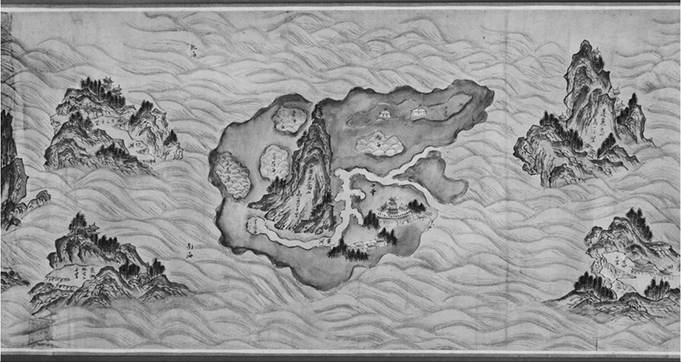
Figure 14.1. This eighteenth-century seascape with islands depicts the Daoist mountains and isles, an idealized vision of the abode of the immortals. Karen Thornber explores the tension between environmentally sensitive doctrines such as Daoism and environmental reality.
Reproduced with permission from Canterbury Museum.
inland limits set the frontier, until modern times. Contrary to a common misconception, Central Asian empires did not expand and invade when stressed by drought. Drought and cold ruined them, destroying troops and horses. More usually, expansion occurred during warm, wet periods that allowed humans, horses, and livestock to reproduce and flourish in the otherwise cold and dry lands. This was true of the Xiongnu and later of the Liao, Jin, and Mongol dynasties. Thus, the interplay of monsoon cycles affected Chinese history, though only as one of a huge number of variables.