New Imperialism, 600-1450 ce
After 200 ce, empires decayed, in part because of a cooler, drier climate. The Han dynasty fell. Steppe empires shrank back to oases and better-watered grasslands. The Roman Empire declined and the western portion fell in the fifth century.
Imperial decline allowed some ecological recovery, though not as much as once thought, since it appears that Europe and China did not collapse ecologically—their economies, polities, and trade shrank, but their agriculture continued.After 600, a new cycle of empire began. In the west, Islam rose, and following it, the Arab, later Arab-Persian, Empire. In the east, the Sui (581-618) and Tang (620-907) dynasties reunited China, paradoxically during a cold, dry period. As climate improved, Tang, like Han, conquered far into Central Asia. Canals expanded greatly; the innovative Grand Canal brought grain from the fertile south to the drought-prone capital in the west. Climate and ecology could facilitate imperial plans, but were not determinative, providing challenges that could be met in various ways.
Before and during this period, West Asian plants, medicines, food-ways, fabrics, and religions reached China, and a rather more limited set of Chinese contributions spread west, resulting in a slow closure of the gap between empires. Finally, China and the expanding Arab realm clashed at the Talas River—almost in the exact center of Asia—in 751 ce. The Arabs won. Chinese power slowly faded in Central Asia as Islam rapidly spread. One result was that western agriculture, technology, medicine, foods, and environmental management dominated Central Asia for centuries, while Chinese agroecology shrank back to China's frontiers.[1165]
From 600 to 1368, Central Asia often drove the dynamic of empire in East Asia. There vast, but thinly populated and often short-lived empires arose, either conquering China or affecting China's dynasties.
The relative power of the Central Asian Turks and Mongols had ecological roots: they could raise good horses, which is hard to do in the Chinese core area, as it is short of good forage with mineral nutrients. Thus, the Turks and Mongols could both maintain better cavalry and make China dependent on them via the horse trade (Figure 14.2). Trade along the “Silk Road”—the Central Asian caravan routes—was also critically important during this period, not least as a source of new ideas and technology. The nomads developed a strategy of learning military techniques at one end of the Silk Road and applying them—as a new and unpleasant surprise—at the other. This is how gunpowder reached the West, along with only somewhat less strategically useful foods and medicines. The Mongols, for instance, brought high-quality Near Eastern wound-treatment methods to China.[1166]Less pleasant were the effects of repeated conquest on northern China. Gardenmaking contributed to the Song's breakup. Emperor Huizong (1082-1135, r. 1101 — 1125) ambitiously developed a park (Genyue) designed to bring Heaven's favor upon himself and his empire. A specially created “Flower and Rock Network” mobilized China's vast labor and transportation networks, overseeing a massive redistribution of flora, fauna, and rocks from south to north, and its tribute empires. Huizong's enterprise demonstrates the importance of cultural and religious ideas in promoting imperial ecological transformation. It also shows the ecological power, and limitations, of a pre-modern empire. This gargantuan project drained Song finances, diverted its people from more pressing tasks, and ultimately diminished an already weakening dynasty.[1167] From Genyue's collapse onward, wars engulfed China, propelling the non-Han conquest dynasties of Liao and Jin, and Mongol
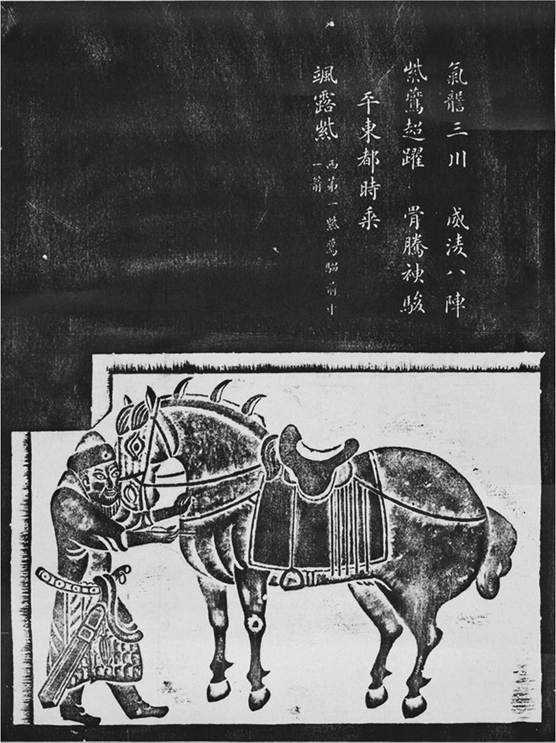
Figure 14.2. This rubbing, from Tang Emperor Taizong's tomb, portrays Taizong's own steed, which he rode while pacifying the eastern capital of Luoyang.
Horses revolutionized warfare and enabled steppelanders to conquer Chinese territory. Reproduced with permission from Canterbury Museum.Yuan dynasties farther and farther south.[1168] Population and infrastructure took decades to recover.
The dynasty-changing Chinese uprising of 1368 forced the Mongols back to the steppes, where they confronted the Little Ice Age (ca. 1300s-1800s). Extreme cold and dry conditions ended all possibility of further Central Asian conquests. Not only could the Mongols never build up great herds again; the Chinese, and elsewhere in Eurasia the Near Easterners, Europeans, and Indians, began a sustained demographic increase that tipped the balance of power in their favor.
New World Empires
Meanwhile, a wholly different set of empires was arising in a world unimaginable to the Arabs and Chinese. Agriculture in the Americas was almost as ancient as it was in the Old World. Maize became extremely productive, yielding enough food per acre to support imperial ambitions. Potatoes in the Andes added another productive food source. Yet empires started late. The realms controlled by the great city of Teotihuacan in Mexico and the smaller but important one of Tiwanaku in Bolivia seem to have deserved the title, though tiny in comparison to their Chinese and Persian cousins. The usual effects on trade, distribution of crops, and spread of new crops and ideas throughout imperial regions took place. Empires in South America spread technologies like terracing, canal irrigation, and raised potato beds. Extremely intensive and massive environmental modification, landesque capital, resulted, but was generally locally managed.
The Inca Empire, arising around 1400 ce, did more, not only creating vast road networks and canals, but also developing a socialist economy based heavily on assembling, storing, and distributing grain.[1169] Huge grain-storage depots, with vast bins, still exist in parts of the Inca lands.
The Incas distributed crops widely and had to grow them for different latitudes because their empire extended 3,200 kilometers in length and over 4,500 kilometers in height, encompassing the Andes and many adjacent coastal lands.The contemporary Aztec Empire—Mexico's first and only really large preColumbian empire—was less environmentally manipulative, but nevertheless expanded trade and distributed crops. Mexico's standard money, cacao (chocolate) seeds, were grown widely.[1170] However, the Aztec Empire soon fell to the Spanish. No other sizable New World empires developed, largely because of the strategic difficulties of expanding (given the simple technology) into tropical forests and deserts. In the pre-Iberian New World, ecology worked against imperialism. An enormous range of plants was domesticated, but no animals were, other than the llama/alpaca, Muscovy duck, and turkey (the dog entered the New World with the first humans).
In contrast, in Europe and the Near East, the Islamic Empire soon fragmented into local states, some of which constituted small empires but of little ecological impact. The Turks changed this as, conquering outward from Central Asia, they brought at first savage warfare, then peace and stability under the Seljuk and Ottoman dynasties in the west and the Moghuls in India. Dispersal of goods eventually included new crops, introduced by Spanish and Portuguese from the New World; the Ottomans picked up these so quickly that Americans still call Mexico's domesticated bird a “turkey.” Europeans likewise long called maize “Turkish corn,” because of its origins in European agriculture via the Turks. With peace and new crops, the Middle East flourished as never before.[1171]
This empire-building resulted in a world that in 1400 had huge empires in the Middle East and China; smaller states in the west; and small but growing empires in the New World. All relied on grain agriculture, with a range of other crops, including the critically important legumes for supplying protein to the poor, and equally important vegetables and spices to provide mineral and vitamin nutrients.
All depended on exchange to some extent, but using traditional means of transportation (only shipping could carry large amounts of grain). This meant that every empire was a highly diverse system, characterized by many local ecosystems, each with their own crop complexes, environmental problems, and environmental solutions, ranging from vast irrigation works to massive terracing to extensive forestation. Every empire could draw on ecological diversity. As Horden and Purcell point out, for the Mediterranean world, exploiting different ecological niches and developing locally tailored systems enabled them spread risk and served as insurance.[1172] This is a general point; South China similarly balanced North China, Indonesian islands had different strategies, and the Inca in Peru quite consciously developed local ecologies to balance out resources.A final note is that disease spread with empire as surely as crop varieties and animal species. Many Old World diseases came from livestock: smallpox, probably from cattle (cowpox); influenza, from swine and ducks (especially in South China where they are raised together); and others. Malaria developed in humans in Africa from strains already established in primates, but empires spread it throughout the tropics. Cities and trade routes became focal points of disease spread, where epidemics such as plague could flourish and intensify, often causing vast loss of life. The more complex and intensive the human interaction with the environment, the more diseases could spread to humans.