7 ROME’S GREEK EMPIRE 27 BCE–337 CE
Peace had been imposed on the entire Greek-speaking world by force of arms. Others before Augustus had tried, but the peace had never lasted. This time it did. Indeed, throughout the greater part of that world, it would last for a good two hundred years.
The period is still summed up, even today, by the Latin phrases pax romana (Roman peace) or pax Augusta. Greeks had never experienced anything like it.With peace went a political stability that was also without parallel in earlier Greek history. This was the underlying reality behind the stories of the lurid lives, sordid deaths, and intrigues of the first dynasty of emperors to succeed Augustus in Rome. These and many other such stories first went into public circulation towards the end of the first century CE and have lost nothing of their power to horrify or titillate ever since. Tiberius died a paranoid recluse in his seventies in 37 CE after instituting a reign of terror among the highest levels of the Roman elite; his successor, Caligula, probably did not, in reality, appoint his horse as consul but would still be murdered by his own guards in broad daylight in the centre of Rome. And the infamous Nero, the last in line, we will meet again.
But it has been argued that for most of the empire’s subjects, during those two hundred years, the personality and private vices of the reigning emperor made little difference to their lives. The system of government laid down by Augustus during his forty-year reign would prove both stable and durable.1 And although the right of a particular emperor to rule would frequently be contested in times to come, for as long as the empire lasted no one would ever challenge the imperial system itself—an extraordinary contrast to the constant political experimentation and turmoil of the old Greek city-states.
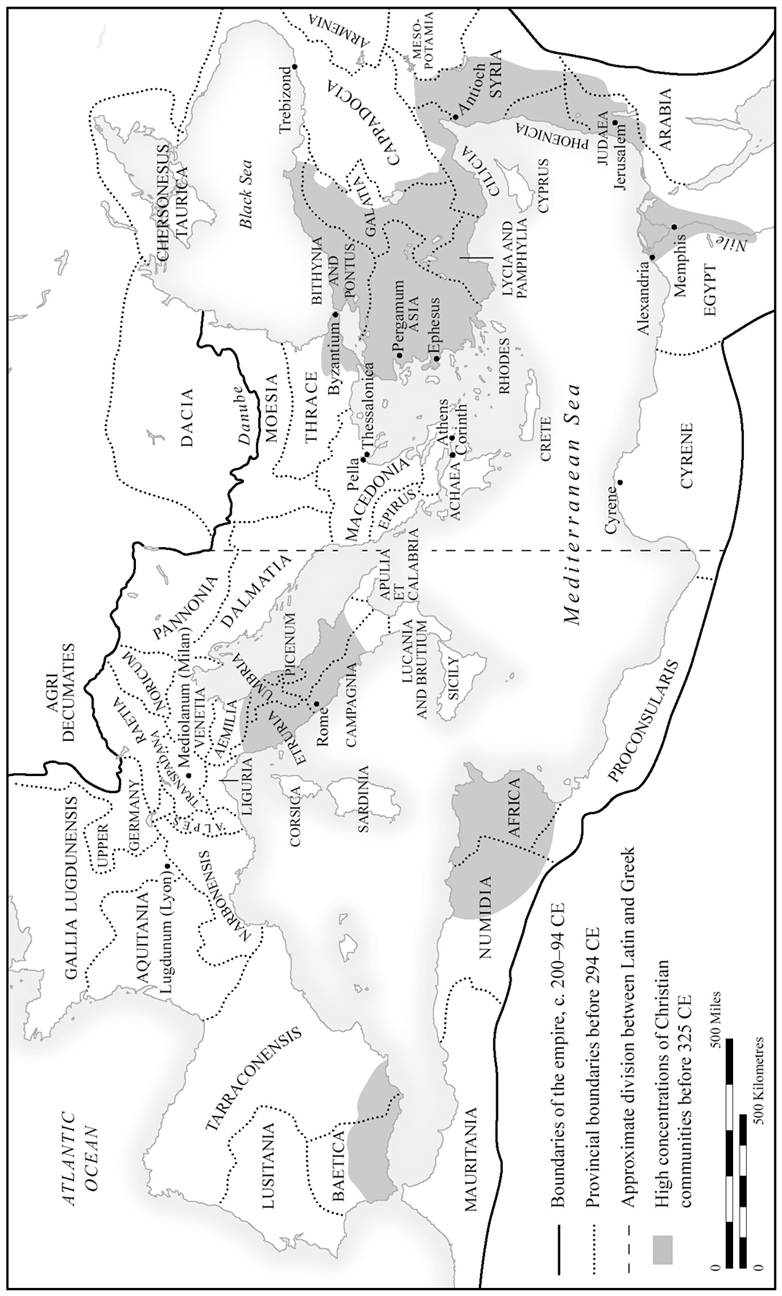
7.
The Roman Empire in the late third century CE
By the time Augustus died in 14 CE, the Roman Empire stretched from the Atlantic coasts of Portugal, Spain, and France in the west to the Euphrates in the east and Aswan in southern Egypt. It included all the islands in the Mediterranean and nearly all the coastline of what Romans were already calling mare nostrum (our sea). Around the eastern fringes of this empire, some smaller kingdoms that had broken away from the Seleucids maintained a notional independence for a little longer. Within a few decades they, too, would be fully absorbed. The Roman Empire would reach its largest extent a hundred years after the time of Augustus, in the reigns of the emperors Trajan and Hadrian. All the lands between the Euphrates and the Mediterranean, where the process of ‘becoming Greek’ had been going on ever since the time of Alexander, would once again be brought together into a single political entity.2
Everywhere, the language of imperial administration and in the highest courts of law was Latin. But throughout the eastern provinces, Greek had either been spoken as a first language for centuries or had long ago been adopted as the normal written medium for business, education, and local administration. Roman officials, no doubt for pragmatic reasons, accepted the situation as they found it. There was never any kind of formal recognition that the eastern half of the empire actually functioned in a different language from the official one. But much of the later history of Europe would be founded on an informal division that seems to have become tacitly accepted during or shortly after the time of Augustus—between a Latin-speaking west and a Greek-speaking east.
Nobody ever thought to draw this linguistic division on a map. Allowing for a few exceptional enclaves on either side, it follows a straight line drawn from north to south through the strait that separates the toe of Italy from the island of Corfu.
In modern terms, Austria (up to the Danube frontier), Croatia, and parts of the western Balkans belonged to the Latin side, as did the North African coast from Tunisia westwards. To the east of that line, and south of the River Danube, the everyday form of Greek known as Koine continued to be the common language of speech and of most written records below the highest levels of the imperial administration.3This line of division marks a subtle but important change to the shape of the Greek-speaking world. Long-established Greek settlements in Sicily, southern Italy, southern France, and the Mediterranean coast of Spain were assimilated. Romans still used the geographical term Magna Graecia (Great Greece) to describe the southern half of their own landmass, Italy. But they did so in Latin. Some memories of the language, customs, and the earlier history of these former Greek settlements would persist until at least the end of the second century CE, possibly for even longer. But despite these occasional survivals, effectively, ‘Great Greece’ had been absorbed into the Latin-dominated west by the time of Augustus. The dispersed Greek-speaking world of ‘ants or frogs around a pond’ had become consolidated, in a way never seen before, upon the islands and continental hinterlands of the eastern Mediterranean.4
Throughout the Greek east, the largest cities prospered and became even larger. The paved streets, long colonnades, elaborate fountains and bathhouses (relying on water brought by Roman engineering) of Gerasa (Jerash) and Gadara (Um Qais) in Jordan or Ephesus and Aphrodisias in Turkey can still be seen and admired by visitors today. Farther west, Crete, now the capital of a province that extended to include Cyrenaica in North Africa, prospered under a central administration as it had never done since Minoan times. On the Greek mainland, Corinth had been reestablished as a Roman colonia for settlers from Italy, after lying desolate for a century.
The revived city was flourishing. So was Nicopolis (‘Victory City’ in Greek). This was originally another colonial project, built on the orders of Augustus on the coast of Epiros, close to today’s town of Preveza, to commemorate his victory over Antony and Cleopatra in the sea battle of Actium not far offshore. But by the second century CE, the distinction between Roman ‘colonies’ and Greek cities established earlier had been all but forgotten. The process of assimilation, that in Sicily and southern Italy had seen Greek replaced by Latin, here worked in the opposite direction. The descendants of Italian settlers in the east now spoke and wrote in Greek.5Roman rule lay lightly on these cities. The empire had been built on the formidable power of armies controlled from the centre. But in peacetime it was maintained by the absolute minimum of bureaucracy possible. Very much as the Persians had used to do, and as Alexander had done in the wake of his conquests, the Romans relied on the elites of the cities and regions they had conquered to do the business of ruling for them. The wealthier citizens of a traditional Greek polis could be relied on for their loyalty because Roman rule protected their interests and guaranteed their status within their communities. Increasingly, as time went on, more and more members of these elites would be rewarded with the gift of Roman citizenship. With it came privileges and rights not granted to the majority of the empire’s subjects.6
Under these arrangements, many of the trappings of Greek civic governance continued long into the period of Roman rule. Larger cities still minted their own coins, even if currency values and the alloys used were standardised across the empire. Local officials could still be elected. City councils still operated and took decisions at the level of the municipality, even if the criterion for office was now wealth. Wealthy citizens vied with one another more than ever for the honour of hosting (and paying for) grandiose public works, festivals, and games.
Their reward would be the privilege of seeing their likeness publicly displayed in a statue of stone or bronze. Ever afterwards, passers-by would be able to read inscribed upon the base on which the statue stood an account of how generous the donor had been. Increasingly, wealth was becoming concentrated in fewer and fewer hands. All these trends can be traced back to the period of the Macedonian conquests—that is to say, to the very beginning of the age of ‘becoming Greek’. Under Rome, they only intensified. On these grounds, it has been argued, we can rightfully speak of a ‘long Hellenistic age’ that began with the campaigns of Alexander in the east and lasted well into the second century CE.7Greek speakers had probably never at any time in their previous history been so numerous, so prosperous, or lived such comfortable lives as they did now. And throughout the eastern empire they continued to do what they had always done best, which was to talk and write in their own language. Writers in every genre that had so far been devised put pen to papyrus. They also invented new ones: biography, the novel, satirical sketches. Philosophy continued to flourish, particularly in Athens and Alexandria. Historians still did their best to understand and interpret the past—particularly, and with an evident nostalgia, the achievements of Alexander the Great. The writers of this period have never won the level of admiration that they themselves heaped upon their long-dead predecessors of the classical period. But far more of what they wrote has survived. Much of what we know about earlier centuries has come to us filtered through the perceptions of Greeks who lived and wrote under the rule of Rome.
In other branches of knowledge, writers in Greek during the same two centuries have been credited with achieving the ‘culmination of ancient science’. Ptolemy of Alexandria, during the first half of the second century CE, studied the movements of the stars and planets.
His treatise on astronomy, written in about 150 and known by the name of its translation into Arabic, Almagest, would represent the furthest extent of human knowledge on the subject until the discoveries of Copernicus in the early fifteenth century. A generation after Ptolemy, Galen of Pergamum was a practising surgeon and anatomist. His surviving medical writings fill twenty-one substantial volumes in the standard modern edition, much the largest output of any ancient writer in Greek. And that is believed to be only about a third of all that he wrote. Volume, of course, is not everything, in either literature or science. But Galen’s understanding of the anatomical structure of humans and animals and his experimental method would set the benchmark for medical knowledge until modern times.8All these were the dividends of peace. But they came at a price. Greek speakers no longer held their destinies in their own hands, except at the most local level of city government. Plutarch, writing towards the end of the first century CE, put into words what many must have thought. Advising a young man who was thinking of running for office in his city, Plutarch warned him that he would face responsibilities once borne by the great Pericles. But you should never forget, either, he goes on, that ‘you who rule are also ruled over by others; you rule in a city subjected to [Roman] proconsuls, the functionaries of the emperor.’ You must not take your authority too seriously, ‘since you can see the calcei above your head’. (Calceus is the Latin word for ‘shoe’, the foreign word tactfully injected to suggest something more like the hobnailed boot of the Roman soldier.) Better, for that reason, says Plutarch, to behave like an actor and keep within the limits of your allotted role. In the present ‘weakened condition of Greek affairs’, the advice continues:
the best course for those who think wisely is to enjoy a life of peace and harmony, since fortune has left to them no prize worth striving for. For what authority do you have… or what power, when a minor edict from a proconsul can dissolve it at a stroke or hand it over to someone else? Even if it should last, what is the point of it?9
The answer that Plutarch and dozens of others like him gave, spread over thousands of pages written during the first centuries of the Roman Empire, was an oblique one. More often than not, they would avoid even mentioning the existence of the political system under which they all lived, still less the compromises that living in it required. Plutarch, in all that he wrote, under his Greek name as a citizen of Chaeronea in Boeotia and latterly as a priest of Apollo at Delphi, chose never to mention that at some point in his life he had acquired another public identity, as the Roman citizen Lucius Mestrius Plutarchus.10 Plutarch was proud enough of that second identity to see it inscribed on the base of a statue of the emperor Hadrian erected at Delphi. But it had no place in his work as a Greek writer. To have alluded to it would have been a lapse of taste, or what today we might term a ‘category error’.
A far more congenial topic was the glory days of the past. Within a couple of generations of the death of Augustus, all over the Greek-speaking east a network of private educators had established a curriculum that inculcated a knowledge of ancient Greek history and culture. For this informal, unofficial system to flourish as it did, there must have been demand for what it offered. At the highest level, students learned to write elaborate speeches in the manner of Isocrates and Demosthenes, who had lived in the heyday of Athenian democracy. Those who graduated as professional speech makers went on to tour the provinces and even gave command performances in Rome itself. They became known as ‘sophists’, after the itinerant philosophers who had made a name for themselves in the fifth century BCE. But these new sophists were celebrated, not for their ideas but for their words. The days when an Alcibiades or a Demosthenes would address the Athenian Assembly and the lives of thousands would depend on whether the motion was carried or not were long gone, and everybody knew it. This was speech making as an art form, even a medium of entertainment.
It was not enough for the members of this new educated elite to write about a better past. They even made a virtue of trying to imitate the very language and style of their great predecessors. This meant turning back the clock on the many changes that had been quietly happening in everyday speech since the conquering Macedonians had adopted a form of the Athenian dialect as their own official language. ‘Common Greek’, or Koine, had evolved a good deal in the four centuries that had gone by since then. But sophists vied with one another to re-create the dialect of Athens, known as Attic, as it had been in the time of the orators they most revered. The craze lasted for a full two hundred years, from the middle of the first century CE to about 250. Around that time, the descriptive label, the ‘Second Sophistic’, began to appear and the name has stuck ever since.11
Fascination with the Greek culture, history, and language of times long gone reached right to the very top of the Roman Empire. Augustus, even before he became emperor, had paid homage to the tomb of Alexander in Alexandria, as his adoptive father, Julius Caesar, had done before him. The victories that had brought supreme power to Augustus had all been won in the Greek east. During his reign as emperor, he went on to take a personal interest not so much in the Greek-speaking regions of his empire as in the historical heartland of what Romans began to term ‘true’ Greece (Graecia vera). Augustus lavished expensive buildings on Athens, Sparta, and other cities of the Greek mainland, as well as on his own huge new settlement of Nicopolis. It may have suited Roman policymakers to promote past Greek achievements as a way of defusing any sense of resentment on the part of their Greek-speaking subjects. It could even be that the obsession with past glories that marks the Greek writers and orators of the Second Sophistic was something subtly—or not so subtly—foisted upon them by their rulers. Whatever the case, both sides seem to have gone along with it. Signs of open discontent are remarkably few.12
Politically speaking, neither ‘true Greece’ nor the wider Greek-speaking empire was of any strategic importance to the emperors, except on those occasions when they waged war on the eastern frontiers. Greece itself, in the form of the provinces of Achaea, Epiros, and Macedonia, had no military significance. No legions were stationed there. But after Augustus, Nero in the first century and Hadrian in the second were particularly fascinated. Both emperors made tours of the east and drew extravagantly on the imperial treasury to grace selected Greek cities with new buildings and public spaces. The cities in their turn were extravagantly grateful.
Nero is mostly remembered today as the psychopath who supposedly ‘fiddled while Rome burned’. But even after his memory had been well and truly damned everywhere else, he still had his admirers in the Greek-speaking east. Nero it was who made the first attempt to cut a canal through the Isthmus of Corinth, a project not completed until 1893. And in a fit of generosity, after having been allowed to win contests in all the great ‘panhellenic’ games, which had to be specially rescheduled to fit in with his visit, Nero granted exemption from all taxes to the entire province of Achaea. ‘Other princes have liberated cities,’ he declared in a speech at the Isthmus of Corinth on 28 November 67 CE, but ‘Nero alone has freed a province’. One enthusiastic beneficiary, echoing a refrain that had long ago become meaningless, went so far as to thank the emperor for restoring ‘the freedom of the Greeks, which from the beginning of time has been indigenous and autochthonous, but had been taken away’.13 Even the very limited ‘freedom’ that Nero had granted, from liability to pay taxes, would soon be taken away again by another emperor, and this time for good.
No Roman emperor took a greater interest in what he called ‘Greece’ than Hadrian, who spent an entire winter in Athens on no fewer than three occasions during a reign that lasted from 117 to 138 CE. His particular fondness for the city would result in a building programme that seems to have been intended to rival those of Pericles and Lycurgus before him. The results can still be admired today. Among them was the Odeon of Herodes Atticus, since the mid-twentieth century a prestige venue for open-air concerts and theatrical performances. Hadrian’s Library was designed to rival the more famous Library of Alexandria, founded by the Ptolemies. The Arch of Hadrian and the surviving Corinthian columns of the Temple of Olympian Zeus, completed on Hadrian’s orders on the banks of the Ilissos River, still stand in the centre of Athens, serenely rising above the traffic-filled urban highway that replaced the riverbed in the last century.
Under Hadrian, Athens was declared the capital city of a new organisation called the Panhellenion. Vaguely modelled on the leagues or temporary alliances of classical times, the Panhellenion was meaningless politically. It was mostly about appearances. But it did set the seal of imperial approval on the supreme cultural position of Athens in the Greek and indeed the Roman world. In other ways, Hadrian’s innovation was an anachronism. Membership of the Panhellenion depended on candidate cities providing proof that their founding fathers had had Greek ancestry.14 Cities that stood to gain from the emperor’s largesse made ingenious efforts to qualify. But further afield, the majority of Greek speakers, and certainly the erudite speech makers whose words we read today, seem to have taken little notice of Hadrian’s initiative. It is easy to see why. A world in which so many people of different backgrounds and languages had been ‘becoming Greek’ for the best part of five hundred years could no longer be meaningfully defined in terms of imagined family trees.
By this time, instead, the view of Isocrates had long ago prevailed in the Greek world: it was not birth that made a man a Hellene but his participation in a type of education that had begun in Athens in the fifth century BCE and that was now enjoying such a vigorous revival. Among the most admired Greek writers of the age were the satirist Lucian, from Samosata on the Euphrates (now Samsat in southern Turkey, close to the Syrian border), and the novelist Heliodorus of Emesa (today’s Homs in Syria). The first described himself (in elegant Greek) as Syrian by birth, the second as Phoenician. Even Plutarch, born and bred in Boeotia, in the old Greek heartland, thought that being Greek was less a matter of race or birth than of moral qualities that could be learned from reading the best ancient authors.15
Beyond the cosmetic and short-lived Panhellenion confected by Hadrian, the larger Greek world of the eastern empire enjoyed a kind of unity that would never have been possible while the Greeks still possessed their political ‘liberty’. Isocrates had urged his contemporaries to raise their sights above the level of the city-state and learn to think of the whole of Hellas, instead, as their polis. In the scattered, embattled world of the fourth century BCE, that could never have been more than a dream. But now, in 155 CE, seventeen years after the death of Hadrian, a sophist from Anatolia by the name of Aelius Aristeides went further in a show speech he delivered in Rome itself.
The whole Roman Empire, Aristeides informed his listeners, was now one single polis. The thousands of cities scattered across its length and breadth were the equivalent of suburbs to imperial Rome.16 In other words, the highest praise that a devoted disciple of Isocrates could think of, for a world empire founded on military might, was to make out that it was really just an inflated version of a Greek polis. It is not recorded what Aristeides’s Roman audience made of this. Romans had been accustomed, for centuries, to think of their res publica, as they still called their state, as a proud and unique creation of their own. No matter, Aristeides was speaking in Greek, and a very erudite sort of Greek at that. For those who wished to hear, in Rome in the middle of the second century, the process of ‘becoming Greek’ had expanded to encompass the whole of Rome’s vast empire.
Six years after that speech was delivered, the emperor Marcus Aurelius came to the throne. He was a Roman, like all the emperors before him, and had been brought up in the capital. But, again like many of his predecessors, he had benefited from a Greek education. For once, when an emperor took an interest in the Greek world, Marcus’s motive was neither political nor antiquarian. He had very little opportunity, in the course of a reign that would last until 180 CE, to spend time in the Greek-speaking east. Much of his energy had to be devoted to waging the first of Rome’s defensive wars, fought against Germanic tribes along the Danube frontier. What attracted Marcus was Greek philosophy. In particular, he was drawn to the ideas of the Stoics that went back to Zeno of Citium, who had taught in Athens in the early third century BCE. Stoic ideas had been widely disseminated and adopted by the Roman elite well before this time. So there was no reason why Marcus could not have expressed his own philosophical thoughts and kept his private diary in his own language. But instead he chose to do so in Greek.
Why he did and whether his Meditations, as they have come to be known, were really intended for himself alone has been debated by scholars. Whatever the truth, Marcus’s introspective candour shows an insight into the mind of an emperor such as is rare, if not unique, in world history. ‘Do not expect Plato’s ideal commonwealth’, he warns himself at one point.17 What more touching recognition could there be of the limits to imperial power? He is emperor, after all. And here, perhaps, lies the key to Marcus’s choice of language. In Latin and in public, Marcus Aurelius Antoninus Augustus was the supreme commander of armies, ruler of the known world, god incarnate, recipient of public prayers and sacrifices in temples everywhere from Hadrian’s Wall in Britain to the Euphrates in today’s Iraq. But in private and in Greek, the same man faced his own self as a unique, fallible human being, humble in the face of nature and of a divine power in which he was not sure he believed, while he struggled to put into words the consciousness of his own individual humanity.
The questions that exercised Marcus Aurelius towards the end of the second century CE were by no means confined to his own exalted circles. Indeed, the philosopher-emperor was giving voice to anxieties and to a type of introspection that were also very much products of the age. The roots of these can be traced quite far back into the Hellenistic period.18 But it was under the Roman Empire that they reached their fullest expression. Part of what was new can be summed up as the discovery of the human individual. Another, closely related, was the yearning of each individual, whether great or humble, to be in some sense ‘saved’. The world of the traditional Greek polis had been intensely corporate. The highest good had been the survival and prosperity of the citizen body. This was what public rituals and worship of the traditional gods had been designed to secure—and always for the whole community.
Since then, the newer philosophies of the Stoics and Epicureans, among others, had encouraged their adherents to think about the meaning and purpose of their own individual lives. But philosophy, for the great majority of the population, would take you only so far. Minimising pain and making the most of pleasure were all very well in principle, but thinking about it wouldn’t make you better if you were ill or save your life when you were in danger. Worst of all was what happened to you when you died. Lucretius, the Roman follower of Epicurus back in the first century BCE, had said it didn’t matter because you wouldn’t be there to worry about it.19 But what if you still worried in the meantime? This is where a new element, one that had no real equivalent in the vocabulary of formal Greek or Roman religion, appears in the thoughts and words of those who wrote in Greek, namely faith. Faith means something more than sharing stories and participating in rituals that express the hopes and fears of a whole community. Faith is personal. Faith means not only that you believe but also that you place all your trust in a divine force that can do something for you, personally. Already, by the time of Augustus and for several centuries thereafter, people were looking for a power beyond themselves that they could trust in this way.
Alongside official religion and public ceremonies, individuals had begun entrusting their welfare to new deities and the cults devoted to them. The bull god Serapis and the goddess Isis had become the objects of empire-wide cults that had originated in Egypt under the Ptolemies. In these cults, elements of older Greek and Egyptian beliefs and ritual practices seem to have been deliberately fused together to serve the new needs of the age. During the second century CE, in the same way, the cult of the Persian sun god Mithras spread through the ranks of the Roman legions to reach into every corner of the empire. Asclepius, originally a minor Greek deity associated with healing, came to be worshipped at sanctuaries which by the Roman period had become more like nineteenth-century sanatoria or the health spas of today. Patients went through elaborate rituals and slept in the sanctuary. If they were lucky, the god would visit them in a dream and they would wake up cured of their ailment. Thousands of inscriptions survive from all over the Greek-speaking world apparently testifying to the success of such cures.20
But not even Asclepius could save you when you died. For this need, too, ritual and some form of religious faith had to be invoked. Initiation by secret rituals into cults that were called ‘mysteries’ was nothing new. The most famous of these, the Eleusinian Mysteries, held at Eleusis outside Athens, had for centuries been a prestigious rite of passage from adolescence to manhood, not just for Athenians but for Greeks from elsewhere too. Now, mystery cults were proliferating. It became a matter of personal choice whether or not to become an initiate, and if so, into which cult. The secrets of these rituals in the ancient world were remarkably well kept. But a good indication of what was expected of them comes from the mid-second century CE, when a would-be initiate into the ‘mysteries’ of the goddess Isis was told to prepare for ‘a kind of voluntary death and salvation through divine grace’.21
Among the Greek-speaking elite of the eastern empire, an attempt was made to address this need in a secular way. This is how the literary genre that we know today as the novel came to be born in the form of the ‘ancient Greek novel’, or ‘romance’, which flourished between about 50 CE and (probably) the early third century. In these stories, boy and girl meet by chance, fall in love, are separated, and then endure extreme ordeals in the most exotic places, before they can be reunited and married, to live happily ever after. Hero and heroine both face the threat of death. Each is willing to die for the sake of love. In set-piece episodes that lend themselves to the kind of melodrama characteristic of later horror movies, each appears to be violently killed, only to be ‘resurrected’ in an apparent miracle.
The most elaborate and technically experimental of these novels is known as the Aethiopica, or An Ethiopian Story. Its author was Heliodorus of Emesa, the self-confessed outsider to the Greek-speaking world who was also a master of elegant Greek prose. Heliodorus in his fiction frequently plays with a numinous sense of a ‘divine providence’ that ultimately oversees the happy outcome of the hero’s and heroine’s trials. But the salvation found in the fulfilment of heterosexual love—itself an innovation in Greek literature, which had largely preferred homosexuality up to this time—is purely secular. Through this and other stories, the human self discovers a purpose for its existence and ultimate salvation in the love of another in its own likeness.
At the time, and for many centuries afterwards, the exploration of the condition of the individual self and its search for salvation in the works of these early Greek novelists would remain a dead end. Too many of these fictional stories were couched in the old-fashioned language and grandiose style of the Second Sophistic, accessible only to those with an advanced education. The novel would have to wait a long time before it could come into its own, eventually to be hailed in the twentieth century, among many other things, as a ‘secular scripture’.22 But in the meantime, the road to salvation for the newly discovered individual would lie through the growth of an entirely new religion. The scriptures of this religion, too, would be written first in Greek.
Despite the fact that the near-universal system for reckoning historical dates today was first created by Christians who counted from the birth of their religion’s founder, it is now generally accepted that the birth of Jesus of Nazareth took place in or shortly before 4 BCE. That was the year when King Herod ‘the Great’, in effect a vassal of Rome, died, and the kingdom of Judaea was split four ways. Most of Jesus’s life was spent in Galilee, where the long-running process of ‘becoming Greek’ had scarcely penetrated.23 It is generally supposed that he and his disciples must have spoken Aramaic among themselves. This had been the common language of the Persian Empire before the conquests of Alexander and was still widely used by ordinary Jews. Jesus himself is said never to have written anything down. If his immediate followers did, nothing of what they wrote in their own language has ever come to light.
Jesus’s short life took him to Jerusalem, at the time the capital of the Roman province of Judaea. There, Greek ways and the Greek language had been resisted in the past. But by this time, Herod’s former capital had acquired more than a Greek veneer. Greek was widely spoken there, and written too, as we know from inscriptions found by archaeologists. It was in Jerusalem that Jesus was accused of sedition and crucified, the standard Roman punishment for slaves and criminals who did not enjoy the benefits of citizenship. It was in Jerusalem, too, during the twenty years or so after his death in about 30 CE, that his former followers began to disseminate the message he had taught. This message first makes its mark in the written record when a Jewish preacher embarked on a mission to spread the new beliefs beyond the geographical heartland of the Jewish people and to make converts among the gentiles. To reach this new audience, the message had to be delivered in a language that everybody could understand. The obvious choice was Greek. And so Jesus’s message was first, rather modestly, announced to the wider world as the ‘Good News’, or ‘Gospel’: Euaggelion, from which come our words ‘evangelist’ and ‘evangelical’.24
The preacher’s name was Paul. No one could have been more different than Paul from the writers of the Second Sophistic, who were beginning to set the literary agenda for the eastern empire during his lifetime. His origins were humble. Originally called Saul, or Shaul, he was born in the city of Tarsus in the province of Cilicia (today part of southern Turkey) and brought up there as a Jew; his parents may have been freed slaves. Later Paul went on to spend time in Jerusalem, where he probably arrived not long after the crucifixion of Jesus. It was there that he met the surviving disciples and learnt firsthand about Jesus’s life and teaching. All this would have taken place in Aramaic. But along the way, Paul had learnt to read and write in Greek, probably in his home city as a young man. This must have brought him into some degree of contact with older Greek texts and the ideas expressed in them. But that was all. The Greek language, for him and for all the earliest Christian writers whose work we possess, was a means to an end. Paul’s Greek is the Greek of every day. He used it to write letters, the most direct means to present information or ideas in permanent form. Communication by letter was part of the daily life of the Greek-speaking eastern empire by this time—not a literary genre at all. This was the form that the great majority of the earliest Christian writings would take.25
Paul’s letters are the oldest Christian texts that we possess. They are addressed to the embryo Christian communities around the eastern Mediterranean that he helped to establish. What he writes in them is extraordinary by comparison with anything that had ever been written in Greek before. From the earliest of them, written within a few years either side of 50 CE, we learn that the writer, who introduces himself by name, is ‘an apostle (not of men, neither by man, but by Jesus Christ, and God the Father, who raised him from the dead)’. ‘Apostle’ is the English form of the Greek word apostolos, which means ‘missionary’. Jesus had died, the self-declared apostle reminds his readers, ‘for our sins, that he might deliver us from this present evil world’. Here was the promise of salvation indeed. The way to reach it lay through the cultivation of virtues that must have seemed at the very least strange to most Greek speakers of the time, quite possibly incomprehensible: ‘love, joy, peace, longsuffering, gentleness, goodness, faith, meekness, temperance’. ‘Thou shalt love thy neighbour as thyself’, declares Paul in one of his most frequently quoted sentences.26
Paul’s letters have almost nothing to say about Jesus as a historical figure, about his life, or about the content of his teaching. The stories that we know from the four Gospels must have been in circulation in some form during Paul’s lifetime, but the Gospels as we know them had yet to be written. For Paul, what matters most about Jesus is that he is ‘the Christ’ (Christos). This was originally not a name in Greek but a title. It translates the Hebrew ‘Messiah’, meaning ‘the anointed one’, and refers to the coronation rituals of the ancient kings of Israel. As with so much in the New Testament, if the language is Greek, the concepts conveyed in it belong to a different tradition entirely, that of the ancient Jews.
What defines the Christ for Paul is the fact that he ‘died for our sins… was buried, and… rose again the third day’. Christ’s resurrection, the way Paul tells it, signals a victory over death itself. ‘O death, where is thy sting? O grave, where is thy victory?’ he writes in one of his most famous passages. It is also, for Paul, a guarantee of what would later be termed the ‘Second Coming’.27 The first generation of Christians actually believed that Jesus would come again during their lifetime. When that happened, the world would end in a fiery conflagration, and God would sit in judgement on the living and the dead.
By the year 64 CE, the ‘good news’ had spread as far as the empire’s capital, Rome itself. We know that there was already a Christian community there, because Paul had addressed its members in a letter written a few years earlier and, according to one early account, went on to preach in the city for two years.28 In July of that year, fire broke out in Rome. It raged for nine days. The entire centre of the city was burned down. To the city’s Jewish population who had been exposed to Christian teaching, as well as to the smaller community of committed Christians, it must have seemed as though the prophecies of the Second Coming were being fulfilled. Although the connection is made by none of the ancient sources, it may have been this that inspired the emperor Nero to lay the blame for the catastrophe on the still obscure Christian sect. The historian Tacitus, writing about fifty years later, reports:
The confessed members of the sect were arrested; next, on their disclosures, vast numbers were convicted.… And derision accompanied their end: they were covered with wild beasts’ skins and torn to death by dogs; or they were fastened on crosses, and, when daylight failed were burned to serve as lamps by night.29
Tacitus surely exaggerated the numbers. But the ferocity of Nero’s scapegoating set a benchmark for cruelty that resonates through later accounts of a type of persecution that would come to be known by the term ‘martyrdom’ (from a Greek word meaning ‘bearing witness’). According to tradition, both Paul and Jesus’s former disciple Peter were executed in Rome as part of this pogrom.
By the time Tacitus came to write up these events in Latin, Christians had begun to produce their own written narratives of Jesus’s life and death. All of these, like Paul’s letters and everything else that in due course would go to make up the Christian New Testament, were written in Greek. First came the Gospel According to Mark in the early 70s CE. Matthew and Luke followed not long afterwards, probably during the 80s. These three are often grouped together and called the ‘synoptic’ Gospels because they share much material and tell broadly the same story. The Gospel According to John came later. It is usually dated to between 90 and 110. The attribution of each Gospel to an ‘evangelist’ was a later invention. By the time that any of the Gospels came to be written, it is most unlikely that any eye witnesses to the life and death of Jesus would still have been living.
Mark’s language is the simplest of the four. Luke is at home with a more ‘middlebrow’ style of Greek and shows some familiarity with the culture that went with it. John goes much further, grafting onto the story not only the divinity of Jesus as the Christ (an element which emerges only slowly in the development of early Christianity) but also the identification between Christ and the divine Logos (meaning ‘word’, ‘reason’, or ‘account’). This was a Christian extension of an idea that had been explored in a long philosophical tradition that went back via the Stoics to Plato, and ultimately to Heraclitus seven hundred years earlier.30
During the second century CE, Christianity attracted very little attention among the elites of the eastern empire. For those who noticed it at all, such as the philosopher Celsus, who in the second half of that century wrote a treatise demonstrating its ‘errors’, the crux of the matter lay in the choice between faith and reason.31 Faith-based Christianity was very much a bottom-up movement. Converts seem at first to have been drawn from the lower classes of society in cities and larger towns—though noticeably not from the lowest and probably also the largest: the ubiquitous population of slaves. There is some evidence that the new religion may have attracted more women than men. And although Paul’s view of women was no more enlightened than the traditional Greek one, the Roman Empire already granted considerably more rights to its female subjects than most Greek states had done. The early Christian church seems to have been more welcoming to them still.32
Except for a few notorious instances, Christianity during the first two and a half centuries of its existence spread largely below the radar of the Roman authorities or the civic institutions of the empire. Individual Christians could be imprisoned, tortured, and if they refused to recant, executed with the usual Roman relish for public suffering inflicted upon the outcast. This was the fate of several prominent Christian leaders and preachers during the second century. But there was still nothing like a systematic attempt to persecute the new religion, still less to stamp it out altogether. Martyrs would remain a tiny minority within a group that in most parts of the empire was itself, in modern terms, not yet statistically significant.33 Martyrdom had to be actively sought because most Roman authorities followed the practice attributed in the Gospels to Pontius Pilate, the governor of Judaea who had condemned Jesus; like Pilate, they would give the accused every opportunity to avoid the extreme penalty. In official eyes, Christianity was a mere superstitio. What its adherents believed was of no importance, so long as they gave proof of their loyalty to the state. It was political subversion that governors feared and punished, not private belief.
Later Christian tradition would give prominence to the extreme sufferings of martyrs. For centuries, the fate of these men—and, later, women too—who had been willing to face a horrific death for their faith, would be held up as the highest example of Christian virtue.34 But these stories obscure for us a reality that must have affected far more people at the time and that would play no less formative a role in the subsequent evolution of Christianity into the world religion that it has since become: right through the second century and well into the next, in the Greek-speaking east there were actually more signs of convergence than of confrontation between Christianity and the mainstream.
Christians were not the only ones to question whether the ritual killing of large numbers of animals in the open air was really the best way for humans to make their peace with a higher power. Galen, the pioneer of medicine and anatomy who had worked with Marcus Aurelius and died not long after 200 CE, was speaking for the new mentality of the age when he justified his own scientific study as
a sacred book which I compose as a true hymn to him who created us: for I believe that true piety consists not in sacrificing many hecatombs of oxen to him or burning cassia and every kind of unguent, but in discovering first myself, and then showing to the rest of mankind, his wisdom, his power and his goodness.35
At about the same time, the citizens of a minor city in southwest Anatolia called Oenoanda chose to display these lines, couched in the ancient verse form of Homer, in a prominent position on the outer wall of their city:
Self-born, untaught, motherless, unshakeable,
Giving place to no name, many-named, dwelling in fire,
Such is God: we are a portion of God, his angels.
The inscription goes on to explain that this had been the response of the god Apollo himself, given through an oracle, when questioned ‘about God’s nature’.36 Statements like these, two hundred years after the lifetime of Jesus, are not proof that Christian teaching was directly influential on the wider Greek-speaking world at this time. Rather, the new religion, and the new language of faith that had come into existence along with it, addressed concerns that were also widely shared by non-Christians.
On the other side of the divide, leading Christians were now more likely than before to have benefited from an education in Greek rhetoric and philosophy. As the second century gave way to the third, when Christian writers came to compose the letters, sermons, and treatises in which they set out their beliefs and argued over the true interpretation of the Gospels, they did so in a much more elevated language and style than would have been thinkable for Paul or the evangelists. Starting a little before 200 and continuing into the middle of the next century, first Clement and then Origen, both of Alexandria, promoted and discussed the Christian faith in a language and style that were scarcely less rarefied than those of the Second Sophistic. These Christian thinkers also brought to their task a profound knowledge of earlier Greek philosophy, and especially the ideas of Plato, which at this relatively early stage became permanently grafted onto the Christian tradition. Before the third century was well advanced, the new religion had made its accommodation with mainstream Greek education.37 The effects of this convergence would be slow to manifest. But when they did, they would transform what could be said, or imagined, in Greek ever afterwards.
According to the English historian Edward Gibbon, whose classic account was written in the 1770s and 1780s, the ‘decline and fall of the Roman empire’ began with the death of Marcus Aurelius and the accession of his son Commodus. These events took place in 180 CE. Commodus today enjoys an unexpected degree of name recognition in the English-speaking world, thanks to his portrayal in two blockbuster films, The Fall of the Roman Empire in 1964 (with Christopher Plummer playing the emperor) and Gladiator, starring Russell Crowe, in 2000. Much of what these popular portrayals say about Commodus seems to have been true, including his assassination in the amphitheatre while dressed as a gladiator.38 But on the scale of personal vices, Commodus may not have been much worse than Nero. The difference was that, after Nero committed suicide in 68 CE, the civil war that followed lasted only a year before the stable system that had been established by Augustus reasserted itself. After the death of Commodus in 192 CE, civil war and empire-wide chaos lasted, on and off, for almost a century.
During the third century, the Roman Empire underwent a series of profound shocks. The pax Romana was at an end—even though in the Greek-speaking east it would return. Emperors came and went, raised to power by the legions they commanded, and as often as not assassinated by the same soldiers a few months later. The legions, especially those stationed on the empire’s frontiers, became more important than they had ever been, as the empire found itself fighting defensive wars on all sides: on the Rhine, on the Danube, and in the Middle East.
In 224 CE, a new Persian dynasty, the Sassanids, came to power. Within a few decades they had taken over Rome’s old enemy in the east, the Parthian kingdom, and reconstituted much of the former strength of the Persian Empire that had once threatened the Greeks and then been conquered by Alexander. In 260 CE, the emperor Valerian was taken prisoner, along with much of his army, while campaigning against them. The great Hellenistic city of Antioch-on-the-Orontes, which at one time had been the chief city of the Seleucid kingdom, fell briefly into Persian hands. On the Balkan front, not long afterwards, a roving band of Goths crossed the Danube and laid siege to Thessalonica. They went on to ravage the coast of Anatolia as far south as Ephesus, where they set fire to the famous Temple of Artemis in 262. Another tribe, called Herouloi, from the area of the Crimea, sailed through the straits from the Black Sea and into the Aegean. Once there, they caused devastation in Athens and other cities of the Greek mainland and islands.
People living in places that had not seen warfare for more than two hundred years found themselves catapulted into a violent and uncertain world. To compound matters, the empire ran out of money. In order to mint sufficient coins to pay the legionaries, the amount of precious metal contained in them had been declining for years. Suddenly, the monetary system seemed on the edge of collapse. Prices of everyday commodities soared. Wealthy benefactors no longer funded new buildings or expensive games—or if they did, they could no longer afford to pay a sculptor to commemorate the fact in stone. What has been called the ‘epigraphic habit’, the gift to modern archaeologists that had flourished in the cities of the Greek east for centuries, came to an abrupt end.39
Beyond the obvious measures, such as doing what they could to defend their frontiers, different emperors turned to different, more or less extreme remedies. In 212 CE, during the early years of the third-century ‘crisis’, the emperor Caracalla took everyone by surprise when he decreed that all subjects of the empire, other than slaves, would from then on be full Roman citizens. It may have been nothing more than a short-term expedient to raise revenue—by vastly extending the tax base. Caracalla did not live long enough afterwards to explain his reasons. But the effect was permanent and would profoundly change the character of the Roman Empire. Up to this point, citizenship had been a prized privilege. According to one modern estimate, no more than a third, and perhaps as few as a fifth, of all Roman subjects had been full citizens before this. The change affected over thirty million people. It has been called ‘one of the biggest single grants of citizenship—if not the biggest—in the history of the world’.40 But Caracalla’s supposedly tax-raising stunt would have an even more far-reaching consequence. From this time on, almost everyone who spoke Greek anywhere in the world was entitled to be called a Roman citizen. The time would come when Greek speakers would no longer think of themselves as ‘Hellenes’ at all, but rather as ‘Romans’ (Romaioi in Greek)—as the great majority of them would continue to do until the nineteenth century.
As the crisis went on, other emperors tried another type of extreme remedy for their ills. This was to turn back to the corporate mindset of traditional religion. If things were going so badly for the empire, it must mean that the gods had been offended. Who could be at fault? Who could you punish, and be sure that the gods would look kindly on you as a result? So began the first systematic persecution not just of individual Christians who fell foul of the Roman authorities but of an entire religion. The first attempt, by the emperor Decius in 249, seems to have been intended not so much to create martyrs as to turn Christians back to the official forms of worship. Many times more sacrificial animals than Christians lost their lives during the two years that it lasted. But later stories made much of the horrific sufferings of those Christians who had refused to perform the prescribed sacrifices. It was an unprecedented intervention by the Roman state.
After Decius was killed in battle in 251 (the first Roman emperor ever to suffer this fate), the persecution eased. But it was back with a vengeance a few years later. The new emperor, Valerian, as he prepared to confront the Persians who had overrun the easternmost provinces, once again decreed that all citizens must make animal sacrifices to the gods. In 258, Valerian went further and ordered the execution of all Christian leaders. Once again, it was the defeat of the emperor in battle, and his subsequent death in captivity, that brought about a reprieve two years later. We only know about these events from later Christian sources, so we have no independent evidence for what may have been the emperors’ motives.41 After Decius and Valerian both met their ignominious ends, several decades would pass before another emperor was ready to repeat the experiment.
It is generally agreed that the crisis experienced throughout the Roman Empire came to an end with the series of military and economic reforms instituted by Diocletian, who ruled from 284 to 305. But, for the Christian minority, the respite would not last long. In March 303, according to Eusebius, the bishop and historian of the early church who lived through these events:
an imperial decree was published everywhere, ordering the churches to be razed to the ground and the Scriptures destroyed by fire, and giving notice that those in places of honour would lose their places, and domestic staff, if they continued to profess Christianity, would be deprived of their liberty.42
Once again, those at the receiving end had no interest in recording what might have been the reasons for these measures. And we have no other source of information. In 303, the empire was not under threat—far from it, a decisive victory over Persia had been won only five years before. And if Christians were not, this time, being offered up as scapegoats, what other purpose could there have been to the persecution? Across the empire as a whole it is likely that by the year 300 CE, Christians amounted to no more than between 7 and 10 per cent of the population on average. So they can hardly have been a threat in themselves.43
Whatever the reasons behind the measures taken, their effects would be to propel Christianity from being a fringe sect and minor social and administrative irritant to being within a very few years the biggest political issue to face the Roman state. And once that challenge had been thrown down, it was Christianity that would emerge triumphant.
Among the reforms instituted by Diocletian was the curious, and in the event short-lived, innovation of dividing imperial authority four ways. Two senior and two junior emperors ruled simultaneously, each with responsibility for a different part of the empire. The ‘tetrarchy’, as this system was called, could in hindsight be seen as the first tentative gesture towards the empire’s future division, roughly along the line of the language division between Latin and Greek. For the time being, though, it was not to last. The four-way succession to Diocletian was excessively complicated. The son of one of the previous tetrarchs, by the name of Constantine, became co-emperor in 306. Probably from the start, Constantine determined to restore one-man rule. It would take him the best part of twenty years.
Constantine was born in today’s Niš in southern Serbia. His mother, Helen, may have come from a Greek-speaking family. But his own first language was Latin. Benefiting from the usual upper-class education, Constantine would have learned to read Greek, but was apparently never very fluent in it.44 His first imperial responsibility was for the empire’s most westerly provinces. Indeed, it was at York, in England, that the troops who had been loyal to his father proclaimed him co-emperor. Despite this, it would be in the east that Constantine would leave by far the greater legacy. Exactly what role Christianity played in Constantine’s early life has been hotly disputed ever since. All we know for certain is that in 313, with the tetrarchy now reduced from four to two, Constantine and his last remaining co-emperor, Licinius, issued a joint proclamation that officially ended the persecution of Christians throughout the empire.45
In Christian circles, stories were soon circulating about a vision that Constantine had seen while he had been preparing for a campaign to eliminate one of his imperial rivals. The campaign had ended in a spectacular victory that gave Constantine control of Rome in October 312. In the fullest account of this vision, circulated by Eusebius in a biography of Constantine written shortly after his death and allegedly reported on oath:
About the time of the midday sun, when day was just turning, he said he saw with his own eyes, up in the sky and resting over the sun, a cross-shaped trophy formed from light, and a text attached to it which said, ‘By this conquer’.
The following night, so the story went on, Constantine had dreamed that ‘the Christ of God’ came to him and ordered him to fashion a military standard in the form of the Christian cross.46 So far, so traditional. Constantine had found a new divine patron. Greek and Roman history is full of such portents. Commanders of armies had set great store by them since at least the time of the Persian Wars. Still within the bounds of tradition, during the next few years, as co-emperor with responsibility for the western half of the empire, he paid appropriate respects, in return, by paying for the building and adorning of Christian churches in Rome.
What made it political was that at the same time, Licinius, now Constantine’s only remaining imperial rival, began a new persecution of Christians in the east. This meant going back on the agreement that the two men had reached and their joint proclamation. Now, one co-emperor was backing the new religion in one half of the empire, the other trying to eliminate it in the other. So the stage was set for the final struggle for supremacy between the two. Constantine defeated Licinius in September 324 in a battle fought on the Asian shore of the Bosphorus. Whether intended or not, his campaign to make himself sole emperor had turned into a war of liberation on behalf of the Christian minority. In a letter to Eusebius, written shortly after his victory over Licinius, Constantine explained it like this:
But now, with liberty restored and that dragon driven out of the public administration through the providence of the supreme God and by our service, I reckon that the divine power has been made clear to all, and that those who through fear or want of faith have fallen into sins, and have come recognize That which really Is, will come to the true and right ordering of life.47
From this point on, there could be no going back. Politically, Constantine had won his supremacy as the champion of an oppressed minority—and of the God that they worshipped. He now had no choice but to deliver. The traditional two-way transaction between gods and favoured mortals would never work again. Perhaps by this time, more than a century after Marcus Aurelius, Galen, and the Oenoanda inscription, no one really believed in it anyway. You couldn’t negotiate with the one god of the Christians. Nothing less than total obedience would do. It was the perfect religion for an autocratic political system.
The price for Constantine was to forgo the divinity that had been the traditional entitlement of Roman emperors while alive and formal deification after death. Instead, when the time came for him to die, in Nicomedia (today’s Turkish city of Izmit) in 337, shortly after celebrating the newly instituted festival of Easter, Constantine became the first Roman emperor to be ‘initiated by rebirth in the mysteries of Christ’ when he received the Christian rite of baptism. Eusebius describes the dying emperor as transfigured, as he ‘put on bright imperial clothes which shone like light, and rested on a pure white couch, being unwilling to touch a purple robe again’.48
Constantine’s personal motives and the nature, or sincerity, of his conversion have been the subject of controversy in modern times. Was he essentially a traditionalist who realised too late how radical a revolution he had started? Or was he perhaps a realist who recognised a new spirit of the age and decided to make a virtue of the inevitable? Maybe he was one of those rare, true innovators who are willing to risk the challenge of the new in the knowledge that they cannot possibly foresee where it might lead? The dedicated champion of the faith depicted by Eusebius is too one-dimensional to be credible—unless one believes, with Eusebius, that battles and military campaigns are won by faith alone. Constantine was a canny and successful ruler over a still-mighty empire, one of very few in three centuries. Devout Christian or not, he was not above putting his own son and first wife to death for reasons of cold politics. It may be that what mattered most to Constantine was to restore order to a disordered empire and that he saw in Christianity the means to do it. Whether he was right or not may still be an unanswered question almost two thousand years later.49
In any case, at the time of Constantine’s baptism and death, Christianity was not yet the official, still less the only, religion of the Roman Empire. But the adoption of the new religion by the most powerful man in the world had consequences for Christianity, too. Overnight, a bottom-up movement had become top-down. One of Constantine’s first acts after defeating Licinius and becoming sole emperor was to convene a conference of Christian bishops at Nicaea (today’s Iznik), in northwest Anatolia, to decide between the rival interpretations of the faith that were in circulation at the time. It has aptly been observed that the intention behind this and later ‘ecumenical councils’, as such meetings came to be called, was not to encourage debate but to quash dissent.50
The official definition of the Christian faith that came out of that meeting is known as the ‘Nicene Creed’. The same Greek text, translated into many different languages, is still recited by congregations in Christian churches around the world. It begins, ‘I believe…’ The Nicene Creed establishes belief as an act of public declaration. And as such it has remained the basis of the Christian faith ever since. For the first time, it mattered what people, collectively and individually, declared in front of their peers that they believed. In this way, private belief or opinion (doxa in Greek) was drawn into the public sphere, where it could potentially be regulated or controlled. Religion was political, from that time on, in a way that it never had been before. A word that had barely existed up to this time had to be pressed into service to give expression to the novel idea. This was orthodoxia, meaning ‘correct belief’. Christianity as a state religion begins not with Jesus of Nazareth or with Paul the Apostle but with the Council of Nicaea in 325 CE. At the same moment, too, begins the history of the world’s troubled relations between religion and politics.
Another decision by Constantine would have almost as great an effect on later world history. Once again, the sequel would be quite out of proportion to anything that Constantine himself could have intended. It had been a common practice, going back at least as far as Alexander, for victorious Hellenistic kings and Roman generals or emperors to found new cities or reestablish old ones and to name them (in Greek) after themselves: well-known examples are Philippopolis (Plovdiv in today’s Bulgaria) and Hadrianopolis (Adrianople in English, now the Turkish city of Edirne). Often, the location would be chosen close to the site of a spectacular victory. Constantine decided to be no different. More or less opposite the place where he had beaten Licinius, on the European side of the Bosphorus, was a small, half-ruined Greek city, built on a promontory between a long inlet and the Sea of Marmara. This city was already a thousand years old—if it is true that its first settlers had come from Megara, near the Isthmus of Corinth, in the seventh century BCE. It was a good strategic site, surrounded by water on three sides and overlooking the straits that separate Europe from Asia. Its name was Byzantium.
The inauguration of the refounded city took place with much pomp and circumstance on 11 May 330 CE.51 The new city was an imperial foundation; one of the first institutions to be created for it was a Senate, modelled on the traditional aristocratic assembly of Rome. But it was not yet a capital. Constantine would make his home there for most of the years that remained to him. It was, of course, in Greek that the emperor named his city: Konstantinoupolis, or Constantinople, meaning ‘city of Constantine’. For the first time ever, and almost by accident, the Greek-speaking world had acquired a political centre, one that would remain unchallenged for almost eight centuries and would never entirely lose its symbolic resonance for Greeks thereafter.
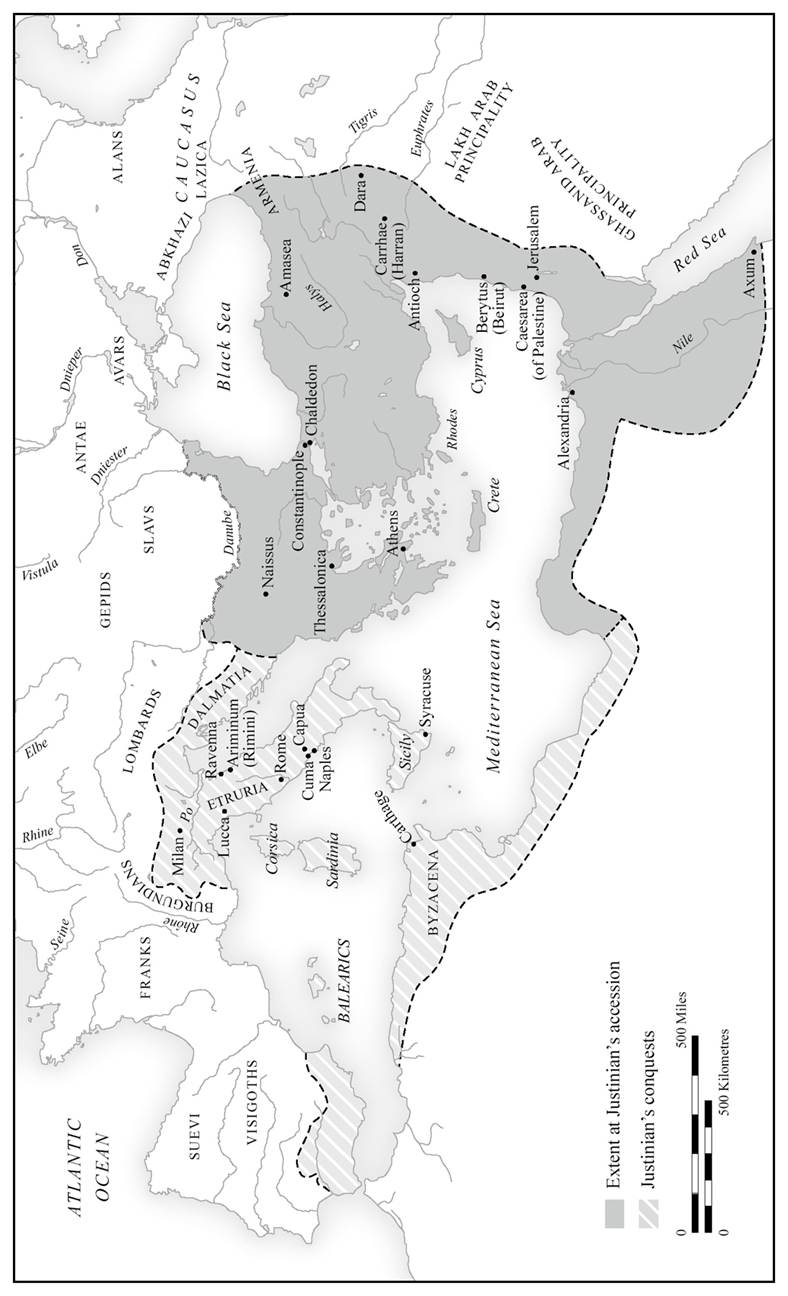
8. Extent of the Roman Empire at the end of the reign of Justinian (565 CE)
More on the topic 7 ROME’S GREEK EMPIRE 27 BCE–337 CE:
- 6 ‘BECOMING GREEK’ 322 BCE–27 BCE
- The Greek Poleis, Rome and Its Illustrious Epicurean Citizens
- Monumental Temporality and the Consolidation of Empire in Augustan Rome
- 4 THE FIRST WORLD WARS AND THE ‘CLASSICAL’ AGE 494 BCE–404 BCE
- 5 CULTURAL CAPITAL 404 BCE–322 BCE
- One Empire, One Peace: The Rise of Rome to the Pax Romana’s Decline
- 1 OF LEDGERS AND LEGENDS 1500 BCE–c. 1180 BCE
- 3 INVENTING POLITICS, DISCOVERING THE COSMOS c. 720 BCE–494 BCE
- 8 BECOMING CHRISTIAN 337–630
- 2 ‘HOMER’S WORLD, NOT OURS’ c. 1180 BCE–c. 720 BCE