5 CULTURAL CAPITAL 404 BCE–322 BCE
It was a strange sort of liberty. Neither of the Greek rivals had proved strong enough to beat the other on a level playing field. Everybody knew that the power of Athens had been broken only thanks to the vastly superior resources of the old enemy, Persia.
After the war was over, interstate politics in the Greek world continued to be as rancorous as before. There was one difference, though. After the Spartans made their treaty with the Persian Great King in 412 BCE, an external ringmaster was always involved in the affairs of the Greek city-states. For half a century after the end of the Peloponnesian War, that would be Persia—until another entirely unexpected player entered the ring.On the Athenian side, losses in battle and from the plague during the war’s early years had reduced the citizen body to little more than half of what it had been during the heyday of the previous century. On top of the humiliation of having part of their fortifications demolished and surrendering most of their remaining fleet, the Athenians had to submit to being ruled by a thirty-man junta, known ever since as the Thirty Tyrants. In reprisals against democrats, somewhere between twelve hundred and fifteen hundred Athenians were murdered under their regime.1 Within months, civil war broke out. The Spartans then changed their policy. After only a year, democracy was restored—for the second time in a decade. Slowly, a morally and financially depleted Athens began to rebuild something of what had been lost.
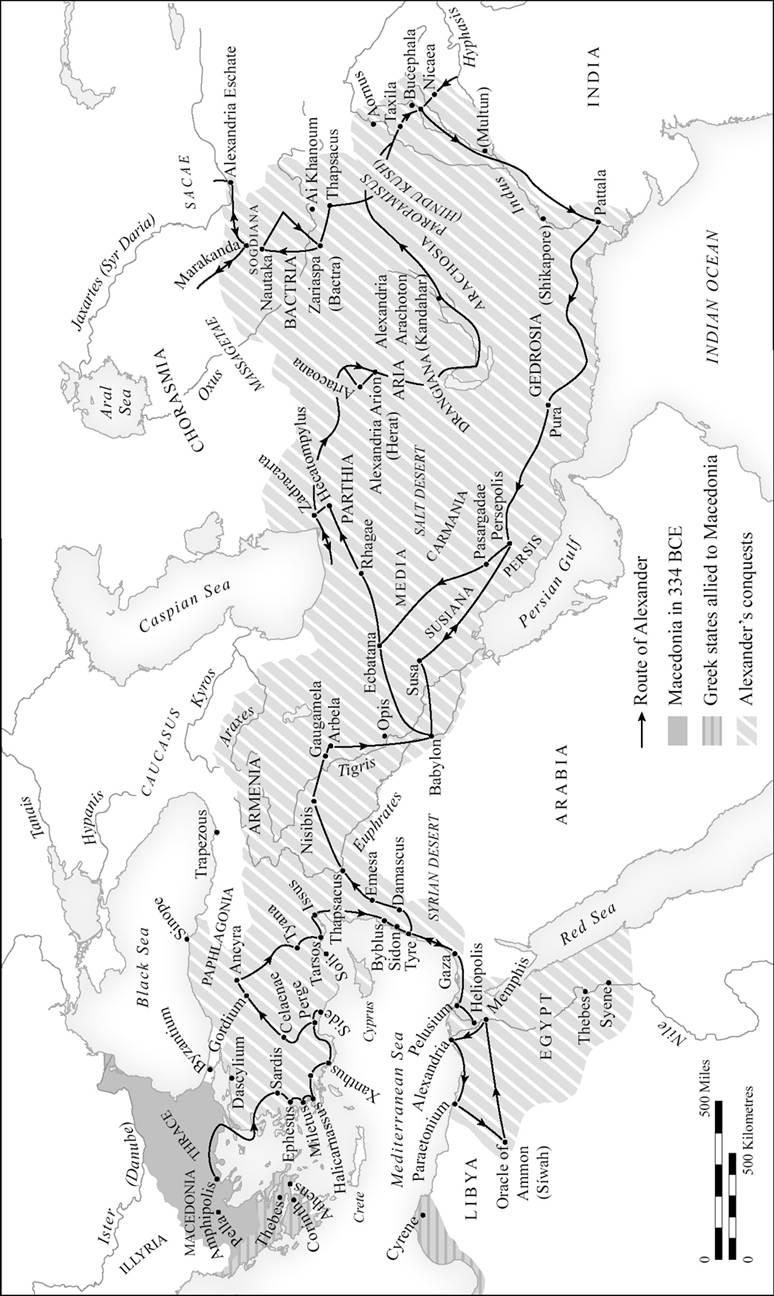
5. Alexander’s expedition and empire
For Sparta, it was a classic case of ‘winning the war but losing the peace’. It may have been because the polis system offered no rules on how to exercise authority over outsiders that Greek city-states, when they did find themselves in a position to do so, were so bad at it.
The Athenians had failed in the fifth century BCE; now it was to be the turn of the Spartans. Victory over Athens simply replaced a much-resented Athenian empire with a Spartan one that would soon be resented, if anything, even more. By the time the Thirty Tyrants had been deposed in Athens, divisions had already deepened between the Spartans and the two most powerful states that had been allied with them in the war against Athens: Corinth and Thebes. The two-way rivalry of the past century and a half was giving way to a more complex set of relationships that would involve all four of these city-states and dozens of minor ones. This was the dynamic that would play out in the Greek-speaking world over the coming decades.2Far away to the east, Darius II of Persia died in the same year as the Peloponnesian War ended, 404 BCE. The new Great King was Artaxerxes II. But his claim was contested by his brother Cyrus, the satrap in Anatolia who had proved such a good friend to the Spartans in general and to Lysander in particular during the final years of the war against Athens. The Greek cities of Anatolia, as well as Sparta itself, opted to back the man they knew, Cyrus, for the throne of Persia. A contingent of mercenaries from other Greek states, known ever afterwards as the ‘Ten Thousand’, joined in. But then Cyrus was killed in a battle on the banks of the Euphrates in 401 BCE. The story of the mercenary expedition is vividly told by Xenophon, who had left Athens to join it and ended up commanding the remnant that made its way through many hardships to the Black Sea coast and thence to the Aegean.3 The Greeks had picked the wrong side after all. They found themselves up against the new satraps sent to the region by the victorious Artaxerxes. Sparta, still backed by the Greek city-states of the region, went on to fight a limited war against them for several more years.
To put a stop to this, the Persian satrap came up with a psychologically astute ploy.
In 396 or 395 BCE, he sent bribes in gold to ‘the leading men in various states on the understanding that they would make war on Sparta’. If Xenophon is to be believed, the Athenians disdained the money. They ‘were ready enough for the war in any case, as they thought that empire was their own prerogative’. Another historian tells us that they took the cash anyway. So did the Thebans and Corinthians, and perhaps others.4The Corinthian War, as it has become known, lasted until 386 BCE. On one side were the Spartans; on the other, a fragile alliance of Thebes, Corinth, Argos, and Athens, backed by Persia. Once the allies began to gain the advantage, the Persians shifted back to supporting Sparta. As a result, the Spartans emerged as marginally ahead of their rivals at home. The commander of their fleet, Antalcidas, who had once again defeated an Athenian naval force in the Hellespont, went all the way to Susa, the Persian capital, to negotiate terms of peace with Artaxerxes. So far as these concerned the Greek states, the terms were designed to benefit Sparta. But the author and principal beneficiary of the peace treaty was the Great King himself. For this reason, it would most often be called, then and later, the ‘King’s Peace’.
This time, Sparta really did have to hand back to Persia all the Greek ‘cities of Asia’ that had been liberated at the end of the Persian Wars—a promise that had been made during the later stages of the Peloponnesian War, but not fulfilled. In the event of the treaty being violated, the king reserved to himself the right to intervene with full military force. The King’s Peace was understood to apply to all Greek states, whether or not they had formally ratified it. For those that did, including Athens, Sparta, Corinth, and Thebes, it was not quite an act of submission, such as the gift of earth and water that had once been demanded by Artaxerxes’s predecessors. But it did surrender the unambiguous right to regulate relations among the Greek states.
Their much-prized ‘autonomy’, meaning from each other, was guaranteed at the same time—but at the price of acknowledging the Great King as final arbiter among them.5From the Persian point of view, the King’s Peace worked extremely well. The Greek states continued to war among themselves, often using the treaty’s terms as a pretext. The Peace would be renewed several times, and each time followed by new wars. Artaxerxes II, who reigned until 358 BCE, could be forgiven for thinking that the chronic boil on the western flank of his empire had finally been lanced.
In 378 BCE there came another shift in the balance of power among the Greek city-states. In Thebes, newly liberated from direct control by Sparta, a democratic regime brought to prominence two men who would go on to dominate politics on the Greek mainland until both were killed during the wars of the next decade, Pelopidas and Epameinondas. One of the few really decisive battles of this period was won by the Thebans, led by Epameinondas, over the Spartans at a place called Leuctra, not far from Thebes, in 371 BCE. The Thebans under Epameinondas pressed home their advantage. The Spartan homeland of Laconia had never been invaded by an enemy since, according to their oldest legends, their own Dorian ancestors had arrived to displace the native helots. Now, Theban troops advanced right up to the outskirts of Sparta itself. It seems to have been Epameinondas who thought of the killer blow. According to the terms of the King’s Peace, every Greek polis was supposed to be autonomous. What better pretext could there be, now that Thebes had gained the upper hand, for joining forces with the enslaved helots of Messenia and compelling the Spartans to grant them their liberty as an autonomous city-state?
This was what the Spartans had most dreaded for centuries. Now it came to pass. Epameinondas has ever afterwards been remembered as the liberator of this oppressed population. His motive was probably less what we would call today humanitarian, and more a matter of political strategy.
Once the Messenian helots had been liberated, Epameinondas encouraged them to build their own city. The walls and many of the public buildings of Messene, founded shortly afterwards, are still impressive today. The Spartans would never afterwards sign up to any treaty that included recognition of Messene as a free polis. As a direct result, once-mighty Sparta would become increasingly marginalised in Greek affairs from this time on.But still the Greek city-states continued to wage war among themselves. Athens began to rebuild a set of maritime alliances that more cautiously mirrored the Delian League of a hundred years before. This time, though, the Athenians more often than not sided with their old rivals, the Spartans, to try to halt the rising power of Thebes. Matters came to a head once again in a battle fought outside the city of Mantinea, in the centre of the Peloponnese, not far from today’s Tripoli, in 362 BCE. On one side were the Thebans, supported by all the Peloponnesian states that had benefited from Theban intervention against Sparta. On the other were the Spartans, their few remaining allies from the Peloponnese, and a contingent sent by Athens. As the now elderly Xenophon put it, writing not long after the event:
Nearly the whole of Greece had been engaged on one side or the other, and everyone had imagined that, if a battle was fought, the winner would become the dominant power and the losers would be their subjects.
In the event, ‘both sides claimed the victory’, but neither side ‘was any better off after the battle than before it’.6
Xenophon had already noted, a few pages earlier, writing about the Athenian contingent at Mantinea, ‘Good men among them were killed and, very evidently, those whom they killed themselves were good men too.’ The historian left it to others to record that his own son, Gryllos, had been among the Athenian dead. Epameinondas, too, died shortly afterwards of a wound he had received during the battle.
One account even credits Gryllos with delivering the fatal blow. A statue of Epameinondas, erected in Thebes shortly afterwards, bore an inscription that commemorated his achievements in the Peloponnese. Thanks to him, it claimed, ‘all Hellas’ was now ‘autonomous in freedom’.7 The promise of local autonomy, that had been enshrined in the terms of the King’s Peace, was now, thanks to Epameinondas, supposed to apply to the entire Greek world. One wonders what anybody thought the boast could possibly mean, in the circumstances.Xenophon was not far off the mark when he concluded, in almost the last sentence of his history, ‘There was even more uncertainty and confusion in Greece after the battle than there had been previously.’ One modern commentator puts it more pithily: the city-states ‘had reached a balance of impotence’.8 The reality of what Greeks were doing during the first half of the fourth century BCE is depressing. But to hear them talk, you would hardly have guessed it.
And we can hear them talking. That, paradoxically, is their real achievement at this time—to enable us to listen in to what some of them, at any rate, were thinking and saying. In 399 BCE, the seventy-year-old Socrates had been prosecuted before an Athenian law court, charged with impiety and ‘corrupting the city’s youth’. This was only four years after the brutal regime of the Thirty Tyrants had been overthrown and democracy restored. Several members of that junta, in their time, had been among the ‘youth’ allegedly corrupted by the accused. The charge of ‘impiety’ might well have resonated with a citizen jury still edgily looking for scapegoats after their city’s defeat by Sparta.9 Socrates was found guilty and condemned to die by drinking hemlock in prison. It is one of the best-known stories of classical antiquity. But its aftermath was to affect even more than the future course of Western philosophy.
Beginning quite shortly after Socrates’s death, and continuing for half a century afterwards, two of his pupils determined to perpetuate his legacy. One of these was Xenophon, the historian, who was also a philosopher. The other, Plato, had been born in 427 BCE and would go on to lay the foundations for a whole philosophical tradition, including aspects of Christianity. Both men presented to a reading public a series of conversations that supposedly had taken place between Socrates and a host of interlocutors while he had been alive. Increasingly over time, it is thought, Plato relied on the dramatic device of the dialogue and the fictional voice of Socrates to expound ideas which were all his own.
The most ambitious of Plato’s dialogues, known in English as the Republic, sets out a rather unworldly version of the ideal state. Although he was not averse to grappling with political issues—indeed, at one stage he gave advice to a ‘tyrant’ of Syracuse in Sicily—Plato’s philosophy tended to advocate a withdrawal from the real, visible world altogether. Everything that we see and experience, Plato argued, is only a crude copy of the eternal and unchanging ‘idea’ or ‘form’ that it embodies. It is the task of the philosopher to reach out for knowledge of the real thing, even if it will always lie beyond our senses. Plato’s idealism is a far cry from the Greek-on-Greek carnage of the Corinthian War, or Leuctra, or Mantinea, or the politicking that fed those conflicts. But thanks to Plato’s artful handling of the written word, we never lose the impression that we are listening to the speaking voice of Socrates, in the constant to and fro of conversation.
At the same time, the art of public speaking flourished as never before, particularly in Athens, where citizens addressed the Assembly or the law courts. This was the art that in time would come to be known by the Greek word rhetoric and is still with us today. The English oratory derives from its Latin equivalent. In the world of a Greek polis, to able to speak well in public, and to persuade your hearers, was much more than an accomplishment. In a law court, it could be a matter of life or death; a speech in the Assembly could make the difference between peace and war.
Just like the informal conversations of Socrates, formal speeches, too, were beginning to cross over into the domain of writing and gain a new life far beyond their original context. By the time that Socrates was tried and condemned, it was becoming increasingly common for orators to compose their speeches in writing ahead of their delivery—just as politicians or their speechwriters do today. Not only that, but in Athens a lively market had grown up for ghostwritten speeches to be used in law courts. In a legal system in which there were no barristers and every citizen had to plead his own case before a jury that might be made up of five hundred fellow citizens, there was a market for ready-made speeches written in advance and memorised for the occasion. If you lacked the spontaneous brilliance of a Socrates but could afford the expense, your chances of winning your case would be greatly enhanced when you hired a professional to write your speech for you.
No doubt the same thing went on in other cities too. But it was in recently defeated Athens that the art of speechwriting really caught fire. This was how Isocrates (no relation to Socrates) started out in his thirties around the year 400 BCE. But soon Isocrates went one better. On his own admission, he lacked the physical stamina to stand up before an audience of six thousand in the Assembly or the five hundred that made up the city’s Council or a citizen jury in a court of law. Instead, Isocrates created a name for himself as, in effect, the world’s first political columnist—more than two thousand years before the first newspapers. Always couched in the form of a spoken address before a live audience, his speeches were carefully composed in the study, on a papyrus roll, and then circulated in manuscript copies, the equivalent of publication in a preprint age. If Socrates had been the greatest philosopher who never wrote a word, his near-namesake is remembered as the greatest speechmaker of the ancient world who never made a speech.10
In 380 BCE, Isocrates published his Panegyricus, or Festival Speech. The King’s Peace had been handed down six years before. Isocrates makes out that he is addressing a crowd assembled from all over the Greek world to celebrate one of the great ‘panhellenic’ festivals, such as the Olympic Games. Now, he argues, is the time for the Greek city-states to sink their differences and win new glories in ‘an expedition… gathered together in the cause of the liberty of our allies, dispatched by all Greece, and faring forth to wreak vengeance on the barbarians’, that is to say, on the Persians who had twice invaded their homeland a century before.11 That the Greeks could unite at all for such a purpose was scarcely credible in 380 BCE. But Isocrates draws on the imagined setting for his speech to invoke the spirit of collective euphoria that had been new in the time of Aeschylus and Herodotus. He urges his fellow Hellenes to go beyond identifying with their own particular city-state or region and identify, instead, with Hellas as a whole.12
On the face of it, Isocrates was promoting the same idea of Greek unity as Herodotus had once done. But there is a difference. The historian from the Ionian mainland had been even-handed in giving each of the city-states (more or less) its due. Isocrates writes as an Athenian. His whole argument is designed to create a leading role in the proposed expedition for his own city. Athens, he declares, now leads the rest of the Greek world in the art of fine speaking—indeed, in the very sort of verbal dexterity that is on display in the Festival Speech:
By so much has our city exceeded all mankind in matters of thought and speech, that her students have become the teachers of others; she has caused the name of Greeks to be understood, not in terms of kinship any more, but of a way of thinking, and people to be called Greeks if they share our educational system, rather than a common ancestry.13
At a stroke, Isocrates had redefined what it meant to be Greek. No longer primarily a matter of kinship or biological inheritance, identity is to be understood as a set of values that anyone can aspire to attain, given sufficient goodwill and effort. In all probability, long before this, outsiders had been attracted to Greek ways of doing things and had adopted Greek customs and even the Greek language. There were signs of something of the sort having happened as far back as Mycenaean times. But to spell it out like this, and to propose it in writing as a principle that applied to all Greeks, now and in the future—that was entirely new. And, against the grain of political probability or the military realities of the time, it was to prove a self-fulfilling prophecy. How this would come about, no one alive in 380 BCE could possibly have foreseen. But both Isocrates and Plato, with their mastery of the written word masquerading as oral speech, would play their parts, both in and beyond their lifetimes. More than two thousand years before there was ever any question of Athens becoming the real capital of Greece, the city that had been humiliated in the Peloponnesian War and that still struggled to project its power on the battlefield was on its way to becoming the world’s first cultural capital.
When Isocrates sent out his Festival Speech to be copied and circulated, Philip II, King of the Macedonians, as he would come to be known, was just two years old. Twenty years later, and two years after the Greek city-states had fought themselves to an impasse at Mantinea, the death of his brother in battle brought Philip to the throne. The year was 360 BCE.14 The battle had been fought between Macedonians and Illyrians, far away on the northern fringe of the Greek world. At the time, the news was barely noticed among the city-states. But this was the event that would herald the arrival, within a very few years, of a new and decisive force in interstate Greek politics.
Contemporaries recognised even in his lifetime that ‘Europe had never produced a man like Philip son of Amyntas’. It was a two-edged assessment. Tales of Philip’s drunkenness and debauchery abounded in the ancient world. But at the same time, according to one later account, he had been ‘possessed of eloquence and a remarkable oratorical talent’. Wounds sustained in battle at different times in his life had left him with one eye and a pronounced limp. But much of Philip’s later success would be the result of astute diplomacy rather than the brutality of which he was also capable. A modern biographer credits him with creating the ‘first nation state in Europe’ and suggests that it was Philip, far more than his more famous son Alexander, who truly laid the foundations for the conquests and the new Greek civilisation to come.15
This was the man who wasted no time in pulling together the ramshackle kingdom he had inherited. Next, he began to enlarge it at the expense of its neighbours. The nearest of these were the settlements that Greeks from the southern Aegean had been building on the coastline of Macedonia and Thrace for several centuries. All of these had been established on the polis model and were technically autonomous. But from the early years of the Peloponnesian War, Athens and Sparta had competed for the allegiance of these settlements; each, at different times, exercised varying degrees of control over them. Now, Philip began a series of campaigns to take control of his own coastline and gain access to the sea. With a mixture of guile and brute force, one by one he annexed these settlements to his kingdom or else obliterated them.
With Macedonia well on the way to becoming a regional power, it was only to be expected that the next time war broke out among the Greek city-states, Philip would be drawn in. In 355 BCE, a spat began over the custodianship of the sanctuary of Delphi. A ‘sacred war’, as conflicts of this type were conventionally known, dragged on for almost ten years. The immediate protagonists were Thebes and a number of very small states indeed, in central Greece, that traditionally had worked together to administer the sacred site. But as usual, the conflict widened through a network of shifting alliances. It was an appeal to Philip by one of the states involved, in 353 BCE, that brought the Macedonians for the first time into the fray. By 346 BCE, when terms of peace were hammered out, Philip was in a position to dictate them. And despite face-saving formulas all round, it was he who emerged as the only real victor—the new master of the ring.16
For the Greeks of the most powerful city-states, the immediate challenge was political and military: How to respond to this new threat to their own ambitions? But thanks to the Athenian habit of preserving their political debates in writing, we can see that a deeper perplexity held the southern Greeks in its grip. The argument was not only about politics. It was also about identity. Who were those Macedonians who had suddenly arrived on the doorstep of the Greek city-states and seemed poised to take over? For Demosthenes, the statesman whose passionate oratory would dominate the Athenian Assembly from the 350s to the 320s BCE and be admired ever since, Philip was a monster bent on the destruction of everything the Greeks had ever held dear. ‘Not only is he no Hellene,’ thundered Demosthenes in a speech delivered at a time when the peace of 346 BCE was already beginning to unravel, but also
he has nothing to do with the Hellenes. He is not even a barbarian from a place that one could speak well of, but a pestilence of a Macedonian, from a place that used not to be able to provide even a slave worth buying.17
One Athenian’s idea of a ‘pestilence’ could be another’s golden opportunity. Isocrates was ninety years old in 346 BCE but as active an opinion-former as ever. He had never given up on his long-cherished idea of a united Greek expedition against Persia. Here, in Philip, was a force capable of filling the gap at the top and providing the leadership that had eluded both Athens and Sparta for so long. In a wordy and often obsequious open letter, written in May 346 BCE, Isocrates addresses Philip directly and lays out for him his destiny. This is to be nothing less than to unite all the Greeks and lead them in avenging the wrongs inflicted by the Persians a century and a half before.18
Isocrates was writing as much for home consumption as to flatter the man he addressed. For the benefit of his Athenian readers, he played up the traditional claim made by Macedonian monarchs that their dynasty was directly descended from the demigod of legend, Heracles, and had come originally from the city of Argos in the Peloponnese. As a descendant of the most ‘Hellenic’ hero of all time, argued Isocrates, Philip was ideally suited to lead the expedition against the Persian ‘barbarians’. His subjects, the Macedonian rank and file, on the other hand, Isocrates rather carefully describes as ‘a kinship group not of the same race’. Greek speakers would have to rethink the simple division of the world into ‘Hellenes’ and ‘barbarians’ that went back to the Persian Wars. From now on, and for as long as it continued to matter, ‘Macedonians’ would become an in-between category, sometimes opposed to ‘Hellenes’, sometimes grouped along with them in opposition to ‘barbarians’, depending on the point of view of the person speaking.19
The question of Macedonian identity, that so preoccupied Athenian opinion-formers and politicians in the middle of the fourth century BCE, has continued to divide scholars in our own day. The truth must surely be that the Macedonians living in the time of Philip II were as ‘Hellenic’ as they chose to be—and when they chose to be. Often, they seem to have prided themselves on their differences from the Greeks of the city-states.20 Macedonia was, in Greek terms, an ethnos, meaning a more or less tribal society ruled by a hereditary monarch. Society was hierarchical, with the king at the top and surrounded by a competitive military elite, known as Companions. City-dwelling Greeks, accustomed to diluting their wine with water, were routinely horrified that Macedonians drank theirs neat. For us today that might not seem so terrible—but the stories of both Philip and his son Alexander indulging in binge drinking and drunken violence with their Companions are too frequent and too well-attested to ignore. These were not so much individual character traits as part of the culture of the Macedonian court.
On the other hand, there is good evidence that the Greek language had been spreading northwards from Greek-speaking Thessaly since the eighth century BCE. By the time of Philip II, not only the Macedonian royal house but also their elite, at the very least, had been giving their sons and daughters Greek names for several generations. Many of the most characteristic Macedonian names are transparently formed from Greek words. Among them are some of the most famous: Philip (‘Horse-Loving’), Cleopatra (‘Father’s Fame’), Ptolemy (‘Warlike’). Whatever languages or dialects may once have been spoken among the people over whom they ruled, the highest levels of Macedonian society were thoroughly Greek-speaking by the mid-fourth century BCE. And wherever the elite led, the rest could be expected to follow. Macedonia, in other words, was rapidly becoming Greek.21
Philip led the way more vigorously than any Macedonian king had done before him. Under his rule, Macedonian centres of population began to look like Greek cities. At Aegae, the old capital now used for mostly ceremonial purposes, at Pella, that by 400 had replaced it closer to the coast, and at Dion on the lower slopes of Mount Olympus, colonnaded temples began to rise, built in the manner found throughout the Greek-speaking world. At Aegae, as well as a sumptuous new palace, Philip had a huge semicircular theatre built right in front of it, in the Greek style. Athenian drama had been appreciated in Macedonia since at least the end of the fifth century BCE, when the elderly Euripides had retired there. During Philip’s reign, painters, sculptors, and philosophers from the southern city-states, and especially from Athens, were recruited in large numbers. The most famous of these was Aristotle, who had studied philosophy under Plato in Athens and would later return there to found his own school. Aristotle’s home city of Stageira had been one of those Greek settlements on the coast of Macedonia recently razed by Philip. But this was to prove no bar to Philip recruiting Aristotle to become private tutor to his son, Alexander—nor to Aristotle accepting the post.22
Most striking of all is the earliest evidence for the public use of writing in Macedonia. This was another innovation which took place under Philip. Along with written documents and the first public inscriptions on stone came a choice, one that would have far-reaching implications. Once upon a time, in the days when Greek-speaking settlements were being founded all over the Mediterranean, each one would develop its own distinctive version of the alphabet and proudly display its own local form of speech on stone. But no longer. As literacy had become widespread, standardisation had set in. By the mid-fourth century BCE, writing was reaching far beyond the bounds of any one city-state. If you wanted your words to be intelligible and to be read by as many people as possible, you would need to write in a way that people would be familiar with, wherever they happened to live and irrespective of how they spoke at home. It is not clear whether the initiative came from Philip himself, but when Macedonians began to put pen to papyrus and to carve words into stone for public consumption, they did so not in their own dialect but in the Greek of Athens, known as Attic.23
The peace brokered by Philip in 346 BCE would prove short-lived. During the next five years, most of his energies were directed eastwards, towards conquering Thrace. Apart from city-states on the coastline that had been founded centuries earlier by Greeks from the Aegean, Thrace lay outside the Greek-speaking world, as its people had their own language. But once the Macedonian army had subdued all of Thrace and reached the straits that separate the continents of Europe and Asia, whose shores had been thoroughly ‘colonised’ by Greeks, Philip’s interests came directly into conflict with those of Athens. This was because the Athenians were dependent, as ever, on supplies of grain from the Greek settlements on the Black Sea coasts. A hostile power in control of the straits had starved Athens into submission twice before and could well do so again. Amid this crisis, in 341 BCE, Demosthenes even urged an alliance with the old enemy, Persia, to head off the new one, Macedonia.24
War broke out the next year, in 340 BCE. Attempts led by Demosthenes to recruit an Athenian-led alliance against the Macedonians met with only a lukewarm response. Once again, the city-states of central Greece were at loggerheads over the custodianship of Delphi. Philip had acted as arbitrator before. Would he do so again? Appeals by rival contestants gave him the excuse he may have been waiting for to divert his armies from Thrace and bring them south. Panic broke out in the Athenian Assembly when news arrived that an army of Macedonians and northern Greeks thirty thousand strong, with two thousand cavalry, had already reached the borders of neighbouring Boeotia. For once, so great was the emergency, Demosthenes was able to persuade his city’s age-old rivals, the Thebans, to fight alongside Athens to preserve both their homelands. The decisive battle was fought at the beginning of August 338 BCE on the banks of the Cephisus River in Boeotia, below the town of Chaeronea. On one side were the Macedonians and their northern Greek allies. On the other, more or less matching them in numbers, were the combined forces of Athens and Thebes, with small contingents from a few other city-states. Sparta, as so often now, stood aloof.
Philip won the day. As many as half the Athenians and Thebans were either killed or taken prisoner. Demosthenes himself fought among them and survived to deliver the public oration on the fallen back in Athens shortly afterwards. In another speech that has been often quoted since, the up-and-coming Athenian politician Lycurgus pronounced the obituary in 330 BCE, not only for those who had lost their lives but also for the ‘liberty of Hellas’ that had been extinguished along with them. Even today, there are many who date the end of ‘classical’ Greek civilisation to the battle of Chaeronea in 338 BCE.25
It all depended on what you meant by liberty and Hellas. It had been in the crucible of the Persian Wars that these concepts had been forged in the first place. But Demosthenes had been prepared to cut a deal with the Great King of Persia. The ‘liberty’ of the Greek city-states by now meant little more than the right to annihilate one another on the battlefield in a cycle of mutual attrition in which no one could ever win. So deeply ingrained had the mentality of the autonomous polis become in the Greek heartland, it was the idea of their autonomy from one another that held the deepest claim on the loyalty of Greek citizens, trumping by some margin their shared identity as Hellenes. ‘Hellas’ was barely even a pretext.
In any case, Philip’s actions during the weeks and months after the battle hardly lived up to the apocalyptic tones of a Demosthenes or a Lycurgus. Thebes was punished by having its democracy replaced by an oligarchy and a Macedonian garrison installed to ensure good behaviour. But Athens was spared, even though its leaders had been far more outspoken against the Macedonians, and for far longer. Those states that had not already promised allegiance to Philip quickly did so. Only Sparta refused. A brief punitive expedition by Macedonian troops into Laconia had the effect of isolating the Spartans in their heartland while leaving their city and its institutions untouched. All the other Greek city-states were then required to send representatives to a conference convened by Philip at Corinth. This was where the new political settlement was handed down. It established a military alliance and a ‘Common State (Koinon) of the Hellenes’, with rules for its governance. Modern historians refer to this as the ‘League of Corinth’, a name which rather misses the point of the original Greek. In effect, the settlement prescribed a kind of federation, governed by a representative council but with all members owing allegiance to the ‘Leader’ (the Greek word hegemon gives us the word hegemonic). Needless to say, the Leader was to be the king of the Macedonians—meaning not just Philip but also his heirs in perpetuity.26
Perhaps curiously, and a source of dissension to come, Macedonia itself remained outside the federation. Politically and culturally, Philip chose to mark a separation between his own kingdom and the wider ‘Hellas’ that for the first time acquired a semblance of political existence under his leadership. For long afterwards, people would continue to talk of ‘Greeks’ and ‘Macedonians’ as distinct groups, even though both together would soon make up the nucleus of a rapidly expanding Greek-speaking world.
A second meeting of delegates, summoned from the city-states, took place at Corinth in the spring of 337 BCE. Philip announced his intention of leading an expedition to liberate the Greek cities of the Anatolian seaboard from Persian rule. This was exactly what Isocrates had been preaching in vain for so long: a united, ‘panhellenic’ expedition against the old, common enemy. Among the last words that Isocrates ever wrote, before his death at the age of ninety-eight, were these, addressed to the victor of Chaeronea. If you can ‘force the barbarians into servitude to the Greeks’, he wrote to Philip, ‘there will be nothing else left for you but to become a god’.27
Philip by this time controlled a territory that included almost all of today’s Greece, much of Bulgaria, Albania, the Republic of North Macedonia, and all the European part of Turkey.28 No one except Xerxes—and he only very briefly—had ever before held so much power in this region or over so many Greeks. True to his word, a year after his announcement to the Greek representatives assembled at Corinth, Philip despatched the advance guard of the promised all-Greek expedition into Persian-held territory. In the spring of 336 BCE, three of his generals led a force across the strait of the Dardanelles from Europe to Asia.
Presumably Philip still intended, as he had announced at Corinth, to place himself at the head of the main force that was to follow. But he seems to have been in no hurry. First, there was to be a royal wedding celebrated at Aegae, the old, ceremonial capital of Macedonia. The previous year, Philip had married for the seventh time, though several of his previous wives were still living. Now, he was marrying off his daughter, Cleopatra, to a close relative who was the ruler of neighbouring Epiros. All of Philip’s own marriages, with the possible exception of the most recent, had been strictly strategic. So was this one for his daughter. A dynastic alliance with Epiros would neutralise a potential threat to his rear while he was away campaigning in Asia.
It would also neutralise a threat closer to home. His estranged fourth wife, Olympias, was not only the mother of the bride and sister of the groom but also belonged to the royal family of Epiros. This mattered because Olympias was the mother of Philip’s chosen heir, the twenty-year-old Alexander. Philip and Alexander had quarrelled violently during the past year, apparently over Philip’s own latest marriage to a girl closer to his daughter in age. The quarrel had been patched up, at least on the surface, by the summer of 336 BCE. But Alexander, who had led one of the charges at Chaeronea when aged only eighteen, had not been included in the expedition that had been sent across the Dardanelles. Philip was laying his plans carefully. While he had been away on a previous campaign, he had appointed his young heir to manage the kingdom during his absence. This was the role he seems to have been planning for Alexander once again.
The wedding took place at Aegae (modern Vergina) in either July or October 336 BCE. It was in every sense a state occasion. Guests were invited from every corner of the Greek world and beyond. The morning after the ceremony, the recently completed theatre was packed—which implies an audience of many thousands—for the entertainment that had been promised. Despite hard drinking the night before, the festivities were due to begin at sunrise. In procession, statues of the twelve gods of Olympus were wheeled or carried into the circular space in front of the tiered seats. Along with them came a thirteenth, representing Philip himself. Whatever exactly was meant by this, it was the kind of statement that up to this time Greeks, however vainglorious, had always stopped short of making. To traditional ways of thinking, there was a line between mortal men and the immortal gods that no mere human, no matter how powerful, could safely try to cross. Behind the procession came Philip’s son and heir, Alexander, walking with the bridegroom, then Philip himself, dressed all in white. The royal bodyguard, ordered by Philip to hang back for the occasion, followed at a discreet distance.
What followed must surely qualify for the most theatrical murder ever staged. As Philip entered the open space in front of the assembled spectators, a former member of his bodyguard rushed up to him, drew a concealed dagger, and plunged it into the king’s chest. Philip died on the spot. The assassin ran for the city gates, where there were horses waiting. He would have got away, so the story goes, but he tripped over a trailing vine as he was trying to mount. Three of the king’s guards caught up with him and killed him before he could speak.29
Philip had been murdered in broad daylight, in front of witnesses numbered in the thousands. No one could doubt the identity of the murderer. His name was Pausanias. The official story was that he had harboured a grudge, not directly against his king but against one of his courtiers, and Philip had refused him redress. But Pausanias did not act alone, as the detail of the getaway horses proves. The convenient vine that tripped him as he was preparing to mount suggests that he was never meant to get away. Even Alexander entertained no doubts that Pausanias had been part of a plot. Those would be the very grounds on which the new king would have several potential rivals for the throne executed in the next few days or weeks, as supposedly complicit.30
Speculation has been rife ever since. Ancient authors suspected Alexander’s mother, Philip’s estranged wife Olympias. Some also, circumspectly, even though they were writing hundreds of years after the event, thought that Alexander himself might have been implicated. Modern historians have returned to the issue—a classic murder mystery with a trail that had already gone cold more than two thousand years ago. Many of them entertain the possibility that Olympias, or Alexander, or both, may have given Pausanias his instructions. No one doubts that the chief beneficiary of Philip’s death, at that particular time, was the twenty-year-old who would very shortly afterwards be crowned Alexander III, King of the Macedonians—later to be known the world over as ‘Alexander the Great’.31
No new evidence is ever going to come to light that would prove the matter one way or the other. But the manner of the crime has Alexander’s fingerprints all over it. Everything we know about Alexander’s life and deeds, both before and after the event, shows an audacity that is still, after so long, breathtaking. Time and again, he would respond to a challenge that everyone else thought impossible and succeed—through ingenuity, physical endurance, sheer delight in risk for its own sake, as well as, surely, an extraordinary run of luck. This is the well-rehearsed story of the most audacious military commander, probably of all time, who spent most of his short life on campaign and never lost a battle. Everything that Alexander did, from his taming of the unbreakable horse Bucephalas in his early teens to the legendary cutting of the Gordian knot and innumerable exploits against towns and fortresses built in remote and inaccessible places, betrays the same ruthlessness and the same determination to succeed at any cost, whether to himself or to others.32
Almost everything that Alexander ever did was done in public, more or less explicitly performed for show. This was as true of his most celebrated triumphs as it was of those acts that even his most devoted biographers, ancient and modern, have deplored. He would develop a track record for eliminating some of the individuals who had been closest to him and to whom he owed the most. A comrade who had saved his life in battle would be rewarded by being run through with a pike during a drunken brawl, in front of an assembled company. Others, after serving with him for years, would be judicially murdered, often horribly and always in public, on the flimsiest of pretexts.33 To commit the ultimate crime in Greek eyes, the killing of one’s own father, in a public place, onstage before a huge audience drawn from all over the Greek world, while also being physically present, with his own hands perfectly clean—and to get away with it.… Was not that the ultimate test and proof of the psychopathic genius that Alexander would go on to display throughout his life?
In Aegae, a very public wedding had turned into a very public funeral. Philip’s body was cremated, then the remaining bones were washed in wine, wrapped in a purple cloak, and placed inside a casket of solid gold emblazoned on the lid with the Macedonian emblem of the sunburst. When the tomb was opened by the archaeologist Manolis Andronikos in 1977, with all its treasures intact, forensic examination of the remains inside the casket revealed that they had belonged to a man in his forties (Philip died at forty-six), with signs of trauma around the right eye and one leg shorter than the other. These details are consistent with the injuries that Philip is known to have suffered in battle. Although doubts have been cast by some archaeologists, it is almost certain that the ‘Tomb of Philip’, that lies beneath the reconstructed ‘Royal Tumulus’ on the edge of the Greek market town of Vergina, is indeed the last resting place of Philip II. Alexander himself must have been present at the obsequies and have overseen every detail of what has been preserved.34
The new king was now ruler over all the lands and peoples that had been subdued by his father. But to secure his position, it was not enough to eliminate those members of Philip’s inner circle who could possibly present a threat in future. Alexander lost no time in making his mark and facing down any actual or potential revolts on several fronts. His first move was to forestall any reassertion of independence by the Greek city-states. The Athenian delegation to the wedding at Aegae had unctuously given an assurance that there would never be a safe haven in their city for anyone who dared to plot against Philip. But no sooner was Philip dead, and the news arrived in Athens, than Demosthenes led jubilant celebrations in the Assembly.35 And it was not just in Athens that this happened. Other states were restive too. So Alexander’s first move was to reconvene the conference at Corinth. His father’s tomb had probably only just been sealed when he headed south. But this was to be more than a diplomatic mission. Or rather, it would define Alexander’s future ideas of diplomacy. He travelled south at the head of a large Macedonian army.
The Thebans and the Athenians panicked when they found the victors of Chaeronea back, in strength, on the borders of their territory. But Alexander had made his point. So long as they obeyed his orders and sent their representatives to a new meeting at Corinth, their citizens were in no danger from his army. Once the delegates from all the city-states had assembled, he reaffirmed the settlement that his father had handed down two years before and his own position as hegemon. Only the Spartans continued to sulk. They sent no delegates nor recognised the terms. Alexander ignored them. The expedition against the Persians would still go ahead, he announced. All the Greek city-states were to contribute troops. They should make preparations and be ready. In the meantime, Alexander had another war to wage, against the Illyrians, Macedonia’s northern neighbours. And so he headed north again with his army in the spring of 335 BCE.36
Then, a few months later, came news that he was dead, killed on campaign. Once again, rejoicing flickered through the Greek states like wildfire. This time it was Thebes that took the lead, declaring a struggle in the name of ‘liberty’ and a mission to ‘throw off the Macedonian yoke’.37 But Alexander was not dead. He arrived outside Thebes, at the head of an army, with characteristic swiftness. In the event, the Thebans stood alone in their defiance, although they had many sympathisers, including Demosthenes and most of the Athenians. When the defenders refused to back down, Alexander’s troops took Thebes by storm. Once the battle was over, Alexander determined to make an example of Thebes. The warning was all the more effective because it was carried out in the name of the ‘Common State of the Hellenes’, whose representatives had to sign up to it. The citadel of Thebes was razed to the ground. Only the house that had once belonged to the poet Pindar was spared, as a mark of respect. Some six thousand Thebans were killed and thirty thousand sold into slavery. Once again, the Athenians were fearful that they would be next; once again they were spared. Alexander would never greatly trust the Athenians—and with good reason, as later events would prove. But at this point he needed them as more or less willing allies if he was to justify his invasion of Asia as revenge for the depredations of the Persian Wars.38
By the spring of 334 BCE, everything was ready. All through the preceding winter, contingents summoned from the Greek city-states had been mustering in Macedonia. The advance guard of Macedonian troops, that had been sent to Anatolia by Philip, was coming under increasing pressure from the new Great King of Persia. Darius III had come to the throne at about the same time as Philip’s assassination, and was very effectively beginning to assert his authority. If the Macedonians were to stay in the field against him, they would have to be reinforced soon. Alexander led his army from Amphipolis, in Macedonia, to the Dardanelles in just twenty days. Then, while the whole army and its baggage train were being ferried across the straits, he took time to visit the site of ancient Troy. It suited his purpose to present himself as the new Achilles, the ‘best of the Achaeans’, according to Homer in the Iliad. His would be the destiny to carry forward the age-old conflict between Europe and Asia that (according to Herodotus, not Homer) had begun with that legendary war.39
The full force of Greeks and Macedonians that came together on the Asian side of the Dardanelles may have reached as many as fifty thousand men. It included an elite cavalry numbering about five thousand. Compared to estimates of the amphibious forces that Xerxes had once led in the opposite direction, the size was quite modest. Alexander would soon get used to his forces being heavily outnumbered in each of their major battles. But this was the largest army that had ever come together under Greek command.40 The greatest adventure in the whole of Greek history, and surely one of the greatest in the history of the world, was about to begin.
The Persians had moved too slowly either to hinder the crossing of the Dardanelles or to prevent Alexander’s forces from joining up with the Macedonians already on the Asian side. But they were not far away. Battle was joined a few miles inland from the southern shore of the Sea of Marmara. A steep-banked river then called the Granicus presented a natural obstacle that the Persians could exploit to halt the Greek advance. This was the first of four set-piece battles fought during the next eight years that would determine the course of the campaign. At one point, Alexander came close to losing his life. But in the end the Persians were pushed back across the river. Their retreat turned into a rout. The invaders had won the day.
After it was over, Alexander sent a trophy to Athens, to be dedicated to the city’s patron goddess, Athena. Accompanying it was the inscribed legend, ‘Alexander, son of Philip, and the Hellenes, excluding the Lacedaemonians, dedicate these spoils, taken from the barbarians who dwell in Asia’.41 It was the old opposition writ large: between Hellenes and barbarians, between Europe and Asia. But there was a barb, too. The ‘Lacedaemonians’—the Spartans—were the only Greeks who had refused to join Philip’s ‘Common State’ or to subscribe to the expedition. The Spartans had also, not long before, been the bitterest rivals of the Athenians. And the trophy itself consisted of precisely three hundred captured suits of armour. This had been the number of Spartans killed during the defence of the pass of Thermopylae in 480 BCE, remembered ever since as the most heroic act of self-sacrifice during the Persian Wars. Alexander’s dedication to the patron goddess of Athens was the ultimate snub to Sparta. The military machine that had humbled Athens in the Peloponnesian War had become simply irrelevant.
In the same spirit, though far more chilling in modern eyes, was the savagery shown to the sizeable force of Greek mercenaries who had fought in the battle on the Persian side. During the battle itself, Alexander had given orders for this contingent to be surrounded and ‘butchered to a man’. Despite this, some two thousand survived to be taken captive. To make an example of them, Alexander had them sent back to Macedonia in chains and put to hard labour. The conference at Corinth had expressly forbidden citizens of member-states from enlisting in foreign armies.42 So Alexander’s behaviour could still be seen as the legitimate actions of the hegemon of the Common State of the Hellenes. Even the harshness of the methods was scarcely out of the ordinary by the standards of traditional Greek interstate warfare. But the episode also dramatically highlights how far Alexander’s expedition was from being anything like a Greek ‘crusade’, as is often claimed. More Greeks actually fought on the Persian side against him than under his banner. Often disparagingly called ‘mercenaries’, these paid soldiers were in many cases exiles from their own cities or, like the survivors of the destruction of Thebes, implacable enemies of the Macedonians by conviction. The Common State was very far from being able to claim the allegiance of all Hellenes.43
By the autumn of 334 BCE, Alexander’s army had traversed the entire Aegean seaboard of Anatolia and had reached the south coast. The work of liberating the Greek cities was already done—even though some of them, notably Miletus and what had been Herodotus’s hometown of Halicarnassus, had put up resistance and had to be ‘liberated’ by force. At the end of the year, Alexander turned inland and made for the heart of Anatolia. It was at the ancient Phrygian city of Gordium, not far from today’s Ankara, that he is supposed to have ‘cut the Gordian knot’. Centuries before, this knot had been tied so intricately that no one could undo it; anyone who succeeded, according to a local prophecy, would become master of the entire Persian Empire. Alexander’s solution, so the story goes, was to slice through the ropes with his sword. The places he was passing through, by this stage of the expedition, had previously lain on the outer fringes of the Greek world. As he resumed the march next spring, Alexander was leading his troops ever farther from that world and from the political arrangements that his father had set up for its governance.
The second great battle was fought in November 333 BCE on the south coast of today’s Turkey at a place the Greeks called Issus. Darius III led his troops in person this time. When he fled the battle, his camp followers and much of his baggage train fell into the Macedonians’ hands. In this way Alexander took captive Darius’s mother, one of his wives, and two of his daughters. For centuries afterwards, he would earn praise for his treatment of these royal captives, which a later age would have called ‘chivalrous’. Darius then offered peace terms, but Alexander rejected them. He himself was the new ‘King of all Asia’. ‘Everything you possess is now mine,’ he wrote back haughtily. If Darius disagreed, he would have to come back and fight another day.44
That day would come two years later, when the two armies once again faced each other, this time on the plains of today’s Iraqi Kurdistan, not far from Mosul and the site of the ancient city of Nineveh. By this time, Darius was prepared to hand over to Alexander the entire western half of his empire, up to the River Euphrates, as well as his daughter in marriage and an enormous ransom for his other captured family members.45 But Alexander was not interested in making peace. His expedition had already crossed the Euphrates, and the Tigris beyond it, to reach Gaugamela, where the battle would be fought. Alexander had used the time in between to win two famous sieges, of Tyre and Gaza, and massacre most of the survivors among those who had resisted. He had also annexed from Persia the whole of Egypt, with the willing support of its people, and paid a visit to an oracle at the remote oasis of Siwah in the Libyan Desert. There, the priest may or may not have told him that he was the son of Zeus, whom the Egyptians worshipped under the name of Amun. Before leaving Egypt, it is said that he laid out the ground plan for a new city on the Mediterranean coast to be named after him—Alexandria.
At Gaugamela, on 1 October 331, Alexander faced his largest opposing force yet. This was the first time that the Greek cavalry encountered war elephants, recruited from Darius’s easternmost provinces. But once again, the enemy was routed. Darius escaped with his life but would soon be treacherously murdered by his own side. Alexander’s way was now open to Babylon, one of the greatest cities of the ancient world, and Susa, the administrative capital of the Persian Empire. In both cities he seems to have been acclaimed as the new, legitimate Great King of Persia.46 He then fought his way south to Persepolis, the Greek name for the empire’s old ceremonial centre. Before Alexander was done there, his troops set fire to the sumptuous palace of the Persian kings and a large part of it was destroyed. According to one version of events, the fire was started by Alexander himself, by accident during a drunken rampage. Another presents it as a calculated act of revenge for the burning of Athens by Xerxes and Mardonius. Shortly afterwards, Alexander dismissed from his command all the troops from the Greek alliance that had followed him thus far. Those who wished to enlist for further conquests were invited to do so as mercenaries. And some did. The rest went home.47
In the eyes of those who continued to follow him, Alexander’s goals from this point on became harder and harder to understand. The historians on whose words we rely for our information, most of them writing in Greek several hundred years later, were just as puzzled, as indeed are we today. Was it an insatiable desire for conquest that led Alexander on, now that all his readily understood objectives had been achieved? Or was there a rational plan? Was his undoubted tactical military brilliance harnessed to a strategic political mind and a longer-term purpose?
Alexander left Persepolis in May 330 BCE. For the next four and a half years, he led his armies north and east to the shores of the Caspian Sea and far into modern Afghanistan, then south, to cross the River Indus into the Punjab. The last of the great battles of the campaign was fought on the banks of the River Jhelum, in today’s Pakistan, in May 326. The enemy this time was the rajah of the Pauravas, a gigantic figure of a man whom the Greeks called Porus. His army included the largest contingent of war elephants that the expedition had yet faced. Despite the elephants, Porus lost; Alexander allowed him to keep his kingdom in return for his future allegiance.
Shortly afterwards, the expedition reached its farthest point. Camp had been pitched on the bank of the River Hyphasis, now the River Beas, in northwest India, probably not far from Amritsar. All the ancient sources agree on what happened next. Alexander wanted to go on. There was more rich land to be conquered, between here and the next even greater river, the Ganges. Beyond that, Greeks believed at the time, must lie the river called Ocean, that marked the ultimate boundary of the inhabited earth. Alexander urged his men to follow him onwards, to create an empire that ‘will have no boundaries but what God Himself has made for the whole world’.48
If Alexander did in fact utter those words, or something similar, it was the only time in his life when he failed to get his way. As the story continues, the men were implacable. They would go no farther. After sulking in his tent for three whole days, Alexander agreed to turn—not quite back, but aside, to follow the course of the Indus downriver to the Indian Ocean. Along the way he fought more battles, brutally imposing his authority against anyone who dared to stand against him. Once at the coast, he divided his forces, sending one half by sea up the Arabian Gulf and into the strait of Hormuz, while he himself led the land force by a punishing route through the deserts of Baluchistan.
This is the Alexander of legend, the world conqueror who would never have stopped unless he had been forced to. The story may well be true. No ancient source contradicts it, and most modern historians take it at face value. But it has been suggested that Alexander’s motivation may have been more calculated. According to this alternative view, the path of Alexander’s conquests followed the traditional boundaries of the Persian Empire at its greatest extent—so far and no farther. His strategic and political objective would therefore have been to assert his personal authority over all the far-flung domains of the empire that he had conquered with the defeat of Darius. If this was so, then his one and only reported defeat, by his own subordinates on the banks of the Hyphasis, was no such thing, and the return via the Indus and Baluchistan had already been part of the plan.49
Alexander arrived back at the Persian capital, Susa, in the spring of 324 BCE. Apart from a brief campaign against a rebel movement the following winter, he concentrated on the administration of his empire. Evidently, it had never been his intention simply to put his own people in charge of the lands they had conquered, still less to impose Greek or Macedonian ways upon them. To some extent like the Persian kings before him, and very much as the Romans would later do on an even larger scale, Alexander went out of his way to win over the local ruling class in each region and to exercise control through them.
A constant complaint by contemporaries and by later Greek historians was that their hero demeaned himself when he conferred titles and responsibilities on defeated ‘barbarians’, and himself adopted ‘barbarian’ ways of dressing and behaving. But what looked like ‘going over to the enemy’ and the self-aggrandisement of a ‘tyrant’ or an oriental despot (all traditional terms of abuse in the ancient Greek world) have seemed to modern historians more like the signs of a far-reaching programme for cultural and political fusion.50 The empire that Alexander was busy consolidating in 324 BCE was not conceived as a Greek empire. It may well have been a first—ever—attempt at global supremacy, deliberately transcending the boundaries of ethnicities, cultures, and identities. But, even though Alexander had probably never had any such intention, the effect of his conquests was already, visibly, to carry Greek ideas, Greek ways of doing and making things, and above all the Greek language far inland from the places where they had started out, across the Asian landmass as far as today’s Uzbekistan, Afghanistan, Pakistan, and the northwestern corner of India.
The result can be compared to the spread of ‘global English’ since the nineteenth century of our own era—and it came about for very much the same reasons. Just as English is spoken and written all over the world today by millions of people of very many different backgrounds and ethnicities, so the Koine (or ‘Common Greek’) of Alexander’s day, based on the prestige dialect of classical Athens, was already taking root as a universal language of government, commerce, and culture.
Meanwhile, back in Athens itself, the years when Alexander was storming through the east were a time of remarkable cultural investment. Ever since the exemplary destruction of Thebes in 335 BCE, the world of the Greek city-states had experienced an almost unprecedented interval of peace. The settlement laid down by Philip after the battle of Chaeronea seemed to be working well. True, there had been a revolt by Sparta in 331 BCE. But no other state joined in, and the Spartans had never been part of the Common State of the Hellenes anyway. The role of hegemon had been taken by Antipater, the regent left behind by Alexander to rule over Macedonia. Antipater had put down the Spartan rebellion within a year. In 324 BCE, the peace was still holding throughout the entire Greek peninsula and the islands of the Aegean.
Peace brought renewed prosperity. Athens was not the only city-state whose treasury had been emptied by decades of interstate warfare. Now revenues were flowing again. The citizen body of democratic Athens was receptive to the big-spending ideas of their most accomplished orator and administrator, Lycurgus. New public works were designed to impress citizens and visitors alike. One of these was a marble stadium for the games that were part of the regular Panathenaic Festival, the city’s local answer to the Olympic Games. Another was the splendid new theatre, also built of marble, on the southern slope below the Acropolis. Plays had been performed there, in the sanctuary of Dionysus, for more than 150 years. But, remarkably, Athens had never boasted a permanent theatre until this time. The Theatre of Dionysus that we see today took thirty years to build and was not finished at the time of Lycurgus’s death in 324 BCE. It seems to have been part of a deliberate drive to establish the dramatic repertoire of the previous century as a distinctively Athenian ‘brand’, a legacy to the whole Greek-speaking world.51
These were the years when the philosopher Aristotle moved to Athens and taught students in a school, known as the Lyceum, built in a shady grove on the banks of the Ilissos River. Alexander’s former tutor would always remain an outsider in Athens, denied the rights that came with citizenship. Shortly before he arrived there, Aristotle’s experiments with living organisms in a lagoon on the island of Lesbos had laid the foundation not only for biology as a subject of scientific enquiry but also for the experimental method which is today the basis for every branch of science.52 In Athens, in his class on philosophy, Aristotle told his students that the goal of human life is ‘so far as possible to become immortal and to strive in every way to live according to the finest thing that is in us’, that is, according to reason. Alexander may really have believed he was a god and seems to have claimed divine honours from his subjects; but his more humane master argued instead that godhead lies within the grasp of every human being—and without having to kill, conquer, or destroy anyone or anything.53
At the same time, the public spaces of the Agora and the precinct of the new Theatre of Dionysus were becoming populated on a scale never before seen by men and women made of bronze and marble. Sculptors had devised techniques to create a more fluid impression of bodies in motion. A softer sensuousness was replacing the austere formality of the previous century. The greatest Greek sculptor of the age, the Athenian Praxiteles, is reputed to have been the first to create a female figure entirely nude—and she was no less a personage than Aphrodite, the goddess of love. His Aphrodite of Cnidus caused a scandal when it was first seen, perhaps around the year 330 BCE. The explicit sensuality of the pose has provoked conflicting responses in viewers ever since.54
There must have been a sense of unreality during those years, as Athenians and other Greeks went about these peaceful pursuits while news kept arriving of more and more battles fought and won hundreds of miles to the east. It was one thing to speculate about the nature of human happiness, to catalogue and promote classic works of dramatic art, or to celebrate the languid pleasures of the human body. But even as we still celebrate these achievements today, it takes an effort to remember that at the time these must have felt like stolen pleasures. Nobody in the Greek world knew when, or whether, Alexander would return, or if he did, what he might do next.
After he had dismissed their contingents from his army at Persepolis, Alexander seems to have given little thought to the Greek city-states that he had left behind. Back in Susa, early in the summer of 324 BCE, it was time for him to take stock. The centre of gravity of his newly conquered empire lay in Mesopotamia, not the Aegean. But then Alexander decided it was time for the Greeks to learn where they belonged in the new order of things. The settlement that his father had reached with them a dozen years earlier, after the battle of Chaeronea, had been made for a different world. The four-year cycle of the Olympic Games was about to come around again. The full moon on 4 August would bring the great festival to its climax.55 The sanctuary of Zeus at Olympia would be packed not only with athletes but also with spectators and political actors drawn from the whole Greek-speaking world. Alexander had a shock in store for them.
When his envoy arrived at Olympia, he read out a document that has been known ever since as the ‘Exiles’ Decree’. On the face of it, the decree looked innocuous, even humanitarian. But its political implications were to prove far-reaching. Alexander announced that every citizen who had been deported from his home state or had lost citizen rights must now be allowed to return. The decree also gave Antipater authority to impose its terms by force if necessary.
To understand the full significance of this measure, we have to imagine a world in which it was not only thinkable but also normal practice to use deportation and deprivation of civic rights as a routine legal sanction. The Greek world of the fourth century BCE was full of deportees. Some would have been criminals convicted of an offence. But the great majority were either mercenaries who had forfeited their rights back home, political exiles who had fallen foul of the ruling faction in their city, or sometimes a whole population that had been displaced by an act of conquest. A particularly notorious case concerned the island of Samos, whose people had been deported en masse to the Anatolian mainland by Athens some four decades previously. In the summer of 324 BCE, as many as twenty thousand of these displaced persons had found their way to Olympia for the sacred festival. When the decree was read out, their jubilation was predictable.
For everyone else, it seemed like a recipe for chaos. What would be the rights of people living in property confiscated from owners who had been deported? Where were the returnees to be housed? Most shocking of all, the decree cut right across the terms of the settlement for the Greek city-states that had been handed down by Philip fourteen years before and subsequently renewed by Alexander himself. There was no question of consultation among delegates to the Corinth conference or of reconvening that notional governing body of the Common State of the Hellenes. In effect, the Common State was dead. In the words of one modern historian, this was ‘the language of autocracy’.56 It also had a very specific purpose. By this simple stroke, Alexander could ensure that every Greek city-state, however tiny, would in future be home to a sizeable proportion of citizens who owed their rights not to their own government but to Alexander personally. Autocracy, indeed.
No Greek state dared defy the ruling. But several, including Athens, did their utmost to drag their feet while they tried to negotiate exceptions. This was still going on the following summer when news arrived in Greece: Alexander was dead. This time, it was true. He had been taken ill in Babylon and died there on 10 June 323 BCE, a month short of his thirty-third birthday. The cause, despite the inevitable rumours that began to circulate shortly afterwards and have never quite been laid to rest, was almost certainly natural.
Far from mourning the loss of the most successful military leader the Greek world would ever know, or even celebrating his short life, the Athenians were as jubilant as they had been at the death of Philip before him. Secret preparations to throw off the ‘Macedonian despotism’ began as soon as the first rumours reached the city. Once the news was confirmed, the Assembly resolved ‘that the demos (people) should take thought for the common liberty of the Hellenes’. Envoys were sent to potential allies to remind them how in the past the Athenian demos had stood up for the freedom of ‘Hellas as the common homeland of the Hellenes’ and to urge them to fight again, now, for their ‘common deliverance’.57
It is a reliable measure of feeling among the Greek states that at least twenty of them responded to this call. In response, Antipater led a Macedonian force south into Greece. For a time, the Macedonians were besieged by the rebels in the town of Lamia—hence the modern name for the conflict, the ‘Lamian War’. But after the arrival of reinforcements from Macedonia, the Greek states were roundly defeated at the battle of Crannon, in Thessaly, in September 322 BCE. Antipater then imposed a separate peace on each of the allies. The penalty for Athens was to have a Macedonian garrison imposed. The democratic constitution was abolished and replaced by an oligarchy. Only a cabal made up of the wealthiest citizens would be allowed to vote in the Assembly.58 Demosthenes, whose power of oratory and whose passionate opposition to Macedonian expansion had dominated Athenian civil life for three decades, fled the city, only to take poison as Antipater’s men came after him.
The story of Athens as a political and military power was finally over. But the cultural investment by Lycurgus and his contemporaries would prove its worth in the long run. Athens from this time on would fulfil the prophecy of Isocrates to become the cultural capital of a whole new, vastly expanded Greek-speaking world. So new would that world turn out to be, and so different the civilisation it would go on to produce, that today we call it not ‘Hellenic’ but ‘Hellenistic’—from a Greek word that originally meant ‘adopting Greek ways’ or ‘becoming Greek’.59
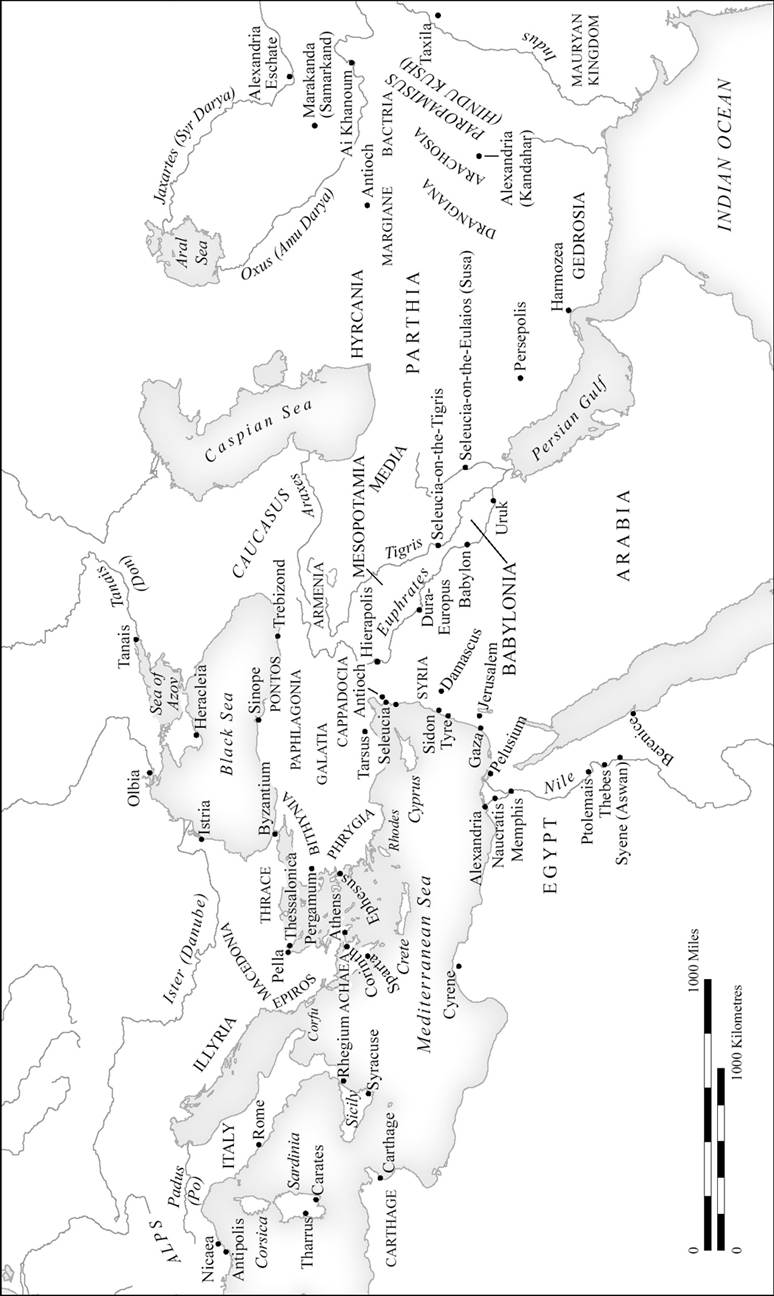
6. The Hellenistic world