Sargonic Empire
2.1. Antecedents and Roots
Although the Sargonic Empire was a completely novel experiment in the use of political power, it was not without precursors. Already a millennium earlier, Mesopotamia saw the appearance of a curious interregional venture, the so-called Uruk Expansion.[118] This network of unmistakably Babylonian enclaves occupied practically the same territory that was later claimed by the Sargonic kings—from Anatolia and the Mediterranean coast in the west to the outer reaches of the Iranian Plateau in the east.
Some sought to identify it as a territorial empire,[119] but the absence of evidence that these enclaves were ever parts of a monolithic power-system renders such a conclusion most unlikely. As best as can be ascertained, the “Uruk Expansion” was a commercial phenomenon, a system of colonies established by Uruk and other Babylonian proto-city-states without a recourse to military con- quest.[120] While emphatically not an empire, the “Uruk Expansion” was nevertheless significant historically, since it was apparently this development that was responsible for the establishment of trading patterns and commercial routes existing later in the very same region.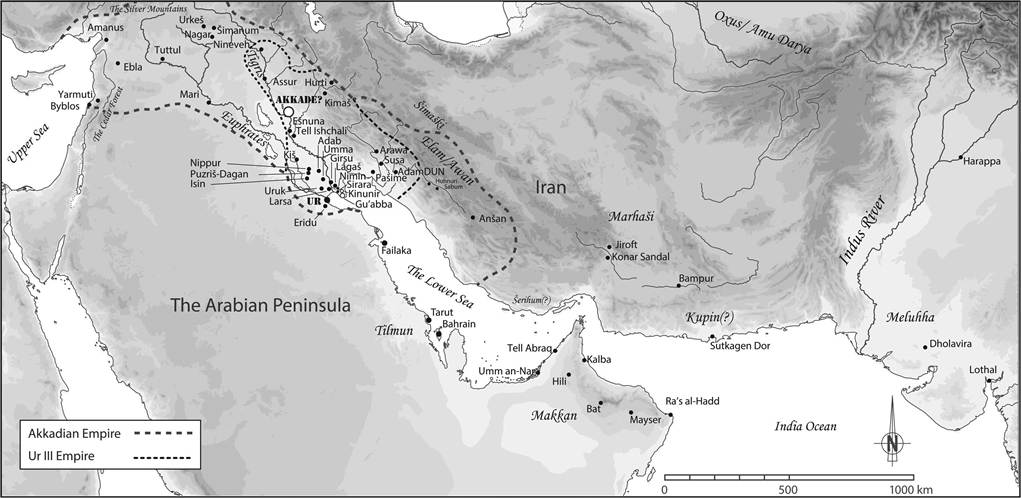
Map 2.1. The Akkadian and Ur III Empires. Copyright: Oxford University Press.
THE SARGONIC AND UR III EMPIRES 45
A more direct antecedent of the Sargonic Empire, both in time and space, was the kingdom of Kis, which in Early Dynastic times brought under its sway northern Babylonia, the Diyala Region, and probably certain trans-Tigridian territories, also managing to achieve hegemony over parts of southern Babylonia.[121] Although, due to the scarcity of relevant historical data, this Kisite entity remains largely a hypothetical construct, it appears that it was a territorial state of almost “imperial” size and objectives—thus contrasting sharply with the political organization of southern Babylonia, where city-states were the norm.
It also had a stronger and more authoritarian form of kingship. Since both these features were characteristic of the Sargonic organization as well, a case can be made that the Sargonic Empire, either directly or indirectly, had its roots in the Kisite kingdom.2.2. Outline of the Empire's History: Sargon through Sar-kali-sarri
The home of the Sargonic dynasty was the city of Akkade, which in all likelihood lay in the vicinity of Baghdad, within a crucial area where the Euphrates and the Tigris rivers come closely together. Its alleged founder was Sargon (Sarru-kin),[122] who is reputed to have ruled for 40 years. During the first decades of his reign Sargon conquered northern Babylonia together with its traditional political center Kis, probably also bringing the Diyala Region under his rule. He then confronted Lugal- zagesi of Uruk, who, only a short time earlier, had claimed a limited hegemony over southern Babylonia. In the ensuing war, Sargon faced and overcame a formidable coalition of southern city-states led by Lugal-zagesi, after which he became the master of southern Babylonia as far as the Persian Gulf (or the “Lower Sea” as he calls it in his inscriptions).
Subsequent to his victory over the south (or perhaps already much earlier), Sargon began to spread his power beyond the strict borders of Babylonia. The scale of these military operations was staggering, since it was not to be replicated until the days of the Neo-Assyrian Empire. In the west, Sargon captured the key Syrian cities of Mari (Tell Hariri), Tuttul (Tell Bi’ya near Raqqah), Ebla (Tell Mardikh), and Yarmuti (probably the later Yarimuta near Byblos), reaching the “Cedar Forest” on the coast of the Mediterranean (“the Upper Sea”), and perhaps even venturing into Anatolia. Toward the north he campaigned against Simurrum (the upper reaches of the Diyala River), probably also capturing most of Assyria as well. And in the east, having conquered the Susiana region (Susa and Urua), he waged war on the Iranian powers of Elam, Awan, Sabum, and Marhasi.[123] As a result of the latter operation he may have conquered significant portions of the Iranian Plateau, though this remains uncertain.
There are indications that he also sent an amphibious expedition into the Persian Gulf, reaching the coast of Makkan (Oman).[124] See map 2.1.Owing to this stupendous military achievement (which, like the conquests of Alexander the Great, almost defies explanation) Sargon claimed to rule “from the Upper Sea to the Lower Sea,” coining for himself accordingly the title of “Absolute Ruler” (sar kissatim). Although this claim was not entirely without justification, it is certain that no articulated political and administrative system of any importance was imposed upon the conquered territories during his reign. It would also appear that Sargon's hold over many of those newly acquired lands was ephemeral. Even in southern Babylonia the old system of city-states remained in place, with their rulers now simply Sargon's vassals. For these reasons, the political entity so created under no circumstances deserves to be called an empire. At best, it was an imperial project under way. Significantly, though, Sargon's conquests delineated the basic extent of the Sargonic expansion, since the reigns of his successors added to it only marginally.
In addition, Sargon made first attempts to impose Akkade's ideological imprint on southern Babylonia, as evidenced in the creation of the office of the en-priestess of the moon-god Nanna at Ur (which was held by his daughter—and possibly the first poetess of record—Enheduana), which was meant to counterbalance the (male) en-ship of the goddess Inana of Uruk, a dominant ideological and political institution in the south since Uruk times.
The enormity of Sargon's military accomplishment (and those of the other Sargonic kings as well) is underscored by the fact that these early conquerors were, as is described by Michael Mann, “marcher” warlords.[125] It is important to realize that the Sargonic conquests were carried out without the benefit of horses or camels as a means of transportation. This made it necessary for them to rely primarily on water transport to carry their materiel and food supplies.
While this mode of transportation was possible in the Persian Gulf region and within the basins of the Euphrates, Khabur, Balikh, and Tigris rivers, any farther-flung military operations had to be done on foot. Particularly noteworthy here was the feat of Sargon's grandson Naram-Suen, who, in pursuit of the rebel king of Uruk named Amar- Girid, marched from (A)simanum in northern Mesopotamia to the range of Jebel Bishri in northern Syria, crossing on the way the Tigris and the Euphrates rivers.[126]Two of Sargon's original inscriptions state that “5,400 men ate daily before him.”[127] This passage is usually understood as a reference to Sargon's standing army. More likely, however, those 5,400 men were Sargon's court officials and retainers, among whom some elite troops (especially, his personal guard) may have been included. The actual army, which must have consisted mainly of conscripts, undoubtedly was considerably larger. Some sense of how large this army may have been is provided by the numbers of enemies allegedly killed or captured by Sargon's successor Rimus in the course of his pacification of southern Babylonia, and as part of his campaign against Elam and Marhasi. Thus, during an operation directed against just one of the rebel cities (Kazalu), Rimus killed 12,052 enemy soldiers and took 5,862 prisoners.[128] The total number of killed or captured Elamites and Marhasians is said to have been 20,428.[129]
During the time of Sargon, most of the troops at his disposal probably were supplied by the southern city-states. As suggested by the fact that a governor of Adab named Meskigala is known to have participated in Sargon's expedition to the Mediterranean,[130] such troops apparently were led and commanded by the respective governors of the contributing city-states. If so, Sargon's army was essentially a coalition composed of largely autonomous military contingents.
The task of consolidating Sargon's territorial conquests and of turning them into a true empire fell to his sons Rimus and Manistusu, whose combined reigns lasted a total of 23 years.
Information on the events of these two kings' tenures is sparse, with even their ruling sequence being uncertain.[131] As far as it can be ascertained, during that time significant progress was made in imposing a more direct rule on southern Babylonia and in integrating it, both politically and economically, with its northern counterpart. Following a major revolt in the south against Sargonic rule during Rimus's reign, the southern city-states were turned into provinces governed by royal appointees. In a related development, the holdings of arable land owned by the southern temple estates were often confiscated, becoming the king's property. In accordance with the land-tenure conditions existing in northern Babylonia, such land was then distributed among the king's dependents in exchange for services.[132] This period also saw the transplantation to the south of the northern institution of privately owned arable land.As for Rimus's and Manistusu's foreign involvement, their efforts in that area concentrated on the consolidation of their father's conquests. Rimus waged a major war against Sargon's adversaries Elam and Marhasi. This conflict reached the territory of Marhasi itself (Kerman), putting an end (at least temporarily) to Marhasi's domination of the Iranian Plateau. Similarly, Manistusu sent an expedition to Makkan, apparently succeeding in establishing a permanent foothold there. As evidenced in his building activity in Nineveh, he also sought to strengthen Akkade's hold over Assyria.
However important the contributions of these two rulers may have been, it was only under their successor Naram-Suen that the empire reached the heights of its power and internal development. The chronology of the unusually long reign of Naram-Suen (55 years) unfortunately remains uncertain. It appears that the first two or three decades of his reign were essentially a continuation of his predecessors' work, and that it was a time of stability and great prosperity.
This situation was dramatically changed by an event that put the very existence of the empire into question. Around Naram-Suen's thirtieth regnal year (if not even later) a major revolt against his rule erupted. It was originally confined to the cities of Kis and Uruk, but it soon spread throughout Babylonia, eventually enveloping the whole empire. If one can trust Naram-Suen's inscriptions, the only place that remained loyal to him was his capital Akkade. Yet, despite these dire circumstances, and against all odds, Naram- Suen emerged victorious from this ordeal, quenching the rebellion and restoring the empire to its former borders.[133] In the wake of this heroic struggle, which was remembered by later generations as the “Great Rebellion,” Naram-Suen carried out a concentrated program of administrative reforms. As the “Great Rebellion” must have taught him, the main obstacle in the way of turning Babylonia into a truly unified state was the still unresolved question of the south. According to the southern ideology, city-states constituted exclusive domains of a democratic society of gods, with their borders being divinely sanctioned—and hence immutable. This ideological peculiarity made the creation of supra-city-state entities in southern Babylonia virtually impossible. Naram-Suen's solution was to elevate himself to the divine plane, in order to be able to claim divine rule—and thereby political sovereignty as well— over other city-states.[134] Characteristically, Naram-Suen's deification was instituted within the framework of the southern ideology. Since the possession of an earthly domain was one of the essential traits of divine status, Naram-Suen needed to own such a domain as well. Accordingly, he became the divine master of Akkade. But, while useful politically, this solution was not free of drawbacks, since by associating his divine self with Akkade, Naram-Suen turned that city into the empire's prime religious center. By doing so, he unavoidably put himself in direct conflict with Nippur, the traditional religious capital of southern Babylonia. Although this conflict was of no consequence during Naram-Suen's reign, it probably added negatively to the anti- Sargonic resentment during the reign of his successor.This ideological innovation was accompanied by equally momentous transformations in the realm of administration and economy. From the perspective of imperial policy, the most important development here was the creation of a chain of garrisons at the nodal points of the empire (see also section 2.3) and the introduction of an efficient system of communications, both of which were meant to strengthen the empire's defenses. The running of the administration was facilitated by the systematization of accounting procedures, with Akkadian replacing Sumerian as the official idiom.
As for the extent of Naram-Suen's foreign possessions, apart from recovering all the territories that had been conquered by his predecessors—an event he used to claim the title of the “king of the four quarters (of the world)”—he was able to extend the empire's borders still further. His most notable accomplishment in that area was his operations along the empire's northern border, which involved a campaign to the sources of the Euphrates and the Tigris, and the conquest of the “Upper Lands” (probably the southern sections of Armenia).
Naram-Suen was succeeded by his son Sar-kali-sarri, who also enjoyed divine status.[135] It appears that the first half of his reign of 25 years was comparatively peaceful and prosperous, and that he was able to control most of the territory he inherited from his father. The events of Sar-kali-sarri's later years are nearly completely unknown, except for the fact that he had to face the intrusions of Gutian and Amorite tribesmen (for which see section 2.4). Despite this lack of information, a good guess is that, already before his death, most (if not all) of the empire's foreign possessions were irretrievably lost. With this loss, which put an end to the Sargonic domination of the international trade routes, came the end of the empire as well.
2.3. Empire's Goals and Its Internal Organization
When confronted with the magnitude of the Sargonic expansion, one's first reaction is awe—and such too was the response of its contemporaries. One then naturally questions the purpose of this enormous undertaking. While one of the motivations behind it was to obtain for Babylonia products not available locally, such as metals, stone, and timber, this could not have been the main objective, since that goal would have been fully met by the mere control of the bordering Zagros zone, where all these materials were available in abundance. Thus, the main reason why the Sargonic kings undertook the enormous effort and expense of sending their armies to the outer borders of Western Asia and, subsequently, of maintaining a modicum of control over that vast territory must have been different. As I identify it, that reason was the goal of controlling—and thereby of exploiting economically—the main trade routes. In fact, it was the Sargonic rulers themselves who created the first great commercial highway of the Near East, through the linking of a number of subregional trading networks. Starting in Meluhha (Indus Valley), this highway ran along the coast of the Persian Gulf via Makkan and Tilmun (Bahrain) to southern Babylonia, continuing then along the Euphrates all the way to the Mediterranean coast.[136]
That the reaping of profits from international commerce was the main motivation behind the Sargonic expansion is corroborated by the testimony of the Sargonic kings themselves, who, beginning with Sargon, identify as one of their greatest accomplishments the bringing of the ships of Meluhha, Makkan, and Tilmun to Akkade. Further indication of this is provided by the fact that, apart from exacting the payment of tribute, the Sargonic Empire was never engaged in a systematic economic exploitation of the conquered territories. Nor did the Sargonic kings make any attempt, as far as we know, to annex those lands to Babylonia and to put them under their direct rule. The empire's involvement in the periphery was limited to the establishing, at various strategically important points, such as Mari, Nagar (Tell Brak), Tuttul, Assur, Nineveh, and Susa, of large military strongholds. Permanently staffed with Akkadian soldiers and administrators, these garrisons overlooked trade routes, safeguarding the free movement of caravans and collecting custom dues.
In this way, the empire's administrative system consisted essentially of its military organization, to which there was attached extensive scribal and accounting personnel. Although it existed (at least in some form) already under Sargon, the standing army was considerably expanded during the following reigns. It appears that, subsequent to the “Great Rebellion,” it was also significantly reorganized. Its highest officers were “generals” (sagina), who were posted in charge of the empire's chief nodal points. The power and prestige of that office was such that, following the empire's demise, in various parts of the periphery (as in Mari and Elam) the title of sagina became the favored designation of a royal figure.
As part of the changes that followed the “Great Rebellion,” administrative and accounting procedures were significantly reformed. This led to the introduction of a new script and new types of administrative records. Since the documents produced during that time show a remarkable uniformity throughout the empire, a large program of scribal training must have been carried out as well.
This system of limited and comparatively light-handed imperial control, which appears to have fully developed only after the “Great Rebellion,” was fortified by treaties and diplomatic marriages with the important regional powers. Although documented only for Urkis (Tell Mozan), Elam, and Marhasi, such arrangements were probably made as a matter of course, constituting one of the main tools of the empire's foreign policy.
2.4. Empire's Demise
Although causes of imperial collapse are notoriously difficult to identify, they almost always involve a combination of internal (structural) and external (mainly political) factors. In the case of the Sargonic collapse, structural factors probably took precedence. As emphasized earlier, the empire was never fully integrated either politically or economically. This was especially true of its foreign possessions, where Akkade's rule was nominal (or symbolic) at best. Therefore, once the external factors intervened in force—and those, as we shall see shortly, were formidable— the empire was unable to maintain its control of the periphery, especially since its allies and vassals lacked any incentive to keep their prior commitments. Thus, as soon as the disintegrative processes had set in, they declared independence of Akkade, thereby hastening the collapse.
As for the outside factors, probably the most significant among them was the intrusion of two new ethnic groups—the Amorites and the Hurrians—into northern Syria and Upper Mesopotamia, which formed the heart of the empire's foreign possessions. The Amorites, who were active in the middle Euphrates Valley already during the reign of Naram-Suen,[137] moved into the Khabur triangle sometime during the time of Sar-kali-sarri, subsequently expanding as far to the east as the Tigris Valley and the Zagros. Proceeding from the opposite direction, a generation or so earlier the Hurrians had invaded the same territories, coming eventually into contact with the Amorites. Probably already by the end of the Sargonic period these two ethnic groups divided that entire zone among themselves, with the Amorites taking its southern section, and the Hurrians settling in the northern half.
Another destabilizing development was the Gutian intrusions, which began during Sar-kali-sarri's reign. In the opinion of contemporaries at least, these mountain folk were the main cause of the Sargonic collapse. While this view doubtless is an exaggeration, the fact that the Gutians became the main political power in Babylonia following the empire's demise indicates that their intrusions must have contributed significantly toward the collapse. Since their homeland lay in the Zagros, the appearance of the Gutians on Babylonia's eastern fringe possibly resulted from their having become dislocated through the Hurrian and Amorite wanderings described earlier.
As has been suggested by some scholars, these ethnic movements—and therefore the empire's collapse as well—are attributable to climatic changes that apparently occurred around that time.[138] However, while suggestive, the scientific data cited in support of this theory are inconclusive.
2.5. Impact and Legacy of the Sargonic Empire
As a result of the Sargonic conquests, for the first time since the days of the “Uruk Expansion” (see earlier discussion in section 2.1) polar parts of Western Asia were brought into direct contact with each other. For a century or so, an unprecedented level of exchange and human intercourse occurred—equally on the material and intellectual levels. Apart from artifacts, minerals, animals, and plants, technology, ideas, literature, and art were also traded en masse. To the people who experienced it, especially those living at the center of the empire, it must have looked like the dawning of a new age. Not only did a “world economy” of sorts develop for the first time, but a high degree of cultural integration was also brought about throughout the area affected by the Sargonic phenomenon.
The empire had a strong and lasting impact on the later history of Mesopotamia. For two millennia—down to the time of Alexander the Great—Sargon and Naram- Suen served as paragons of a heroic world-conqueror. They began to be imitated as soon as their empire came to an end, first by the Elamite ruler Puzur-Insusinak (see section 2.6), and then by the Ur III kings. This fascination with the Sargonic Empire continued in Old Babylonian times, especially in Assyria, where the Amorite Samsi- Adad traced his political descent to Naram-Suen, adopting the latter's ideology and titulary, and modeling his own “empire” after the Sargonic example. Such too was the case of the ruler of Esnuna (and Samsi-Adad's contemporary) named Naram- Suen, who, both by his adopted name and his actions, tried to emulate the great Sargonic king. And, when 100 years later Hammurabi's son Samsu-iluna successfully fought a great rebellion in his kingdom, in the written accounts of that conflict he chose to paint himself as a Naram-Suen Redivivus, victoriously quenching a “Great Rebellion” of his own.
Assyria's self-identification with the Sargonic Empire continued into the first millennium bce. Not only did the Neo-Assyrian kings consider themselves to be Sargon's and Naram-Suen's heirs, but they also used Sargon's conquests as a blueprint for their own empire.[139]
Posterity's fascination with the Sargonic Empire also found reflection in the large body of later literary compositions, dating from the Ur III period through Neo-Babylonian times, which treat the exploits of Sargon, Manistusu, and Naram- Suen.[140] Classified variously by scholars as legends, sagas, epics, or myths, these compositions, while occasionally going back to the original Sargonic inscriptions, for the most part are pure inventions, whose purpose was to teach a moral lesson about the history at hand.
What impressed later generations most about the Sargonic Empire was the incredible scale of its conquests. Nothing like that had been attempted before, and no earlier ruler had claimed dominium over such an unimaginably large and diversified geographical area. Equally appealing was the heroic and daring spirit that apparently accompanied those ventures. Sargonic armies—particularly that of Sargon—were likely relatively small. Thus, what made them so successful must have been, above everything else, their bravery and audacity, and curiosity about the unknown. Not surprisingly, many of their feats appeared to be nigh supernatural, both to their contemporaries and later history.
2.6. Sargonic Aftermath
The length of the period between the end of Sar-kali-sarri’s reign and the ascent of Ur-Namma, the founder of the Ur III dynasty, is uncertain, though ca. 80 years is probably the most likely figure.[141] The last Sargonic kings ruled for a while over the remnants of the empire, which included portions of northern Babylonia and the Diyala Region. These territories were subsequently captured by Gutian tribesmen, who, having settled there and assumed an urban way of life, eventually established a bona fide territorial state, which extended along the Tigris Valley, from Sippar to Adab in southern Babylonia.[142] Ruling from Adab, the late Gutian kings were even able to impose their rule on the neighboring state of Umma, which became their vassal. Other portions of southern Babylonia retained independence, reverting to the earlier decentralized system of city-states. Lagas and Uruk became dominant political powers there, with Lagas experiencing a particularly prosperous phase of economic and cultural revival under the dynasty of Ur-Bau and Gudea.
Toward the very end of the post-Sargonic period, Babylonia was plunged into a period of political upheaval of bewildering complexity. It appears that this upheaval was precipitated by the actions of an Elamite ruler named Puzur-Insusinak, who, after establishing himself at Susa and bringing under his control significant portions of the Zagros, invaded and then occupied the Diyala Region and large sections of northern Babylonia.[143] Puzur-I nsusinak’s conquests, which, in view of their scale, might even be considered imperial, altered the balance of power in Babylonia, in that it weakened the position of the Gutians, not only in Babylonia but also in the Zagros, where the original Gutian homeland and their real power base were situated. It may be conjectured that the latter developments emboldened the southern Babylonian city-states to rise against the Gutian rulers of Adab, who, by the virtue of their control of the middle Tigris Valley, denied southern Babylonia access to trade routes and deprived it of irrigation water. A ruler of Uruk named Utu-hegal chased out the last Gutian ruler from Adab, putting an end to the Gutian domination. During his short reign of eight years, Utu-hegal extended his power to Ur, perhaps putting a number of other southern states under his rule as well. Such a limited hegemony is indicated by his use of the grandiose title of the “king of the four quarters,” which had been introduced by Naram-Suen. Be that as it may, however, the true unification of the south came only with Ur-Namma, the founder of the Third Dynasty of Ur.
3.