THE CLASSICAL AGE
Culminating in the Formation of Large World Empires on the Margins of Eurasia: The Mediterranean and China (323 bce-600 ce)
Peter Fibiger Bang
At the end ofthe fourth century все, the Eurasian expansion, ofwhich the Achaemenid Empire had been the first sign, gained speed.
In less than two centuries a spate of vast empires formed in a band stretching across the great landmass of Afro-Eurasia.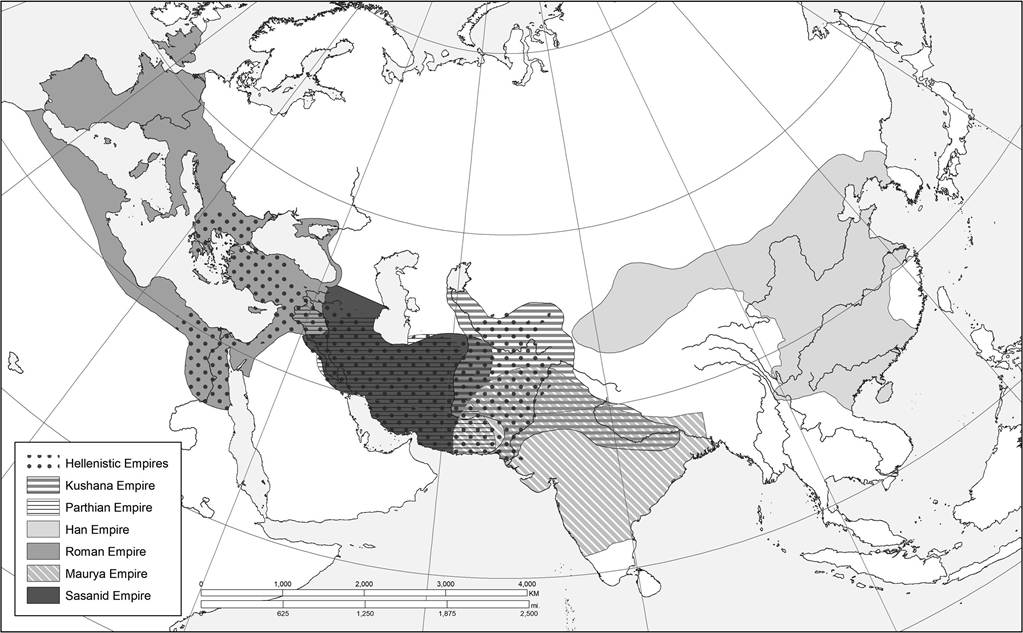
Map II. The Classical Age, Culminating in the Formation of Large World Empires on the Margins of Eurasia: The Mediterranean and China (323 bce-600 ce)
They generally mapped onto the agricultural heartlands, slowly developing and expanding on the immense continent from east to west. This was no co-incidence. Later a similar process can be observed in the pre-colonial Americas. As Beattie and Anderson make clear in Chapter 14 of Volume 1 on ecology, empire traced the core agricultural zones of the preindustrial world. If, perhaps, the empire of the Achaemenids had comprised some 20-25 million people, the world of grand empires had grown to include some 150-200 million half a millennium later. Intensive cultivation and a degree of social complexity had developed in a number of core areas long before—of course, in China on the Yellow River, and with the so-called Harappa civilization in India. But the records are too sparse and too shrouded in myth to permit an actual history of potential empire. All this changes by this period as a number of polities formed of an entirely different order of magnitude. In trying to identify some unifying themes for a pre-colonial world history, many have looked to either the people of the steppes or Old World long-distance trade—nomadic warriors or Silk Road merchants. But the significance of these phenomena pales in comparison to the broad, powerful sweep represented by this expansive and imperial development across Afro-Eurasia.
First was Alexander the Great, ruler of a kingdom that had been built up on the western fringes of the Achaemenid world. In a virtual blitzkrieg (334-323 все) his army managed to defeat Darius III and take over the Persian Empire before he died, barely having reached the age of 33, at which point his newly won possession quickly split up among a number of his high-ranking generals. As a consequence, competition intensified in the Mediterranean between these rival Hellenistic empires (Fischer-Bovet, Chap. 6). The system received a further boost when more westernlying powers such as Rome and Carthage, having begun to accumulate imperial territories for themselves, joined the fray. From then on, this part of the world formed an interconnected system, as the Greek contemporary historian Polybios observed, out of which Rome would emerge victorious and gain hegemony in the second century bce (Bang, Chap. 9).[386] Meanwhile, Alexander’s exploits on the eastern frontier of the Achaemenid Empire had arguably paved the way for a dynasty, the Mauryan, to expand and assert its power among the many budding kingdoms and principalities along and beyond the great riverine plains of North India (Ray, Chap. 7). Under Asoka, the peace and order of the Mauryas, dhamma, was announced far and wide on tall, polished columns and in rock-cut reliefs. Finally, further east, a system of intensely competitive warring states had developed. The monarchy of the Qin came out on top to “unify all under heaven”, Tianxia, in 221 bce, only to find itself toppled by the Han a few years later (Lewis, Chap. 8).
This was the classical age of empire. By the turn of first century of the Common Era, a league of universal imperial polities bestrode the vast Afro-Eurasian landmass from east to west. The Han dynasty in China, the Kushanas in North India and Afghanistan (Benjamin, Chap. 11), the Parthians in Iran and Mesopotamia (Canepa, Chap 10), and finally the Roman Empire, which held the territory around the Mediterranean Sea.
To Tacitus, the historian and Roman senator (c. 56-120 CE), the case for empire could be summarized in the following adage: “there can be no peace among the peoples without soldiers, no soldiers without pay and no pay without tribute.”[387] Empire afforded order and protection by maintaining an army, paid for through taxes that were levied on subjects. In the Near East, the same idea was expressed in the notion of the “circle of justice.” The ruler provided justice and protection, and subjects reciprocated by staying loyal and by paying their taxes (see further discussion in Chap. 9, both of this volume and of Volume I, the latter by Bennison). Yet, from another perspective, imperial power represented brutal conquest, plunder, and submission. The Maghrebi historian Ibn Khaldun would later theorize the “government of conquest.” In this theory, a strong cohesive group of conquerors might capture power and impose its rule, but would then decline in a few generations as its members became absorbed into the subject society. Government was open for a new takeover as the conquering group withered away. To Ernest Gellner, the circle of justice and the paradigm of Ibn Khaldun represented two alternative forms of statehood. Sometimes, today, ancient empire is mainly understood from the Khaldunian perspective as feeble, fleeting, and ephemeral.[388] Rather than being mutually exclusive, however, the two models are best understood as representing different phases in the formation of empire and the necessary transition from conquest to stable peacetime government. Many conquerors never managed to consolidate their rule and have mostly been forgotten. Others, like Attila the Hun, are remembered for the terror they struck into the hearts of the sedentary rulers. But their power often evaporated as quickly as it came, occasionally enjoying a few decades of success, skirmishing as predators along the frontier of the more densely settled lands, in competition with its sedentary rulers. Here, the Huns of Attila in the fifth century ce find a counterpart in the shadow empire achieved by the Xiongnu in the second century bce, on the frontier of the early Han dynasty empire. No less often, however, the populations of these mobile frontier societies constituted a reservoir of recruits for the armies of established rulers.By contrast, the universal empires, dominating Afro-Eurasia at the turn of the first century ce, largely succeeded in making the transition. Although they continued to draw on some practices of fluid nomad society, both the Parthian and Kushan rulers had already adopted a sedentary form of organization before acquiring their empires. Imperial monarchies like the Romans and the Chinese not only managed to create standing armies whose scale—numbering in the (low) hundreds of thousands of soldiers—would only rarely be matched, and not really surpassed, until the seventeenth century, they also successfully forged elites into stable pillars of their rule. They did so by co-opting leading members of the subject populations into helping rule the empire. “Not even provincials,” the emperor Claudius declared to the assembled elite of Roman senators, “do I believe should be rejected [for membership of the senatorial order] as long as they may add lustre to this house.”[389] An imperial ruler should draw on all the resources and all the talent of his realm, not just rely on the people of the metropolis. Successful consolidation meant widening the catchment area of the ruling class and depending less on the original group of conquerors. When empires of this sort also managed to reduce levels of external competition by absorbing most of their rivals, the scene was set for very durable and long-lasting rule. Empires might see dynastic changes or power shift to a different branch of the imperial family; such events could be serious enough to spark temporary division, rebellion, and warfare. However, in a certain sense, they remained ripples on a sea of continuous stability.
The Parthian and Sasanian dynasties, in combination, ruled Iran and Mesopotamia for more than seven centuries. Roman hegemony in the Mediterranean ran parallel to this experience. The Qin and the Han dynasties could claim only, but still a very respectable, four and a half centuries between them. When Virgil, the poet laureate of Latin literature, made Jove promise the Romans “empire without end,” it was of course poetical hyperbole. Measured in the time span of mortals, however, he was not wide of the mark.[390]Stability facilitated the dissemination of a number of shared upper class, transregional cultures, based on literature, public rituals, modes of conspicuous consumption, and monumental manifestations of elite power. Their idiomatic expressions were anchored in cosmopolitan formulas of prestige, defined by a canon of exemplary models. These were deemed classical and universal, not tied to any particular local context, but fit for all ages and every place. The literati of the Han court saw themselves as the heirs of a cohort of learned people who, in the centuries prior to the imperial unification, had traveled between the rivaling courts of Tianxia to offer their service to monarchs virtuous enough to listen and follow their edifying lore.[391] The Romantics of the nineteenth century condemned this type of culture as lacking in originality and genuine sincerity. The mannered products of civilization were anything but an authentic expression of the people, the complaint sounded, all founded on dead and fossilized languages. Yet, it was precisely the artifice and studied quality of high culture that enabled the cosmopolitan model to “travel” and provided a shared medium and symbolism for elites across vast distances. Celebrating demanding programs of personal cultivation and disciplining of character, the dignified modes of aristocratic life were designed to make their carriers stand out from the crowd.
Within these networks of elites and their cultural refinement, the courts of monarchs served as nodal points, attempting to act as arbiters of taste and to spark cultural emulation.
Imperial government, however, had few effective instruments with which actively to change the cultural orientations and the identities of subjects; no programs of forced “conversion” were initiated, nor introduction of general schooling to inculcate the population majority of peasants into the tenets of courtly literary culture. That would, in any case, have failed the purpose; the integration of imperial high culture was not aimed at the hoi polloi, the broad mass, but was instead based on distinction and discrimination, an exclusionary phenomenon. Across the empires, elite rule over the peasant (and slave) majority was solidified. Hierarchical selectivity, therefore, meant that rulers could, to a very large extent, rely upon ambitious elites to change their outlook on their own, to seek privileges and align themselves with the prestige of the imperial power. This was the civilizing process that the sociologist Norbert Elias would identify on the basis of the early modern absolutist French court. But long before Louis XIV—the paradigmatic Sun King—the imperial courts of antiquity presided over a set of slowly expanding literary and symbolic commonwealths. Confucian learning, courtly Sanskrit culture, as well as Greek and Roman literature— these constituted a set of patterns forged in the crucible of imperial culture that would continue to set a standard in the centuries to come.Although these cultural models came to define the classical stylistic expression of what are today several of the world's civilizations, they did not develop in isolation or solely on the basis of the culture of the conquering community. Imperial monarchs and their elites participated in a competitive dialogue, both with the conquerors of past times and the living rulers, lesser and greater, who inhabited the wider orbits of their contemporary world. A good illustration of this dynamic process is afforded by the remarkable third-century ce inscription describing the Kushan ruler Kanishka III as “maharaja, rajatiraja, devaputra, kaisara”—“great king, king of kings, son of heaven, Caesar.”[392] In order adequately to reflect the majesty of the ruler, the text, in
the Indian language of Prakrit, calls upon the repertoires of Persian, Greco-Roman, and possibly Chinese imperial lordship. To be sure, the Kushan rulers sat astride a crossroads of Eurasia, and so mirrored influences of both East and West. But all imperial monarchies had to speak to several constituencies and all sampled elements of elite culture from across and beyond their realms in forging their own idiom to enhance the splendor of their ruling society.
For a long time the ancient art of Gandhara provoked wonder for its combination of Greek-style sculpture and Buddhist content. Were these artworks the products of a small lingering community of Hellenic descendants from the time of Alexander’s campaigns, hundreds of years before? These speculations fed on the dreams of adventure that animated the imagination of metropolitan publics during the age of colonialism. They found their expression in The Man Who Would Be King, Kipling’s short story about two reckless British charlatans who sought fame and fortune on the Afghan frontier and stumbled upon an isolated enclave of distant descendants of Alexander’s Macedonian soldiers (see further, Vasunia, Chap. 15, Vol. 1). The truth is probably more mundane, but no less fascinating. As the Iranian Parthian dynasty gradually severed itself from the Seleucid successors to the Perso-Mesopotamian part of the realm of Alexander during the second century bce, they continued to publicize their philhellenism. This was a proclamation that their court was fully able to participate in the opulent sophistication of Hellenistic civilization and would continue to welcome the service of the segments of Greco-Macedonian elites who were still under their authority. It seems more than likely that the Kushan monarchs took up sponsorship of Hellenic art in symbolic rivalry with their Parthian opponents. When the Sasanian dynasty later ousted the Parthians, scored a number of widely broadcast triumphs over Roman emperors, and embarked on a victorious campaign against their Eastern neighbour, it was but a short step for a precocious Kushan ruler defiantly to claim the title of kaisar to match and mirror the exploits of his Sasanian rival.
Bibliography and Guidance
World history of the classical age is still in its infancy. Scheidel (2009 and 2015) and Mutschler and Mittag (2008) have spearheaded empirically based comparisons between ancient imperial Rome and China. Spawforth (2007) placed imperial courts across Eurasia during this period, within the same comparative framework, while Lavan, Payne, and Weisweiler (2016) have explored the formation of cosmopolitan elites and the hierarchical submission of subject peoples from the Achaemenids to the Sasanian dynasty. Bentley (1993) is a classic exploration of cultural exchange between pre-colonial civilizations and offers illuminating discussions, not least of the art of Gandhara. Versluys and Pitts (2015) mobilize the notion of globalization to bring the cultural agendas of world history to bear on the Roman world. Finally, Benjamin (2018) surveys the band of empires across “classical” Eurasia, emphasizing, more than this author, the significance of the so-called Silk Road.
Bibliography
Banerjea, J. N., and Prof. Jagannath. 1957. “The Rise and Fall of the Kushana Power.” In K. A. N. Sastri, ed., A Comprehensive History of India, Vol. 2, 222-262. Calcutta.
Bang, P. F. 2015. “Platonism: Ernest Gellner, Greco-Roman Society and the Comparative Study of the Premodern World.” Thesis Eleven 128, no. 1: 56-71.
Benjamin, C. 2018. Empires of Ancient Eurasia: The First Silk Roads Era, 100 BCE-250 CE. Cambridge.
Bentley, J. 1993. Old World Encounters: Cross-Cultural Contacts and Exchanges in Pre-Modern Times. Oxford.
Dessau, H. 1892-1916. Inscriptiones Latinae Selectae, 3 Vols. Berlin.
Falk, H. 2009. “The Pious Donation of Wells in Gandhara.” In G. J. R. Mevissen, and A. Banerji, eds., Prajnadhara: Essays on Asian Art, History, Epigraphy and Culture in Honour of Gouriswar Bhattachary, 23-37. New Delhi.
Gellner, E. 1981. Muslim Society. Cambridge.
Howe, S. 2002. Empire: A Very Short Introduction. Oxford.
Konow, S. 1929. Corpus Inscriptionum Indicarum, Kharoshthi Inscriptions with the Exception of Those of Asoka. Calcutta.
Lavan, M., R. E. Payne, and J. Weisweiler, eds. 2016. Cosmopolitanism and Empire. Universal Rulers, Local Elites and Cultural Integration in the Ancient Near East and Mediterranean. Oxford.
Lüders, H. 1912. “Epigraphische Beiträge.” Sitzungsberichte der koniglich preussische Akademie der Wissenschaften: 806-831.
Mutschler, F.-H., and A. Mittag, eds. 2008. Conceiving the Empire: China and Rome Compared. Oxford.
Scheidel, W., ed. 2009. Rome and China: Comparative Perspectives on Ancient World Empires. New York and Oxford.
Scheidel, W, ed. 2015. State-Power in Ancient China and Rome. Oxford and New York.
Sherk, R. K., ed. and trans. 1988. The Roman Empire: Augustus to Hadrian (Translated Documents of Greece and Rome). Cambridge.
Sims-Williams, N., and H. Falk. 2014. “Kushan Dynasty ii: Inscriptions ofthe Kushans.” Encyclopedia Iranica, online edition, http://www.iranicaonline.org/articles/kushan-02-inscriptions.
Spawforth, A., ed. 2007. The Court and Court Society in Ancient Monarchies. Cambridge.
Versluys, M. J., and M. Pitts, eds. 2015. Globalisation and the Roman World: World History, Connectivity and Material Culture. Cambridge.
More on the topic THE CLASSICAL AGE:
- 4 THE FIRST WORLD WARS AND THE ‘CLASSICAL’ AGE 494 BCE–404 BCE
- Potestas
- Demonic Influence and Symptoms of Melancholia
- Conclusion
- Until relatively recently, historians of psychiatry were inclined to view the Christian Middle Ages as a medically primitive era, and the period before 1200 was considered particularly bleak.[646]
- Monks and Friars
- INSCRIBED BODIES IN EVERYDAY LIFE
- Bibliography
- Legacy
- CHAPTER FOUR Town and Country Urban devotions and rural rituals