The Ptolemaic and Seleucid empires are the two largest and longest-lasting territorial states that emerged from Alexander’s conquest of the Persian Empire.
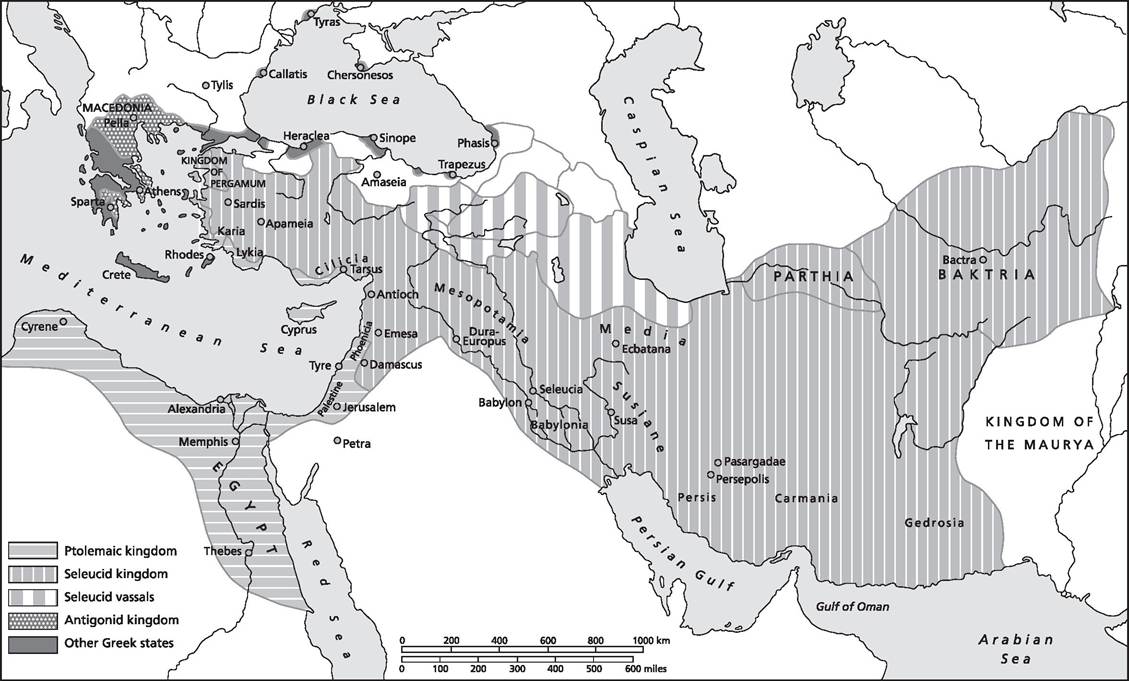
At its maximal extent in the third century bce, the Ptolemaic Empire included a large section of the eastern Mediterranean, namely Cyrenaica (modern Libya), Egypt and part of lower Nubia, Coele-Syria (the ancient denomination for modern Israel, the Palestinian territories, Lebanon, and part of Jordan and Syria), Cyprus, southern and western Anatolia, Thrace, cities in the Aegean, the Peloponnesus, and Crete.
The Ptolemaic state is sometimes considered to be a maritime empire, while at other times this status is contested. It is traditionally called a kingdom, because this is the closest translation of the Greek word basileia and because by the first century bce it consisted only of Egypt and Cyprus. However, it is argued here that, within a comparative approach to state formation, the Ptolemaic state faced the challenges of empire regarding the integration of diverse, multiethnic populations, as well as mediating the relationship between central and local elites.1 It has been analyzed through a colonial lens, but scholars have cautioned that the colonial model represents only one way to look at the multitude of social relationships among Egypt’s diverse populations.2 The same holds for the Seleucid kingdom, whose territory was larger and even more composite since it included most of the former Achaemenid Empire, from Syria and Anatolia to the Pamir Mountains (modern Afghanistan). Coele-Syria, furthermore, passed from the Ptolemies to the Seleucids in 198 bce. It is assumed here that such premodern empires consist of networks of communications, built through case by case negotiations rather than uniform policies.3 In terms of duration, both empires were the most enduring states in the region since the Neo-Assyrian Empire (911-612 bce). The Ptolemaic dynasty ruled for 293 years (323-30 bce), making it the longest-lasting of all the pharaonic dynasties. The Seleucid dynasty lasted 248 years (312-64 bce), comparable to that of the Achaemenid empire1 Scheidel 2013, 27-30, with bibliography; Goldstone and Haldon 2009, 17-19. I thank Cathy Lorber and Andrew Monson for their comments on this chapter.
2 Bagnall 1997; Manning 2010, esp. 49-54; see discussion on “hellenization” in the last section of this chapter.
3 On empires as networks of communications, see Liverani 1988.
Christelle Fischer-Bovet, Hellenistic Empires In: The Oxford World History of Empire. Edited by: Peter Fibiger Bang, C.A. Bayly, Walter Scheidel, Oxford University Press (2021). © Oxford University Press. DOI: 10.1093/oso/9780197532768.003.0006. (220 years). This time scale is all the more remarkable since empires were frequently not a durable type of state (map 6.1).[393]
This has led recent scholarship to stress the success, or at least sustainability, of the Hellenistic empires when compared to other pre-modern states (here used as a synonym of “early states”).[394] Manning emphasizes the resilience of Ptolemaic institutions while rejecting previous models of oriental despotism and dirigisme that assumed a level of control far too high on the part of the king.[395] Another way for empires to survive is to transform themselves into “generic territorial states” where “metropole and periphery” merged, as noted by Scheidel. Here, empires may be conceptualized as a “developmental stage” of the state.[396] This chapter offers an analysis of these two complementary processes—that is, resilience of institutions and the transformation of the state—in order to identify and explain what developments were particular to these two Hellenistic empires, their effect on their populations, and the ways in which internal decay does not automatically lead to collapse, but rather at times to reconstruction under the same dynasties. The Ptolemaic Empire lost its most peripheral areas in the second century but was able to consolidate its state institutions and to integrate various population groups through reform.
The Seleucid Empire did likewise, often carrying out several reforms at once, but the integration of various populations seems to have been less thorough. Like any empire, both were exposed to endogenous threats (dynastic conflict, coups d’etat, domestic revolt, and pressure from elites—central and peripheral). More interestingly, they faced the same exogenous factors because they belonged to the same state system— dubbed “an interstate or multipolar anarchy” in Eckstein’s theory of international relations—a system that became even more complex with the Roman expansion into the eastern Mediterranean.[397] From an ecological point of view, the high intensity of volcanic eruptions during this period affected the seasonal monsoon, and thus the Nile flood, which seems to have triggered droughts that could destabilize the political situation in Egypt. Its effect on the Tigris-Euphrates river system remains unexplored.[398]The political entities ruled by the Ptolemies and the Seleucids achieved the main functions usually attributed to early states, as proposed by Tilly: warmaking, state-making, protection, extraction, and to some extent three additional functions—adjudication, distribution, and production. The degree to which these functions were accomplished differed, especially in peripheral areas, but this did not prevent the rulers from asserting territorial claims over those regions.[399] After a
HELLENISTIC EMPIRES 169
Map 6.1. The Hellenistic World, ca. 250 bce.
Source: Bang and Scheidel, 2013, The Oxford Handbook of the State in the Ancient Near East and Mediterranean, map. 12.1. Copyright: Oxford University Press.
historical survey of both empires, the second section of this chapter offers a macroperspective on the capacity of these empires for warmaking, protection, and extraction, as well as on their military and economic goals, and on the main challenges they encountered. The third section turns to state building and to a more detailed evaluation of how they organized and reformed their institutions to perform primary state functions, while the last section examines the effects of empire building on the societies and cultures of these regions.
Our knowledge of the vast geographic area under investigation comes from a variety of sources.11 First, thousands of Greek inscriptions, Greek and Egyptian papyri, and cuneiform clay tablets offer a unique glimpse into the administrative and economic institutions of these states and the daily lives of their subjects. Second, archeological material and coins add to this contemporary and diachronic body of evidence. Finally, the accounts of ancient Greek and Roman authors, only partly preserved, provide a partial (and biased) historical narrative of the period, often written long after the fact.12
I.