5. The Codex Iustinianus Repetitae Praelectionis Composition and Content
The Codex Iustinianus70 comprises 12 books. Unlike the Theodosian Code, Justinian’s Code deals in the first place with ecclesiastical law (C.
1.1-13),71 followed by the sources of law, the position of the emperor in the legal system (C. 1.14-25), and the administration of the empire (C. 1.26-57). Books 2 to 8 deal with private law, book 9 with criminal law, and books 10 to 12 are predominantly concerned with the law of the fisc, municipal administration, the colonate, and subordinate offices. The books are divided into titles. Within the titles the imperial constitutions are arranged in chronological order. At the beginning of each constitution the emperor who enacted it and the addressee are named (see above in connection with the Theodosian Code); at the end the date of the enactment is given (subscription).Interpolations
The concrete changes which the compilers of the Code made to the originals can again only be seen in those instances where the same text has been transmitted twice, in particular when a constitution is also included in the Theodosian Code.72 Parallel transmission of material taken from the Codex Gregorianus or the Codex Hermogenianus is very much rarer.
A law enacted by the emperors Gratian, Valentinian II, and Theodosius I in AD 383 will serve as an example for alterations in the text. The constitution deals with the rights of the seller of an estate if the price paid by the buyer is lower than the actual value of the estate. The law is included in the Theodosian Code as well as in Justinian's Code.
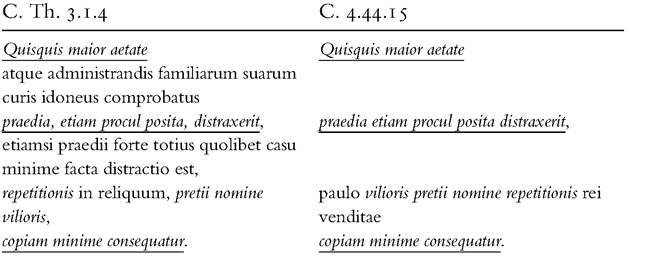
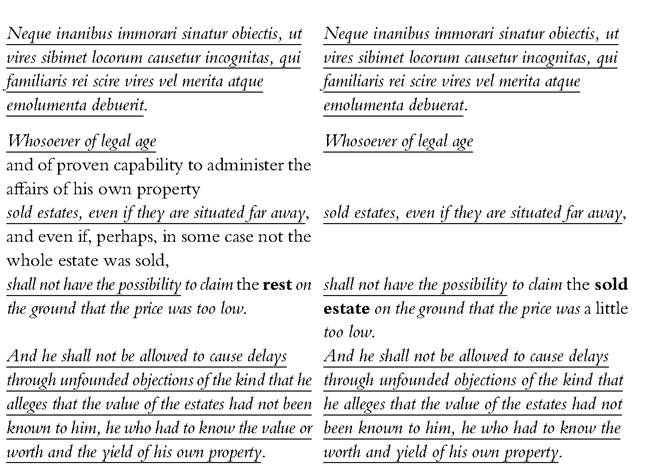
The version in the Theodosian Code requires that the seller be of legal age and capable of managing his affairs.
Justinian’s Code speaks only of the necessity of the seller being of legal age; the second requirement is completely left out. Justinian’s Code also omits the passage which explains that the sale of part of the estate suffices; probably this passage was simply seen as unnecessary. The next alteration to the text, however, signifies an actual substantive change in the law: in the version in the Theodosian Code the seller demands that the buyer now also pay the ‘rest’ - that is, the difference between the price originally agreed and the actual value of the estate - and the emperor refuses this demand. In Justinian’s Code, by contrast, the seller demands the return of the sold estate, and the law in this version states that this is not possible if the price is only a little below the actual value of the estate. Here the compilers of Justinian’s Code altered the text of the original constitution in order to include a change in the law which had taken place since the enactment of the original: under Justinianic law the seller of an estate could rescind the sale if the price was lower than one-half of the actual value of the estate. The buyer could avoid this by paying, in addition, the amount by which the price fell short of the full value.73 If, however, the difference between the price and the actual value of the estate was only small, the seller had no right to rescind the sale - so says the law in the version in Justinian’s Code. The last part of the law, which states that ignorance of the value of one’s own property cannot serve as a pretext for rescinding contracts, was left unchanged. So the types of interpolations seen in the example are the complete omission of passages (atque - comprobatus, etiamsi - distractio est) and changes to the wording (repetitionis in reliquum, pretii nomine vilioris - paulo vilioris pretii nomine repetitionis rei venditae).74 Elsewhere in Justinian’s Code the addition of passages is also attested.75Editions, Transmission, and Textual Criticism
The authoritative edition of the Codex Iustinianus was produced by Paul Krüger and published in 1877.76style='font-size:9.5pt;line-height:115%;font-family:"Arial",sans-serif'> There was also an editio minor with an abbreviated critical apparatus.
It was first published in 1877 and reprinted a number of times. Starting with the ninth reprint (1915), in the course of revising the editio minor of the Digest (see Section 3) Paul Krüger also expanded the editio minor of the Codex Iustinianus.The manuscript transmission of Justinian’s Code is inferior to that of the Digest. A late-antique manuscript which in appearance and age is similar to the Codex Florentinus has survived only fragmentarily, in the form of a palimpsest.77 We also have smaller fragments of manuscripts from late antiquity.78 Excerpts in collections and the remnants of complete manuscripts have survived from the early middle ages.79 The great majority of the manuscripts which are extant date from the high middle ages.80 Some of the early manuscripts no longer contain the original number of constitutions, which is due to an intentional thinning out. Occasionally, missing constitutions have been added in the margins. Most of the early manuscripts, however, feature complete inscriptions and subscriptions, which are often omitted in the later transmission because they are of no practical legal value. The Summa Perusina,81 which is a commentary on a complete manuscript of Justinian’s Code probably dating from the seventh century, does not preserve the original text of the Code but does at least preserve the inscriptions.82 Here too reconstruction of the text is aided by instructional works in Greek, especially by the Kata poda of the Code written by the antecessor Thalelaius (above, 126); it takes the place of the Code in the Basilica.
The medieval Latin transmission — except for the Veronese palimpsest — no longer contains the Greek constitutions of the Code. These constitutions must be added from collections of east Roman church law (for example, the Collectio tripartita,83 the Collectio XXV Capitulorum,84 the Collectio LXXXVII Capitulorum,85 and so forth)86 or from the Basilica and their Scholia. There, however, the constitutions have not always survived in their original form but only in paraphrases.