8. The Origins of the Collectio Sirmondiana: a new look at the evidence
Mark Vessey
I. Introduction
The Theodosian Code was meant to replace all other collections of ‘general laws’ from the period which it covered, and largely succeeded in doing so.
Historians might wish that its success had been less complete. We should like to know what materials were available to the compilers of the Code, what they did with them, and how faithfully they carried out the emperor’s instructions. The survival of a substantial body of fourth- and early fifth-century imperial legislation transmitted independently of the Code would have enabled us to answer these questions. But because the actual and potential sources for the composition of the Code were also the immediate victims of its imposition we are, for the most part, left to infer the process from its product. This unfavourable state of affairs is not without significant parallel in other areas of late antique literature. The literary historian of this period is constantly confronted with the results of a number of more or less successful attempts to canonise one text or version of a text at the expense of others. We have only to think of the honour given to Virgil in Macrobius’ Saturnalia or the privilege accorded certain ‘approved’ writers in the Commonitorium of Vincent of Lerins (bo Ji works closely contemporary with the Theodosian Code) to be reminded that the early fifth century was a time of critical importance in the formation of more than one kind of literary canon. Yet the grammarians and the authors of Christian orthodoxy seem, if anything, to have been more sparing of the extra-canonical than Theodosius and his legal commissioners, at least to judge from the quantities of classical and patristic ‘apocrypha’ that were allowed to slip through their nets, compared with which the body of leges extra collectionem that we are able to set beside the Theodosian Code is small indeed. Within this category of extravagantes, a special place is held by the group of imperial constitutions first published in 1631 by the Jesuit scholar Jacques Sirmond under the suggestive, if potentially misleading, title of Appendix Codicis Theodosiani.[548]The ‘Sirmondian Constitutions’, as they are usually called, are a series of sixteen (or properly eighteen) laws issued between AD 333 and 425, dealing mainly with ecclesiastical issues. As an ensemble, they have three obvious claims to consideration by students of the Theodosian Code. They include matter which, not being reproduced in the Code, may be the kind of thing that Theodosius’ commissioners either missed or purposely disregarded.[549] They contain laws that are reproduced in the Code in an abbreviated form or according to different original copies, and so shed light on the editorial practice of the Code’s compilers and the nature of their sources.[550] Finally, their existence as a collection may be the result of a private initiative in legal codification as early as, or even earlier than, the making of the Code itself. In other words, the Sirmondian Constitutions may be seen (1) as a supplement to the Code, (2) as a control on the Code, and (3) as a minor analogue of the Code. While all these aspects of the Sirmondians have been recognised by students of the Theodosian, the third could bear more attention than it has yet received.
If the Sirmondian Constitutions represent a late antique legal collection, as is commonly supposed, they raise a number of questions similar to those which we are accustomed to ask of the Theodosian Code itself. What kind of a collection was it? When, where, and how did it take shape? What purpose was it meant to serve? How much of the original collection has survived? Of course it is one thing to ask such questions of a text as well presented and attested as the Theodosian Code, quite another to ask them of an anonymous untitled compilation containing no identifiable editorial matter and transmitted ‘entire’ (if that is the right word) in only two manuscripts, one of which was copied from the other.
Given the intrinsic difficulty of the problem posed by the origins of the Collectio Sirmondiana, we might expect to find an interesting diversity of modern solutions to it. In fact we find an almost perfect consensus. The handbooks tell us that the collection was formed between 425 (the date of its latest law) and 438 (the date of the Theodosian Code) in Gaul or North Africa.[551] The unanimity of their notices is due to their being derived from a common source: the prolegemona to Mommsen’s 1905 edition of the Sirmondian Constitutions, published as a complement to his edition of the Code.[552] Now Mommsen’s opinion, like Papinian’s (CTh, 1.4.3), must be allowed to carry a certain weight in such matters. But in this case he is scarcely an independent witness. In most major respects his preface resumes the findings of his countryman Gustav Haenel, which had first appeared in print in 1840.[553] Conceived partly as a rejoinder to Godefroy’s denial of the authenticity of the first three constitutions, Haenel’s essay remains to this day the only extended treatment of the transmission and provenance of the Collectio Sirmondiana. One hundred and fifty years later, it is perhaps not too soon to reopen the discussion.*
Broadly speaking, we may distinguish three kinds of evidence for the origins of the Sirmondian collection: the external evidence of manuscripts and attestations, the internal evidence of the contents and their arrangement, and the circumstantial evidence of relevant compilatory activity in places and periods in which such a collection might have been put together. Any satisfactory solution to the problem will presumably depend upon the tracing of these three lines of evidence to a point of convergence. Following Haenel’s example, I have chosen to begin with the external evidence. For practical reasons, I base my observations mainly on the published findings of other scholars; insofar as their work appeared after 1905, or too late to influence Mommsen, it may conduce to a view of the Collectio Sirmondiana significantly different from the current communis opinio.
Needless to say, I have no wish to preempt further study of the manuscript tradition of the collection and the various texts associated with it. Such study may, in due course, provide data to replace the guesswork to which I have at times resorted. Nevertheless, without undertaking any new palaeographical or codico- logical research, I hope to be able indicate the limits within which a ret of answers to the questions posed above can reasonably be sought.IL External evidence
First we must determine the extent of our ‘collection’. That is, we must decide whether we are dealing with a single collection of legal texts or with two (or more) separate, contiguous or overlapping series. Haenel divided the manuscripts of the Sirmondians into three classes according to their contents.[554] His first class consisted of manuscripts containing Const. 1-18, the second of those containing Const. 1-7 or odd items from within that series, the third of those containing Const. 1-3 only. Since it is now known that one of the two manuscripts in his third class was copied on the other, and as we may suspect that the earlier of those manuscripts represents a truncated variant of his second class, I shall limit my discussion to the first two classes.[555] These I shall distinguish as (1) manuscripts representing a long recension of the Collectio Sirmondiana and (2) manuscripts representing a short recension of the collection.
Manuscripts representing the long recension
Berlin, Deutsche Staatsbibliothek lat. 83 (Phillipps 1745) + Leningrad,
Saltykov Schedrin Public Library F.v.II.3 [= Mommsen’s Z]
Paris, Bibliotheque Nationale lat. 1452
Sirmond’s Appendix or imperatoriarum aliquot legum collectio consists of 21 laws, the last three of which, he states, were derived from sources other than those that supplied the first eighteen.[556] These three laws are of considerable interest, since two of them (dated 417 and 430) are not in the Theodosian Code while the third, though in the Code, appears to have been transmitted separately from it.[557] However, the history of their transmission does not directly concern us here and I shall have no more to say about them.
For the present purpose, the Collectio Sirmondiana in its long recension consists of the first eighteen constitutions printed by Sirmond. His sources for these were a Lyons canon-law manuscript (now divided between Leningrad and Berlin) and its apograph, a Codex Anitiensis (i.e. from Le Puy, now in Paris). These manuscripts present the constitutions in a single sequence numbered I-XVIII. Const. 17 and 18 are both introduced as de Teodosiano sub titulo XXVII, de episcopali definitione, or as taken from the twenty-seventh section of Book 1 of the Theodosian Code, where indeed they may be found.[558] This is usually assumed to imply that they were added as an afterthought to a collection assembled without reference to the Theodosian. Mommsen prints only Const. 1-16 in his edition of the Sirmondians and modern scholars are at one in regarding that as the primitive form of the collection. Plausible as the reconstruction may appear, it is based on a circular argument. Only if we know when and how such a ‘primitive’ collection was formed can we say for certain what could or could not have belonged to it. Granted, if Sirmond’s collection was in existence before 438 it could not then have contained items de Teodosiano. Yet we have as yet no evidence that it was in existence by that date. Const. 1-18 all appear in the same hand in the Lyons manuscript, which is not likely to have been written much before 700.[559] Study of the codicological context may enable us to push back the terminus ante quem for this state of the collection by a few decades, but it will hardly take us into the fifth century. I shall come to the codicological evidence in a moment. First it will be convenient to glance briefly at the manuscripts of the shorter recension of the Collectio Sirmondiana.Principal manuscripts representing the short recension[560]
Ivrea, Biblioteca Capitolare 35 [E]
Berlin, Deutsche Staatsbibliothek lat.
82 (Phillipps 1741) + VaticanCity, Biblioteca Apostolica reg. lat. 1283 [Y] Paris, Bibliotheque Nationale lat. 12445 [D] Oxford, Bodleian Library Selden B.16 [O]
These manuscripts all present Const. 1-7 as complements to Book 16 of the Theodosian Code in the form transmitted by the Breviary of Alaric.[561] Interestingly enough, no manuscript of the Breviary is known to contain any of Const. 8-16. Owing to the relatively late date (ninth century onwards) of EYDO and associated manuscripts, the significance of their contents for the textual history of the Sirmondian collection(s) is unclear. If we could assume that the archetype of such manuscripts belonged to a first generation of expanded forms of the Breviary, we should have a strong reason for postulating the existence of the short recension of the Sirmondians as early as the beginning of the sixth century. A question would then arise as to the relation between this short recension and the longer recension attested by the Lyons manuscript. A priori, there would seem to be only two possibilities: either the long recension grew out of the shorter, or the short recension is a truncated form of the longer. Since the ‘break’ between the short and long forms occurs between Const. 7 and 8, both of which refer to the release of petty criminals at Easter, we should have to suppose either that the continuator of the short recension began his work with a law on the same topic as the one which he found at the end of the existing collection, or that the two parts of the original long recension were accidentally separated at that point. Neither alternative seems to me inherently more probable than the other and I therefore submit that the evidence of the Breviary manuscripts containing Sirmondian constitutions does not - as presently understood - help us determine which of the two recensions, long or short, is the earlier.
Having registered this negative point, we may return to our primary source for the long recension of the Collectio Sirmondiana'. the Lyons canon-law manuscript.
The Codex Lugdunensis from Sirmond to the present day
In the preface to his Appendix Codicis Theodosiani, Sirmond informs us that he had first transcribed the ‘new’ constitutions from a Lyons manuscript (Codex Lugdunensis ecclesiae), then collated his transcription against a manuscript of Le Puy (Anitiensis alter). He further specifies that neither of these manuscripts contained the Theodosian Code itself (i.e. neither contained an interpolated text of the Breviary of Alaric). Both, instead, were canon-law manuscripts containing, among other material, the acts of African and Gallic councils: non Theodosianas leges, sed synodos partim Africanas, partim Gallicanas continebant.15 It is evident that the two manuscripts in question were those to which Sirmond frequently refers in the apparatus to his edition of the Gallic councils, published in 1629, and whose general agreement he there observes.16 The Le Puy manuscript, as already mentioned, was copied on the one from Lyons; though useful to editors as a source of readings for parts of the text now illegible in, or missing from, the Lyons manuscript, it is of no independent value for a study of its contents. We may therefore confine ourselves to the Lyons manuscript.
In Sirmond’s preface to the Concilia Antiqua Galliae, this manuscript is described more precisely as having belonged to the the chapter library of Lyons cathedral (Lugdunensis ... Ecclesiae
15 Appendix Codicis Theodosiani, sig. a2v.
16 Concilia antiqua Galliae... cum epistolis pontificum, principum constitutionibus, et aliis Gallicanae rei ecclesiasticae monumentis, 3 vols. (Paris 1629).
Metropolitanae codice) and as containing the Collectio Dionysiana (i e one of the canon-law collections compiled by Dionysius Exiguus) followed by the acts of nineteen Gallic councils from Arles I (314) through Màcon I (581/3).[562] Thanks to work done by C.H. Turner at the beginning of this century it is now possible to trace an almost complete history of the Codex Lugdunensis from the moment it entered Jacques Sirmond’s hands to its current resting-places in Leningrad and Berlin. That history is chiefly important as confirmation that the portion of the manuscript now in Berlin is our sole independent witness to the long recension of the Collectio Sirmondiana. It also shows how the fortunes of a manuscript even in recent times can affect - and occasionally reflect - the course of historical scholarship.
Some time after Sirmond had used it, the Lyons manuscript made its way into the library of the Jesuit Collège de Clermont in Paris. How it got there is not known, though we may surmise with Turner ‘that Sirmond, in his wanderings round France, found the monks or canons more willing to lend him the manuscripts he pressed them for than to take the trouble to ask for them back’.title="">[563] In any case, a large number of other manuscripts used by the great editor also ended up at the Collège de Clermont (where Sirmond lived from 1608 until his death in 1651). By the time the Jesuit house was suppressed and its library put up for sale in 1764, the Codex Lugdunensis had apparently been divided into three parts.[564] The first and second parts, numbered 563 and 564 in the Clermont catalogue, subsequently fell into the hands of the Russian bibliophile Peter Dubrovsky who, as secretary to the Russian ambassador in Paris at the time of the French Revolution, managed to obtain a considerable quantity of manuscripts belonging to the Benedictine Abbey of St Germain des Prés, which he later gave to the Imperial Library in St Petersburg. (It is possible, therefore, that Clermont 563-564 had gone to St Germain des Prés in 1764.)
8. The Origins of the Collectio Sirmondiana 185 Meanwhile, the third part of the Lyons manuscript (Clermont 569), containing among other things the text of the Collectio Sirmondiana, was sold in 1764 to the Dutch collector Gerard Meerman, in whose library it bore the number 578.[565] When the Bibliotheca Meermanniana went to sale in 1824, the English bidders at the auction included Dr Thomas Gaisford, Regius Professor of Greek at Oxford and later Dean of Christ Church, acting for the Bodleian Library, and Sir Thomas phillipps, a wealthy private collector whose library at Middlehill in Worcestershire (transferred in 1863 to Thirlestaine House, near Cheltenham) was for many years one of the most important repositories of Greek and Latin manuscripts anywhere in the world.[566] Gaisford acquired 58 volumes for the Bodleian, including the oldest surviving copy of Jerome’s Chronicle.[567] Canon-law manuscripts were evidently not high on his shopping-list (a Greek manuscript numbered 20594 in Madan’s catalogue and said by him to contain ‘Canons, etc.’ appears to have been the only purchase of this kind). Sir Thomas Phillipps, we are told, was unwilling to bid against the Bodleian’s representative. It may therefore be assumed that the latter showed no interest in the many canon-law manuscripts, including a portion of Sirmond’s Codex Lugdunensis (Clermont 569 = Meerman 578 = Phillipps 1745), that passed at that moment into the Middlehill collection.
While it was in England, Sirmond’s manuscript was inspected by Gustav Haenel, who gave a full description of it in the prolegomena to
his edition of the Constitutions, and by Georg Pertz, who in the summer of 1844 spent a fortnight at Middlehill making a list of manuscripts relevant to the programme of the recently launched Monumenta Germaniae Historical3 In 1887, following the death of Sir Thomas Phillipps, the Sirmondian manuscript was one of a large number of former Meerman (i.e. ultimately Clermont) manuscripts bought en bloc by the Royal Library in Berlin, where they would henceforth be at the disposal of Theodor Mommsen and other scholars working on the MGH.2*
A full descriptive catalogue of the Meerman manuscripts in Berlin was published in 1892.25 Among the first to use the new Berlin, Königliche Bibliothek lat. 83 (formerly Phillipps 1745) was Friedrich Maassen, whose long-awaited edition of the Merovingian church councils for the MGH finally appeared in 1893.26 A little less than three decades earlier, Maassen had been told by informed persons in Oxford that he would not be allowed access to Sir Thomas Phillipps’ library, and had therefore relied on Haenel’s account of Phillipps 1745 for the description which he gave of it in his catalogue of Latin
23 G. Haenel, Catalogi Librorum manuscriptorum qui in bibliothecis Galliae, Helvetiae, Belgii, Britanniae Μ., Hispaniae, Lusitaniae asservantur (Leipzig 1830), cols. 803-96, covering Phillipps 1-2986, largely copied from Sir Thomas Phillipps’ own published catalogue; Novellae constitutiones, cols. 413-16, on Phillipps 1745. G.H. Pertz, ‘Reise nach London und Middlehill, Juli bis September 1844’, Archiv der Gesellschaft für ältere deutsche Geschichtskunde 9 (1847), 486-504 at 499. Munby, Phillipps Studies III, 40-1. Letters from both men to Phillipps are quoted by Barker, Portrait (cited n. 21 above; see under their names in the index).
24 Munby, Phillipps Studies V, 22-6 provides details of the sale. The possibility that the Prussian government might acquire the Phillipps-Meerman MSS was apparently first raised by Mommsen himself after a visit to Thirlestaine House in 1885. A letter from Sir Edward Maunde Thompson recommending him to the administrator of the library casts interesting light on the German scholar’s contemporary reputation: ‘Professor Mommsen who is here in London tells me that he is to go down to Cheltenham. I shall be very much obliged to you if you will do everything you can for him. You will find him a very pleasant man - and he speaks English very well. He is one of the most tremendous swells that they have in Germany - and at his name every German student shakes in his thick boots and knocks his shock head on the pavement in adoration. I believe he has never been known to make a mistake in his life, and he has the power of dictating ten books at a time to as many scribes. But as you are an Englishman you need not tremble [!] - only be kind to him’ (Phillipps Studies V, 19-20). The autograph of this letter is in the Bodleian Library.
25 Verzeichniss der von der Königlichen Bibliothek zu Berlin erworbenen Meerman· Handschriften des Sir Thomas Phillipps (1892), including V. Rose, Die lateinischen Meerman-Handschriften des Sir Thomas Phillipps in der Königlichen Bibliothek zu Berlin, republished as Bd. 1 of Rose’s Die Handschriften-Verzeichnisse der Königlichen Bibliothek zu Berlin (Berlin 1893; same pagination). The description of Phillipps 1745 (no. 83 in the new catalogue) is at 167-71. For details of Phillipps MSS subsequently acquired by the Royal Library see E. Jacobs, ‘Die von der königlichen Bibliothek zu Berlin aus der Sammlung Phillipps erworbenen Handschriften’, Zentralblatt für Bibliothekswesen 28 (1911), 23-9.
26 F. Maassen, Concilia aevi Merovingici, MGH Leges III, Concilia, I (Hannover 1893), with a brief description of Phillipps 1745 at XIII.
8. The Origins of the Collectio Sirmondiana 187 canon-law manuscripts.27 Contrary to Haenel, Maassen correctly identified the Phillipps manuscript as Sirmond’s Codex Lugdunensis minus the first 22 quires. However, he had no idea where to look for the pissing portion. The reconstruction of the Codex Lugdunensis as a whole only become possible in 1879 when another collaborator on the MGH, Karl Gillert, published an inventory of Latin manuscripts in the Imperial Library of St. Petersburg. His list included the former Clermont 563-564, since reunited as Petersburg F.v.II.3.28 Even then, the connection between the two halves of the original codex would only have been apparent to an exceptionally sharp-sighted connoisseur of canonical manuscripts. Such a man was Cuthbert Hamilton Turner of Magdalen College, Oxford, who in 1890 had embarked on an ambitious project to edit the earliest Latin documents of canon law.29 Turner narrowly missed the opportunity to collate Phillipps 1745 while it was still in England.30 Even so, he was able to set Gillert’s description of the St. Petersburg manuscript against the description of its other half in the Berlin catalogue and reconstruct a unity corresponding to Sirmond’s Codex Lugdunensis, His article reporting the discovery appeared in the first volume of the Journal of Theological Studies in 1900,31 too late for
27 ‘Bibliotheca Latina juris canonici manuscripta’, Sitzungsberichte der Kaiserlichen Akademie der Wissenschaften zu Wien, Phil.-Hist. CI. 56 (1867), 157-212 at 169-80; Geschichte der Quellen und der Literatur des canonischen Rechts im Abendlande bis zum Ausgange des Mittelalters I (Graz 1870), 775-7.
28 K. Gillert, ‘Lateinische Handschriften in St. Petersburg’, Neues Archiv 5 (1879), 597-617 at 616-17. On p. 617 the author writes: ‘wo der Codex [F. v. II. 3], bevor er in die Hände Dubrowsky’s gelangte, aufbewahrt worden sei, habe ich nicht feststellen können.’
29 This lifetime’s labour issued in the two great volumes of Turner’s Ecclesiae Occidentalis Monumenta Iuris Antiquissima, published in parts between 1899 and 1939 (the final fascicle appearing posthumously). It is clear that Turner intended from the first to edit the Gallic councils of the fourth and fifth centuries, for which Sirmond’s Lyons codex would have been a capital source. Among other miscellaneous papers of his now at Pusey House, Oxford, is a copy (dated 22.9.92) of the following letter from Mommsen, apparently written in response to an inquiry by Turner: ‘Dear Sir, The synods included in our collection [i.e. the MGH] begin with Orleans 517, and include the 6th and 7th century: the previous of the 4th and 5th have been excluded, as also the statuta ecctfesiae] ant[iqua]. They do not belong to the part under my direction, and I cannot approve the decision; but it has been taken by our council, and so you are at liberty regarding the earlier Gallic councils. Yours truly, Mommsen.’ In the event, Turner was only able to publish the acts of the councils of Arles I and II and of Vaison, and the Statuta ecclesiae antiqua. There is a notice on C.H. Turner by H.N. Bate in the Dictionary of National Biography, 1922-1930 (Oxford 1937), 861-4, based on a longer memoir prefixed to Turner’s posthumously collected papers, Catholic and Apostolic (London and Oxford, 1931).
Ecclesiae Occidentalis Monumenta luris Antiquissima, II.i: Concilia Ancyritanum et Neocaesariense (Oxford, 1907), praef., vii: ‘Codicem [sc. Berlin, Phillipps lat. 83] ipse non yidi, quippe qui iter longinquum Berolinense suscipere non valuerim (non enim cuivis nomini contingit adire Corinthum) neque ut in Angliam per spatium temporis exiguum commodaretur impetrari potuit. Utinam adhuc apud nos constitutum contulissem!’ Turner had the relevant parts of the MS collated for him by a member of Magdalen College and by his friend Alexander Souter.
1 Cited n. 18 above.
Mommsen to take account of it in his edition of the Theodosian Code. It was followed three years later by another containing a detailed study of the St Petersburg part of the manuscript, which Turner had arranged to consult on loan in the Bodleian.[568] After Dr Gaisford’s failure to raise an eyebrow at the Meerman sale of 1824, this was the closest Oxford ever came to housing Sirmond’s Lyons codex.
The Codex Lugdunensis: contents and successive states
The Codex Lugdunensis originally contained 306 folios made up 38 quaternions and a single bifolium.[569] The first and last folios having been lost, those that remain are now numbered 1 through 185 in the Leningrad part and 1 through 119 in the Berlin part. The manuscript begins with the preface of Dionysius Exiguus to the second edition of his collection of canons, followed by capitula or summary lists of contents for the councils in the Dionysian collection, the Council of Ancyra, and twelve Gallic councils of the fourth, fifth, and early sixth centuries. Next comes the full text of the councils, in the order given by the capitula down to the Council of Epaon (517). Thereafter the relation between capitula and text becomes somewhat confused. It is clear that the collection announced in the initial summary of contents was progressively augmented with new matter. There are acts from an further seven Gallic councils, together with a variety of other ecclesiastical texts. The Collectio Sirmondiana is the final item among these additions. How did it get there? Unless its inclusion was a scribal accident, we must assume that someone judged this a fitting place for such material, and that the character - and perhaps even the origins - of the collection may therefore be illuminated by its codicological context. Before we can understand that context, it is necessary to reconstruct the stages by which the ‘Lyons’ collection (as I shall call it) acquired the form presented by the Codex Lugdunensis. We shall look first at the main sequence of councils down to Arles V (554), then at the final supplements to the collection including the Sirmondian Constitutions.
7 The main conciliar sequence: Gallic councils to Arles V (554)
already indicated, the full text of the councils in the Lyons codex follows the order given in the initial summary of contents as far as the Council of Epaon (517). The discrepancies between the capitula and the main text after that point may be seen from the following table:
Table 1: Contents of the Codex Lugdunensis
Capitula
XXII Epaon (517) XXIIII Arles ‘secunda’* [Vaison II (529)]** [End of capitula]
Text
XXIII Epaon (517) XXIIII Arles IV (524)
XXV Carpentras (527) Capitula s. Augustini
XXVI Orange II (529) Clermont (535) Orleans III (538) Orleans V (549)
Capitula relate to Orange II (529) * Number and title missing
style='page-break-before:always'>Table 2: Scribes of the Codex Lugdunensis
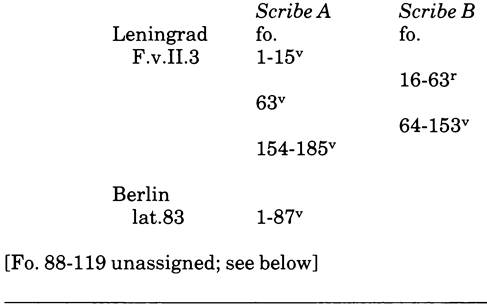
As Turner points out, irregularities in the quiring of the Leningrad portion of the manuscript suggest that, at least for some of the time, the two men worked simultaneously from detached parts of a single exemplar.34
Various explanations have been advanced for the inconsistencies between capitula and text, and for the disorderly arrangement of the councils between Arles IV (524) and Arles V (554). Despite the objections recently raised by Hubert Mordek,[570] I see no reason to dissent from Turner’s view that the capitula represent a primitive collection to which additions were subsequently made. The collection in its first state would have contained:
(1) The Dionysiana in its second edition.
(2) The Council of Ancyra.
(3) Twelve Gallic councils numbered XIII-XXV, in strict chronological order, beginning with Arles I (314) and going down to Vaison II (529), with Orange II (also 529) in next-to-last place.
(On this view, the reading Arelatensis secunda in the capitula [no. XXIIII] must be explained as an error resulting either from confusion of Arfelatensis] and Arfausicana] or from the prominence of Caesarius of Arles at Orange II.) Such a collection could have been made in or shortly after 529. It had evidently not been in existence long before someone noticed that it lacked both Arles IV (524) and Carpentras
[1] ‘Chapters in the History of Latin MSS. III.’, 427-8.
8. The Origins of the Collectio Sirmondiana 191 (527) and had these inserted in their proper place in the text, though without attempting to revise the capitula. The anti-Manichaean Capitula s. Augustini were presumably added at the same time.[571] Exactly what happened to Vaison II at this juncture is hard to say, but as a natural complement to Orange II it would, both before and after the addition of new material, have been the last item in the corpus and so the one most likely to be lost through damage or accidental separation.
If this reconstruction is substantially correct, the ‘Lyons’ collection in its second state would have contained a chronological series of Gallic councils numbered XIIII-XXVI (or XIIII-XXVII as long as the acts of Vaison II were still present). At least one, and probably as many as three, further supplements were added before the collection attained the form in which it appeared to the copyists of the present manuscript.
First, three more councils - Clermont in the Auvergne (535), Orleans III (538) and Orleans V (549) - were added in correct chronological order but (apparently) without ordinal numbers. The terminal clause EXPLICIT FELICITER AMEN that occurs after Orleans V marks the end of the collection in its third state.
The next set of additions - consisting of Arles III (449/461), Vaison II (529) and Arles V (554) - is rather a mixed bag. Only the last council, which provides a terminus post quem for the collection in its fourth state, is chronologically posterior to what comes before. The other two councils, including Vaison II (which, I have suggested, may have fallen out of the collection at an earlier stage) are manifestly gap-fillers. Either these items were already present in the exemplar of our Lyons manuscript, or they were added by the Lyons scribe from another source. Given the early date (554) of the last addition relative to the probable (late seventh-century) date of the Lyons manuscript itself (see below), the former alternative is the more likely. In this case, the ejaculatory DEUS ADIUVA ME that follows the acts of Arles V would derive, like the previous EXPLICIT FELICITER AMEN, from the exemplar, and we can conclude, with Turner, that the whole of the Leningrad and Berlin manuscript down to and including the Fifth Council of Arles represents a collection made, or rather completed, soon after the middle of the sixth century’.[572]
The attempt to distinguish successive stages in the development of the canonical collection contained in the first 273 folios of the original
Codex Lugdunensis (i.e. Leningrad, fo. [0]-185 + Berlin, fo. 1-87) is a necessary preliminary to study of its remaining contents, which include the Collectio Sirmondiana in its long recension. There, as in what precedes, we are confronted with a semblance of disorder resulting, in all probability, from a series of rational but imperfectly coordinated initiatives. Unfortunately, Turner’s interest in the Lyons codex did not extend this far and no student of the Sirmondians has (to my knowledge) yet attempted to replace the collection in the codicological context which he so successfully reconstructed. Not having had an opportunity to inspect either part of the codex, I shall not pretend to solve all the problems that remain. The following remarks may at least help set an agenda for future research.
2. Final supplements; the Collectio Sirmondiana
So far as we can now tell, the last 33 folios of the Lyons codex (i.e. Berlin, fo. 88-[ 120]) contained the following four items:
(1) An Adnotacio provinciarum adque urbium Gallicanarum, i.e. the Notitia Galliarum?s
(2) The letter Divinae cultum of Pope Leo the Great to the bishops of Viennensis concerning metropolitan authority in that province at a time when it was being wantonly usurped by Hilary of Arles.[573] [574]
(3) The acts of the First Council of Macon (581/583).
(4) The Collectio Sirmondiana in its long recension (Const. 1-18).
Maassen, following Haenel’s description, observes that these pages of the manuscript are written in a different hand from the one which had copied the preceding items and concludes that they represent a later addition.[575] Turner, relying on Rose’s description in the Berlin catalogue, mentions the appearance of a new hand at this point but wisely abstains from making any inference. Having detected the work of more than one scribe in the Leningrad portion of the codex, he naturally wished to know ‘which, if any, of these hands continue to write in the Berlin portion’ but (since the Berlin Library would not part with the manuscript) never had a chance to find out.[576] E.A. Lowe saw and described both parts of the Lyons codex in separate volumes of his Codices Latini Antiquiores but made no attempt to sort out the relation of the scripts.[577] With the help of Lowe’s descriptions and facsimiles it is nevertheless possible to give a partial answer to Turner’s question.[578]
AS we would expect, the first hand in the Berlin part of the manuscript is the same as that on the last folio of the Leningrad part (see Table 2), described by Lowe in one place as ‘a curious narrow uncial’ and in another as ‘a heavy uncial with long ascenders and descenders and short uprights knob-like or wedge-shaped at the head-line’. This is our Scribe A responsible for some 45 of the Leningrad folios and all of the Berlin manuscript down to DEUS ADIUVA ME (fo. 87v), the end of the conciliar collection in what we have taken to be its fourth state. According to Lowe, the rest of the Berlin manuscript, including the Collectio Sirmondiana, was written in half-uncial by two different scribes, one of whom produced ascenders that are ‘long and club-shaped’, while those of his collaborator were ‘often wedge-shaped’. Comparison of facsimiles published in CLA and elsewhere reveals that the semi-uncial hand with the long and club-shaped ascenders is the same as that found in the Leningrad manuscript and that the copyist whom I have called Scribe B was at work in the latter part of the Berlin manuscript. More particularly, it shows that this scribe copied (all or at least part of) the Notitia Galliarum and (all or at least some of) the acts of the First Council of Macon.
Did he also copy the Sirmondian Constitutions? It seems he did. A lithographic print included by Haenel in his 1840 Dissertatio reveals that the lines introducing Const. 1 (exemplum legis de confirmando etiam inter minores aetates iudicio episcoporum et testimonium unius epi accepto ferri) are in the same hand as the immediately preceding text of Macon I, that of Scribe B.44 Without access to the manuscript, that is as much as one can say with confidence. The part assigned to Lowe’s other copyist (Scribe C) remains obscure. There is, however, no indication in the apparatus of Haenel’s or Mommsen’s edition, or in Rose’s description of Phillipps 1745, of a change of scribal hand in the text of the Sirmondians. We may therefore assume that the whole series of constitutions was copied at the same time as the other final supplements to the ‘Lyons’ collection, and that it formed part of a putative fifth state of the collection whose terminus post quern is fixed by the First Council of Macon. A terminus ante quern for that state is provided by the date of production of the manuscript. Consequently, if we can fix the latter with reasonable precision we shall have established chronological limits within which to look for a Sitz im Leben for the Collectio Sirmondiana.
3. Date and place of production of the codex
Palaeographers who have studied the Codex Lugdunensis - Turner, monograph on the Lyons scriptorium, cited n. 46 below.
I owe my photocopy of this page of Haenel’s Dissertatio to the kindness of Professor T.D. Barnes.
Ludwig Traube, and Lowe - agree in dating it to the seventh century with a preference for the period c. 650-700.[579] In his epoch-making monograph on the Codices Lugdunenses Antiquissimi, published in 1924, Lowe went so far as to claim that the manuscript ‘showed every sign of being a product of the Lyons [calligraphic] school’.[580] As Rosamond McKitterick has recently reminded us, however, Lowe was inclined to be over-enthusiastic in his detection of such signs.[581] With respect to this particular manuscript, he himself came in time to take a more cautious view, giving as his opinion in CLA that it was ‘written in a Burgundian centre under Insular influence, to judge from the script’.[582]
Certainly the codex was at Lyons by the ninth century when it was used and annotated by the deacon Florus, and for that reason it deserves the epithet Lugdunensis applied by Sirmond and retained (partly for the sake of convenience) in this chapter. But the presence of a book at Lyons in the ninth century is not by itself an argument for its production there two centuries earlier. As McKitterick points out, it ‘may simply represent the zeal with which Florus... and his predecessors collected books from the surrounding region’.[583] Apart from these general grounds for scepticism, it is unlikely that a canon-law collection copied in Lyons in the second half of the seventh century would stop short at the First Council of Macon of 581/583. Thanks to Mordek’s masterly study of the systematic canon-law collection renamed by him the Vetus Gallica, we now know that the last years of the sixth and first part of the seventh century were a period of intense conciliar and canonical activity in the church of Lyons. Already by c. 600, this activity had issued in the production of the Vetus Gallica, a work largely based (for the Gallic councils) on the ‘Lyons’ collection in what we have taken to be its fourth state but also drawing on other sources for the acts of the First, Second and Third Councils of Lyons and those of the First and Second Councils of Macon.[584] Even allowing for a decline in the intellectual vigour of Lyons canonists in the second half of the seventh century, one can hardly imagine that the same collection would be reproduced there at that time with so few complements. Rather than admit such an improbability, I prefer to suppose that the so-called Codex Lugdunensis was copied somewhere else in the period c. 650-700.
8. The Origins of the Collectio Sirmondiana 195 Whoever copied it presumably either had access to an exemplar containing everything that we now find in the manuscript or else found the collection in its fourth state (i.e. including everything down to DEUS YDIUVA ME at the end of Arles V) and added four further items, perhaps but not necessarily drawn from a single manuscript source.
That the manuscript was produced in a Burgundian centre, as the palaeographers suggest, is borne out both by the fact that the main core of the text derives from a collection also known to have been at Lyons by c. 600 (when it was used for the Vetus Gallica) and by the presence of the acts of the First Council of Macon.
4. Historical development of the ‘Lyons9 collection: from Arles to Lyons Having obtained a clear idea of the contents and likely successive states of the ‘Lyons’ collection, we must now try to place its evolution in a historical context. In doing so, we may hope to recreate the circumstances in which the Sirmondian Constitutions came to jostle with the other texts listed above.
Mordek has shown how, in the course of the half-century following the death of bishop Caesarius of Arles in 542, the responsibility for major initiatives in the conciliar life of the church of south-eastern Gaul passed gradually from Arles to Lyons.[585] The process of accretion of specifically Gallic conciliar and other materials in the ‘Lyons’ collection ought, I believe, to be viewed against the background of this translatio sacerdotii.
In its earliest recoverable state, as indicated by the original sequence of capitula, the collection may be said to present an Arles-centred corpus of Gallic councils, perhaps completed by a person or persons operating outside the immediate sphere of Caesarian influence (and thus capable of missing two of the less obvious councils from the period 517-529). Those missing councils, as we have seen, were duly inserted in the second state of the collection. The third state discloses a definite ‘northern’ bias: omitting the Caesarian council of Marseille (533), it includes both the Third and Fifth Councils of Orleans, both of which were presided by the bishop of Lyons, but passes over an intervening council in the same city presided by the metropolitan of Bordeaux and attended by only two bishops from Lugdunensis. The fourth state is attained with the addition of an important supplement of Arlesian material - most of which, however, reached the compiler too late to find its proper chronological place.
The collection ending DEUS ADIUVA ME (Berlin, fo. 87v) should thus
have taken shape somewhere in the ecclesiastical provinces of Viennensis and Lugdunensis, probably closer to Lyons than to Arles in the years following the Fifth Council of Arles of 554. In c. 570 a council attended by fourteen bishops or their representatives from sees within the Burgundian realm of King Guntram met at Lyons under the joint presidency of bishops Philippus of Vienne and Nicetius of Lyons. As was by then customary, the council invoked the authority of existing canon law in enacting its own canons, of which there were just six.[586] One or more codices canonum would presumably have been available to members of the council during its sittings. But there is nothing in the acta that requires us to suppose that the bishops at Lyons in c. 570 had at their disposal a text of canon law as extensive as the Collectio Lugdunensis in its fourth state.
A decade or so later the situation had changed significantly. The sixteen Burgundian bishops who assembled at Macon (near Lyons) at the command of King Guntram in 581/583 and who there enacted twenty canons on a wide variety of disciplinary issues were evidently subscribing a legislative programme drawn up on the basis of a careful collation of texts. Besides the usual prefatory reference to the patrum statuta, the acts of the First Council of Macon contain verbatim extracts from the canons of Epaon (517) and of Clermont (535) and a possible allusion to a canon of Orleans III (538).[587] All three of these councils are included in the ‘Lyons’ collection in its fourth state, a copy of which is known to have been at Lyons by c. 600. The presiding bishop at Macon I, as at Macon II a few years later, was Priscus of Lyons, a prelate much maligned by Gregory of Tours but who nevertheless appears, on the evidence of these councils, to have been a zealous reformer somewhat after the manner of Caesarius of Arles. Although Mordek is inclined to deny him a role in the confection of the Vetus Gallica, Priscus’ conciliar activity may not be wholly unrelated to the renewed interest in canon law that animated the church of Lyons at this time.[588]
And not only in canon law. The acts of Macon I and II contain a number of references to canones et leges, to civil as well as well as ecclesiastical law.[589] The implications of this usage, which marks a new departure in both the style and substance of Gallic conciliar pronouncements, are beyond the scope of the present paper. We should note, however, that the two councils refer explicitly to leges in connection (a) with the privileges of ecclesiastical courts and (b) with relations between Christians and Jews, both topics treated in Sirmondian Constitutions (Const. 1, 3, 6; 4). The conjunction is a significant one, for it points to a time and milieu in which special efforts were being made to coordinate Roman law with the law of the church and to produce (or at least invoke) the textual warrant for both. When the authors of conciliar acta were so concerned to cite the lex Romana, a series of imperial edicts on matters affecting the church might easily be appended to a collection of conciliar texts.
The appearance of the Collectio Sirmondiana as the coda to a mainly canonical collection, and as the immediate sequel to the canons of Macon I, may thus be interpreted as a symptom of developing attitudes towards law and legal texts in late sixth-century Gaul. What else can we deduce from the evidence of the Codex Lugdunensis? Of the supplements that characterise the ‘Lyons’ collection in what we have taken be its fifth and final state, two have yet to be discussed: the Notitia Galliarum and the letter Divinae cultum of Pope Leo the Great. Both texts, I suggest, are items of propaganda designed to assist a restructuring of Gallic ecclesiastical politics in the time of King Guntram. As Jill Harries has shown, the Notitia Galliarum in the form in which we have it is an ecclesiastical document, probably ‘compiled or published in response to a specific crisis concerning the status of metropolitan cities’ in Gaul.[590] In the context of the ‘Lyons’ collection, it may be seen as an endorsement of the metropolitan claims of Lyons and Vienne at the expense of those of Arles, there presented merely as a civitas in the provincia Viennensis. This interpretation is corroborated by the inclusion with the Notitia of Pope Leo’s famous letter to the bishops of Viennensis, in which he rejected the jurisdictional claims of the most ambitious and turbulent fifth-century bishop of Arles.[591]
Ill· Conclusions
As was stated at the outset, solving the problem of the origins of the Collectio Sirmondiana requires recourse to at least three kinds of evidence: external, internal, and circumstantial. Since this paper only addresses the external evidence of the manuscript tradition, it cannot provide any final solution. That said, however, our review of the tradition has enabled us to reach a number of tentative conclusions which, while they may not fix the ultimate origin of the collection, at least suggest a plausible Sitz im Leben for its emergence.
1. There is is no evidence at present for the existence of a Sirmondian ‘collection’ before the last quarter of the sixth century. It is possible that further study of the tradition of the short recension (i.e. Const. 1-7, transmitted with Book 16 of the Theodosian Code in the form of the Breviary of Alaric) will cause this conclusion to be revised. Meanwhile, since we have no reason to suppose the short recension earlier than the long one, discussion of the origins of the collection must focus on the long recension, represented by Sirmond’s Codex Lugdunensis.
2. On palaeographical grounds, the Codex Lugdunensis should probably not be dated earlier than c. 650. The collection which it contains (including the Sirmondians) could, however, have come into existence at any time after the First Council of Macon (581/583). Indeed, since it does not contain the canons of the Second Council of Macon (585), there is a strong prima facie case for dating this state of the ‘Lyons’ collection to the period between 581 and 585.[592]
3.size=1 face="Times New Roman"> As one of four documents together distinctive of the final state of the ‘Lyons’ collection, the Collectio Sirmondiana belongs to a milieu in which (a) new attention was being paid to the relation between civil and canon law, (b) special care was being taken to collect and present texts recording law of both kinds, and (c) legal documents were being used to support the metropolitan claims of one major Gallic see at the expense of those of another. The milieu in question is that defined by the conciliar and political activity of bishop Priscus of Lyons in the early 580s. In order to be more precise than this we should have to make a full study of the relation between the historical circumstances just adumbrated and the specific contents of the Collectio Sirmondiana.
*
The position outlined above is very similar to that taken by Haenel in the 1840s.[593] As was mentioned earlier, Mommsen’s prolegomena to the Sirmondian Constitutions are largely indebted to Haenel’s research. Only in the matter of dating the collection did Mommsen differ significantly from his predecessor, believing that such a collection could not have come into existence after the promulgation of the Theodosian Code. In fact, Haenel’s view of the emergence of the collection is perfectly compatible with Mommsen’s assumption concerning its ultimate origins. If Mommsen is right, the compiler who added the final supplement to the ‘Lyons’ collection in c. 580-585 (as I have argued) would have found all or most of his imperial constitutions in a single document more or less contemporary with the papal letter Divinae cultum.
The collection we know as the Sirmondian Constitutions may have begun its existence as a minor anticipatory analogue of the Theodosian Code, the work of some unknown Gallic (?) compiler of the early fifth century. But it owes its survival to a currency achieved at a later date. This chapter may help to reinstate the Collectio Sirmondiana as a document of Merovingian as well as late Roman history and literary culture - like the Theodosian Code itself.