9. From Benedict to Gratian: the Code in medieval ecclesiastical authors
Dafydd Walters
The enigmatic phrase in the Ripuarian Frankish law, ecclesia vivit lege Romana1 is amply illustrated in ecclesiastical and secular legislation, in canonical collections and in Christian authors generally in western Europe from the fifth century onwards.
In both eastern and western Europe, secular imperial law and canon law bolstered one another, for example under Theodosius II or Justinian, and under Charlemagne. Canon law in the West enjoyed vigorous and ultimately independent growth, but it continued to acknowledge the authority of Roman law, and not only in matters explicitly ecclesiastical. After the apparatus of Byzantine imperial government failed in the western lands beyond the exarchate, lex Romana continued to be regarded by the Church as authoritative even when it was subtly edited. The lex Romana in question was, in the main, the Theodosian Code together with the novellae constitutiones of Theodosius Il’s successors and their anonymous interpretatio (possibly a clerical addition). The formal source for most of the citations in this paper is the composite version of the CTh and its satellites known as the Lex Romana Visigothorum (LRV) or Breviary of Alarie II (506), the manuscripts of which also include an epitome of Gaius’ Institutes and other fragments of classical law. Just why the canonists acknowledged the authority of this source deserves more attention than can be given here, where the purpose is rather to see to what extent and for how long the CTh or LRV remained the lex Romana the canonists so unquestioningly accepted.Gratian’s Decretum or Decreta (more properly his Concordia Discordantium Canonum (c. 1140) not only marks the transition from the ius antiquum of the canonists to the ius novum, it also brings to an end the practice of citing the Theodosian Code.
Gratian, or his earliest redactors, followed Ivo of Chartres in substituting texts from the Corpus luris Civilis (CIC) of Justinian for those from LRV which earlier western compilers of canon law collections had used: evidence1 Lex Rib., 61(58).!, ed. F. Beyerle and R. Buchner, MGHLeges IIL2 (Hannover, 1954). for one consequence of the reception of Justinian’s law in northern Italy at the end of the eleventh century.
The texts in this chapter have been chosen to illustrate the use made of both these sources, Theodosian and Justinianic. They comprise the Rule of St Benedict (died c. 520): the Etymologiae of Isidore of Seville (c. 560-636); Merovingian formulae of the sixth and seventh centuries; genuine and spurious decretals and capitularies of the Carolingian era; and the works of three eminent compilers of canon law collections before Gratian: the de synodalibus causis of Regino of Prüm (c. 906), the Decreta of Burchard of Worms (c. 1012), and the Panormia (c. 1095) of Ivo of Chartres, together with the Decretum attributed to him.
1. The Rule of St Benedict. St Benedict drew on many sources for his monastic or coenobitic Rule, and showed familiarity with St Basil and John Cassian. In his 59th chapter he specified the legal forms to be used when young children were offered2 to a monastery by their parents (de filiis nobilium aut pauperum qui offeruntur, where nobiles is equivalent to divites). A rich parent who chose to endow the monastery at the same time as giving it his son might reserve to himself a usufruct (life interest) in the property given, but the son was not to enjoy the remainder at the father’s death because, contrary to the normal rule de familiae herciscundae, such a son, if a monk, had no share in family property.
The word used for what the son was not to have is possessio, not dominium, so it appears to follow that such a son would have been debarred from invoking the possessory interdicts (CTh 4.21-23) and would also have been excluded from the rights of succession set out in CTh 5.1 (de legitimis hereditatibus). Something akin to the oblate’s ‘civil death’ is to be found in this text.2. Isidore of Seville. The popularity of Isidore’s Etymologies3 as the pocket encyclopaedia of the earlier middle ages is well-known. Gratian himself was still enthusiastically citing them some 500 years after they were written. In Books II and V, Isidore twice set out a list of 27 legal categories4 among which is the following:
Erit autem lex honesta,(a) justa, possibilis, secundum naturam, secundum patriae consuetudinem,(b) loco temporique conveniens, necessaria,(c) utilis,(d) manifesta quoque, ne aliquid per obscuritatem in
2 i.e. as oblati in the sense of those intended to be brought up in the monastery, in contrast with adult conversi. Later canon law gave such children the same right to reject the decision made by the parents on their behalf as was given to impubes who were betrothed by their parents.
3 ed. W.M. Lindsay (Oxford, 1911). The sources are discussed by B. Kübler, Isidorusstudien’, Hermes 25 (1890), 496; R.W. Carlyle and A.J. Carlyle, History of Mediaeval Political Thought in the West (Edinburgh, 1903-36), vol. 2, part 2, 96-101.
See Appendix 1. The first list is preceded at the end of II.10.5 by Legis enim praemio autpoena vita moderatur humana.
[6” Erit autem, etc.captionem contineat,(e) nullo privato commodo sed pro communi civium utilitate conscripta.(f) (II. 10.6; V.21)
This passage suggests the following possible Theodosian sources: (a) CTh 8.12.1, Ep[itome] G[aii] 2.9.18 (contra bonos mores); (b) CTh 5.12.1 and int; (c) CTh 2.29.2.pr and int (where the interpretatio has necessitates for desideria in the text); (d) Ep.G 2.9.5 et s; (e) CTh 1.1.2 and int; (f) CTh 1.1.4 and int.[594] [595] In its turn, the Isidorian passage is copied in Ivo of Chartres, Decretum 4.168 and Panormia 2.142, in the Collectio in III partibus 3.6.10 and by Gratian, Distinctio 4.2.
Evidence of Isidore’s more direct familiarity with CTh is found in c.2 of the canons of the 2nd Council of Seville (619) concerning a claim to certain disputed parishes between Fulgentius, bishop of Ecija and Honorius, bishop of Cordova, where the Roman thirty-year prescription rule is invoked. The canon ends with a verbatim extract from CTh 2.26.4 (385): sed tam longi temporis reprobatur obiecta praescribtio... repetentis iura sine mora restituetur5
3. Merovingian formulae. The formulae (protocol collections, styles or precedents) from the Merovingian Frankish epoch were drawn up by clerks acquainted with vulgar Roman notarial practice, to record gifts to churches and other juristic acts in which the church had an interest, like divorce agreements. A selection is provided below. The sources are LRV, and texts other than CTh and the novels are cited (e.g. the epitome of Gaius and fragment of Ulpian). Justinian’s law is also occasionally quoted.[596]
(i) Formulae Andecavenses (Anjou) (3rd quarter of 7th cent.?)
no.
41 (p. 18) n. 1: NVal III 4, int.Isid. Etym. 5.24 < CTh 8.17.2.2.
[Ulp. Frag. 16.1][597]
(ii) Arvernenses (Clarus Mons, i.e. Clermont in the Auvergne), (mid-sixth cent.?)
no. 3 (p. 30) conferment of freedom secundum legem Romanam (line 14): [LRV. Lib. Gaii 1.]
(iii) Marculfian Formulary (early 2nd half 7th cent.)
Bk. II no. 17, testament (in single instrument, not testament and codicil):9
p. 86 line 14, ut Romane legis decrevit’. [LRV, Paul. Sent. 6.6] p. 88 line 5, Dig. 28.4.1.1.
no. 18,[598] taking security in homicide cases where parties compose:
p. 88 n. 3 = p. 89, LRV, Paul. Sent. 2.18.10 int.
p. 89 no. 19, sale of land, LRV, Paul. Sent. 2.17.1 int.
(iv) Turonenses (Tours) (end of 6th cent.)
Note the frequency of the phrase lex Romana declarat, etc.
no. 4, p. 137 [paraphrase of J. Inst. 2.7.2 (cessio)].
Some explicit citations:
no. 11, p. 141, epistola collectionis (declaration of‘adoption’ of an abandoned child following fruitless enquiry as to its family of origin). This formula describes, in common form, the finding of a new-born child wrapped in cloth and left at the church door, being in danger of death, three days’ inquiry as to its origins having been made without success, etc; and concludes: decrevimus (the matricularius of St Martin’s of Tours]...
quae data est ex corpore Theodosiani libri quinti dicens\ ‘si quis infantem a sanguine emerit aut nutrient... etc.’ i.e. interpretatio to CTh 5.10.1 (LRV 5.8.1).[599]no. 14, p. 142, gifts between future spouses, begins with CTh and LRV 3.5.2, int. (most of first sentence, in slightly modified form. CTh int. has: Quotiens inter sponses et sponsas de futuris nubtiis ... firmaverit (rest of int. not in formula). The formula has: Quicquid inter sponsum et sponsam etc... firmetur (the ‘quotation’ ending there).
Further examples in summary form are listed in Appendix 2.
4. Decretals and capitularies of the Carolingian era, genuine and spurious.[600] Time has not permitted a thorough examination of the lists of Frankish capitularies for traces of Theodosian law, though many are to be found. Some are discussed below in connection with the Decretum
9 A. de Wretschko, ‘De usu Breviarii Alariciani forensi et scholastico per Hispaniam, Galliam, Italiam regionesque vicinas’, in CTh, ed. Mommsen, LI, cccvii-ccclxix, omits no. attributed to Ivo of Chartres, Book 16. Mommsen, in his edition of the Theodosian Code (I, p. ccclxi), noted an example in the Capitulary of Herard of Tours (died 870).[601]
5. Regino of Prüm. Regino was abbot of the Benedictine abbey of Prüm on the river of that name, a tributary of the Moselle above Trier, from 892 until 899 when he left for St Martin’s at Tours, it is said to escape from intrigue. He died there in 915. De synodalibus causis[602] is primarily a manual for prelates exercising visitatorial functions, and contains much secular law in its second part, having been compiled when bishops, filling a vacuum in the administration of lay justice, often judged secular as well as ecclesiastical causes.
Book I begins with notitia (inquisitiones) ‘quid episcopus vel ejus ministri in suo synodo diligenter inquirere debeant vicos publicos sive villas atque parochiae propriae diocesis’, i.e. 96 visitation articles on the care and furnishing of churches, clerical conduct etc. There follow 455 cc. illustrating these matters, but only two cite CTh:
c.22 CTh 5.10.1, cf. LRV 5.8.1, int., cited from the Epitome Aegidii: ‘si quis infantem a sanguine emerit et nutrierit, habendi eum et possidendi habeat potestatem’, etc., though whether in potestate like a filius familias, or in servitude as the CTh text says, is unclear (CTh, AD 329 which says ‘... obtinendi eius servitii habeat potestatam...’ Cf. Regino II c.71, below).
c.418 CTh an&LRV4.7.1 (a rescript of 321, repeated in CJust 1.13.2, Constantine to [H]osius of Cordoba), int., that slaves manumitted in church in the presence of the higher clergy (sacerdotes), or the slaves of clergy whenever manumitted, gain their freedom and cives esse Romanos.
[c.429 is a quotation from LRV, liber Gaii 4.8: Haenel, 318 (cf. Gaius 1.64).]
Book II comprises 454 cc. chiefly on secular law, including crimes and other wrongs. Cc. 4 & 5 set out 89 visitation articles inquiring into secular conduct (and cf. cc. 419, 420). Leaving aside 11 citations from Paul’s Sententiae, there are 24 texts based on CTh, one from the novels of Majorian and one from the Sirmondian Constitutions:
c.57 deparricido: int. to CTh 9.15 (deparricidis). 1 > LRV9.12.1.
c.59 si servus occiditur a domino...: int. to CTh 9.12.2, si servus, dum culpam dominus vindicat, mortuus fuerit, etc. > LRV 9.9.1.
c.69 de expositis infantibus: int. to CTh 5.9.1. > LRV 5.7.1.
c.70 (de eadem) int. to CTh 5.9.2 > LRV 5.7.2.
c.71 (de eadem) int. to CTh 5.10.1 > LRV 5.8.1 (identical with Bk I
c.22 above)
[c.85 de eo, qui aliquem interficit'. LRV, Paul. Sent. 5.25.3.]
[cc. 86-90 also from Paul. Sent., collated by Haenel with Regino’s svork: see Haenel, LRV p.436.]
c.116 ne episcopi sententia retractetur. The text reads: Constantinus Imp· dicit', [a] ‘Pro sanctis et venerabilibus habeatur, quidquid episcoporum fuerit sententia terminatio, [b] nec liceat ulterius retractari negotium, quod episcoporum sententia deciderit.’ Fragment [a] is from the third sentence of the first Sirmondian Constitution (Constantine to the Praetorian Prefect Ablatius, in 333: Mommsen, CTh 1:2, 907 lines 7-9) which has the rubric (omitted by Mommsen) de confirmando etiam inter minores aetates judicio episcoporum, etc. Fragment [b] is from the seventh sentence (Mommsen, 908 lines 1 and 22). The First Sirmondian Constitution is of course one of six (out of 16 published by Sirmond, 1631) not represented elsewhere in CTh.15
c.121-2: c.121 is a quotation from the Synod of Worms, (753) dealing with what is to happen to slaves who cohabit as husband and wife, and who risk being separated when the land to which they are adscripti is sold, and ends with the words: sed lex Romana longe melius de hac duntaxat causa praecipere videtur: passing then to c.122, CTh (and LRV) 2.25. (de communi dividundo), 1, int., i.e. that since the separation of children from parents, or wives from husbands, is unjust, care is to be taken when imperial or public estates are divided to substitute other slaves so that slave families remain together, quod sollicitudo ordinatium debet specialiter custodire, ut separatio fieri omnino non possit.15
[cc. 128,129: from PauZ. Sent.]
cc. 142-146 deal with marriage, etc:
C. 142 CTh 9.7.5 (AD 388) (LRV 9.4.4) int.: no intermarriage between Jews and Christians, and any such unions to be treated as adultery.
c.143 CTh 9.7.2 (AD 326) (LRV 9.4.2) int. : only specified close kinsmen can accuse a woman of adultery (the penultimate sentence, forbidding outsiders to accuse, is omitted by Regino).
c.144 ibid., final sentence of int., allowing a husband the right to accuse his wife on suspicion of adultery.
c.145 CTh 9.7.4 (AD 385) (LRV 9.4.3), int.: household slaves (familiae) of either spouse can be tortured for evidence of wife’s adultery, subject to certain conditions etc.
c.146 CTh 9.9.1 (AD 326) (LRV 9.6.1), int.: death sentence for free woman who takes her own slave as sexual partner, etc.
class=21 style='margin-left:0cm;text-indent:18.0pt;line-height:95%'>15 See de Wretschko in Mommsen, CTh 1:1 at p. ccclii n. 6; the identification was noted by Μ. Conrat, Geschichte der Quellen und Literatur des römischen Rechts im früheren Mittelalter I (Leipzig, 1891), 147 n. 6 and 259 n. 5.16 Regino II c.122 continues with a further statement emphasising this rule, which maY be his own addition.
[cc. 147-9: fromPaz/Z. Sent.]
c.173 NMaj 6.5. (de sanctimonialibus vel viduis) (AD 458) (Mommsen 2, p. 164, lines 53-61 and p. 165 lines 64-67), with some slight variation.[603] Widows who neither re-marry or take religious vows within five years of their husbands’ death are to lose their property to those who would be their heirs; whom failing, to the fisc.
c.174, cites CTh by name (2.12.5, LRV also; AD 393), int.: women are reminded that they are barred from prosecuting or otherwise conducting lawsuits other than their own. In c.174 this rule is used to reinforce a canon from a synod at Nantes, that as women are bidden to be silent in church by St Paul, so too they must not argue in court or in public assembles nor dispute openly with men. It concludes by forbidding nuns from acting as advocates in the legal business of their Houses, unless the bishop give them licence.
c.262 CTh 9.7.6 (AD 390) (LRV 9.4.5). Here Regino gives the Theodosian text, which lacks an interpretatio (public death by burning for male homosexuals who act the female role).
c.307 CTh 4.16.2 (AD 379) (LRV 4.14.1), int.: in private cases, a litigant is not bound save by the decision of his own judge.
c.308 CTh 2.18.3 (AD 325) (LRV 2.18.2), int., first half of last sentence: cases are not to be heard partly by one judge and partly by another.
c.313 CTh 2.18.1 (AD 321) (and LRV), int., omitting second half of last sentence, from quia si apud ipsum, etc: duties of judge when hearing a case.
c.352 CTh 9.18.1 (AD 315) (LRV 9.14.1), int.: death penalty for kidnappers.[604]
c.360-362 Death penalty for magicians, fortune-tellers, mathematici etc.
c.360 CTh 9.16.3 (AD 321/4?) (LRV9.13.1), int.
c.361 CTh 9.16. 4 (AD 357) (LRV9.13. 2), int.
c.362 CTh 9.16. 7 (AD 364) (LRV 9.13.3), int[605] The interpretationes to these (and comparable) provisions of CTh omit reference to some ofthe harsher fourth- and fifth-century Roman punishments, e.g. forfeiture of property and exile, CTh 9.16.1, cf. 9.16.12; execution by sword, 9.16.4; the rack (eculeus) etc., 9.16.6. Where death is the penalty, the interpretatio usually says merely capite puniatur. This may partly be the reason for the preference shown in canonical collections for citing the interpretatio rather than the Theodosian texts themselves and suggests an ecclesiastical origin of the interpretatio.
From Appendix I to Regino:
c.23 CTh 9.1.9 (AD 366?) (LRV 9.1.4) int.: a written complaint by the accuser must precede any trial, civil or criminal.
c.24 CTh 9.1.14 (AD 383) (LRV9.1.8), int.*. those who accuse others of homicide must acknowledge in writing that they will suffer the same fate (if a false accuser). The rest of the interpretatio is omitted in c.24.
c.25 CTh 9.1.15 (AD 385) (LRV 9.1.9), int.: criminal accusations are not to be made by the accuser’s agent, even if an imperial rescript is held permitting it; etc.
c.26 CTh 9.1.19 (AD 423) (LRV 9.1.11), int. (c.26 repeats the first sentence of the interpretatio as far as tradendusf. ‘criminal’ means when so decided by the judge, and not before that.
From Appendix III to Regino:
c.74 Wasserschleben (p. 495, n.) notes the influence inter alia of CTh 9.1.15, int. (see Regino, Appendix I c.25, above), but the change in procedure is interesting: c.74 says accusations are to be made orally, not in writing; and no absent person may be either accuser or accused. The primacy of written accusation in the Code has given way to the primacy of oral, public accusation of early medieval secular law, and perhaps not only because accusers were commonly illiterate.20
6. Burchard of Worms.21 Burchard’s Decreta was compiled some time between 1012 and 1028.22 He was born c. 965, became bishop of Worms in 1000 and died in 1025, having been at the court of the emperor Otto III before his consecration. Although it owes something to the arrangement of Regino’s notitia, and to the organisation of the subject-matter found in the Collectio Anselmo Dedicata (the work of Anselm II, Archbishop of Milan, died 896), Burchard’s work has been called the first thematic, as opposed to mainly chronological, collection of canon law.23 He is also the author of the oldest surviving collection of Germanic manorial customs.24 It is unfortunate that the edition published by the abbe Migne is a random example of the available manuscripts: ‘worthless’ according to Stefan Kuttner.25 A proposed new edition by Otto Meyer was abandoned when his papers were destroyed, but he recorded that Burchard’s work was known in Italy by c. 1035, on the evidence of Peter Damian and the catalogue of the
20 Text: Wasserschleben, not Migne PL vol. 132.
21 See in general G. Duby, La femme, le chevalier et le pretre (Paris, 1981): English translation: The Knight, the Lady and the Priest (New York, 1983).
22 Colin Morris, The Papal Monarchy (Oxford 1989), 30.
23 W. Ullmann, Law and Politics in the Middle Ages (London, 1975), 131. The Collectio Anselmo Dedicata has not been printed in full, but for the first of its twelve books see J.C. Besse, Revue de droit canonique 9 (1959), 207ff., at 214. See also id., Histoire des textes du droit de I’Eglise au moyen age de Denis a Gratien. Collectio Anselmo Dedicata (Paris, I960).
24 U.R. Blumental, The Investiture Controversy (Philadelphia, 1988).
25 A judgment based inter alia on his examination of Vatican MS 16.
class=a5 style='text-indent:0cm'>Library of the Abbey of Nonantola, near Modena.The Decreta consists of 20 books and a form for opening a synod. The Roman legal texts are of the kind seen in Regino and which are to be found again in Ivo, but the absence of any trustworthy text makes detailed examination almost useless. However, here is one example of an indirect citation from the Codex suggested by some references in E.A. Friedberg’s Canonessammlungen zwischen Gratianus und Bernardus von Pavia.[606] The passage in question is the interpretatio to CTh 9.7.2 > LRV 9.4.2 given above.[607] Burchard repeats this passage at XVI.57 and it reappears fifty years after Gratian in Bernard of Pavia’s Compilatio prima (c. 1190), V 13.5,[608] in a title on adultery and rape {stuprum) from which it was copied in 1234 in the Liber Extra, 5.16.4.[609] Regino’s text is also found in two other works, the Collectio Parisiensis secundo 84.4 and in the Leipzig collection, 42.7.[610]
7. Ivo of Chartres (c. 1040-1116). This canonist had been a pupil of Lanfranc at the abbey of Bee and, although a supporter of Gregory VII, was a moderate in the Investiture contest.[611] He became bishop of Chartres in 1090 and his Panormia is dated c. 1095. The Decretum is usually attributed to him, though less certainly than the Panormia.[612] In Ivo we find clear evidence that the Corpus luris Civilis was available to canonists.[613] The contents of the Panormia[614] are given in Appendix 4, the following being examples of its use of Roman legal authority:
Book 2, cc.64-71, prescription and possession: No Roman text is cited {CTh 4.14.1 > LRV 4.12.1 would have been appropriate), but c.67 applies the 30-year prescription rule to a bishop claiming rightful possession of his diocese.
Book 2, cc. 138-168, de legibus, the contents being largely repeated by Gratian in Dist. 10: e.g. c.145, de legibus Justiniani is a reference to Dig. 1.2, de origine juris etc. and naming the Codex, Digest, Institutes and Novels; c.147, citing J.Inst. 1.2 and Dig. (Ulpian) 1.4.1.1 on royal statute law; and cf. cc.160, 162, 163 quoting the Institutes and CJust (1.8.1 and 8.2) respectively.
Book 3, cc.167-173, de vita clericorum', e.g. c.169: a bishop or presbyter who consults a prophet or the auspices is to be deposed,35 which Gratian repeats in can. 26 q.5 c. si quis episcopus. This is in fact contrary to a provision in CTh 16.10.1 pr (AD 320) in which Constantine had ordered such consultations to take place; although the next lex of the same title (AD 341) says ‘superstition shall cease’.
Book 5, de causis et negotiis laicorum, cc.23-76: e.g. c.23 (repeated by Gratian, can. 11 q.l c. omnes) apparently citing CTh (... omnes itaque comprimente, and see c.24 et seq).
Book 6, de nuptiis et matrimoniis etc., cc.129 (& cf. Book 7): e.g. c.l, which is CICiv. Dig. 1.9.1 (repeated by Gratian, causa 29 q.l, diet, ante).
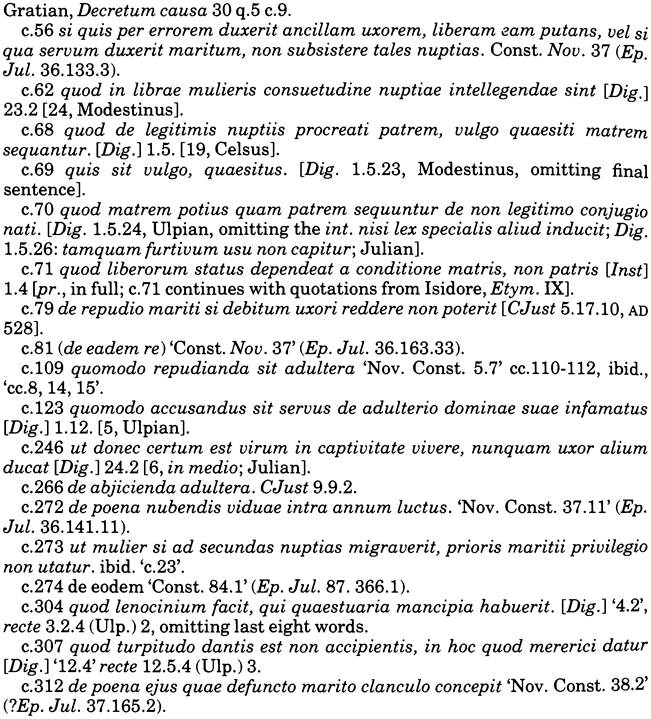
The Decretum33 attributed to Ivo (see n. 32 above) consists of a prologue and seventeen books. The Roman texts are chiefly imperial laws described by the author as novellae constitutiones but taken from the Epitome luliani, as the examples from Book 8 show (see Appendix 5). In Book 4, cc.168-177, there is a list of legal sources, here shown in brackets, which the author treats as authoritative:
c.168 quid sit lex honesta (< Isid. Etym V c.21).
c.169 quod leges temporales postquam institutae sunt, servandae sint (< St Augustine, de vera relig. 31).
The text of cc.170-172 illustrates the transition to citations from Justinian’s Corpus luris Civilis'.
(c.170 de libro constitutionum Theodosii [< Isid. Etym. V.l]).37
(c.171 de libro quam appellant codicam Justiniani et de libro Pandectarum et de eoquem appellant codicam Novellarum [< Paul the Deacon’s Historia Langobardorum 1.25; not V.25 as in Migne]).38
35 From the 4th Council of Toledo (633) c.30; c.29 (ed. Vives), 203. There is earlier canonical prohibition of such practices: 2nd Council of Braga (572) cc. 72-4 (Vives, 103), condemning astrology, the observing of secular seasons, incantation when collecting medicinal herbs, etc., and 3rd Council of Toledo (589) c.23 (Vives, 133), against the custom of dancing and secular singing during liturgical services.
36 Ivonis Carnotensis episcopi Decretum in partes XVII, ed. J. Molin (Louvain, 1561): carelessly reprinted in Migne, PL 161.
c.170: De libro constitutionum Theodosii. Isidorus, Etymologiarum libro v, cap. i. (Dist. 7, c. Fuerunt autem hi) Theodosius minor Augustus ad similitudinem Gregoriani et Hermogeniani, codicem factum institutionum, a Constantini temporibus sub proprio cujusque imperatoris titulo disposuit, quem a suo nomine Theodosianum vocavit.
c.171: De libro quem appellant codicem Justiniani, et de libro Pandectarum, et de eoquem appellant codicem Novellarum. Ex historia Longobardorum [i.e. of Paul the Deacon] libro, n. [recte i] cap. 25. Justinianus Augustus leges Romanorum, quarum prolixitas nimia erat et inutilis dissonantia, mirabili brevitate correxit. Nam omnes constitutiones principum, quae utique multis in voluminibus habebantur, intra duodecim libros coarctavit, idemque volumen codicem Justiniani appellari praecepit.
(c.172 item de libro Justiniani quam vocant Novellas constitutiones.)3^
c.173 quod constet esse legam quidquid imperator per epistolam constituit..., Inst. 1.2. (6, in medio).
c.174 de capitulis a Carolo (Magno) legibus insertis.
c.175 de legeAnglorum ab Ebelberto rege edita Beda...
c.176 de capitulis a Lothario Augusto legibus additis.
c.177 leges Christianorum regum ab ecclesiis recipiendis (and cf cc.178-188). ‘
Book 16, de officiis laicorum et causis eorundem, in 362 chapters, contains Theodosian material which de Wretschko identified.[615] href="#_ftn616" name="_ftnref616" title="">[616] [617] Ivo’s chief proximate sources are the False Capitularies of ‘Benedict Levi- ta’.[618] Citations of CJust as well as CTh and the other materials in LRV are included. The first Theodosian text listed by de Wretschko is c.61:
(Rubric from c.59) 'Servi testimonio adversus dominum minime standum. Cod. [i.e. CJust] 9.1.20’. This is a constitution of 397; it corresponds with CTh 9.6.3 > LRV 9.3.2:
‘Si quis ex familiaribus vel ex servis cujuslibet domus, cujuscunque criminis delator atque accusator emerserit, ejus existimationem, caput, vel fortunas periturus, cujus familiaritati vel dominio inhaeserit, ante examinationem judicii in ipsa expositione criminum, atque accusationis exordio, ultore gladio feriatur...’ Thus far Ivo; CJust and LRVcomplete the constitution: ‘vocem enim funestam intercidi oportet potius quam audiri, maiestatis crimen excipimus.’ Ivo does not give the interpretatio: Si servus, etc; though a version of it appears in the epitome of Aegidius which he frequently cites elsewhere.[619]
The immediately preceding c.60 in Ivo, Bk 16, under the same rubric, is however an almost exact reproduction of CJust 4.20.8, a constitution of 294, nine years earlier than the first constitution of CTh. This pattern of indirect citation from CTh, chiefly via Benedict Levita, and directly from CJust, is repeated throughout Ivo’s Decretum.*3
8. Gratian's Decretum, c. 1140, in the earliest redactions that have survived, shows an almost total acceptance of Justinian’s Corpus luris Civilis. The abandonment of citation from CTh is not quite complete, however, although this may be due to oversight, or to an unwillingness to change the text of proximate sources which themselves included Theodosian matter. In the introduction to his edition of Gratian, Friedberg lists some of the surviving citations from vulgar Roman law, less than 20 in all, in contrast with about 150 citations from CICiv.** The citations given by Friedberg are from Haenel’s edition of CTh'.*3
CTh 11.39.8, cited by Gratian in causa 11, q.l, c.9.
CTh 16.2.16, in causa 23, q.8, c.23.
CTh 16.2.29, in causa 25, q.2, c.20.
From Haenel’s edition of Lex Romana Visigothorum, Friedberg lists 10 citations from Paulus’ Sententiae (e.g. Paul. Sent. 2.20.4 in causa 32, q. 7 c.26). There are two further citations from CTh,'. 9.3.2 or the interpretatio in causa 2, q.7 c.53 and interpretatio 9.37.1 in causa 2, q.3 c.8, together with eleven citations of imperial constitutions from the epitome luliani, seven of them from Novel 115 in the Ep. lul. numbering.
The canon lawyers owned no loyalty to the authors of the laws they cited and incorporated. Evidently they still admired the lex Romana, but they came to prefer that version of it which was recovered in the course of the controversies between the western empire and the papacy which are disguised under the name of the quarrel over Investitures: Justinian’s Corpus luris Civilis. Probably no single reason can explain the reception of this law, but it provided the better text (though not the fuller one: not all of CTh is reproduced in CJust), and, in the wake of the Reception, Theodosius had to make way for Justinian.
Appendix 1
Isidore of Seville (c. 560-636), Etymologiae Bk V (cols. 197-228 in Migne, PL 82: Sancti Isidori Hispaliensis episcopi Etymologiarum libri XX\ also ed. W.M. Lindsay [Oxford, 1911]).
43 Though the task of identifying the former is not assisted by Migne’s editor’s habit of supplying CJust references whenever they incorporate constitutions from CTh.
44 CICan, vol. 1, at col. xl. I have not yet checked these references against T. Reuter’s Concordance to Gratian, which was not available to me when writing this chapter.
45 Bonn, 1842.
De legibus [cc.1-27; omitting de temporibus, cc.28-39].
1. de auctoribus legum (ss 1-7)
2. de legibus divinis et humanis (1,2)
3. quid different inter sejus, leges et mores (1-4)
4. quid sit jus naturale (1,2)
5. quid sit jus civile
6. quid sit jus gentium
7. quid sit jus militare (1,2)
8. quid sit jus publicum
9. quid sit jus Quiritium (1,2)
10. quid lex
11. quid scita plebium
12. quid senatusconsultum
13. quid constitutio et edictum
14. quid responsa prudentium
15. de legibus consularibus et tribunitiis (1,2)
color=black face="Times New Roman">16. de lege satyra
17. de legibus Rhodiis
18. de privilegiis
19. quid possit lex
20. quare facta sit lex
21. qualis debeat fieri lex
22. de causis
23. de testibus (1,2)
24. de instrumentis legalibus (1-31)
25. de rebus (1-37) (e.g. hereditas, jura, peculium etc.)
26. de criminibus in lege conscriptis (1-27)
27. de poenis in legibus constitutis (1-38).
Appendix 2
Further examples of the influence of Roman Law in the Formulae Turonenses, given in summary form (wording mostly modified as illustrated above):
no. 15, p. 143, lines 18, 19, CTh 8.12.1, LRV 8.5.1, int. (bride’s antenuptial traditio of movables) (not noted by Zeumer).
[no. 16, p. 143, first sentence, LRV, Paul. Sent. 2.20.2, int. (Ep. Aeg.) (father endows daughter following marriage to which he did not consent).]
[no. 17, p. 144, line 20, LRV, Paul. Sent. 2.24.5, int. (gift between spouses to take effect at death of donor).]
no. 19, p. 145, line 24, CTh and LRV 3.16.1, int. first twelve words (divorce in the form of repudium by either spouse of the other).
no. 20, p. 146, lines 10-12, CTh and LRV 2.12.4, int. (husband who sues for his wife is bound by her mandate).
no. 21, p. 146, lines 23-5, CTh and LRV 2.24.1, int.-, first half of first sentence: (de familiae herciscundae'. respect for testament, even if imperfect, when property divided among certain descendants).
no. 22, p. 147, first two lines, ref. to previous example, and line 15, where CTh and LRV 5.1.4 is applied, but not cited (nephews instituted as heirs).
no. 23 at pp. 147-8, 2nd sentence: cf. CTh and LRV 5.1.2, int. (adoption) [p· 147,1st line: cf. LRV, Lib. Gaii 5.1: adoption].
no. 24 p. 148, line 15, cf. CTh and LRV 3.18.1, int.-, line 16, cf. CTh and LRV 3.17.3, int.\ line 20, cf. CTh 3.30.6, LRV 3.19.4, int-, Zeumer adds Lex Raetica Curiensis 3.19.4 (contract of pupillage/wardship).
no. 25 p. 149, lines 8, 9: 'Romanamque legem ordinantem’ cf. CTh 2.9.3, LRV
2.9.1 (breach by adult of pact or compromise freely made).
[no. 29, p. 152: 'LexRomana pro utilitate humani generis exposcit, ut' followed ^y (cf.) LRV, Paul. Sent. 5.39. int. (Ep. Aeg.)].
ibid: second para: CTh 9.1.14, LRV 9.1.8, int. (whoever prosecutes for homicide must, in writing, agree that he accepts the same fate if proved false as would the one he falsely accuses: also cited by Regino, Appendix I to edition cited, c.24). In this case, the int. is reproduced verbatim, not in paraphrase.
no. 30 atp. 153, first word: CTh 9.14.2, LRV 9.1.8, int. (self-defence incases of highway robbery etc at night).
no. 32, p. 154, lines 25-6: cp CTh 9.24.1, LRV9.19.1, int. (punishment in cases of marriage and abduction).
ibid., p. 155, last two lines: cf. CTh 9.24.3, LRV 4.12.1, int. (accusations of ravishment: prescription after five years).
no. 39, p. 157, line 7, cf. CTh 4.14.1, LRV 4.12.1, int. (thirty-year prescription period for certain actions).
Additamenta no. 1, p. 159, line 22: CTh 8.12.1, LRV8.5.1, int. (on requirement of publicity for gifts to be valid).
Appendix no. 2, p. 163, line 29: cf. CTh and LRV 3.5.1, int. (antenuptial gifts 'sicut in Theodosiano codice “de sponsalibus et ante nuptias donationibus” narrat auctoritas': lines 26-7: line 29 refers to gifts or promises made in a series of documents).
Appendix no. 3, p. 164, line 23: Rerum omnium scripturarum traditio subsequatur' (an oft-repeated quotation in such texts): cf. CTh and LRV 3.5.2, int. (antenuptial gift from H to W 'omni earn scripturarum sollemnitate firmaverit\ Mommsen 1.2, p. 134, line 2; cf. above, Turonenses, no. 14).
Appendix no. 4, p. 165, 'Mos antiqua et lex Romana declarat auctoritas ut:’ followed by CTh and LRV 2.12.4, int. (see above, Turonenses no. 20).
(Text of the above: Formulae Merowingici et Karolini aeui, ed. K. Zeumer, from which the LRV refs, have been taken. The dates of the collection are suggested by Zeumer: (i) p. 2, (ii) p. 27, (iii) pp. 32-4 and (iv) pp. 128-9.)
Appendix 3
style='font-size:7.5pt;line-height: 115%'>Basic bibliography to establish citation of the Codex Theodosianus etc. in Benedict Levita, False Capitularies and Pseudo-Isidore, False Decretals; and the question of medieval forgeries.
1. Capitularies
Texts: MGH Leges in folio 1 & 2:1 and 1 and 2:2 (2:2 includes Benedict Levita’s spuria)} Leges in 4to, Capitularia Regum Francorum 1 (inc. Collectio Ansegis) and 2:1-3, ed. G.H. Pertz.
Commentaries:
P. Hinschius, see 2, below, tabula fontium at cxii-cxvi and comm., cxliii-clxiii; clxxxiii-clxxxvi.
E. Seckel, ‘Studien zu Benedictus Levita’, Neues Archiv 26 (1901); 29 (1904); 31 (1906); 34 (1909); 35 (1910); 39 (1914) 39 NA; 40 (1916); 41 (1917): and see Zeitschrift der Savigny-Stiftung/kanonistisches Abteilung 22 (1934) and 25 (1935).
F.L. Ganshof, Recherches sur les capitulaires (Paris, 1958) (with tables and indices: without them in Revue de I’histoire de Droit franqais et etranger 35 (1957).
2. Decretals
Text: Decretales Pseudo-Isidorianae et capitula Angilramni, ed. P. Hinschius (Leipzig 1863; repr. Aalen 1963).
Commentaries:
P. Hinschius, op. cit. above 1863, [Intro.] Pt II, Ixxvii-cix; and LRV < Paul. Sent, and C.Greg., loc. cit. cxxxiii.
S. Williams, ‘The pseudo-Isidorian problem today’, Speculum 19 (1954), 704.
ibid., [Proceedings of the] Congres de droit canonique medievale (Louvain and Brussels, 1959), 92-3 for evidence of the defects in Hinschius’ edition, based on the collation of 79 mss.
H. Fuhrmann, Einfluss und Verbreitung der pseudoisidorischen Fälschungen, 3 vols (1972-4), MGH Schriften Bd. 24.
3. Recent commentaries etc. on these and other medieval forgeries
J.M. Wallace-Hadrill, ‘Archbishop Hincmar and the authorship of Lex Salica', Tijdschrift voor Rechtsgeschiedenis 21 (1952): repr. as chapter 5 of The Long-Haired Kings (London, 1962; repr. Toronto 1982). (The demolition of the views of S. Stein, ‘Lex Salica’, Speculum 22 (1947), 113-34 & 395-418 are in pt. Ill of Wallace-Hadrill’s paper, 106 et seq. in the 1962 reprint.)
Fälschungen im Mittelalter (5 vols + Index vol.), MGH Schriften, Bd. 33 (proceedings of MGH congress, Munich, Sept. 1986): esp. vol. 2, Gefälsche Rechtstexte: Peter Landau, ‘Gefälschtes Recht in den Rechts Sammlungen bis Gratian’, 11-50; G. Schmitz, ‘Die Waffe der Fälschung zum Schutz der Bedrängten? Bemerkungen zu gefälschten Konzils- und Kapitularien- texten’, 79-110; W. Hartmann, ‘Fälschungs verdacht und Fälschungsnachweis im früheren Mittelalter’, 111-27; H. Schneider, ‘Ademar von Chabannes und Pseudoisidor - der “Mythomane” und der Erzfälscher’, 129-50.
Appendix 4
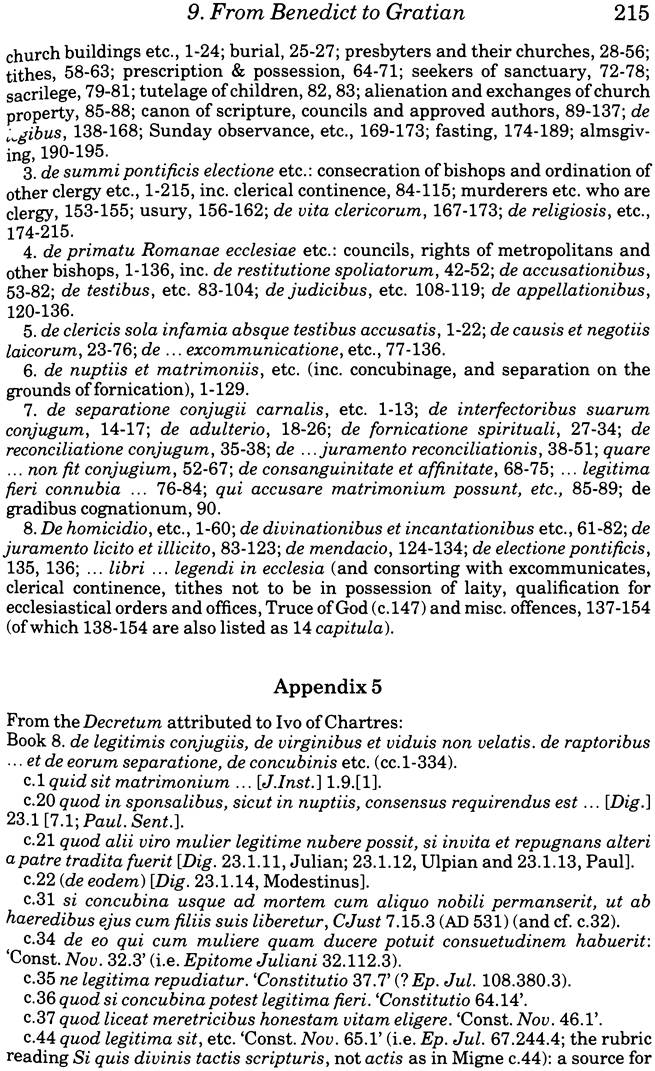
Ivo of Chartres, Panormia (Panormia Ivonis Carnotensis episcopi libri VIII) Prologus: de multimoda distinctione Scripturarum sub una cartorum eloquiorum contentarum.
name=bookmark354>1. de fide, de diversis haeresibus, de baptismate ... consecrandorum... etc: cc.
1-112 on baptism; 113-122 on confirmation; 123-162 on the Eucharist.
2. de constitutione ecclesiarum et oblatione fidelium etc.: the church and