Are There Fundamental Limits to Chemical Knowledge?
An important epistemological task of philosophy of science consists in understanding the limits of scientific knowledge on a general level. Again, it is up to scientists to check the limits of a specific theory or model in order to avoid unjustified scientific claims that lead people astray by unfounded promises.
Unfortunately, such promises increasingly appear, with the public struggle for funding and public attention, in popularizations of science, and sometimes even in the disguise of philosophy. The epistemological task consists in scrutinizing a scientific approach, its concepts and methods, for implicit assumptions that limit the scope or validity of its epistemic results. Such an analysis may provide not only an epistemological assessment of the scientific approach but also answers to the more ambitious question of whether complete and perfect knowledge is ever possible or not. In the following, I discuss three issues that each shed light on the limits of chemical knowledge: the concept of pure substances, methodological pluralism, and the proliferation of chemical objects.As has been discussed in the previous sections, chemistry is based on the concept of chemical substances - experimentally in characterizing, classifying, and producing materials and in describing chemical change, as well as theoretically in explaining, classifying, and predicting materials and chemical change through structure theory. However, chemical substances are idealizations in two regards that each pose limits to chemical knowledge. First, although chemical substances are experimentally produced through purification techniques and as such are real entities, perfect purity is a conceptual ideal that can never be fully reached in practice. Thus, any real substance as an object of experimental investigation contains impurities, whereas any conceptual description needs to assume perfect purity or a well defined mixture of pure substances.
Because even very small amounts of impurities can drastically change chemical properties, through catalytic activity, there is always the risk that the gap between concepts and objects leads to misconceptions and wrong conclusions. On the other hand, because chemists know well about the problem, they can take particular care about possible impurities that they assume are relevant in each case.Second, and more importantly, the pure substances that chemists produce and put in bottles for chemical investigations do not exist outside the laboratory. Instead, the materials outside the laboratory are messy and mostly under continuous transformation and flux. Any material sample of, say, a soil, a plant, or even sea water, can be analyzed into hundreds or thousands of substances of different amounts, depending on one's analytic accuracy. And before it became a sample, the piece of matter was in continuous flux and interaction with its environment and hardly a perfect homogeneous mixture. The problem is not to describe all that; rather the problem is that any accurate description of material phenomena outside the laboratory turns into an endless list of facts. Moreover, if a mixture contains more than five or ten substances, the theoretical reasoning of chemistry fails because of over-complexity. Hence, the conceptual framework of chemistry is not very suitable to describe the real material world, but still it is the best we have for that purpose. The way chemists deal with such real-world issues is, again, by making assumptions about what is relevant and what not by focusing on specific questions for which the relevance of factors can be estimated or controlled.
Once relevance aspects shape the kind of facts one considers and the kind of knowledge one pursues, the abstract ideal of complete and perfect knowledge is given up. The fragmentation into different knowledge domains according to different relevance aspects then seems unavoidable, and new domains grow as new questions become relevant.
While that might to some degree be true of all the experimental sciences, in contrast to theoretical physics, it is characteristic of chemistry as the prototype of experimental laboratory sciences and as by far the biggest discipline.[98] In contrast to the ideal of a universal Theory of Everything, which has been important in theoretical physics, chemistry is guided by a pragmatist pluralism of methods. Not only does each sub-discipline of chemistry develop its own kinds of methods, concepts, and models tailored to specific substance classes and types of chemical change, but also within each particular research field there is, even for the same experimental system, a variety of different models at hand that serve different purposes. One might argue that this is because the right universal approach has not yet been found. However, methodological pluralism seems to be rather a characteristic of chemistry that allows flexibly dealing with complexity by splitting up approaches according to what matters in each case. Rather than being a surrogate of universal theories, methodological pluralism is an epistemological approach in its own right. It requires that the quality of a model is not judged by standards of truth and universality but, instead, by its usefulness and the precision by which its scope of applications is limited. A model in chemistry is a theoretical tool to address specific questions, which is useless if you do not know for which kind of systems and research questions it can reasonably be used.Methodological pluralism produces a kind of patchwork knowledge rather than universal knowledge. The advantage is that it allows incorporating new kinds of knowledge without fundamental crisis, by extending the patchwork. Moreover, it can deal with relevance aspects, which the claim to universal knowledge cannot. Because patchwork knowledge can always be extended, by including new kinds of knowledge and new relevance aspects, the scientific endeavor is open-ended in both dimensions.
Therefore, the idea of complete and perfect knowledge, and all its derived epistemological concepts that might be useful to apply to the notion of universal knowledge, is meaningless in chemistry.Further support for the last conclusion, that chemical knowledge can never be perfect and complete, comes from an analysis of the concept of chemical properties (i.e., from the specific subject matter of chemistry). All material properties are dispositions: they describe the behavior of materials under certain contextual conditions, such as mechanical forces, heat, pressure, electromagnetic fields, chemical substances, biological organisms, ecological systems, and so on. Because a property is defined by both the behavior and the contextual conditions, we can freely invent new properties by varying the contextual conditions to increase the scope of possible knowledge almost at will. Chemical properties stand out because the important contextual factor is of the same kind as the object of investigation, both being chemical substances, such that chemical properties are strictly speaking dispositional relations. A chemical property of a substance is defined by how it behaves together with one or more other substances, and the important behaviors are those of chemical transformation, although the lack of transformation (i.e., chemical inertness) is sometimes also important. If a new, hitherto unknown substance results from the transformation, it can be made subject to further investigations, by studying its reactivity with all known substances, which in turn may result in many hitherto unknown substances to be studied, and so on. The procedure results in exponential growth of substances, not just in theory but also historically over the past two centuries, and there is no fundamental limit to an endless proliferation in the future. Because each substance increases the scope of possible chemical knowledge, chemical knowledge can never be complete.
Even worse, one can argue that the synthesis of new substances increases the scope of possible knowledge (the number of undetermined properties) much faster than the scope of actual knowledge (the number of known properties).
If we call the difference between possible knowledge and actual knowledge non-knowledge, chemistry produces through synthesis much more non-knowledge than knowledge, as the following simplified calculation illustrates. Assume we have a system of n different substances, then the number of all possible chemical properties corresponds to the number of all combinations from pairs to n-tuples (times the variations in concentration and other contextual conditions, which will be neglected here). While the synthesis of a new substance increases the scope of actual knowledge only by a single property (the reaction from which the substance resulted), it increases the scope of possible knowledge or undetermined chemical properties according to simple combinatorics by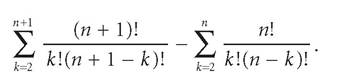
For instance, if the original system consists of 10 substances, which corresponds to 1,013 possible properties, the synthesis of a single new substance creates 1,023 new possible properties. Thus, while the actual knowledge increases only by one property, non-knowledge grows by 1,022 undetermined properties. If the system consists of 100 substances, a single new substance increases non-knowledge by 1030 undetermined properties, and so on. One might criticize the calculation as being too simplistic, but a more precise calculation, which additionally considers variations in concentration and other contextual conditions, would bring about an even faster growth of non-knowledge.
The epistemological problem or paradox is ultimately rooted in the peculiarities of the chemical subject matter (i.e., in radical change) and therefore unknown in other sciences. Rather than depicting the world as it is, chemistry develops an understanding of the world by changing the world. Because the changes are radical in that they create new entities, any such step of understanding increases the complexity of the world and thus makes understanding more difficult. We will see below that this paradox of understanding also poses specific ethical issues.
5.