C Kinds of Science: Objectives and Methods
You can distinguish among kinds of science not only by their subject matter or methods, but also by their ultimate objectives. I mentioned (Chapter 2.G.) that many philosophers have difficulty in understanding why scientists hold Popper's and John Platt's programs in such high regard, given that scientists generally pay almost no attention to any philosophical teachings.
You may recall Godfrey- Smith's comment about scientists liking Popper because he holds up a heroic mirror for them to admire themselves in—violin-playing cowboys!—but he doesn't explore the motivation for scientists to invent and test theories in the first place. In a sense, scientists always have to do something; their job is to figure out nature. And, says the philosopher Bryan Magee,25 Popper's philosophy is “a philosophy of action.” Popper describes how scientists can get their job done. This perspective suggests that we can distinguish among kinds of science according to the kinds of action that scientists take.4. C.1 Basic Science Versus Applied Science
Many discussions of modern science either take it for granted that we're talking about basic research science, or they blur—even reject (Chapter 10.A)—the distinction between basic and applied science. The express purpose of basic science is to discover Truths about nature, solely for the sake of understanding it. Naturally, basic scientists and society, especially research funders, hope that basic science discoveries will translate into solutions for societally significant problems, but concrete payoffs are not its immediate goal.
Applied science is directed toward concrete payoffs; it seeks to solve specific problems, often in the service of technology development paid for by commercial enterprises or governments. Despite the fact that applied science typically relies on or extends the findings of basic science, it is not primarily dedicated to advancing knowledge about the world per se.
Applied science questions may or may not be answered by testing hypotheses. Clinical science (“translational research” refers to findings meant to go “from bench to bedside”) is applied science that aims to find cures for diseases via the study of human subjects, for example. Consider the study of HIV/AIDS. While both basic and applied scientists are hoping to contribute to a cure, the basic researcher might be trying to identify novel biochemical mechanisms that viruses use to replicate (and which could be new therapeutic targets), whereas the applied researcher might be trying to make a drug to block viral replication as it is currently understood. An applied scientist may be happy with a drug that is 95% effective in blocking viral replication because that could represent a major improvement in treatment. A basic scientist, however, might be encouraged by such a finding and yet not satisfied until she figured out everything about the viral replication process. Basic and applied sciences differ in their goals and the kinds of problems they try to solve.Of course, it may be difficult or impossible to say precisely when basic turns into applied science. Scientists working on practical problems do make groundbreaking basic discoveries, as Arno Penzias and Robert Wilson did when their efforts to modify a radio telescope accidentally led them to discover Cosmic Microwave Background radiation26 thereby gaining evidence for the Big Bang (and eventually winning a Nobel Prize to boot). Conversely, we support basic cancer research because we hope that it will lead to a cure for cancer. To a large extent, though, it makes sense to consider basic and applied science to be different kinds of science.
4. C.2 Confirmatory Versus Exploratory
Unfortunately, the ill-defined “confirmatory-exploratory” terminology27 has come into vogue as another way of distinguishing among different kinds of science. The underlying impulse is not bad: it can be useful to differentiate between large-scale, rigorous studies that are intended to produce definitive evidence for or against an important prediction, and small-scale studies, where you’re just trying to get a foothold in a new area of research.
As it is used, the confirmatory- exploratory distinction has a number of drawbacks.You might do a “confirmatory” study ifyou had a lot of data and wanted to test a prediction of a well-developed and -corroborated hypothesis. An ideal confirmatory study would have large sample sizes, be tightly controlled, double-blinded, preregistered, and have impeccable statistical design. So far so good. However, some confirmatory studies are also called “hypothesis-testing” studies, while others do not test an explicit hypotheses. A drug company might do a confirmatory study to test a prediction, such as, “drug X will reduce the frequency of heart attacks,” if it hopes to take X to the marketplace and treat patients, not because it cares about the hypothesis underlying X’s cellular mechanism of action per se. Its main objective is to establish whether or not X works so it can either continue to its program on X or cut its losses and move on to a new project. Calling them “hypothesis-testing” creates a misunderstanding that is compounded by the ambiguity of the term “confirm” (Chapter 1L.). A confirmatory study could quite unexpectedly reveal that drug X is worthless or even harmful.
A neutral and descriptive name (e.g., “decision-making” studies) would call attention to the defining characteristics of confirmatory studies, which is to decide something once and for all.
“Exploratory” on the other hand, has been applied to preliminary pilotlevel studies that are sometimes also called “hypothesis-generating” or even “pre-hypothesis” studies, and, in this context, “exploratory” seems apropos. Unfortunately, “exploratory” is sometimes applied to small-s cale rigorously conducted hypothesis-testing studies, which is not at all helpful.
You can probably already guess that the biggest problem with the “confirmatory-exploratory” terminology is that it suggests a dichotomy that entirely omits the vast middle ground between primitive exploratory studies and well-advanced, dedicated decision-making investigations.
In trying to shoehorn all of science into “confirmatory-exploratory,” the terminology misses a huge swath of experimental science, which is focused on the hypothesis-based work that gives rise to most of our currently accepted scientific knowledge. At a minimum, I suggest that “decision-making,” “hypothesis-testing,” and “exploratory” categories would capture many significant distinctions among kinds of science. Nevertheless, attempting to divide up science like this requires even more categories, and several have come into common use.4. C.3 Scale: Big Science/Small Science, Big Data/Little Data
If you search for information about the status of the hypothesis in today's biomedical sciences, you'll eventually encounter pundits who proclaim that science no longer “needs” the hypothesis and that the successes of Discovery Science, Systems Biology, or Big Data prove it. In the next sections, I'll review definitions and point out how they fit into the discussion about hypothesis-based and nonhypothesis-based science.
Big Science differs from Small Science28 by its scale: Big Science projects can have industrial-sized magnitude, multisite collaboration, thousands of researchers, and budgets and administrative structures to match. Big Science takes advantage of automated analytic devices to collect massive amounts of data and relies heavily on computer-based algorithms for analysis. It strives for “throughput,” the ability to obtain and process information quickly and efficiently. But, beyond its scale, Big Science is characterized by its large fund of accepted general principles and methods, as well as by the “invisible colleges of researchers”29 who interact mainly with each other. Big Science is mature; there is wide agreement within a Big Science community about the major scientific problems that it must solve.
Small Science30 labs tend to be self-contained and have bare-bones administrative support and budgets. Small Science is typified by its multiplicity of research topics and experimental methods.
Scientists in these labs disagree on the fundamental questions that face them, and within their community there is a lot of flux in research directions, with many questions being actively pursued at once. As a whole, Small Science is a mile wide and an inch deep.If you were to change perspectives and look only at the sizes of the datasets (a “dataset” is a collection of data about a specific topic) that scientists deal with, rather than the size of the laboratories or extent of their collaborations, you might see science as divided into Big Data and Little Data investigations. If you were to plot the size of the dataset that a given laboratory works with against the numbers of laboratories working with that dataset, you'd get a relationship that resembles a falling exponential function (Figure 4.1). There are only a few labs working with huge datasets (on the left of the x-axis) and increasingly many labs working with smaller and smaller ones as you move to the right of the axis. This plot, said to illustrate the “long tail”31 of science, gives a global impression of how the entire scientific enterprise sorts itself out on these dimensions. How does the information in the long tail line up with the other classifications? Big Data and
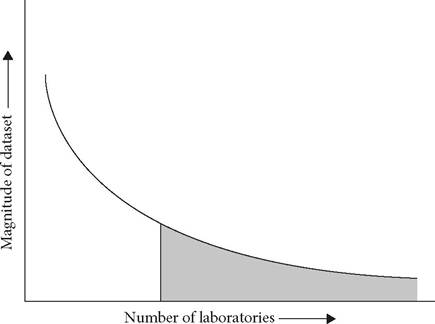
Figure 4.1 The “long-tail” of science. First named by Chris Anderson (quoted by C. L. Borgman, see Note 31) the graph shows that as the number of laboratories grows, the size of the datasets that each laboratory uses and generates decreases. Only a relatively few large labs are dealing with the extremely large datasets that characterize Big Data. Small Science is carried out in the long tail of the distribution and generates the large majority of scientific findings today.
Little Data are only “awkwardly analogous”32 to Big Science and Small Science. While all Big Science projects make use of Big Data, some Small Science labs do as well.
Big Data strategies are now open to laboratories of all sizes since powerful, inexpensive computers and access to massive datasets have become widely available.“Little Data” is a logically necessary though rarely used term for the raw material and final output of Small Science. Little Data are generated by the materials, methods of data collection, and analyses that most Small Science projects employ; small datasets with relatively few subjects and variables, and people, rather than machines, to do much of the work. Small Science using Little Data methods is not easily “scalable,” meaning that you can't readily increase the rate of progress from the start of data collection to the generation of conclusions. For instance, for the past 50 years or so the premier way to measure the electrical properties of neurons in the brain has been for a single investigator to insert a fine glass probe with a submicroscopic tip into a single neuron in an in vitro slice of brain tissue. The method yields extremely high-resolution information; it is also a pitifully slow method, and so far no one has come up with a better one. Single-cell recording like this represents a typical Small Science/Little Data scalability bottleneck. Despite such drawbacks, Little Data projects make up the long tail of the distribution and represent the principal sources of research information in many fields, including biology and biomedical science, neuroscience, and psychology. And, even today, Little Data and Small Science generate the great majority, perhaps 85%,33 of all scientific knowledge.
4.