Let’s Get Metaphysical
In a metaphysical context, it seems reasonable to add one more constraint to the definition of fundamentality: non-arbitrariness [14]. Something is truly fundamental if it could not have been otherwise.
In that sense, a theory like the Standard Model utterly fails: 61 constituents? Why not 42, or 137? Even if one day we succeed in formulating an incredibly coherent and compact Theory of Everything, the kind that could easily fit on a T-shirt, we could always ask “Why these equations, and not others?”There is a way to get rid of all arbitrariness, but it is rather extreme: it is to consider “nothing” as a candidate for the fundamental “ground of being” that underlies all of reality. As I argued elsewhere [15], the infinite ensemble of all abstractions is a unique construct that contains, overall, zero information: if you want to specify some subset of the ensemble, you need to do it explicitly, and this description contains information; but if you want to refer to the infinite ensemble itself, you can simply say “all abstractions”, which takes almost no time and contains essentially zero information.
Being unique, the infinite ensemble of all abstractions is not arbitrary in any way. Being abstract, it can exist by itself, by virtue of its internal logic, so it is not dependent on anything else—another attribute that we should expect from something truly fundamental. Of course, for pure abstraction to act as the fundamental ground of being, like the scenarios illustrated in Figs. 3 and 4, one has to accept that a physical world like ours can be nothing more than an abstract structure “seen from the inside”, at higher (or lower) levels of description. (This is essentially the same postulate that Max Tegmark’s uses to ground his famous Mathematical Universe Hypothesis [16]: since mathematics is the general study of abstract structures, pure abstractions are mathematical structures.) For many scientists and philosophers, this is a tough cookie to swallow, which is represented, on Figs.
3 and 4, by clouds labelled “fogFig. 3 Abstraction all the way down
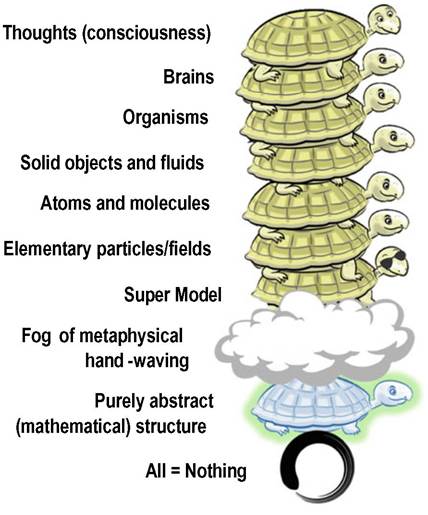
of metaphysical hand-waving”. In my 2015 FQXi essay on the relationship between mathematics and physics [17], I explained why it is reasonable to consider that a physical world is simply an abstract structure that contains self-aware sub-structures: what makes such a world physical is the contemplation of its mathematical structure by these sub-structures.
In Figs. 3 and 4, the circle labelled “All = nothing” represents the infinite ensemble of all abstractions. I thought it was appropriate to use the Zen symbol enso, since “dynamic emptiness” is one of its possible meanings. The bottom-up hierarchy in Fig. 3 is consistent with Tegmark’s Mathematical Universe Hypothesis: in this view, elementary particles/fields emerge from an underlying description that is purely mathematical/abstract. The top-down arrangement in Fig. 4 is representative of more mystical views of reality that anchor consciousness directly to the fundamental ground-of-being, with the physical world being a manifestation within consciousness.
The chains in Figs. 3 and 4 are asymmetrical: one goes “up” in scale from the ground-of-being, the other goes “down”, so in a sense, they are still somewhat arbitrary! Why not attempt to merge them together? With enso now at both ends, the chain could close on itself. In [14], I explored the possibility of such “strange loops” of explanation.
That being said, the most honest answer to the question “What is fundamental?” is, of course, that in the current state of our scientific knowledge, the question is
Fig. 4 Abstraction all the way up
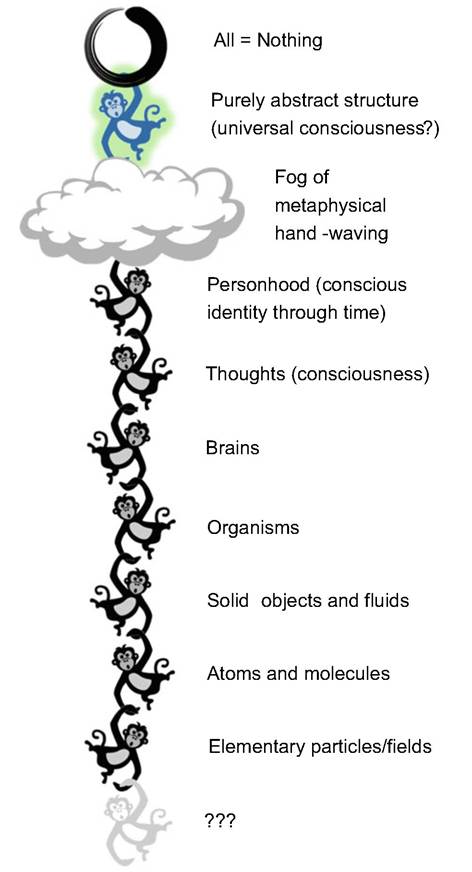
still wide open. Science and philosophy must (and will) go on. Will the quest for fundamentally ever end? And if it does, will it end in victory or in defeat?
Einstein said that “the most beautiful thing we can experience is the mysterious.” It might also be the most fundamental.