I Think Therefore I Am Fundamental?
As we’ve just seen, analysing almost anything, even the simplest molecules, from the first principles of particle physics is depressingly hard, which makes fundamentally effectively pop up everywhere.
The Standard Model is disappointing, and we’re all going to die. Maybe we can do better by turning the problem of fundamentality around, starting at the top? After all, fundamentally, all our philosophical and scientific musings (as well as everything else that we know anything about) are states of consciousness.“Consciousness-first” approaches, whether they are found in scientific, philosophical or mystical arguments, all suffer from a conundrum that constitutes, for many, an immediate deal breaker. It seems clear that consciousness requires a physical brain to operate: you damage the brain, you damage the consciousness; you destroy the brain, you destroy the consciousness (at lest, from an external point of view). Moreover, in the early universe, there were at least millions of years, maybe billions, when there were almost certainly no conscious beings to be found anywhere. So how can consciousness come first?
During a session on consciousness and integrated information theory held at FQXi’s 2016 conference, I asked the panel what was more fundamental: consciousness, or space/time/matter (Fig. 2). There were many nuanced answers, but overall, consciousness won!
Frank Johnson’s famous thought experiment, “Mary the color scientist”, is one of the best arguments for believing that qualia, the subjective properties of conscious states (for example, what it is like when we perceive the color red), cannot be reduced, even in principle, to physics or any other physical science:
Mary is a brilliant scientist who is, for whatever reason, forced to investigate the world from a black and white room via a black and white television monitor.
She specializes in the neurophysiology of vision and acquires, let us suppose, all the physical information there is to obtain about what goes on when we see ripe tomatoes, or the sky, and use terms like ‘red’, ‘blue’, and so on. She discovers, for example, just which wavelength combinations from the sky stimulate the retina, and exactly how this produces via the central nervous system the contraction of the vocal chords and expulsion of air from the lungs that results in the uttering of the sentence ‘The sky is blue’. [...] What will happen when Mary is released from her black and white room or is given a color television monitor? Will she learn anything or not? [11]If Mary learns something new (which seems reasonable), then qualia, as fundamental elements of conscious experiences, cannot fully be accounted for by any amount of information about physics, chemistry or biology, and are truly, independently fundamental.
Going back to Descartes’ Cogito ergo sum, another argument for the fundamentality of consciousness is the obvious fact that all we really know for certain about the Universe is that “consciousness is going on”, more precisely, our own consciousness. Consciousness underlies everything we know, so it must be, in some important sense, epistemologically fundamental. But does this necessarily imply that it is also onto-
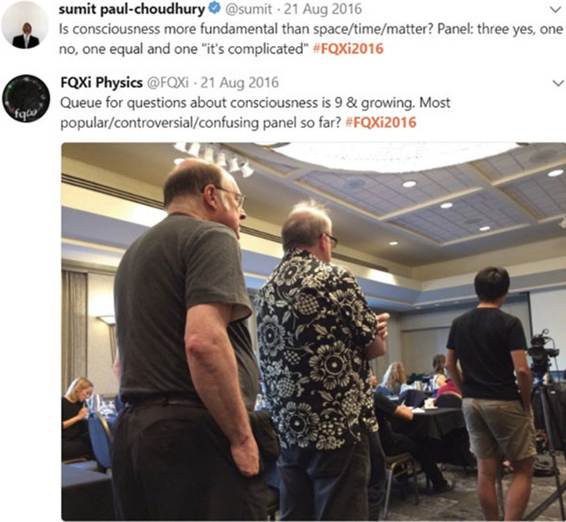
Fig. 2 Question period during a session on consciousness and integrated information theory at FQXi’s 2016 conference
logically fundamental, and that it constitutes an independent, fundamental aspect of objective reality?
If we want to clarify the question “What is fundamental?” and make sense of the divergence of opinions among scientists and philosophers, it seems important to clearly distinguish between epistemological fundamentality (the fundamentality of our scientific theories) and ontological fundamentality (the fundamentality of reality itself, irrespective of our description of it).
But this is not as straightforward as it seems.Since science is supposed to model reality, the two kinds of fundamentality should ideally coincide. But of course, there is no way to know for certain what the true nature of reality is: the world is what it is and does what it does, science only tries to follow the best it can. As limited observers, we only have access to a restricted domain of reality. We can certainly try to ascertain the relative fundamentality of our scientific theories, but to believe that we can say anything meaningful about ontological fundamentality, we must first believe that we can say something meaningful about reality-in-itself.
The problem is that the sum total of what we have codified about nature in our scientific laws underdetermines what reality-in-itself could be. As Sean Carroll puts it,
The fundamental stuff or reality might be something wholly distinct from anything any living physicist have ever imagined; in our everyday world, physics will still work according to the rules of quantum field theory. [12]
It could be that the question “What is Fundamental?” only makes sense epistemologically [13], and that the very concept of fundamentally does not apply at the ontological level: the world is simply a coherent whole, and nothing is truly more fundamental than anything else.
On the other hand, the fact that we cannot use the tools of science to ascertain the deep nature of reality does not mean that we cannot use our logic and our intuition to make reasoned hypotheses about it!
4
More on the topic I Think Therefore I Am Fundamental?:
- THE NATIVE PROBLEM
- REVIEW OF FORENSIC ASSESSMENT INSTRUMENTS
- CHAPTER FOUR Town and Country Urban devotions and rural rituals
- Excluding Evidence
- Testate Succession
- The substantive: materiality and policy
- B. Personal Servitudes
- CASE 145: Periods of Gestation
- FIVE COMPONENTS OF LEGAL COMPETENCIES
- XAT 2009