Nominalism in Mathematics
After describing the Platonist proposals above, I will now consider some of the nominalist alternatives. In particular, I will examine: mathematical fictionalism (Field 1980, 1989), modal structuralism (Putnam 1967, Hellman 1989), and deflationary nominalism (Azzouni 2004).
What all of these proposals have in common is the fact that they do not take mathematical objects (or structures) to exist. In fact, they deny their existence. As a result, the main difficulty faced by Platonism (the explanation of how we have mathematical knowledge) vanishes. But other problems emerge as well. Along the way, these nominalist proposals offer distinctive understandings of mathematics.3.1 Mathematical fictionalism
In a series of works, Hartry Field provided an ingenious strategy for the nominalization of science (Field 1980, 1989). As opposed to Platonist views, in order to explain the usefulness of mathematics in science, Field does not postulate the truth of mathematical theories. On his view, it is possible to explain successful applications of mathematics with no commitment to mathematical objects. Therefore, the indispensability argument, which Field takes to be the only non-question-begging argument for Platonism, is blocked. The nominalist component of Field's account derives from the fact that no mathematical objects are assumed to exist; hence, mathematical theories are false.[48] By devising a strategy that shows how to dispense with mathematical objects in the formulation of scientific theories, Field rejects the indispensability argument, and provides strong grounds for the articulation of a nominalist stance.
Field's strategy depends on two interrelated moves. The first is to change the aim of mathematics, which is not taken to be truth, but something different. On his view, the proper norm of mathematics is conservativeness (Field 1980, 16-19, 1989, 59).
According to Field, a mathematical theory is conservative if it is consistent with every internally consistent theory about the physical world. Such theories about the physical world do not involve any reference to, or quantification over, mathematical objects, such as sets, functions, and numbers; they are called nominalistic theories (Field 1989, 58). And it is precisely because mathematics is conservative that, despite being false, it can be useful. Mathematics is useful because it shortens our derivations that do not involve reference to mathematical entities. After all, if a mathematical theory M is conservative, then a nominalistic assertion A about the physical world (i.e., an assertion that does not refer to mathematical objects) is implied by a body N of such assertions and M only if it is implied by N alone. That is, provided we have a sufficiently rich body of nominalistic assertions, by using mathematics, we do not obtain any new nominalistic consequences. Mathematics is only a useful instrument to help us in the derivations.The outcome of this is that conservativeness can be employed only to do the required job if we have nominalistic premises to start with (Field 1989, 129).11 The second move of Field's strategy is then to provide such nominalistic premises in one important and typical case, Newtonian gravitational theory. Field then elaborates on a work that has a respectable tradition, Hilbert's axiomatization of geometry (Hilbert 1971). What Hilbert provided was a synthetic formulation of geometry, which dispenses with metric concepts, and therefore does not include any quantification over real numbers. His axiomatization was based on concepts such as point, betweenness, and congruence. Intuitively speaking, we say that a point y is between the points x and z if y is a point in the line-segment whose endpoints are x and z. Also intuitively, we say that the line-segment xy is congruent to the linesegment zw if the distance from the point x to the point y is the same as that from the point z to w.
After studying the formal properties of the resulting system, Hilbert proved a representation theorem. He showed, in a stronger mathematical theory, that given a model of the axiom system for space he had put forward, there is a function d from pairs of points onto non-negative real numbers such that the following “homomorphism conditions” are met: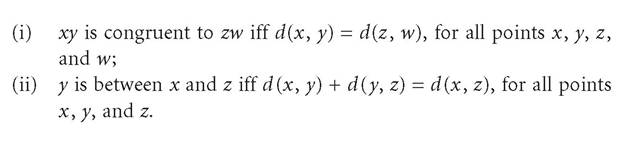
11 It is a confusion to argue against Field's view by claiming that if we add some bits of mathematics to a body of mathematical claims (not nominalistic ones), we can obtain new consequences that could not be achieved otherwise (Field 1989, 128). The restriction to nominalistic assertions is crucial.
As a result, if the function d is taken to represent distance, we obtain the expected results about congruence and betweenness. Thus, although we cannot talk about numbers in Hilbert's geometry (there are no such entities to quantify over), there is a metatheoretic result that associates assertions about distances with what can be said in the theory. Field calls such numerical claims abstract counterparts of purely geometric assertions, and they can be used to draw conclusions about purely geometrical claims in a smoother way. Indeed, because of the representation theorem, conclusions about space, that can be stated without real numbers, can be drawn far more easily than we could achieve by a direct proof from Hilbert's axioms. This illustrates Field's point that the usefulness of mathematics derives from shortening derivations.[49]
Roughly speaking, what Field established was how to extend Hilbert's results about space to space-time. Similarly to Hilbert's approach, instead of formulating Newtonian laws in terms of numerical functions, Field showed how they can be recast in terms of comparative predicates. For example, instead of adopting a function such as “the gravitational potential of x” which is taken to have a numerical value, he employed a comparative predicate such as “the difference in gravitational potential between x and y is less than that between z and w.” Relying on a body of representation theorems (which plays the same role as Hilbert's representation theorem in geometry), Field established that several numerical functions can be “obtained” from comparative predicates.
But in order to use those theorems, he first showed how to formulate Newtonian numerical laws (such as Poisson's equation for the gravitational field) only in terms of comparative predicates. The result is an extended representation theorem.[50]Using the representation theorem, Field can then quantify over space-time regions rather than real numbers in his formulation of Newtonian theory. Given his quantification over space-time regions, Field assumes a sub- stantivalist view of space-time, according to which there are space-time regions that are not fully occupied (Field 1980, 34-6, 1989, 171-80). Given this result, the nominalist is allowed to draw nominalistic conclusions from premises involving N plus a mathematical theory T. After all, due to the conservativeness of mathematics, such conclusions can be obtained independently of T. Hence, what Field provided is a nominalization strategy, and since it reduces ontology, it seems promising for those who want to adopt a nominalist stance vis-a-vis mathematics.
Field can then adopt a fictionalist attitude about mathematical theories. Although mathematical objects (such as numbers) do not exist, Field can have a verbal agreement with the Platonist by introducing a fiction operator in the syntax of mathematical statements (see Field 1989). For example, despite the fact that the statement “There are infinitely many prime numbers” is false, since numbers do not exist, the statement “According to arithmetic, there are infinitely many prime numbers” is true. The fiction operator functions here in an analogous way to the corresponding fiction operator in literature. For instance, the statement “Sherlock Holmes lived in Baker Street” is false (or, at least, it lacks truth-value, depending on the theory of fictional names one adopts), since Sherlock Holmes does not exist. However, the corresponding statement with the fiction operator, “According to the Holmes stories, Sherlock Holmes lived in Baker Street,” is true.
Mathematical fictionalism explores this important connection between mathematics and fiction.3.2 Modal structuralism
In recent years, Geoffrey Hellman has developed a program of interpretation of mathematics that incorporates two features: an emphasis on structures as the main subject-matter of mathematics, and a complete elimination of reference to mathematical objects by interpreting mathematics in terms of modal logic (as first suggested in Putnam 1967). Because of these features, his approach is called a modal-structural interpretation (Hellman 1989, vii-viii and 6-9).
But the approach is also supposed to meet two important requirements (Hellman 1989, 2-6). The first is that mathematical statements should have a truth-value, and thus “instrumentalist” readings of them are rejected from the outset (semantic component). The second is that “a reasonable account should be forthcoming of how mathematics does in fact apply to the material world” (Hellman 1989, 6).
In order to address these requirements, Hellman developed a general framework. The main idea is that although mathematics is concerned with the study of structures, this can be accomplished by focusing only on possible structures and not actual ones. Thus, the modal interpretation is not committed to mathematical structures. There is no reference to these structures as objects nor to any objects that happen to “constitute” these structures. And this is how the ontological commitment to such structures is avoided: the only claim is that the structures under consideration are possible.
In order to articulate this point, two steps are taken. The first is to present an appropriate translation schema in terms of which each ordinary mathematical statement S is taken as elliptical for a hypothetical statement, namely: that S would hold in a structure of the appropriate kind.[51] For example, if we are considering statements about natural numbers, the structures we are concerned with are sequences of natural numbers satisfying the usual principles for such numbers.
The principles in question define the behavior of addition, subtraction, and other operations over numbers. In this case, each particular statement S is (roughly) translated as:? VX (X is a sequence of natural numbers satisfying the usual principles for them S holds in X).
In other words, if there were sequences of natural numbers satisfying the usual principles for these numbers, then the statement S would hold in them. This is the hypothetical component of the modal-structural interpretation (for a detailed analysis and a precise formulation, see Hellman 1989, 16-24).
The categorical component constitutes the second step (Hellman 1989, 24-33). The idea is to assume that the structures of the appropriate kind are logically possible. In this case, we have:
3X (X is a sequence of natural numbers satisfying the usual principles for these numbers).
In other words, it is possible that there are sequences of natural numbers satisfying the usual principles for such numbers. In this way, each mathematical statement S is translated into two modal statements. The first is that if there were structures of the appropriate kind, S would be true in such structures. The second is that it is possible that there are structures of that kind. Following this approach, truth-preserving translations of mathematical statements can be presented without ontological costs, given that only the possibility of the structures in question is assumed.
Hellman then shows how the practice of theorem proving can be regained in a modal-structural framework (roughly speaking, by applying the translation schema to each line of the original proof of the theorem under consideration). Moreover, by using this translation schema, he shows how arithmetic, the theory of real numbers, and set theory can be recovered (see Hellman 1989, 16-33, 44-7, and 53-93, respectively). In this way, Hellman is able to accommodate “virtually all the mathematics commonly encountered in current physical theories” (1989, 45-6).
We can now consider the issue of the application of mathematics. The main idea is to adopt the hypothetical component as the basis of the application, but now the structures to be entertained are those commonly used in particular branches of science. Two points need to be made.
The first is about the general form of applied mathematical statements (see Hellman 1989, 118-24). These statements involve three crucial components: the structures that are used in applied mathematics, the non- mathematical objects to which the mathematical structures are applied, and a statement of application that specifies the particular relations between the mathematical structures and the non-mathematical objects. The relevant mathematical structures can be formulated in a set theory. A set theory is a powerful mathematical theory in which one can formulate virtually all mathematical theories, including those used in applications. Let us call the set theory used in applied contexts Z (for Zermelo[52]). The non-mathematical objects of interest in the context of application can be expressed in Z as Urelemente, that is, as objects that are not sets. We will take “U” to be the statement that certain non-mathematical objects of interest are included as Urelemente in the structures of Z. Finally, “A” is the statement of application, describing the particular relations between the relevant mathematical structures of Z and the non-mathematical objects described in U. We can now present the general form of an applied mathematical statement (Hellman 1989, 119):

This is, of course, the hypothetical component appropriately interpreted to express which relations would hold between certain mathematical structures (formulated as structures of a Z) and the entities studied in the world (the Urelemente).
The second consideration examines in more detail the relationships between the physical (or the material) objects studied and the mathematical framework. Hellman calls them “synthetic determination” relations (1989, 124-35). More specifically, we have to determine which (synthetic) relations among non-mathematical objects can be taken, in the antecedent of an applied mathematical statement, as the basis for specifying “the actual material situation” (1989, 129). Hellman's proposal is to consider the models of a comprehensive theory T'. This theory embraces and links the vocabulary of the applied mathematical theory (T) and the synthetic vocabulary (S) in question, which intuitively fixes the actual material situation. It is assumed that T determines, up to isomorphism, a particular kind of mathematical structure (containing, for example, Z), and that T' is an extension of T In that case, a proposed “synthetic basis” will be adequate if the following condition holds:
Let a be the class of (mathematically) standard models of T', and let V denote the full vocabulary of T': then S determines V in a iff for any two models m and m' in a, and any bijection 0 between their domains, if 0 is an S isomorphism, it is also a V isomorphism. (Hellman 1989, 132)
The introduction of isomorphism[53] in this context comes, of course, from the need to accommodate the preservation of structure between the (applied) mathematical part of the domain under study and the non- mathematical part. This holds in the crucial case in which the preservation of the synthetic properties and relations (S-isomorphism) by 0 leads to the preservation of the applied mathematical relations (V-isomorphism) of the overall theory T'. It should be noted that the “synthetic” structure is not meant to capture the full structure of the mathematical theory in
question, but only its applied part. (Recall that Hellman started with an applied mathematical theory T.)[54]
This is an important point. Mathematics is applied by establishing appropriate isomorphisms between (parts of) mathematical structures and those structures that represent the material situation. And this procedure is justified, since such isomorphisms establish the “sameness” of structure between the mathematical and the non-mathematical domains. But on the mathematical side, we are only considering possible mathematical structures (those expressed in the antecedent of an applied mathematical statement). Thus, as opposed to Quine's view, no commitment to actual mathematical structures is found even in the context of successful applications of mathematics.
3.3 Deflationary nominalism
Whereas both mathematical fictionalism and modal structuralism involved the reformulation of mathematical theories to avoid commitment to the existence of mathematical objects, no such reformulation is found in what can be called deflationary nominalism. The central move of this proposal is to emphasize that quantification over a certain object (such as a mathematical entity) is not enough to guarantee the commitment to the existence of such an object.
According to Jody Azzouni, two kinds of commitment should be distinguished: quantifier commitment and ontological commitment (see Azzouni 2004, 127; see also 49-122). We incur a quantifier commitment whenever our theories imply existentially quantified claims. But existential quantification, Azzouni insists, is not sufficient, in general, for ontological commitment. After all, we often quantify over objects we have no reason to believe exist, such as fictional entities. To incur an ontological commitment - that is, to be committed to the existence of a given object - a criterion for what exists needs to be met. There are, of course, various possible criteria for what exists (such as causal efficacy, observability, and so on). But the criterion Azzouni favors, as the one which all of us have collectively adopted, is ontological independence (2004, 99). What exist are the things that are ontologically independent of our linguistic practices and psychological processes. The idea here is that if we have just made something up through our linguistic practices or psychological processes, there is no need for us to be committed to the existence of the objects in question. And typically, we would resist any such commitment.
Quine, as we saw, identifies quantifier and ontological commitments, at least in the crucial case of the objects that are indispensable to our best theories of the world. Such objects are those that cannot be eliminated through paraphrase and over which we have to quantify when we regiment the theories in question (in first-order logic). For Quine, these are exactly the objects to which we are ontologically committed. Azzouni insists that we should resist this identification. Even if the objects in our best theories are indispensable, even if we have to quantify over them in order to formulate our best theories of the world, this is not sufficient for us to be ontologically committed to them. After all, the objects we quantify over might be ontologically dependent on us - on our linguistic practices or psychological processes - and thus we might have just made them up. But, in this case, clearly there is no reason to be committed to their existence. However, for those objects that are ontologically independent of us, we are committed to their existence.
As it turns out, on Azzouni's view, mathematical objects are ontologically dependent on our linguistic practices and psychological processes. And so it is not surprising that, even though they might be indispensable to our best theories of the world, still we are not ontologically committed to them. Hence, Azzouni is a nominalist.
But in what sense do mathematical objects depend on our linguistic practices and psychological processes? In the sense that, in mathematical practice, the sheer postulation of certain principles is enough: “A mathematical subject with its accompanying posits can be created ex nihilo by simply writing down a set of axioms” (Azzouni 2004, 127). The only additional constraint that sheer postulation has to meet, in practice, is that mathematicians should find the resulting mathematics “interesting.” That is, briefly put, the consequences that follow from mathematical principles should not be obvious, nor should they be intractable. Thus, given that sheer postulation is (basically) enough in mathematics, mathematical objects have no epistemic “burdens.” Azzouni calls such objects, or “posits,” ultrathin (2004, 127).
The same move that Azzouni makes to distinguish ontological commitment from quantifier commitment is also used to distinguish ontological commitment to Fs from asserting the truth of “There are Fs.” Although mathematical theories used in science are (taken to be) true, this is not sufficient to commit us to the existence of the objects these theories are supposed to be about. After all, on Azzouni’s picture, it might be true that there are Fs, but to be ontologically committed to Fs, a criterion for what exists needs to be met. As Azzouni points out:
I take true mathematical statements as literally true; I forgo attempts to show that such literally true mathematical statements are not indispensable to empirical science, and yet, nonetheless, I can describe mathematical terms as referring to nothing at all. Without Quine’s criterion to corrupt them, existential statements are innocent of ontology. (Azzouni 2004, 4-5)
In Azzouni’s picture, as opposed to Quine’s, ontological commitment is not signaled in any special way in natural (or even formal) language. We just do not read off the ontological commitment of scientific doctrines (even suitably regimented). After all, as noted, neither quantification over a given object (in a first-order language) nor formulation of true claims about such an object entails the existence of the latter. Only ontological independence does that.
Azzouni’s proposal nicely expresses a view that should be taken seriously. And as opposed to other versions of nominalism, it has the significant benefit of aiming to take mathematical discourse literally. This is a benefit that, so far, only Platonist views could deliver.
4.