PERRIN AND REALISM
Salmon urges that Perrin's argument is an argument for scientific realism. Moreover, unlike the usual philosophical arguments for realism, it is empirical rather than a priori. He writes, “In an effort to alleviate this intellectual discomfort [produced by philosophical arguments between realists and antirealists], I decided to try an empirical approach to the philosophical problem.
Since it seemed unlikely that scientists would have been moved by the kinds of arguments supplied by philosophers, I felt that some insight might be gained if we were to consider the evidence and arguments that convinced scientists of the reality of unobservable entities” (Salmon 1984, pp. 213-214). Salmon believes that Perrin's argument to the reality of molecules provides a “clear and compelling example” of a scientific argument for the existence of unobservable entities. As noted, he considers Perrin's argument to be of the common-cause variety. Even if we reject this interpretation, the question remains as to whether Perrin's argument is, or is best construed as, an argument for scientific realism, and whether Perrin himself understood it in this way.An antirealist might provide a very different interpretation of Perrin's conclusion. Instead of claiming that the theoretical proposition T is true, all that Perrin is doing, or at least all that he is entitled to do, is infer that T is empirically adequate, that it “saves the phenomena.” Assumption T can accomplish the latter without being true. This suggests two questions, one philosophical, one historical. First, is the antirealist correct in supposing that it is possible to have a valid argument to the probable conclusion that some theory saves the phenomena that is not also a valid argument to the probable conclusion that the theory is true? Second, even if it is possible, is it historically plausible to construe Perrin's reasoning in this way?
The answer to the first question is yes.
To show this, let me speak of a theory as “potentially saving” some putative phenomenon described by e. We might think of this in terms of explanation: T potentially saves e if it potentially explains it (explains it in a sense that does not require T to be true). We might suppose that the potential explanation is deductive, so that T entails e.21 With this notion as basic, let us adopt the following:Definition 1. T saves e if and only if (a) T potentially saves e, and (f) e is true. Introducing probability, from definition 1 we can say that if T potentially saves e, then it is probable to degree r that T saves e, if and only if p(e) = r. More generally,
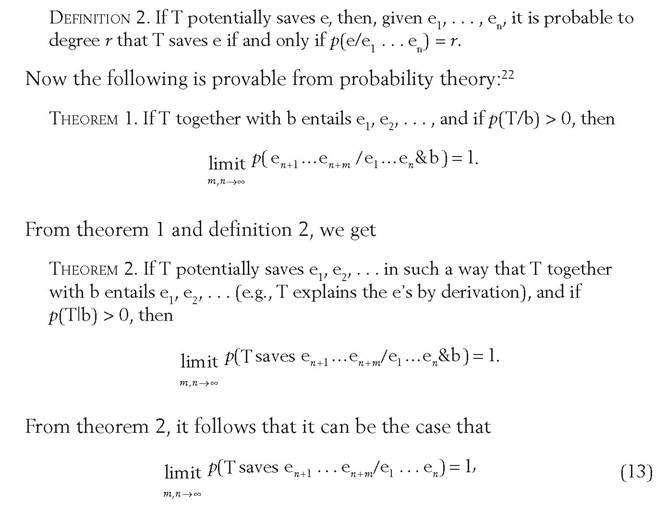
21. This is stronger than van Fraassen's 1980 account of “saving,” which requires only that e be consistent with T My point here is not to attack but rather to defend one antirealist claim, namely, that it is possible to construct a valid argument to the conclusion that a theory saves the phenomena that is not also a valid argument to the truth of the theory. To do so i employ the present concept of “saving”.
22. For a proof, see Earman 1985.
even though p(T/b) is very small, so long as it is not zero. Could equation (13) obtain even if, for any n, p(T/e1... en&b) is very small? Yes, it could. Suppose some incompatible theory T' also potentially saves the e’s in such a way as to entail them, but that the probability of T' on b is very high. Then no matter how many e's T entails, the probability of T on the e's will be and remain very low.
More precisely, suppose that the rival theory T' is such that p(T'/b) = r. If T' together with b entails the e's, then for any n, p(T'/e1... en&b) is greater than or equal to r. If the original theory T is incompatible with T', then for any n, p(T/e1... en&b) < 1 - r. So if the rival theory T' is initially very probable, say p(T'/b) =.95, then, no matter how many e's the original theory T saves, its probability p(T/e1...
en&b) will be and remain less than or equal to.05, for any n. This can be true even if equation (13) obtains, that is, even if the probability that T saves the e's gets larger and larger, approaching 1 as a limit.[167]Accordingly, it is indeed possible for it to be highly probable that a theory saves the phenomena while it is highly improbable that the theory is true. So, to answer our earlier question, their can be a valid argument to the probable conclusion that a theory saves the phenomena that is not also a valid argument to the probable conclusion that the theory is true.[168]
Now let us apply this to Perrin's reasoning. Perrin conducted a series of experiments on Brownian motion with different values for n', n, and
so on, in equation (9). Let C. be the proposition that the calculation of N done by means of Perrin's ith experiment on Brownian particles using equation (9) is (approximately) 6 1023, and let proposition T be as
stated before. In section 4, I noted the possibility of taking Perrin's background information b to contain assumptions that together with T entail C.[169] On an antirealist interpretation, Perrin could be arguing that it is highly probable that T saves the C phenomena without arguing that T is probably true. That is, Perrin could be arguing that

without supposing that p(T/C1... Cn&b) is high, or that

Accordingly, an antirealist has a way of understanding Perrin's reasoning that does not commit the antirealist, or Perrin, to drawing the conclusion that the theory itself is true or highly probable, hence to drawing the conclusion that molecules are real.
Although such a reconstruction is possible, is it historically plausible? Admittedly, Perrin makes some remarks which may suggest antirealism.
For example, near the end of his article he writes, “Lastly, although with the existence of molecules or atoms the various realities of number, mass, or charge, for which we have been able to fix the magnitude, obtrude themselves forcibly, it is manifest that we ought always to be in a position to express all the visible realities without making any appeal to the elements still invisible. But it is very easy to show how this may be done for all the phenomena referred to in the course of this Memoir” (Perrin 1984, p. 599). Perrin argues that one can take various laws that relate Avogadro's number to measurable quantities and derive a new equation containing only measurable quantities. If the two laws governing different phenomena are expressible as N = f(A,B,C) and N = g(D,E,F), where A-F are measurable quantities, we can write f(A,B,C) = g(D,E,F), in which (as Perrin puts it) “only evident realities occur" (1990, p. 600; his italics). But Perrin does not conclude from this that the most we can say is that the molecular hypothesis is empirically adequate or has only instrumental value. His main point seems to be that by expressing an equation of the last form here we obtain a result that “expresses a profound connection between two phenomena at first sight completelyindependent, such as the transmutation of radium and the Brownian movement” (p. 600).
Most of his comments strongly suggest an attitude of realism. For example, “the real existence of the molecule is given a probability bordering on certainty” (1990, p. 216). Elsewhere, he writes, “Thus the molecular theory of the Brownian motion can be regarded as experimentally established, and, at the same time, it becomes very difficult to deny the objective reality of molecules" (1984, p. 554; italics his). These are more typical passages.
Finally, Perrin's argument as I have reconstructed it probabilistically in steps (i)-(v) in section 4 is not an antirealist argument. It is not an argument simply to the conclusion that T saves the phenomena, or to equation (14), a probabilistic version of this.
Step (v) asserts the high probability of T itself.Accordingly, an antirealist must show not simply that Perrin's reasoning can be reformulated in an antirealist way to the conclusion (equation [14]), but that such a reformulation is required or desirable for historical or logical reasons. The historical grounds for such a reformulation are dubious at best. On logical grounds, considering my probabilistic reconstruction, the antirealist would need to show that there are invalid steps in the argument that can be removed only by adopting an antirealist conclusion such as equation (14) rather than a stronger realist conclusion such as equation (15). He must show that Perrin's preliminary arguments leading to step (i)—for example, eliminative-causal arguments of type A in section 4 from Brownian motion (not appealing to his own experimental results), arguments from chemical combinations, from kinetic theory, and from other determinations of Avogadro's number—do not give T a high probability. The antirealist needs to show not simply that these arguments can be reformulated as arguments to the conclusion that T saves the phenomena, but that something is faulty with these arguments themselves—that they fail to confer high probability on T or that they fail to establish step (i). He must show that Perrin's scientific reasoning is erroneous. Perhaps it is. But this is not demonstrated by showing simply that the antirealist conclusion “T saves the phenomena” is possible, or even that it is more probable than T itself, since it commits one to much less than T. In the absence of arguments against specific steps in Perrin's reasoning, one can conclude, with Salmon, that Perrin supplies a reasonable empirical argument for the reality of molecules.[170]