Realism of Properties, Realism of Entities and Their Role in Microphysics
Already during my university studies between 1973 and 1977 I came in contact with the work of Evandro Agazzi, in particular with his work in the philosophy of physics (Agazzi 1969).
I remained deeply impressed by his refusal of the identification of philosophy of science with epistemology, and by his consequent belief that the former cannot be limited to matters concerning the form and language of scientific theories, according to the neo-empiricist perspective, but it should also address issues related to their contents, namely problems of philosophy of nature. He held that philosophy of physics must be identified with a survey on the fundamentals, in the sense both of an enquiry in the epistemological foundations of physical theories and an analysis of their philosophical implications, and this soon became the perspective guiding my research on the foundations of quantum mechanics.In addition to this fundamental methodological lesson on the need to conduct the research in philosophy of science as a study of the foundations of scientific theories, Agazzi influenced my philosophical perspective in an even more direct way, by his conception of scientific realism, and its specific application to the fundamental concept of theoretical quantum mechanics, that of the wave function, which we have discussed so far.
Unlike the neo positivists Agazzi vindicated a substantial autonomy of the philosophical inquiry with respect to scientific research, and as we saw from his discussion of the principle of complementarity he had an approach to scientific theories very different from neopositivism. However, to this philosophy he recognized the merit of not having upheld the cognitive value and the intersubjectivity conception of science:
Neopostivist epistemology, despite having been deeply influenced by Mach’s thought, has come to accept more or less explicitly a realist view of science.
We do not care to discuss here how consistently this could happen: it is sufficient to note that such an outcome was imposed by the cultural program of the entire movement, which was characterized by a view of science as the only authentic source of knowledge (Agazzi 1985: 173).Besides,
the obsession with which neo-empiricism tried to impose absolute fidelity to experience, and the reducibility to it of the very theoretical components of science, can also be seen as an effort to ensure a solid connection with reality (ibid.).
Moreover we know that the main theses of traditional philosophy, including those of realism, had been refuted by the logical empiricists as meaningless, as generally corresponding to propositions of existential content that are not empirical and for which there is no method for determining their truth value.
Instead research on the EPR paradox showed the possibility of supporting a completely different point of view, by showing a clear form of logical incompatibility (which through Bell’s theorem could be turned into an experimental discrepancy) between the quantum description given by some particular state vectors, the so called entangled states, and a very reasonable principle of reality, which identified scientific objectivity with predictability with certainty, considered as a sufficient condition for physical reality (Einstein et al. 1935). It was thus shown uncontroversially that such a realistic principle could meet those requirements of verifiability that the neo positivists believed to be completely inapplicable to philosophical propositions. Thus it became clear that the acceptance of confirmability as a criterion of meaning (but not of scientificity, since scientificity is subject to the stronger requirement of Popper’s falsifiability) allows to reformulate some of the main metaphysical theses in terms of philosophical principles endowed with factual meaning. In a nutshell, according to my point of view, scientific propositions must be falsifiable, whereas philosophical ones can only be disconfirmable.
It has also be shown that there are other formulations of realism endowed with meaning. The first was discussed one year after EPR by Carnap, who analyzed a realistic hypothesis proposed by Lewis in terms of the proposition: “If all minds disappeared from the universe, the stars would still go in their courses” (Carnap 1936-1937). Moreover he highlighted that this statement satisfied the most stringent requirements of factual significance, since it is controllable, albeit incompletely.
Other non-metaphysical variants of the reality principle include various probabilistic generalizations of the EPR criterion: for instance, while the original EPR criterion required predictability with certainty (a strong idealization with respect to actual physical situations), I suggested to replace it with predictability with a high degree of inductive probability (Tarozzi 1979); later on, together with Selleri, I modified it by considering the a priori probabilities themselves as real properties (Selleri and Tarozzi 1983).
The common feature of these different realistic principles (EPR, probabilistic EPR, Carnap) is the attribution of reality not to the object but to its predictable properties. This agrees with the logical empiricist refutation—anticipated by Kant’s critique of existence as a predicate—of the identification of reality with a (further) property of a physical object, an error that persisted for a long time in the debate on the EPR paradox.
Nonetheless, the shift of reality from the object to its predictable properties allows to preserve the notion of independence from the observer (and from his mind or consciousness), which is at the basis of metaphysical realism. The latter, in fact, as defined by Hume, is the doctrine that reality is what would exist, though we and every sensible creature were absent or annihilated. There is a perfect continuity between metaphysical and empirical realism, and the main difference is that the latter, considering the predictability through our best theories as a guarantee for reality, appears to be based on science, and in our case on physics, whereas, according to the former it is science that is to be based on realism.
It was Agazzi’s analysis of the relationship between scientific objectivity and reality, in particular his claim that the latter includes the former (i.e., that being objective takes more than just being real) to be seminal for my investigations, since it enabled me to understand the EPR principle of physical reality in the new light, as I have explained earlier.
He however rightly points out a kind of opposition between this realism of properties or attributes and his realism of objects or entities, and since many years ago and up to the present (Agazzi 2014) he advised me to supplement the reality of the properties, which seems to him rather dim, with that of the object. His exhortation was one of the reasons that led me to investigate, after the EPR problem, also the possibility of an alternative realistic interpretation of the wave function, and to design experiments to test it.
In any case, I feel that empirical realism of the properties and scientific realism of the objects are both fundamental and indispensable issues to any scientific theory; and my dissatisfaction with quantum mechanics stems from the fact that this theory seemed rejects the attribution of physical reality both to its predictable properties and to its basic concepts.
But a recent ideal experiment, which might be easily converted into a real experiment, seems to show that this double anti realistic claim of the standard interpretation is no longer sustainable, and that either Agazzi’s realism of theoretical entities, and or empirical realism of (predictable) properties correspond to an essential condition in the interpretation of quantum mechanics.
The experiment aims to assess the possibility that quantum waves produce correlations at distance of the EPR type, identifying in this way a new perspective that would establish a deep and hitherto unsuspected relationship between the two previously discussed ways of interpreting realistically quantum mechanics.
In fact, consider a pair of photons produced by a non-linear crystal, which propagate in the device illustrated in Fig.
2. Any photon can be detected by the two “near” detectors (D1 and D2), which are placed after a shorter path, or by the two “far” detectors (D3 and D4), placed after a longer path. If we do not take into account all the cases in which both photons are detected by D1 or D2, the physical situation will be described by the state vector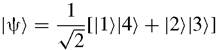
that presents some formal analogies with an entangled state, but is actually an ordinary superposition state.
According to the previous description, if detector D1 clicks, we can predict with certainty that D4 will click, and, if D2 clicks, we can predict that D3 will click. In this case the observed correlations can be considered as a consequence of a wave-like behavior.
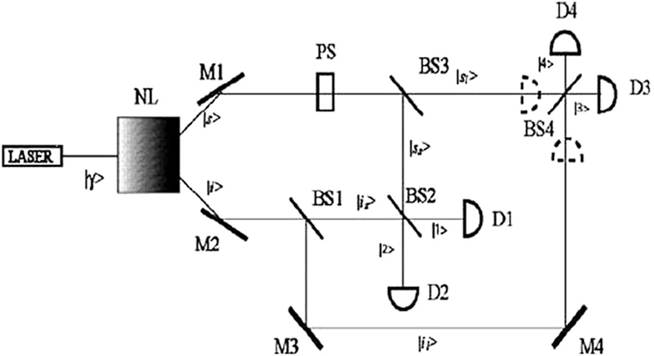
Fig. 2 Another experiment discriminating between the realistic interpretation of the wave function and the reality of the predictable properties
It is interesting, now, to see what happens if we displace detectors D3 and D4 to a position before BS4 (broken lines), once a photon has already been detected by D1 or D2. We have then a delayed-choice experiment (Wheeler 1978), but with an important difference: in our case, an event has already occurred (D1 or D2 has already clicked) before the choice. In this case, we can obtain information about which photon has been detected by D1 or D2 and which photon has been detected by D3 or D4. Now, although we can know which photon has been detected by which detector and therefore the paths they follow, we cannot predict whether detector D3 or detector D4 will reveal the photon after either detector D1 or detector D2 has clicked.
We also observe that, on account of the first interference (by BS2) and of the superposition of the two components of the i-photon and of the superposition of the two components of the s-photons, the latter situation (when detectors D3 and D4 are placed before BS4) is not the classical situation that would arise if both BS2 and BS4 were removed.
In this case, if D1 clicks, we know with certainty that the i-photon has been detected and that the s-photon (if not detected by D2) will reach D3. On the other hand, if D2 clicks, we know with certainty that the s-pho- ton has been detected and that the i-photon (if not detected by D1) will reach D4. Our proposed experiment differs from others designed to test the complementarity principle, because in those experiments, in general, many runs are needed in order to obtain an interference (wave-like) pattern at the detectors. In our experiment, on the contrary, the effect of the wave-like pattern is shown in single runs, hence for individual systems.Now, if we are able to predict something different and new (i.e., whether D3 or D4 will click) when we have wave-like behaviour relative to the predictions allowed by the particle-like behaviour, we see no reason for not attributing an ontological reality to the wave. Still, it is clear that they cannot have the same kind or degree of reality as particles, which are well localized and possess directly measurable properties. On the contrary, measuring directly waves or quantum states is intrinsically impossible: the existence of these objects can only be inferred.
5