Science Is a Tower of Theories and the Standard Model Is Its Foundation!
There’s a popular view among physicists that science is a hierarchical structure, a tower of theories, and that the most fundamental level is to be found, of course, at the base of the tower.
In their analysis of a recent interview-based survey conducted among Australian teachers and researchers, Yates et al. report:M. Seguin (B)
College de Maisonneuve, Montreal, Canada
e-mail: mseguin@cmaisonneuve.qc.ca
© Springer Nature Switzerland AG 2019 49
A. Aguirre et al. (eds.), What is Fundamental?, The Frontiers Collection,
https://doi.org/10.1007/978- 3- 030-11301- 8_6
The physicists responded to the question of what constitutes their discipline with ease, and as if reading from a common script — ‘fundamental’, ‘core’, ‘mathematical’, ‘stripping a problem to its essentials’. Physicists see physics as a fundamental and foundational form of knowledge that describes how the physical world works; it describes ‘the laws of nature at their most fundamental level’. [1]
For Nobel laureate Steven Weinberg, and for a good number of physicists, it is clear where the quest for fundamentality should lead us: to the smallest scales accessible.
We search for universal truths about nature, and, when we find them, we attempt to explain them by showing how they can be deduced from deeper truths. Think of the space of scientific principles as being filled with arrows, pointing toward each principle and away from the others by which it is explained. These arrows of explanation have already revealed a remarkable pattern: they do not form separate disconnected clumps, representing independent sciences, and they do not wander aimlessly—rather they are all connected, and if followed backward they all seem to flow from a common starting point. [2]
[...We] notice a remarkable thing: perhaps the greatest scientific discovery of all. These arrows seem to converge to a common source! Start anywhere in science and, like an unpleasant child, keep asking ‘Why?’ You will eventually get down to the level of the very small.
I have remarked that the arrows of explanation seem to converge to a common source, and in our work on elementary particle physics we think we’re approaching that source. [3]Philosopher of physics David Wallace writes [4]:
A tempting and popular picture of inter-theoretic relations is that of a tower of theories, each approximating the theory below it in the appropriate limit. For physics, at the bottom of the tower would lie the Standard Model of particle physics (perhaps with its base shrouded in mist to leave room for the hoped-for theory of quantum gravity that it approximates). Above it, perhaps, would be quantum electrodynamics; above that, the quantum theory of photons and nonrelativistic atoms; above that, nonrelativistic quantum mechanics; above that, perhaps, classical particle mechanics, and then classical fluid mechanics.
Wallace goes on to explain that this simple hierarchy of theories is an oversimplification, and that in reality, the modelling of physical systems often resembles a patchwork more than a tower. Nevertheless, he states that
We have reached the point where one theory, the Standard Model of particle physics (with the spacetime metric treated as one more quantum field) is at least a candidate to underlie all the various applications of high-level physics, and to provide the basis for explanation of all physical phenomena outside the extremes of the early universe and the singularities within black holes.
It is often stated that general relativity (describing gravity, space and time) and quantum mechanics are the two fundamental pillars of today’s physics. To be more precise, quantum mechanics is a general framework in which specific quantum theories can be constructed, among them quantum field theories. The rather dull name “Standard Model” designates a collection of quantum field theories that constitute our current best model of physics at the smallest scales that we can access. It attempts to explain physical processes via the interaction of 17 types of constituents (Table 1).
These constituents are usually designated by the name “elementary particles”, although the term particle can give a misleading impression about their nature.Table 1 The 17 constituents of the standard model
| Constituent (generation) | Number of variations |
| u Up quark (I) | 6 (particle and antiparticle, with three colors each) |
| d Down quark (I) | 6 |
| c Charm quark (II) | 6 |
| s Strange quark (II) | 6 |
| t Top quark (III) | 6 |
| b Bottom quark (III) | 6 |
| e Electron (I) | 2 (particle and antiparticle) |
| |i Muon(II) | 2 |
| T Tau (III) | 2 |
| ve Electron neutrino (I) | 2 |
| V|J, Muon neutrino (II) | 2 |
| vT Tau neutrino (III) | 2 |
| W boson | 2 |
| Z boson | 1 |
| Y Photon | 1 |
| g Gluon | 8 (color combinations) |
| H Higgs boson | 1 |
| TOTAL: | 61 |
Each constituent in Table 1 is first and foremost a quantum field [5]: at a given time, the field has a certain value at every point in space which indicates the “strength” of possible interactions that could happen there. Quantum fields can exhibit wave-like properties (interference) and particle-like properties (when the strength of the field peaks in a localized region, or when a localized interaction or energy transfer occurs).
In the Standard Model, there is an electron field permeating all space: electrons and anti-electrons are localized “disturbances” or “bundles” in the electron field that carry well defined electric charge, energy and momentum. In the same way that an electron is a quantized manifestation of the electron field, a photon is a quantized manifestation of the “photon field”, better known as the electromagnetic field; a Higgs boson is a quantized manifestation of the Higgs field; and so on. The bosons (the last five entries in the table) account for the fundamental interactions: the weak interaction is mediated by W and Z bosons, the electromagnetic interaction is mediated by photons, and the strong interaction is mediated by gluons. Problematically, the other known fundamental interaction, gravity, is left unaccounted for. Because of the well-known incompatibility between quantum mechanics and general relativity, we simply do not know how to satisfactorily describe gravity as a quantum field.
Most of the 17 constituents of the Standard Model exist in two versions, “particle” and “antiparticle”: only the photon, the Z boson and the Higgs are their own antiparticle. In addition, each type of quark and antiquark comes in three possible “colors”, and the gluons can exist in 8 color combinations—for a total of 61 variations. That’s why it’s often stated that there are 61 elementary particles in the Standard Model. It’s harder to give a precise value for the number of fields, since some properties of various constituents of the Standard Model can be grouped together and accounted for by a single field—or kept separated, whichever is more convenient depending on the context. But no matter how you look at it, the Standard Model is made up of a surprisingly large number of distinct constituents, which certainly casts some doubts on its fundamentality.
It is tempting to contrast the physicists’ Standard Model with the chemists’ periodic table, which contains, by now, over one hundred chemical elements.
The systematic way in which the chemical elements can be ordered by their atomic masses and grouped by their properties is a clear hint that there exists an underlying, simpler level of structure: indeed, we now know that all chemical elements can be generated by the combination of only three elementary particles, the electron, the up quark and the down quark (the quark triplets uud and udd making up respectively the proton and the neutron).In the case of the Standard Model, it is possible to group the fermions (the first dozen entries in Table 1) in 3 generations of 4 particles that mirror each other, but there is no systematic way to organize everything into a satisfying structure. There are ways to represent the 17 constituents in a grid or in concentric circles (as a Google image search for “Standard Model” reveals), but these arrangements are somewhat arbitrary. We have no hint (yet) that there exists an underlying, more fundamental level of structure.
In many ways, the Standard Model is a very successful physical theory. As it was being developed in the 1960s and 1970s, the existence and approximate properties of some of its constituents (like the W and Z bosons, the top quark and the Higgs boson) were predicted before they were observed in accelerators. But it has also many shortcomings: it does not incorporate gravity, and none of its constituents can account for the recent cosmological discoveries of dark matter and dark energy, whose gravitational effects reveal that they make up most of the mass of the Universe.
That’s where subatomic physics stands right now. We can hope that in the coming years (decades? centuries?), the situation will improve: we may succeed in quantizing gravity and marrying it to the Standard Model by adding a new interaction boson, the graviton. General Relativity could be unified with quantum mechanics by successfully reformulating the spacetime metric as a quantum field. The mystery of dark matter and dark energy could be solved: perhaps they will turn out to be side effects of quantum gravity, or we will discover a new dark matter particle/field. The Standard Model could then evolve into a “Super Model” that would contain about 20 constituents (for a total of about 70 variations) and could be considered, at last, a “Theory of Everything”. To borrow Paul Davies’ analogy [6], it would be some kind of “levitating super-turtle” that supports all other levels of physical reality (Fig. 1), from elementary particles/fields to complex organisms, like us, able to reflect upon
Fig. 1 Levels of physical reality arranged as a tower supported by a fundamental Super Model
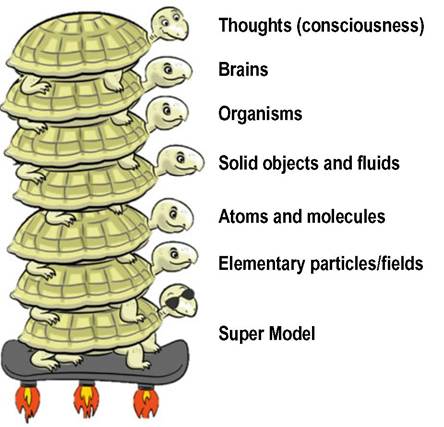
it all. Such a Super Model of elementary particles/fields and their interactions could certainly claim some fundamentally. But could it be considered truly fundamental, or at least “the most fundamental” among all scientific theories?
2
More on the topic Science Is a Tower of Theories and the Standard Model Is Its Foundation!:
- Aguirre A., Foster B., Merali Z. (Eds.). What is Fundamental? Springer,2019. — 189 p., 2019
- Of Mereology and Math
- Quantum Theory