Quantum Theory
Another twentieth-century development with surprising implications is quantum theory. Roughly, this is a branch of physics that is primarily used for situations involving atomic-or-smaller levels.
For example, if your main line of work is particle physics, say investigating the behavior of sub-atomic particles such as electrons, then quantum theory will be a major tool in your toolbox.Quantum theory covers a lot of territory, certainly too much for us to cover in a single essay. What we can do, however, is get a sense of the sorts of questions quantum theory raises concerning our views of the universe. We will first take a look at some basic experimental results that raise deeply puzzling and difficult questions about the nature of reality. These results, and some of the philosophical questions raised by them, are the subject of §3.1. The results discussed in §3.1 are largely what led to the need for a new theory, where that need was filled by the development of quantum theory. In §3.2, then, we take a brief look at the historical development of quantum theory.
As noted at the outset of this essay, we have always looked to our basic sciences for insight into what the world is like, that is, for insight into the philosophical question of what sort of universe we inhabit. Whereas the experiments discussed in §3.1 raise some difficult questions about the nature of reality, in §3.3 we look at some more recent results that shed light on this reality question. In particular, the topics discussed in that section, notably Bell's theorem and the Aspect experiments, show that a broad class of answers to this reality question are no longer an option. In particular, in §3.3 we will see how a quite standard view of reality, one dating back to at least the ancient Greeks, is not compatible with recent experimental results from quantum theory.
3.1 Some puzzling experimental results
In the 1800s, and continuing into the early 1900s, physicists encountered a number of experimental phenomena that did not fit cleanly into the existing theoretical framework.
It is largely such phenomena that led to the development of quantum theory. In this section, we will look at a handful of such experiments, and try to get a sense of some of the puzzling aspects of these experiments.[82]We will begin with one of these classic experimental results, as well as one of the earliest, namely, what has come to be called the “two-slit” experiment.[83]
Suppose we ask the question of whether entities such as electrons are particles or waves. At first glance, since waves and particles have different sorts of experimental effects, it seems that it should be relatively easy to answer the question. For example, suppose we set up an experimental arrangement involving a source of electrons (an “electron gun”), and shoot electrons toward a barrier with two slits. On the side of the barrier away from the electron gun, we will set up a screen capable of recording any electrons that hit it. Depending on whether electrons are particles or waves, we should get two quite separate experimental results.
First, if electrons are discrete particles, then we would expect the barrier to block all the electrons except those that pass through the slits, and as a result, we would expect the recording screen to record a “particle effect” pattern of electrons, with electron hits corresponding to the regions of the screen in line with the slits. Figure 6.2 illustrates this.
In contrast, if electrons are waves, then the two slits should have the effect of splitting each wave into two waves. These two waves would then continue on toward the recording screen, overlapping with one another as they approach the screen. When waves overlap in this way, they produce an interference pattern, which in this case would result in alternating bands of dark and light on the screen. The dark bands will correspond to areas where the waves interacted in a “constructive” manner, much like the way some waves at the beach will add together into a larger wave, and the light bands will correspond to the areas where the waves interacted with one another in a “destructive” way, again much like the way some waves at the beach will interact with one another and effectively cancel each other out.
Such “wave effect” patterns of interference are well known and well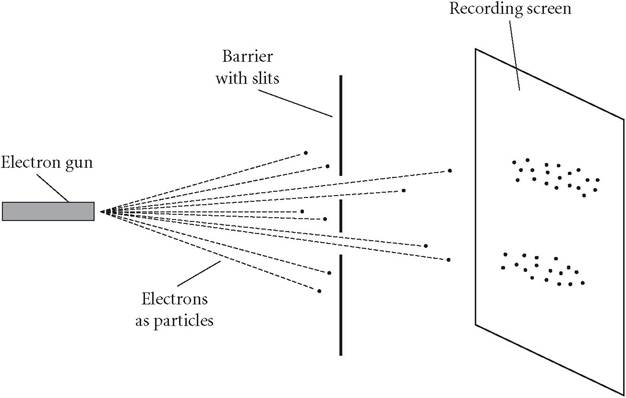
Figure 6.2 Electrons as particles
studied within physics, and if electrons are waves, we would expect this sort of wave effect. Again, Figure 6.3 might help illustrate this.
When this basic, two-slit experiment is carried out, the recording screen registers what above I was calling a “wave effect,” that is, an interference pattern characteristic of waves. This result, then, seems to suggest that electrons are waves. By itself, this result is not surprising. Wave phenomena are common, and there are branches of physics well equipped to handle wave phenomena.
What is very puzzling, though, is what happens when we consider a slightly modified version of the two-slit experiment. For example, suppose we take the two-slit experiment described above, and behind each slit we place a passive electron detector. (This would be a device that will detect the passage of an electron through its respective slit, but in a way that should not interfere with the electron. This would be analogous to the way you might passively detect people that pass by your window, that is, you can record their presence without interfering with them.) The setup would be as illustrated in Figure 6.4.
Given that the electron detectors seem to be passive detectors, we would expect the same result as in the basic two-slit experiment, that is, we would expect a wave effect. But when we run this experiment, we get a clear
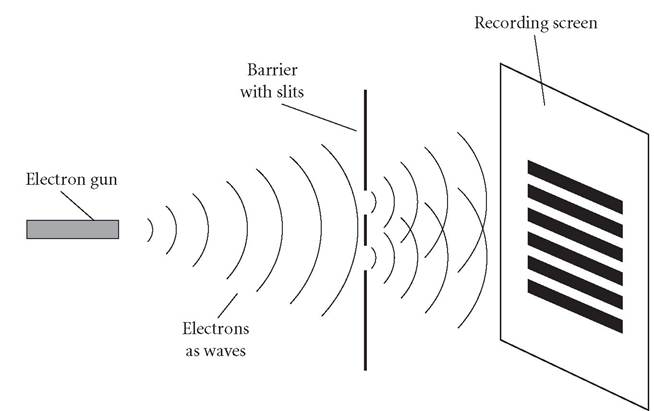
Figure 6.3 Electrons as waves
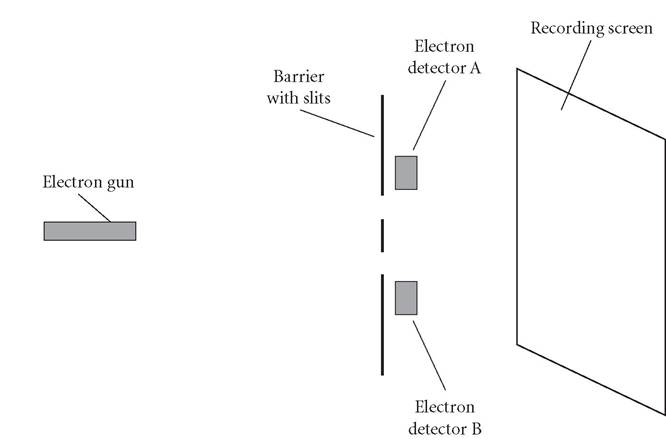
Figure 6.4 Two-slit experiment with detectors
particle effect. That is, we get a piling-up pattern on the recording screen, exactly as if the electrons were particles, with each particle having passed through one or the other slit.
Moreover, we can switch at will between the wave effect and particle effect simply by turning the electron detectors on and off. That is, so long as the electron detectors are turned off, we see a wave effect on the screen. When we flip the switch and turn the detectors on, the wave effect is immediately replaced with a particle effect. Flip the switch off, and we are back to the wave effect. And so on. In addition, if we carefully check the results of the electron detectors, we find that they never detect an electron passing through the slits simultaneously, but rather, it is as if each electron passes through one or the other of the slits, but never both simultaneously (note that, if electrons are waves, we would expect the wave to pass through both slits simultaneously).
What I have described so far are simply experimental results, that is, if we set up experiments as described above, we will get the results described. What if we go a bit beyond the experiments, and consider a philosophical question concerning reality? In particular, what could really be going on in such experiments? What sort of reality could produce these sorts of results? On the one hand, the wave effect we find in the basic two-slit experiment seems like it could only be produced if the electron is really a wave, and moreover, a wave that passes through both slits simultaneously. In contrast, the particle effect we find when the detectors are turned on, together with the fact that the detectors never record an electron passing through both slits simultaneously, suggests that electrons are not waves at all, but particles.
To push this reality problem a bit further, recall again that the wave effect we find in the basic two-slit arrangement could seemingly only be produced if electrons pass through both slits simultaneously. And the particle effect we see when the detectors are turned on, and the behavior of the detectors, could seemingly only be produced if electrons are passing through one slit or the other but never both slits simultaneously.
But how could whether the detectors are turned on or off affect whether an electron passes through both slits simultaneously, or through only one slit? Speaking anthropo- morphically for a moment, how could an electron “know” whether the detectors are on or off ?There are no agreed-upon answers to these reality questions.[84] The experimental outcomes of these and similar experiments are unequivocal, but the more philosophical issue of what is “really” going on, of what sort of reality could produce these experimental facts, remains deeply puzzling. These and other puzzling results helped lead to the development of quantum theory. Eventually quantum theory would be developed in a form that was able to “handle” these sorts of experimental results, in the sense that the theory would be able to make very accurate predictions about what result to expect in such experiments. But quantum theory itself, although probably the most successful theory we have ever had in terms of making accurate predictions, does not address these sorts of reality questions.
This is a good point to bring up a topic introduced in Chapter 2 of this book, namely, the issue of instrumentalist and realist attitudes towards theories.14 Again, an instrumentalist is one who looks to a theory primarily to make accurate predictions, without concern for whether the theory reflects the way things “really” are. One who takes a realist approach, on the other hand, wants a theory not only to make accurate predictions, but also to provide a picture or model of reality.
It is probably safe to say that the majority of physicists working with quantum theory tend to take an instrumentalist attitude toward the theory, that is, they look to the theory to provide accurate predictions (which it does), without worrying about the sorts of reality questions discussed above. And it is certainly true that the majority of texts for college-level physics classes on quantum theory take an instrumentalist approach; I have yet to find an exception.
This is a perfectly reasonable and understandable attitude for a working physicist, or a text on quantum theory, to take. For example, a college-level course in quantum theory has to focus on getting the student to acquire the necessary quantum tools, and there is barely time for that in a single semester, much less time to worry about these more philosophical questions.But as noted in the introduction to this essay, we have always looked to our basic sciences to shed light on our more philosophical views on what reality is like. What is different about recent results involving quantum theory, as illustrated by the two-slit experiments above, is that these results do not seem to allow for any sort of a “normal” picture of reality. Moreover, some more recent results have shed additional light on the reality question, largely by ruling out a large class of possible models of reality. Before turning to those more recent results, which will be the subject of §3.3 below, we will take a quick overview of the historical development of quantum theory.
14
See Chapter 2, pp. 21-4.
3.2 A brief overview of the development of quantum theory
Quantum theory was developed in the first several decades of the twentieth century, and as suggested earlier, largely grew out of attempts to handle unexpected experimental results. In the early years of the twentieth century, developments in quantum theory tended to be piecemeal attempts to solve, or at least make progress on, individual problems, rather than being approaches that arose out of any unified theoretical framework. This early “piecemeal” approach, from roughly 1900 to 1930, is often referred to as the “old” quantum theory. This old quantum theory is in contrast to the “new,” or mature, quantum theory that arose in the late 1920s and early 1930s, which was an account that provided a more unified approach capable of handling a wide range of quantum phenomena.
As an illustration of this early piecemeal approach, consider some early attempts to handle one of the major outstanding problems at the turn of the century, which was a problem involving black body radiation. By way of background, a “black body” is an idealized object that absorbs all radiation directed toward it (such a body would absorb all light, and so appear black). A heated black body will also emit radiation, much as an approximate black body, say a coil burner on an electrical stove, will emit radiation when heated (e.g., a heated coil burner will emit radiation in the form of light, glowing red-hot as it heats up).
Although a black body is an idealized object, it is possible to construct devices that will emit the same pattern of radiation as a heated black body. In this way physicists could produce the pattern of radiation emitted by such a device, and compare it with the pattern predicted by the existing physics. The problem was that, for certain areas of the spectrum, the predicted pattern, and the actual pattern, were way, way off.[85] In short, there was something badly amiss with the existing understanding of radiation.
In 1900, the physicist Max Planck (1858-1947) proposed a modification to the usual account of radiation. Predictions concerning black body radiation, based on Planck's modification, now matched up exactly with the experimental data. However, Planck's modification arose from trying to make the predictions fit the data, rather than arising out of any broader theoretical framework. Basically, Planck was doing the best he could, trying to get the theory to match the data, by whatever means possible.
Although this is only one example, it is typical of those early years. Physicists tried various approaches to various problems, with nothing unifying the approaches. One approach might help make progress on the problem of black body radiation, another seemingly unrelated approach might help with problems of understanding the structure of the atom, yet another for issues involving radioactive decay, yet another for phenomena involving newly discovered x-rays, and so on. In short, the period was marked by physicists trying whatever seemed to work, for whatever problem they were focused on, with no broader theoretical structure unifying the approaches.
As mentioned, this piecemeal approach would continue until about the late 1920s. During this time, Werner Heisenberg (1909-76) and Erwin Schrodinger (1887-1961) independently arrived at approaches that would eventually provide the mathematical foundations of the mature quantum theory.[86] With the new mathematics, Schrodinger was able to show that some of the early piecemeal accounts, proposed without any theoretical foundation and proposed mainly because they made the theory fit the data, were consequences of the new mathematics.
To understand this better, consider again the discussion above of Einstein and special relativity. As described earlier, the unusual implications for space, time, and simultaneity can be derived mathematically from the basic principle of relativity. In this way, those basic principles provide the theoretical foundation for the relativistic account of space, time, and simultaneity. In a roughly similar way, now Schrodinger is able to show that some of the earlier piecemeal approaches to problems in quantum theory can be seen as mathematical consequences of his mathematics. In this way, for the first time there is a mathematical foundation for the earlier piecemeal approaches.
By the mid-1950s, the mathematical foundations of quantum theory had been developed in essentially the same way as they exist today. For example, the mathematics one finds at the core of quantum theory in modern classes on the subject is, for all practical purposes, the same mathematics as that developed in the late 1920s and early 1930s.
The details of the mathematics are beyond the scope of this essay. But in outline, and as indicated, quantum theory is, as are most basic theories in physics, a mathematically based theory. Moreover, quantum theory is used in essentially the same way other theories in physics are used. In particular, the mathematics of quantum theory allows one to make predictions about the outcomes of measurements one might perform on a particular system (for example, whether one would expect a wave or particle effect in a two-slit experiment, or the position or momentum of an electron, or the polarization attributes of light that has passed through a certain type of tilter, and so on). Also as with typical theories in physics, quantum theory allows one to make predictions about how a system will evolve over time. So in this sense - primarily that quantum theory is a mathematically based theory used to make predictions about the outcome of experiments and about how a system will evolve over time - quantum theory is not appreciably different from other theories in physics.
Yet from the start, the mathematics of quantum theory developed in the 1920s and 1930s did not seem to fit well with some of our most widely held views on what, deep down, the universe is like. Einstein, for example, objected all his life to quantum theory.[87] Einstein did not object to quantum theory because he had any reservations about the predictive success of the mathematics of quantum theory (in terms of making accurate predictions, quantum theory is probably the most successful theory we have ever had). Rather, Einstein objected to quantum theory because he did not think the picture of reality suggested by the theory could possibly be accurate.[88]
At bottom, Einstein’s concerns about quantum theory mainly concerned a substantial tension between quantum theory and our usual intuitions about the sort of universe we inhabit. Although these concerns are not the only ones raised by quantum theory,[89] in what remains of this essay we will focus on these concerns. As it turns out, in the early 1960s the physicist John Bell was able to clarify where precisely this tension between quantum theory, on the one hand, and our usual intuitions about reality, on the other, resided. This aspect of Bell's work is now commonly referred to as Bell’s theorem or Bell’s inequality. The main focus of the next section will be to provide an overview of Bell's theorem, together with some relevant experimental results that have substantial implications for our usual views on the nature of the universe.
3.3 Bell’s theorem and the Aspect experiments
John Bell (1928-1990) was a physicist with a long-held interest in the broader implications of quantum theory. One particular interest of Bell's involved the fact that, from the early days of quantum theory, the theory seemed to be at odds with the broadly held view that we live in a “local” universe. Bell's most widely known result, Bell's theorem, focuses on the locality issue, and our first preliminary task will be to clarify what is meant by describing the universe as local.
From the beginnings of western science with the ancient Greeks, we have been convinced that one event or object can only affect another event or object if there is some sort of connection or communication between them. And at bottom, this is what is meant by saying the universe is “local,” that is, one thing can only influence something in its local region of the universe, or alternatively, one thing cannot influence something with which it has no contact or communication. To use a phrase that dates back to the ancient Greeks, we have always been convinced that we live in a universe in which there is no “action at a distance.” This view, that the universe is a local universe, is often referred to as the “locality assumption.”
An example might help to clarify. Suppose you dial the number of a friend on your cell phone, and within a few seconds, your friend's cell phone rings. In this scenario, the chain of connections is rather complex, but the chain of events exists and is reasonably well understood. In broad outlines, your pressing the buttons on your phone causes certain electrical changes within your phone. Some of these changes result in an electromagnetic signal, complex but well understood, being sent by your phone. That signal travels at the speed of light from your phone to a transmission tower, and that transmission tower in turn passes on other electromagnetic signals, until eventually the signals reach your friend's phone, where they in turn cause changes within your friend's phone resulting in your friend's phone ringing. Again, the chain of events is complex, but in each case, one event influences only events in which there is some sort of connection between them.
This example illustrates the way we typically think the universe works. As another example, one which we will return to later, suppose we are in a room, about the size of a large laboratory. In front of us is a device with a movable dial, along with something that looks like a miniature stoplight, with red, yellow, and green lights. We begin to tinker with the dial, moving it to various positions, and as we do so we notice that our moving the dial affects whether the red, yellow, or green light on our stoplight is lit.
Now we notice that on the far side of the room is a similar looking stoplight, again with red, yellow, and green lights. And we notice that as we tinker with the dial on our stoplight, thereby affecting what light is lit on our stoplight, the lit light on the other stoplight is likewise influenced. In particular, we notice there is a very strong correlation between what light is lit on our stoplight, and what light is lit on the other stoplight. We observe this correlation for some time, until there is no doubt about it: when we move the dial on our device, it influences not only what light is lit on our stoplight but also what light is lit on the stoplight on the far side of the room.
In such a scenario, we have strong intuitions that there must be some sort of connection or communication between our device and the stoplight on the far side of the room. We might suspect there are wires under the floor connecting our device with the other stoplight, or we might suspect there is a wireless signal (maybe of the sort involved in the cell phone example above) that allows communication from our device to the far stoplight. But at any rate, we tend to be convinced that there must be some sort of communication or connection between our device and the far stoplight. And the reason for our conviction is just the locality assumption: we are convinced that what happens at one location (our device) cannot influence what happens at a distant location (the stoplight on the far side of the room) unless there is some sort of communication or connection between the two.
Again, we have been convinced, since at least the ancient Greeks, that this is the sort of universe we inhabit. That is, we have been convinced that we inhabit a universe in which the locality assumption holds.
And it is here that Bell's theorem comes in. Bell was able to show that the standard version of quantum theory (for example, the version taught in almost every university and the standard version used by physicists thousands of times a day) is incompatible with the locality assumption.[90] In particular, Bell's theorem shows that there are possible experimental scenarios in which predictions based on the locality assumption, and predictions based on quantum theory, contradict. In other words, Bell showed that quantum theory and the locality assumption cannot both be correct.
At the time Bell published the theorem in the 1960s, it was not possible, for technical reasons, actually to perform an experiment of the sort just outlined. That is, we can think of Bell's theorem as pointing to a design of an experiment that would show, between the locality assumption and quantum theory, that one of them was mistaken. But the experiment itself could not be carried out at the time.
However, over the next several decades, physicists found increasingly sophisticated ways to carry out the sort of experiment just outlined, that
is, a Bell-type experiment that would indicate which of the two, the locality assumption or quantum theory, was mistaken. One of the most important sets of such experiments was carried out by Alain Aspect in the early 1980s, and when I refer to the “Aspect experiments,” I will have in mind this set of experiments.
In outline, Aspect set up a series of experiments that, conceptually at least, are similar to the sort of setup described above involving the stoplights. Bell, of course, did not use miniature stoplights. Rather, his experimental setup involved devices that recorded the spin states of electrons passing through devices that would register those spin states. The indications of the various spin states can be thought of as roughly analogous to the lighting of the red, yellow, or green light in the stoplight example. This device also had the equivalent of a dial, and in a way roughly analogous to the way that moving the dial influenced which of the stoplight's lights lit, changing the dial in the Aspect experiment influenced which spin state was recorded on one device.
Likewise, in Aspect's experiment, there was a similar device on the far side of the room, which recorded the spin states of electrons passing through
it. A key part of this setup was that Aspect was able to assure that there was no communication or connection between the two devices.[91] So if the locality assumption is correct, moving the dial on the one device could not influence the readings on the other device.
Yet in the Aspect experiments, changing the dial on the one device did influence the readings on the other device, even though there was no possibility of any communication or connection between the two devices. So in the Aspect experiments, contrary to the locality assumption, events at the one location did influence events at the other location.
Since the original Aspect experiments in the early 1980s, the results have been replicated by a number of laboratories, using a number of different experimental arrangements. The results of these experiments are robust, in the sense that as in the original Aspect experiments, the locality assumption is consistently seen to be mistaken.
The bottom line is that, as a matter of empirical fact, there is no longer much question that we live in a universe in which the locality assumption does not hold. Again, this result is directly at odds with a belief we have held deeply since at least the ancient Greeks. It does not seem possible for reality to be this way, yet it is - we live in a universe in which events at one location can influence events at another location, even though there is no sort of connection or communication between the two locations.
No one has any idea of how such influence is possible, only that it does in fact occur. The discovery that we live in such a universe is one of the most puzzling results of modern science.
4.