The Theory of Relativity
In 1905, Albert Einstein (1879-1955) published a paper containing the heart of what would come to be known as the Special Theory of Relativity.[74] The special theory, as the name suggests, applies so long as certain special circumstances apply (more on this below).
Somewhat more than 10 years later, in 1916, Einstein published the General Theory of Relativity, which, again as the name suggests, is a general theory not restricted to the special circumstances needed to use the special theory.Both the special and general theories have intriguing consequences for some long-held beliefs - for example, beliefs about the nature of space and time. Many of these consequences can be illustrated with just the special theory. This is convenient, as the special theory, although it has surprising and counter-intuitive implications, is itself not particularly difficult to understand. In contrast, the general theory is substantially more difficult.
We will first take a look at special relativity and its implications. Then, in a somewhat shorter section, we will look briefly at the general theory, as well as some of the philosophical implications of the general theory.
2.1 The basic principles of the special theory of relativity
At its core, what came to be called the special theory of relativity is based on two fundamental principles. One of these principles is what Einstein termed the “principle of relativity,” and the other is what is often referred to as the principle of the constancy of the velocity of light. Let us begin by getting clear on these basic principles. In the 1905 paper mentioned above, Einstein sums up the principle of relativity as the principle that “the laws of electrodynamics and optics will be valid for all frames of reference for which the equations of mechanics hold good” (Einstein 1952, 37). When Einstein speaks of “frames of reference for which the equations of mechanics hold good,” he has in mind what are now generally referred to as “inertial reference frames,” or just “inertial frames.” An example might help illustrate.
Picture yourself on a long, straight stretch of interstate highway, with plenty of other cars. Some cars are going the same direction as you, some in the opposite direction, some faster, some slower. Usually, on such a highway, cars accelerate, decelerate, change lanes, and so on. But for this illustration, imagine no one is accelerating, decelerating, or changing lanes. In short, each car is moving in a straight line, and each car is moving along the highway with a uniform velocity, that is, neither accelerating nor decelerating.
In this example, each car will be an inertial reference frame (or at least approximately so - strictly speaking, we would have to assume perfectly uniform motion). Roughly, the key idea is that we are dealing with straight-line motion at uniform speed. Notice that the different cars will be different reference frames, that is, different points of view. For example, if you are moving along the highway at 60 miles per hour, and a car passes you at 70 miles per hour, your car and the passing car will be different points of view (for example, from your perspective objects along the highway, such as telephone poles, are passing by your window at one rate, while those objects will be passing by the window of the other car at a different rate). But you and the other car will both be inertial frames, and notably, from each perspective, the other is moving in a straight line with uniform speed.
In the 1905 paper, Einstein was primarily concerned with issues involving a branch of physics known as electrodynamics - which is primarily concerned with electrical and magnetic phenomena - and thus he speaks of the laws of electrodynamics. But the principle of relativity can be (and usually is) generalized to include all laws of physics, that is, the basic idea is that the laws of physics are the same in all inertial reference frames.
This basic idea behind the principle of relativity - that the laws of physics are the same in all inertial reference frames - can be rephrased in a variety of ways.
One way to rephrase the principle of relativity, and one which I think makes it easier to flesh out the key implications of the principle, is as follows:The Principle of Relativity: If A and B are two inertial reference frames (i.e., A and B are moving relative to one another in a straight line at uniform speed) and if identical experiments are carried out in A and B, then the results of the experiments will be identical.
The other basic principle of the special theory of relativity is what is often termed the “principle of the constancy of the velocity of light,” which hereafter for convenience I will abbreviate to PCVL. As Einstein phrases it in the 1905 paper, “light is always propagated in empty space with a definite velocity c which is independent of the state of motion of the emitting body” (Einstein 1952, 38). This amounts to saying that if one measures the speed of light in a vacuum, the value will always be the same, regardless of, say, whether the source of the light or the measuring device is in motion.
At bottom, these two principles are the only basic principles of special relativity. From them one can deduce some surprising consequences for our usual notions involving space and time. These consequences are the main focus of the next section.
2.2 Implications of the principle of relativity and the PCVL
In the 1905 paper, Einstein treats the principle of relativity and the PCVL as postulates, from which he deduces “a simple and consistent theory of... moving bodies” (Einstein 1952, 38). The reference to a “consistent theory” is worth noting, as the general belief at the time was that the principle of relativity and the PCVL were inconsistent with one another. However, as Einstein demonstrates, these two principles only seem to be inconsistent. And indeed, when one first encounters the implications of the principle of relativity and the PCVL, there tends to be a sense that these implications in some way must be inconsistent. But again, the appearance of inconsistency turns out to be illusory.
The three most fundamental implications of the principle of relativity and the PCVL involve our usual notions of space, time, and whether events are or are not simultaneous.[75] Let me begin by stating briefly these three key implications, and then illustrate them with some examples.
Time dilation: Suppose A and B are inertial references frames, that is, A and B are in motion relative to one another in a straight line at uniform speed. Then from the perspective of reference frame A, time in B moves more slowly by a factor of
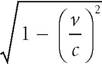
and from the perspective of reference frame B, time in A moves more slowly by the same factor. (This factor, incidentally, is known as the Lorentz-Fitzgerald equation. The variable v represents the velocity involved, and c, as always, represents the speed of light, which for the examples to follow will be approximated to 300,000 kilometers/second.)
Length contraction: Again suppose A and B are inertial references frames. Then from the perspective of A, space in B contracts, in the direction of motion, by a factor of
and from the perspective of reference frame B, space in A contracts, in the direction of motion, by the same factor.3
Relativity of simultaneity: Again suppose A and B are inertial reference frames. Then events that are simultaneous from the perspective of one reference frame will not be simultaneous from the perspective of the other reference frame.4
Some examples may help illustrate these implications. Let us begin with an example involving time dilation. Suppose A and B are inertial reference frames, in motion relative to each other at 180,000 k/s (i.e.,.6 * c). For ease of reference, suppose Angela is in reference frame A, and Betty is in reference frame B. Suppose each has two highly accurate clocks, separated by some distance.
We will refer to Angela's clocks as A1 and A2, and Betty's clocks as B1 and B2. Finally, suppose that when Angela measures the distance between her two clocks A1 and A2, she finds them to be 10 kilometers apart, and that when3 The equation given here assumes that we are dealing with distances in the direction of motion, for example, that we are dealing with the distance between two objects x and y, where x and y lie along the direction of motion. For length contractions in other directions, let 0 = 0° represent the direction of motion and 0 = 90° represent the direction perpendicular to the direction of motion. Then distances at an angle 0 between 0° and 90° shrink by a factor of
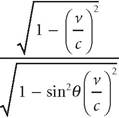
4 More specifically: suppose x and y are two events in reference frame B, that is, from the perspective of reference frame A, x and y are moving just as reference frame B is moving. Assume also that x and y lie along the direction of motion, and that with respect to the direction of motion, x is in the front (i.e., if we draw a line between x and y, the direction of motion is in the direction from y to x). Finally, suppose that from within reference frame B, the events x and y are simultaneous. Then from reference frame A, x and y will not be simultaneous. In particular, from the perspective of A, event y will occur before x by the amount
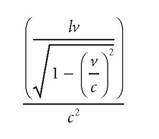
(In this equation, l is the distance, from the perspective of reference frame A, between x and y.)
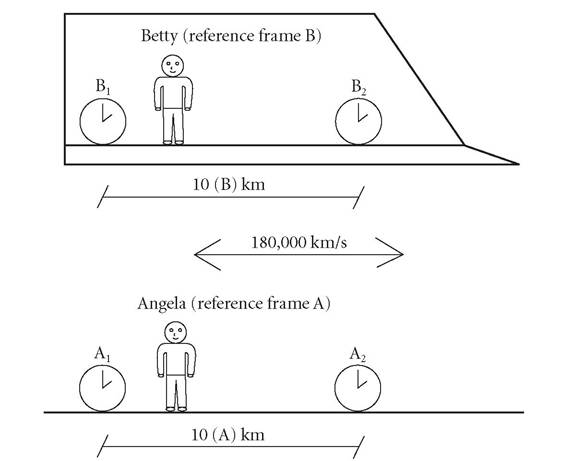
Figure 6.1 Illustration for special theory of relativity
Betty measures the distance between her two clocks B1 and B2, she finds them to be 10 kilometers apart.
The scenario is summarized in Figure 6.1 above.From Angela's reference frame, for every 10 minutes that elapse for her (that is, for every 10 minutes that pass on clocks A1 and A2), only
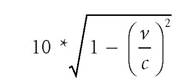
= 8 minutes elapse in reference frame B (that is, only 8 minutes pass on clocks B1 and B2). That is, from Angela's perspective, Betty's clocks are moving more slowly, Betty is aging more slowly, and, in general, time is moving more slowly in reference frame B.[76]
Recall that the time dilation is symmetrical. That is, from Betty's perspective in reference frame B, her time is moving perfectly normally, and it is time in reference frame A that is moving more slowly. So, for example, from Betty's perspective, for every 10 minutes that pass for her, that is, for every 10 minutes that elapse on clocks B1 and B2, only
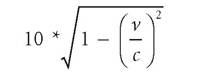
= 8 minutes elapse in reference frame A (that is, only 8 minutes pass on clocks A1 and A2). So from Betty's perspective, it is Angela's clocks that are moving more slowly, Angela who is aging more slowly, and, in general, time in reference frame A is moving more slowly.
In short, from the perspective of Angela's reference frame, time in A is moving normally and time in B is moving slowly. But from the perspective of Betty's reference frame, time in B is moving normally and time in A is moving more slowly. In short, from the point of view of each of the reference frames, time is moving normally in that reference frame and more slowly in the other.
This leads to what is often referred to as the “twin paradox.” Suppose Angela and Betty are twins, that is, they were born at the same moment. Suppose, at some point, Betty embarks on a space journey at high speeds, again, let us say 180,000 k/s, and such that Betty is moving, relative to Angela, in a straight line at uniform speed. Then while Betty is in motion relative to Angela, from Angela's reference frame, time is moving more slowly for Betty, and hence for Angela, she (Angela) is the older twin. But again recall that, so long as we are dealing with inertial reference frames, the effect on time is symmetrical, so that from Betty's reference frame, time is moving more slowly for Angela, so she (Betty) is the older twin. In short, from Angela's perspective she, Angela, is the older twin, and from Betty's perspective she, Betty, is the older twin. In other words, from their respective references frames, each of them will be older than the other.
Who is right in this case, that is, who is really the older twin? Importantly, neither is any more right or wrong than the other. To see this, recall one of the basic postulates of special relativity, the principle of relativity. Recall that Angela and Betty are in inertial reference frames, and hence according to the principle of relativity, if Angela and Betty conduct identical experiments, the results of those experiments will be identical. What this means is that there is no empirical evidence that Betty can produce to show that her point of view is the “right” point of view. Again, this is simply because any evidence Betty might produce can be exactly replicated by Angela. And likewise, there is no evidence Angela can produce to show that hers is the “right” point of view.
As the above example illustrates, one implication of special relativity is that time moves at different rates in different reference frames, and thus it is possible to have twins who are no longer the same age. And moreover, as the so-called twin paradox illustrates, it is possible to have twins where, from each twin's perspective, he or she is the older twin. And as a more general implication (this is an implication of the principle of relativity itself), there is no “right” point of view, that is, there is no privileged reference frame - there are simply different reference frames, but no one is any more “right” than any other.
Thus far, we have seen that special relativity has some surprising consequences for our usual conception of time. As noted above, relativity also has implications for our usual conceptions involving space and distances. Consider again the scenario illustrated above in Figure 6.1. Recall that when Betty measures the distance between her two clocks B1 and B2, she finds them to be 10 kilometers apart. But if Angela measures the distance between Betty's clocks B1 and B2, she will find the distance to be only
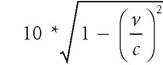
= 8 meters.[77] That is, from the perspective of Angela's reference frame, distances in reference frame B have contracted.
As with the effects on time, the effects on distances are again symmetrical. Recall again that when Angela measures the distance between her two clocks A1 and A2, she finds them to be 10 kilometers apart. But if Betty measures the distance between A1 and A2, she will find those clocks to be only
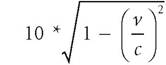
= 8 meters apart. That is, from Betty's reference frame, her distances are perfectly normal, and it is the distances in Angela's reference frame that are contracting.
And here again, neither Angela nor Betty is any more “right” than the other. It is just that the distances between points, or the amount of space an object takes up, are different when measured from different reference frames. And again, no reference frame is any more right than any other.
Most people I know, when first introduced to these implications of special relativity, have the sense that this cannot be a consistent picture of space and time (I recall having the same sense, when I first came across relativity, that there must be some sort of contradiction lurking in special relativity). For example, consider again the twin paradox. How could Angela and Betty both be the older twin? How could Angela be older than Betty, and Betty be older than Angela? Does that not have to be contradictory?
One key to seeing how this is not genuinely contradictory is to keep in mind that there is no privileged reference frame - for example, no reference frame from which to say who is “really” older and who is “really” younger. From relativity theory, we now understand that we must always speak of motion from a point of view, that is, motion relative to a reference frame. And likewise, we now understand that we must speak of time and space relative to a reference frame. We cannot say that Angela is older than Betty, but rather, that from Angela's reference frame, Angela is older than Betty. And from Betty's reference frame, Betty is older than Angela.
There is no reference frame within which Angela and Betty are both older than the other, and that fact should alleviate some of the sense of contradiction. Another key factor in why there is no contradiction is the relativity of simultaneity. Recall that one of the implications of special relativity is that Angela and Betty will disagree on whether two events are or are not simultaneous. As it turns out, this disagreement about when events occur is central in seeing why there is no contradiction. The details of this are lengthy, such that we do not have space to go into all these details. But we can see an outline of how the relativity of simultaneity factors in.[78]
Suppose Angela and Betty both monitor some timekeeping device, say the clock in London known as Big Ben (perhaps they have arranged a video feed of Big Ben to be sent to their respective locations). And suppose that when the hands of Big Ben read midnight on New Year's Eve of the current year, Angela records that, from her reference frame, she is exactly 25 years old. Angela likewise checks on Betty's age, and finds that it is less than 25 years. (For the sake of a concrete number, suppose Angela finds Betty to be exactly 24 years old.) Thus, Angela notes that from her reference frame, she is the older twin.
Another precisely equivalent way to describe Angela's situation is as follows: from Angela's reference frame, the event of Big Ben reading midnight on New Year's Eve, and the event of Angela turning 25 years old, are simultaneous events. And the event (again from Angela's reference frame) of Big Ben reading midnight, and the event of Betty turning 24 years old, are simultaneous events. And this is, from Angela's reference frame, why Angela is (again from that reference frame) the older twin.
But recall that Betty will disagree with Angela about whether events are simultaneous. From Betty's reference frame, she might agree with Angela that the event of Big Ben reading midnight on New Year's Eve is simultaneous with her (Betty) turning 24 years old. But from Betty's reference frame, the event of Big Ben reading midnight, and the event of Angela turning 25, are not simultaneous. In fact, from Betty's reference point, the event of Big Ben reading midnight on New Year's Eve will be simultaneous with Angela being less than 24 years old (I'll omit the exact figure for Angela's age). So in other words, the events that are simultaneous from Betty's reference frame are her (Betty) being 24 when Big Ben strikes midnight, and Angela being less than 24 when Big Ben strikes midnight. So from her reference frame, when Big Ben strikes midnight on New Year's Eve, she (Betty) is the older twin.
Again, for simplicity I am omitting the mathematical details of this example. But suffice it to say that, when one applies all the implications of relativity to this example, including time dilation, length contraction, and the relativity of simultaneity, what emerges is an entirely consistent account of space, time, and simultaneity. It is, though, an account that runs counter to long-held intuitions about the nature of space, time, and simultaneity.
2.3 The basic principles of the general theory of relativity
In 1916, Einstein published the general theory of relativity.[79] As we saw above, the special theory of relativity applies so long as special circumstances are met, in particular, so long as the situation involves inertial reference frames. In contrast, the general theory of relativity, as the name suggests, is a general theory, in that it applies to all circumstances.
As with special relativity, general relativity is based on two fundamental principles. Let us begin by describing these two principles.
The first principle is what Einstein often referred to as the “general principle of relativity,” but which is now more often termed the principle of general covariance. The basic idea is reasonably straightforward. Recall that in the special theory of relativity, the principle of relativity was the principle that the laws of physics are the same in all inertial reference frames. That is, so long as certain special circumstances hold, for example, so long as we are dealing with reference frames that are moving relative to one another in a straight line with uniform speed, then the laws of physics will be the same in both reference frames.
The principle of general covariance removes the special circumstances of applying only to inertial reference frames. As Einstein phrased the principle in the 1916 paper, the “laws of physics must be of such a nature that they apply to systems of reference in any kind of motion” (Einstein 1952, 113).[80] In other words, the laws of nature are the same in all reference frames.
The second basic principle on which the general theory of relativity is based is usually termed the principle of equivalence. The principle of equivalence says, roughly, that effects due to gravity and effects due to acceleration are indistinguishable. To see the basic idea here, consider an example (one that Einstein himself liked to use to illustrate this principle).
Suppose we again use Angela and Betty as examples, and suppose that Angela and Betty are both in enclosed, windowless rooms, say about the size of an elevator. Suppose Angela, in her room, is on the surface of the earth. Betty's room, in contrast, is in deep space, far enough from any planets or stars so as to experience no effects from such bodies. Moreover, we will imagine that Betty, in her room, is being accelerated “up” (that is, in the direction of a line running from the floor to the ceiling), at 9.8 meters per second squared (i.e., the acceleration due to gravity on the earth's surface).
Now consider what sorts of observational effects Angela and Betty will observe. Angela notices that she feels a “pull” in the direction of her floor, and Betty notices that she feels the exact same sort of pull toward the floor of her room. Angela jumps, and notices that she quickly falls back toward her floor. Betty notices the exact same effect when she jumps. Angela holds an object out at arm's length, drops it, and notices that it moves toward the floor of her room, accelerating toward the floor at a rate of 9.8 meters per second squared. Betty likewise drops a similar object, and notices that it accelerates toward the floor of her room at 9.8 meters per second squared.
Traditionally, we would describe the effects Angela observes as resulting from Angela being in the gravitational field of the earth; and that gravitational field explains the pull she feels, why she falls back down when she jumps, why dropped objects accelerate downwards as they do, and so on. Betty, in contrast, is not in the presence of any gravitational fields, and we would traditionally describe the effects she experiences as being the result of her being accelerated upwards.
But it seems a striking coincidence that the effects of a gravitational field, on the one hand, and the effects of acceleration on the other, would be exactly the same (and indeed, on Newtonian physics, these sorts of identical effects had to be treated as a coincidence). Einstein's principle of equivalence in essence rejects the view that these identical effects are due to different causes, and instead treats situations we would traditionally describe as involving a gravitational field, and situations we would traditionally describe as involving acceleration, as indistinguishable.
At bottom, these two principles - the principle of general covariance and the principle of equivalence - are the foundational principles of general relativity. After articulating these principles in the 1916 paper, Einstein's main task was to provide the key equations that would satisfy the requirements of these principles. These equations (usually referred to as the Einstein field equations) are quite complex, but the basic idea is that solutions to these equations indicate how space, time, and matter influence one another, and these equations are the mathematical core of general relativity. In the next section, we will take an overview of some of the implications of general relativity.
2.4 Implications of the general theory of relativity
In the earlier sections on special relativity, we saw that special relativity has interesting consequences for our traditional views of space and time. The implications of general relativity for space and time are similar to those of special relativity (which is not surprising, given that the conditions under which special relativity applies are a subset of the more general conditions - that is, any conditions - under which general relativity applies).
Consider again Angela and Betty, in reference frames A and B respectively, where A and B are moving relative to one another. Then the same effects on space and time will follow from general relativity as from special relativity. That is, from Angela's perspective, time is moving more slowly, and distances have contracted, in Betty's reference frame; whereas from Betty's reference frame, time is moving more slowly for Angela, and Angela's distances have contracted.
In addition to the effect of motion on space and time, in general relativity gravitational effects also influence space and time. Note that “gravitational effects” will include both effects due to being in the presence of a large body, as well as effects due to acceleration (recall the principle of equivalence, according to which these two situations - being in the presence of a large body versus being in an accelerated reference frame - are indistinguishable).
So, for example, suppose we revisit the twin paradox discussed above. Recall that in the earlier scenario, Angela and Betty (in reference frames A and B respectively) are moving relative to one another in a straight line with uniform speed. In such a situation involving inertial reference frames, we saw that the effects of space and time are symmetrical, so that, for example, from their respective reference frames, Angela and Betty each consider themselves the older twin.
Now suppose we remove the restriction that A and B be inertial frames, and we envision the situation as involving the two rejoining each other and comparing ages. To make the situation a bit more concrete (and the twin paradox is often described using the scenario below), suppose we consider a trip to the nearest star system, which is the Alpha Centauri system, roughly
4.5 light years from the earth. Suppose at the start of the trip Angela and Betty are both 20 years old, and that Betty travels to, and returns from, the Alpha Centauri system, traveling at an average speed of nine-tenths the speed of light.
Notice that the earth and spacecraft will be two different reference frames, moving relative to one another, and also experiencing different gravitational effects relative to one another. For example, Betty, on the spacecraft, will experience substantial G forces not experienced by Angela. (“G forces” refer to the sorts of effects we feel, for example, when accelerating or decelerating rapidly in a car, that is, we feel the sense of being pushed back into our seats, or of being thrown forward. Since Betty's velocity is so much greater than that of a car, the G forces she experiences will be much more substantial than any we could experience in a car.) Betty will experience such G forces as she accelerates away from the earth; then as she nears the star system, she will again experience substantial G forces as she decelerates. She will again experience such forces as she accelerates back toward the earth, and as she decelerates as she nears the earth.
Notice that in this scenario, Angela and Betty will both agree that Betty has experienced gravitational forces (which we would usually describe as resulting from her acceleration and deceleration) that Angela has not experienced. And on general relativity, such forces (as well as motion) affect the passage of time. In particular, in this scenario, Angela and Betty will both agree that the forces experienced by Betty will have resulted in less time passing for Betty, so in this case, both will agree that Betty is the younger twin.
I will omit the calculations, but the bottom line is that, from Angela's reference frame (on earth), Betty's trip to Alpha Centauri and back will have taken approximately 10 years. So upon Betty's return, Angela is 30 years old. In contrast, time (and distances) will not be the same from Betty's reference frame, and only 5 years will have elapsed in that reference frame during the trip to Alpha Centauri and back. So upon her return, whereas Angela is 30 years old, Betty is only 25 years old.
Again, in special relativity, which is restricted to inertial reference frames, the effects on space and time are symmetrical. But in general relativity, in cases where the reference frames are not inertial frames, one still finds that time, space, and simultaneity are affected, but the effects are no longer symmetrical. And in the scenario above, because both Angela and Betty agree that Betty has experienced forces that Angela does not experience, they will both agree that Betty is the younger twin.
In short, we find in general relativity the same sorts of surprising effects on space, time, and simultaneity as we found in special relativity, with the difference that the effects are not necessarily symmetrical. That is, how much time passes, how much space an object occupies and what the distance is between points, and whether events are or are not simultaneous, varies from one reference frame to another.
Another curious consequence of general relativity has to do with the curvature of spacetime. If you have not encountered the notion before, “spacetime” can sound like a complex subject, but the basic idea is quite straightforward. If we want to specify a location in space, a common way to do so is by specifying the location using three coordinates, one each for the x, y, and z axes (this assumes that we have specified an origin point, that is, the location of the (0,0,0) coordinate, but here we will take that for granted). Suppose in addition to the usual three spatial coordinates, we also want to specify a time, so that, for example, we can specify that an event took place at such and such a location at such and such a time. An easy way to do this is to take the usual three spatial coordinates, and add an additional coordinate representing time. We would then be dealing with a 4-tuple (x,y,z, t), where x, y, and z represent the usual spatial coordinates, and t represents time. At bottom, that is all there is to the notion of spacetime; that is, it is simply a way to specify both spatial and temporal coordinates.
So, for example, instead of thinking of an object as moving through space, we can think of it as moving through a system of coordinates which track both locations in space as well as locations in time, that is, spacetime. And one of the more interesting implications of general relativity is that a large body, such as the sun, will cause a curvature in the region of spacetime around it.
This notion of the curvature of spacetime has an interesting consequence for our traditional view of gravity. Since Newton (1643-1727), we have tended to view gravity as a mutually attractive force between bodies. And it is this mutually attractive force, say between Mars and the sun, that we have taken as key to the understanding of the motion of Mars about the sun.
But in general relativity, there is no notion of a mutually attractive gravitational force. Instead, a planet such as Mars moves in a straight line (that is, the shortest path between two points). But this is a shortest path through a spacetime that is curved by the presence of the sun. And in particular, the curvature of spacetime is such that Mars, moving on a straight line through curved spacetime, moves on what appears to be an ellipse about the sun. In short, one of the broadest consequences of general relativity is that it provides an alternative account to the usual Newtonian concept of gravity. And (more on this below), the account provided by general relativity is generally taken to be a better account than the usual Newtonian account. In short, although most of us are raised with the Newtonian account of gravity as a mutually attractive force between bodies, our current best theory replaces this Newtonian account with an account not involving attractive forces, but rather, that involves objects (for example, planets) moving in straight lines through a curved spacetime.
This is not by any means an exhaustive catalog of the implications of general relativity. But the above does provide a sampling of some of the implications relativity has for some of our most common views, for example on space, time, simultaneity, and gravity. Of course, it is one thing to have a theory that has unusual implications, and another thing to have empirical support for that theory. The bottom line is that the empirical support for relativity is quite strong, and in the next section, we take a brief look at some of this empirical support.
2.5 Empirical tests of relativity
In this brief section, we take a quick look at some of the empirical work that supports the general theory of relativity. The bottom line is that the implications of general relativity have been well established empirically, and the main goal of this brief section is to highlight some of these empirical results.
One type of substantial support for general relativity comes from a source you may be familiar with, and perhaps use. Consider a GPS (global position system) unit, which is the heart of the sorts of navigational systems that are becoming increasingly popular in cars. The success of such GPS units provides substantial empirical confirmation for general relativity. At heart, these GPS navigational units depend upon the tenets of general relativity. The basic idea is that a GPS unit triangulates your position based on signals from numerous orbiting GPS satellites. The success of the GPS system hinges crucially on extremely accurate determinations of times and distances, and in a GPS system, the determination of times and distances is based on the equations of general relativity. In this sense, then, the success of GPS systems, such as those in navigational systems in cars, provides daily confirming evidence for general relativity.
There are also a number of more traditional tests of relativity, and here we will mention just a few.
Given advances over the past 100 years in timekeeping devices, one of the easiest implications of relativity to test is the predicted relativistic effects on time. One can, for example, take two identical, highly accurate atomic clocks, and put one on a plane while keeping one on the ground. From the average speed of the plane together with the duration of the flight, it is reasonably easy to predict, based on general relativity, what the differences should be between the amount of time that passes on the clock on the ground and the clock on the plane. The first such tests of general relativity were done over 50 years ago, and in the past half-century, such tests have continued to confirm the predictions of general relativity.
The earliest, and perhaps most famous, test of general relativity involves the bending of starlight. As mentioned above, one of the implications of general relativity is that spacetime will be curved by the presence of a massive body such as the sun. As a result, starlight passing near the sun should appear, from our perspective on earth, to curve. Starlight near the sun usually cannot be seen (because it is washed out by the brightness of the sun), but solar eclipses provide opportunities to observe starlight near the sun. And not long after the general theory of relativity was published, a convenient solar eclipse provided a nice opportunity to put the theory to the test. The details of the test are somewhat complex,[81] but the consensus of the scientific community was that the observations of starlight, in particular the bending of starlight passing near the sun, were in accordance with the predictions of general relativity, thereby providing early confirming evidence for the theory.
There are countless other examples of confirming evidence, but I will close this section with one more. At the end of the 1916 paper, Einstein shows that general relativity does a nice job explaining what had become a bit of an astronomical puzzle. Since the 1600s, it has been recognized that planets orbit in ellipses. In the 1800s, astronomers had begun to notice that the perihelion of Mercury - that is, the point in Mercury's orbit closest to the sun - moved slightly during each orbit. The overall effect is that the perihelion of Mercury (and other planets as well, as it turns out) slowly moves about the sun. The elliptical orbit of planets is nicely explained by Newtonian physics, but the movement of the perihelion of planets is not. But in the 1916 paper, Einstein shows that the movement of the perihelion of a planet is to be expected on general relativity, and he moreover provides the calculations, based on general relativity, showing how much the perihelion of Mercury would be expected to move each year. The prediction was again in close keeping with the observed movement of the perihelion of Mercury, and this too provided good confirming evidence for general relativity.
As mentioned, there are countless other empirical examples that provide support for general relativity. In short, there is not much question that, as counter-intuitive as many of these seem to be, the general relativistic consequences for space, time, simultaneity, the curvature of spacetime and the like, have been well confirmed.
3.