The Semantic View
We instead prefer, and in the rest of our paper will follow, the semantic view, which conceives theories as sets of “logico-mathematical” models. We prefer this view because, by using directly the structures picked out by scientific theories, it is much closer to the actual practice of scientists than the syntactic approach, given that for most scientific theories there exist no axiomatic systems able to reconstruct their structures.[78] Scientific theories are not in fact sets of sentences, as has been assumed in many preceding approaches to the notion of verisimilitude.[79]
Here we use Patrick Suppes’ point of view, which applies model theory and set theory to the analysis of scientific theories and to intertheory relations, and according to which a theory is a set-predicate.
He never actually gives a true definition of the notion of theory, but proposes many examples.[80] Let us introduce some important concepts of his approach.6.1 Theory
To avoid confusion, note that in what follows, in order to explicate the concept of scientific theory, we use a set-theoretic formalism, whereas to explicate the notion of concrete objects we use mereology, a significantly weaker theory. This choice depends on the fact that we attempt to introduce the least possible number of abstract entities.
In order to define what is a theory we must preliminarily define its constitutive elements. First of all, a theory relates primarily to a domain of objects O constituted by individual entities. For example, the gravity law concerns any rigid body falling in a gravitational field. With O we refer to the mereological sum of such objects. Therefore, we assume that, for O, GEM (general extensional mereology) holds.[81] In practice GEM states that the relation “to be a part of’ (this is not a set of independent axioms) is:
1.
a partial order, that is, it is anti-symmetric, transitive and irreflexive;2. such that if o1 is a proper part of o2, then there is another part of o2 that does not overlap with o1 (supplementation);
3. such that there is always an object that is exactly the sum of two objects (unrestricted composition).
Concerning the domain of objects O we define a set of types of experimental operations S = s1, sm. The operations of S produce data sets d1, dm. For
example, in the fall of bodies we measure positions and times. The data appropriately processed by a statistical point of view can produce trends of observable parameters F = f1,., fn. In our example, the positions as a function of time.
However, this is usually not enough. To explain what is going to be, it is necessary to introduce also unobservable parameters G = g1, gk calculated on the
basis of F. In our case, gravitational forces.
Furthermore, parameters G and F are bound by laws L = l1,..., lj, namely sentences, universally closed for all variables F and G, which are at the same time informative and simple (as Mill-Ramsey-Lewis-Earman’s approach claims; see Earman, 1986: Chap. 5).
Therefore, putting together all the previous elements, one has that a theory X consists of a quadruple X = (S, F, G, L), namely it is composed of a set of experimental operations, a set of observable parameters, a set of unobservable parameters, and a set of laws.
6.2 A Model of a Theory
If the operations S can be applied to a domain Gi of objects, obtaining observable and unobservable parameters F and G such that L holds, then one says that Gi is a model of the theory X (and X is a (or the) true theory about Gi).
The same domain of objects Gi could be a model of more than one theory. We emphasize that G; is not a type, but a token, that is a concrete individual part of the world.
A part that is the mereological sum of smaller parts.Notice that the previous definition of what a theory is has no universality claim, that is, it does not claim to be true for a certain set (type) of objects. The truth of a theory comes only after we have established that a certain individual domain of objects is a model of it. In this sense, scientific theories are not in fact falsified, but simply they could become useless when they no longer have models in the sense indicated. Recall Agazzi’s statement that in general old theories are not false but partial.
Through the notion of model one can also specify the following important characteristic a theory may possess. If a theory X has at least one model Gi, one can say that X is able to produce knowledge. This definition is motivated because if Gi is a model of X, then X justifies true statements about Gi, that is the laws L of X applied to Gi. These truths are also justified by the observable parameters F of X. We can therefore say that by endorsing X one produces knowledge.
6.3 Anomalies of Models
Given a domain of objects Gi, being a model[82] of a theory X, there almost always exists a set Sa of operations (belonging to X) that produce data and parameters not fitting, for the objects Gi, with the laws L of X. These operations are the anomalies of the model Gi with respect to the theory X. In order for Gi to be a model of X, it is necessary to eliminate the anomalous data da. It is not possible to drop Sa, because they probably produce good data as well, so we must in a certain sense ignore da. It is well known that all scientific theories, as emphasized by historians of science, live in an empirical environment of anomalies.
6.4 Confronting Theories
A theory Xi = {Si, Fi, Gi, Li) is deeper[83] than a theory X2 = (S2, F2, G2, L2) with respect to the domain O if, at time t:
(a) O12 is the mereological sum without gaps and without overlaps of all models of both X1 and X2, which we know at time t;
(b) at least one of these conditions holds: i. S2 c S1 and ~(G1 c G2); ii.
G2 c G1 and ~(Si c S2);[84](c) the difference between S2 and S1 (G2 and G1) is relevant for O12, that is, it concerns a part of O12.[85]
In more intuitive but rough terms, one theory is deeper than another if the former answers more why questions, about a given area of investigation, than the latter. In this way, a deeper theory increases the explanations of the details of the phenomena at stake, thus allowing our knowledge to become more exact.
We can present this situation in a graphic way:
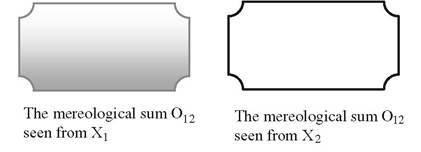
The same part of the world O12 is seen from different theories. The deeper perspective from theory X1 has been colored gray.
Returning to the example of gravitation, a series of data on the freefall in the presence of friction cannot be understood solely through the gravitational force. A theory which also includes friction forces, therefore, is deeper than one that does not. And the introduction of friction forces enlarges G. A similar argument applies to the solar system with respect to classical mechanics and general relativity. Only the latter is able to account for the anomalies of Mercury’s perihelion. So the understanding of the Mercury perihelion anomaly enlarges S. General relativity is obviously not only deeper than classical mechanics, but also wider, in the following sense.
A theory X1 is wider than a theory X2 at time t, if, given O1 the mereological sum of all models of X1 known by us at time t, and O2 the mereological sum of all models of X2 known by us at time t, O2 proves to be a proper part of O1.
Consequently, one theory is wider than another if it increases the number of objects, and hence of natural phenomena, about which scientists can make warranted claims.
Here too the graphic representation is very intuitive:
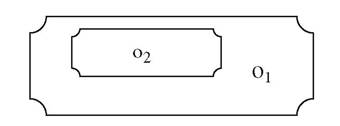
The smaller shape is O2, that is the mereological sum of X2 models, whereas the bigger one is O1, that is the mereological sum of X1 models.
Let us call Sx the union of all sets of experimental operations of a set of theories X = X1, Xh and Gx the union of all sets of their theoretical terms.
A set of theories X = X1,., Xh is deeper at time t than a set Y = Y1,., Yk if:
(a) OXY is the mereological sum without gaps and without overlaps of all domains of objects we know at time t as models of both X and Y;
(b) at least one of these conditions holds: i. Sy c Sx and ~(Gx c Gy); ii. Gy c Gx and ~(Sx c Sy);
(c) the difference between Sy and Sx (Gy and Gx) is relevant for OXY, that is, it concerns a part of OXY.
Moreover, a set of theories X = X1,., Xh is wider at time t than a set Y = Y1,., Yk if the mereological sum of all models of Y known by us at time t is a proper part of the mereological sum of all models of X known by us at time t.
Now we can join the two criteria in the following definition:
A set of theories X = X1, Xh is Agazzi-better (>Ab) at time t than a set of theories Y = Yi,., Yk if at least one of the following two conditions holds:
1. X is wider at time t than Y and Y is not deeper than X;
2. X is deeper at time t than Y and Y is not wider than X.
We believe that with this definition we have a good explication of Agazzi’s perspective on dynamics and comparison of theories. It is, of course, possible that two sets of theories are such that one is deeper than the other whereas the latter is wider than the former.
We can represent this probably uncommon situation graphically as follows: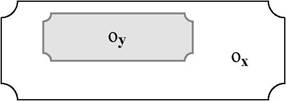
You see that the mereological sum of Y models Oy is a proper part of the mere- ological sum of X models Ox, but the explanation of Oy given by Y is deeper than the explanation of Oy given by X. In this situation it is not possible to determine whether X >AbY or Y >AbX.
A very useful peculiarity of our definition is that a set of theories X is not the conjunction of X1, Xh. Indeed our approach is model-theoretic and not lan
guage-dependent. In the current scientific situation the logical conjunction of accepted theories would often lead to contradictions.[86] In fact, not only does science live in an environment of anomalies, but it is not rare that two accepted theories say something opposite on important topics. See for instance today’s situation, in which quantum field theory is background dependent with respect to spacetime, whereas general relativity is not. Yet no one would renounce either of these two theories!
6.4 Confronting Cognitive Situations
The set of theories X accepted by a group of scientists U at time t is a U,t- cognitive situation.
Let us say that a U1,t1-cognitive situation is Agazzi-better than a U2,t2-cognitive situation if the set of theories X accepted by group U1 at time t1 is Agazzi-better than the set Y of theories accepted by group U2 at time t2.
Based on this definition, in many cases we can compare two cognitive situations of different times and determine whether or not there has been an increase in knowledge and hence scientific progress.
7