Bibliography
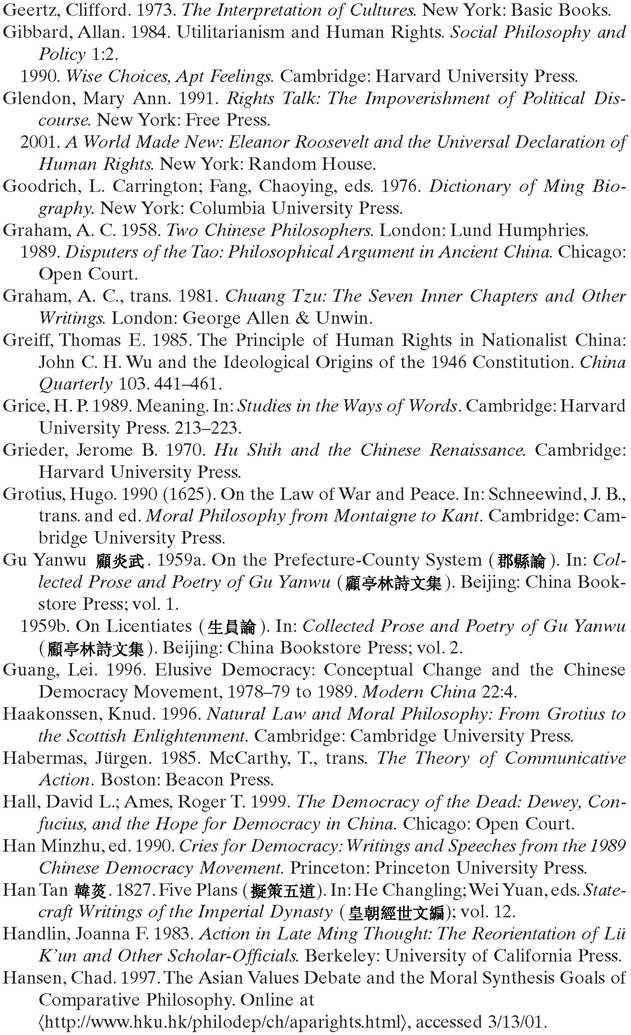
Alitto, Guy S. 1979. The Last Confucian: Liang Shu-ming and the Chinese Dilemma of Modernity. Berkeley: University of California Press.
Alston, Philip. 1990. U.S. Ratification of the Covenant on Economic, Social, and Cultural Rights: The Need for an Entirely New Strategy.
American Journal of International Law 84:2. 365-393.Ames, Roger T. 1997. Continuing the Conversation on Chinese Human Rights. Ethics & International Affairs 11.177-205.
1988. Rites as Rights: The Confucian Alternative. In: Rouner, Leroy S., ed. Human Rights and the World’s Religions. Notre Dame: University of Notre Dame Press. 199-216.
Angle, Stephen C. 1994. Concepts in Context: A Study of Ethical Incommensurability. Ann Arbor: University Microfilms.
1998. The Possibility of Sagehood: Reverence and Ethical Perfection in Zhu Xi’s Thought. Journal of Chinese Philosophy 25:3. 281-303.
2000. Review of The Discourse of Human Rights in China by Robert Weath- erley. Journal of Asian Studies 59:3.
In press. Pluralism in Practice: Incommensurability and Constraints on Change in Ethical Discourses. In: Michael Barnhart, ed. Varieties of Ethical Perspective. Lanham, MD: Lexington Books.
Angle, Stephen C.; Svensson, Marina, trans. and ed. 1999. On Rights and Human Rights: A Contested and Evolving Chinese Discourse, 1900-1949. Contemporary Chinese Thought 31:1.
Baehr, Peter R.; van Hoof, Fried; Liu Nanlai; Tao Zhenghua, eds. 1996. Human Rights: Chinese and Dutch Perspectives. The Hague: Martinus Nijhoff.
Bauer, Joanne R.; Bell, Daniel A.,eds. 1999. The East Asian Challenge for Human Rights. Cambridge: Cambridge University Press.
Benedict, Ruth. 1934. Patterns of Culture. Boston: Houghton Mifflin.
Berlin, Isaiah, Sir. 1970. Four Essays on Liberty. New York: Oxford University Press.
Bernal, Martin. 1976. Liu Shih-p’ei and National Essence. In: Furth, Charlotte, ed. The Limits of Change. Cambridge: Harvard University Press. 90112.
Biagioli, Mario. 1990. The Anthropology of Incommensurability. Studies in the History and Philosophy of Science 21:2.183-209.
Blaustein, Albert P.; Clark, Roger S.; Sigler, Jay A., eds. 1987. Human Rights Sourcebook. New York: Paragon House.
Bourdieu, Pierre. 1974. The Economics of Linguistic Exchanges. Social Science Information 16:6. 645-668.
Braisted, William Reynolds, trans. 1976. Meiroku Zasshi:Journal of the Japanese Enlightenment. Cambridge: Harvard University Press.
Brandom, Robert. 1994. Making It Explicit: Reasoning, Representing, and Discursive Commitment. Cambridge: Harvard University Press.
Brook, Timothy. 1998. The Confusions of Pleasure: Commerce and Culture in Ming China. Berkeley: University of California Press.
Brooks, E. Bruce; Brooks, A. Taeko. 1998. The Original Analects: Sayings of Confucius and His Successors. New York: Columbia University Press.
Brown, Chris. 1999. Universal Human Rights: A Critique. In: Dunne, Tim; Wheeler, Nicholas J., eds. Human Rights in Global Politics. Cambridge: Cambridge University Press. 103-127.
Chan, Joseph. 1995. The Asian Challenge to Universal Human Rights: A Philosophical Appraisal. In:Tang, James T. H., ed. Human Rights and International Relations in the Asia-Pacific Region. London: Pinter.
1997. An Alternative View. Journal of Democracy 8:2. 35-48.
1999. A Confucian Perspective on Human Rights for Contemporary China. In: Bauer, Joanne R.; Bell, Daniel A., eds. The East Asian Challenge for Human Rights. Cambridge: Cambridge University Press. 212-240.
2000. Thick and Thin Accounts of Human Rights. In: Jacobsen, Michael; Bruun, Ole, eds. Human Rights and Asian Values: Contesting National Identities and Cultural Representations in Asia. Richmond, UK: Curzon. 59-74.
Chan, Wing-tsit, trans. 1963. A Sourcebook in Chinese Philosophy.
Princeton: Princeton University Press.1989. The Principle of Heaven and Human Desires. In: Chu Hsi: New Studies. 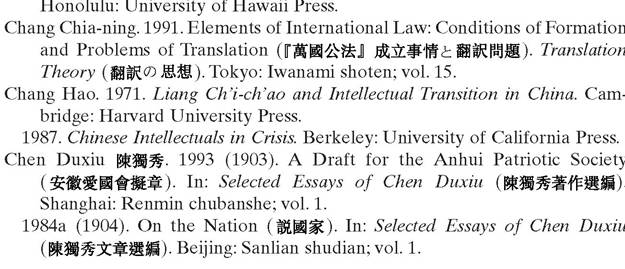
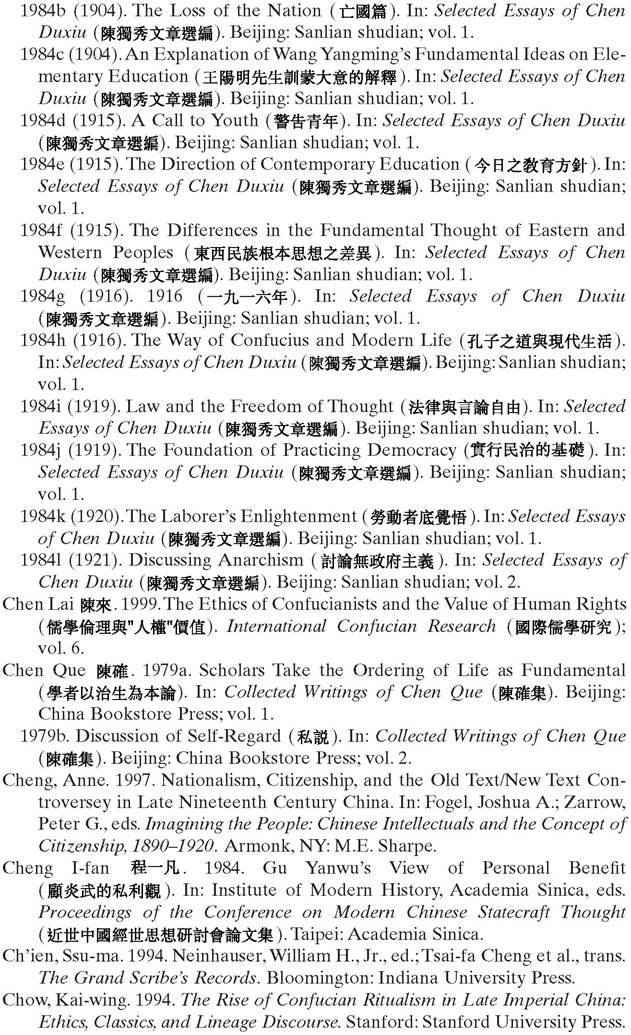
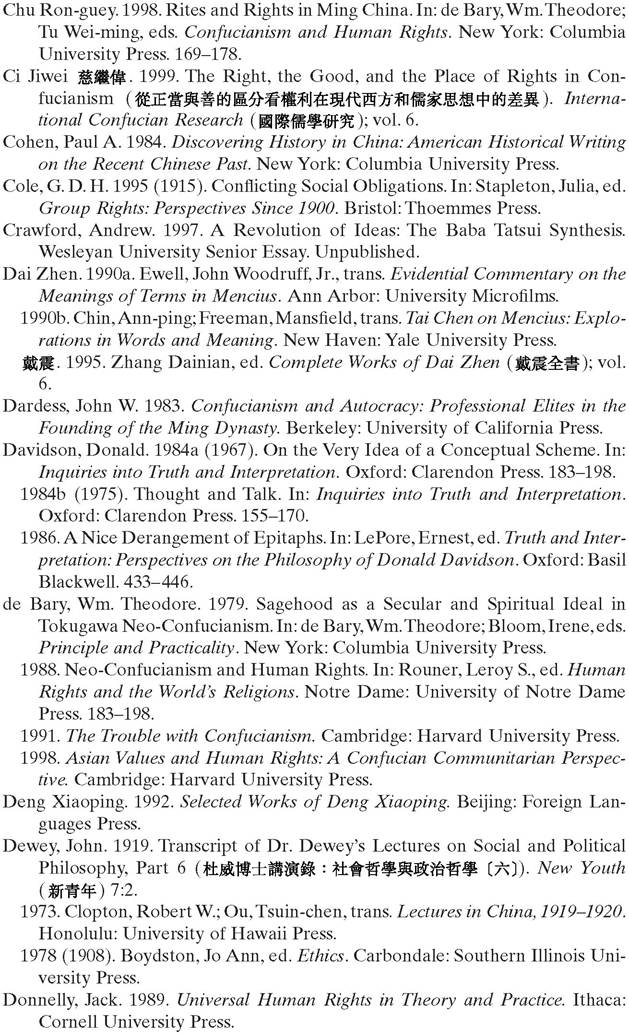
1997. Conversing with Straw Men while Ignoring Dictators: A Reply to Roger Ames. Ethics & International Affairs 11. 207-213.
Dowdle, Michael W. 2001. How a Liberal Jurist Defends the Bangkok Declaration. In: Bell, Lynda S.; Nathan, Andrew J.; Peleg, Ilan, eds. Negotiating Culture and Human Rights. New York: Columbia University Press.
Dworkin, Ronald. 1977. Taking Rights Seriously. Cambridge: Harvard University Press.
Elman, Benjamin A. 1984. From Philosophy to Philology: Intellectual and Social Aspects of Change in Late Imperial China. Cambridge: Council on East Asian Studies, Harvard University.
1990. Classicism, Politics, and Kinship: The Ch’ang-Chou School of New Text Confucianism in Late Imperial China. Berkeley: University of California Press.
2000. A Cultural History of Civil Examinations in Late Imperial China. Berkeley: University of California Press.
Fay, Brian. 1987. Critical Social Science. Ithaca: Cornell University Press.
1996. Contemporary Philosophy of Social Science: A Multicultural Approach. Oxford: Blackwell.
Feigon, Lee. 1983. Chen Duxiu: Founder of the Chinese Communist Party. Princeton: Princeton University Press.
Feinberg, Joel. 1970. The Nature and Value of Rights. Journal of Value Inquiry 4.
Fikentscher, Wolfgang. 1977. Methoden des Rechts. Tubingen: Mohr.
Fingarette, Herbert. 1972. Confucius - The Secular as Sacred. New York: Harper & Row.
Finnis, John. 1980. Natural Law and Natural Rights. Oxford: Clarendon Press.
Fodor, Jerry; Lepore, Ernest. 1992. Holism: A Shopper’s Guide. Oxford: Basil Blackwell.
Fukuzawa Yukichi.
1969. Dilworth, David A.; Umeyo Hirano, trans. An Encouragement of Learning. Tokyo: Sophia University.Fung, Edmund S. K. 1998. The Human Rights Issue in China, 1929-1931. Modern Asian Studies 32:2. 431-457.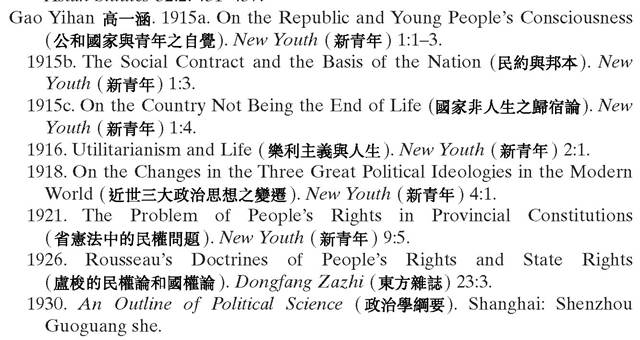
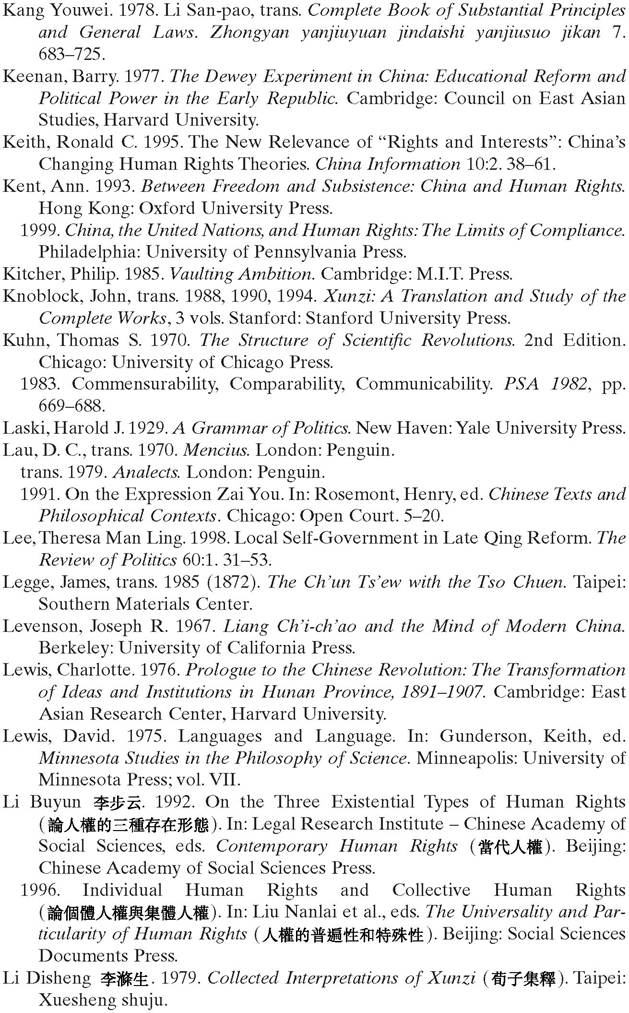
He Qi (Ho Kai). 1992 (1887). To the Editor of the China Mail. In: Xu Zhengxiong, The Development and Divergence of Late Qing People’s Power Thought (Taipei.
ЙД; Hu Liyuan ⅞U⅛⅛g. 1994 (1901). True Interpretation of the New Policies (⅛⅛J?In⅜). Shenyang: Liaoning People’s Press.
Hegel, G. W. F. 1991. Nisbet, H. B., trans. Elements of the Philosophy of Right. Cambridge: Cambridge University Press.
Hoh Chih-hsiang, ed. 1982 (1933). Who’s Who in China. Hong Kong: China Materials Center.
HRIC. 1997. The Dialogue Debate: A Strategy for Advancing Human Rights or a Way of Evading Responsibility? China Rights Forum. Fall issue.
Hsu, Immanuel. 1960. China’s Entrance into The Family of Nations: The Diplomatic Phase, 1858-1880. Cambridge: Harvard University Press.
1983. The Rise of Modern China. New York: Oxford University Press.
Huang, Philip C. 1972. Liang Ch’i-ch’ao and Modern Chinese Liberalism. Seattle: University of Washington Press.
Huang Zongxi ⅞Tzκ⅛. 1985 (1663). Waiting for the Dawn (ЩЖ^гп?;^). In: Complete Works of Huang Zongxi (⅛^H⅛⅛). Hangzhou: Zhejiang Ancient Text Press.
1993. de Bary, Wm. Theodore, trans. Waiting for the Dawn. New York: Columbia University Press.
Hummel, Arthur W., ed. 1970 (1943). Eminent Chinese of the Ch’ing Period. Taipei: Ch’eng Wen Publishing Co.
Hymes, Robert P. 1986. Statesmen and Gentlemen: The Elite of Fu-Chou, Chiang- Hsi, in the Northern and Southern Sung. Cambridge: Cambridge University Press.
Ihara, Craig K. In press. Are Claim Rights Necessary? A Confucian Perspective.
In: Shun, Kwong-loi; Wong, David B., eds. Confucian Ethics:A Comparative Study of Self, Autonomy, and Community. Cambridge: Cambridge University Press.Index to Xunzi (^^5ІШ). 1986. Shanghai: Shanghai Ancient Text Press.
Information Council of the State Council. 1991. Human Rights in China. Beijing. Ip, Hung-Yok. 1994. The Origins of Chinese Communism. Modern China 20:1.
Jensen, Lionel M. 1997. Manufacturing Confucianism: Chinese Traditions and Universal Civilization. Durham: Duke University Press.
Jhering, Rudolf von. 1872. Der Kampf ums Recht. Vienna: Manz.
1900-1. The Struggle for Rights (⅛H∣J⅛‰⅞-⅛⅛j. Tokyo: n.p.
1913. Isaac Huski, trans. Law as a Means to an End. Boston: Boston Book Company.
1915. John J. Lalor, trans. The Struggle for Law. Chicago: Callaghan and Company.
Judge, Joan. 1997. Key Words in the Late Qing Reform Discourse: Classical and Contemporary Sources of Authority. Indiana East Asian Working Paper Series. Availableat (http://www.indiana.edu/~easc/pages/easc/working_papers/ noframe_5_all.htm),accessed 11/18/01.
Kamachi, Noriko. 1981. Reform in China, Huang Tsun-hsien and the Japanese Model. Cambridge: Council on East Asian Studies, Harvard University.
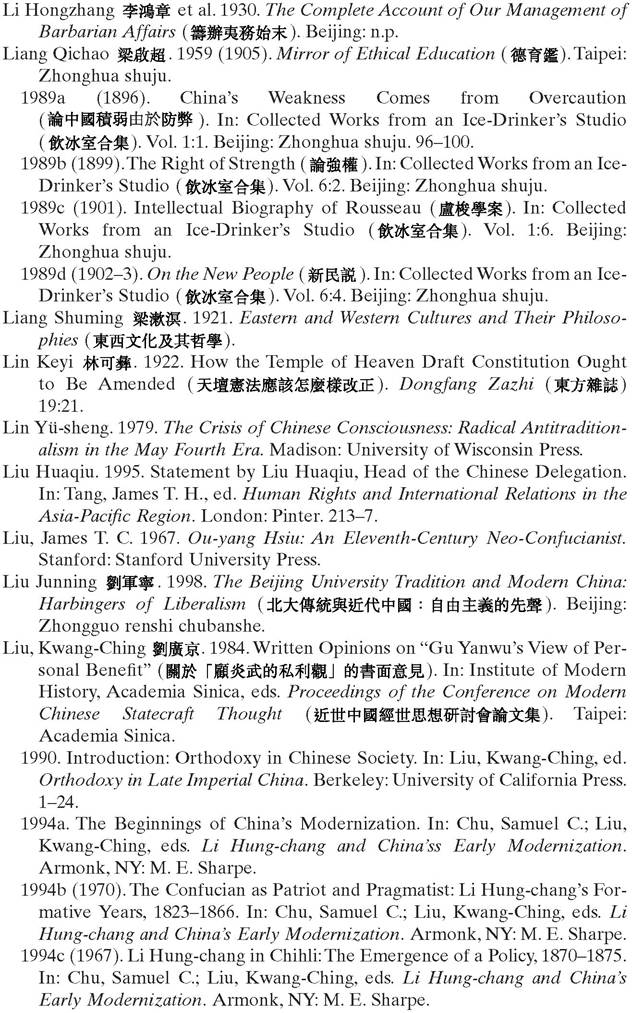
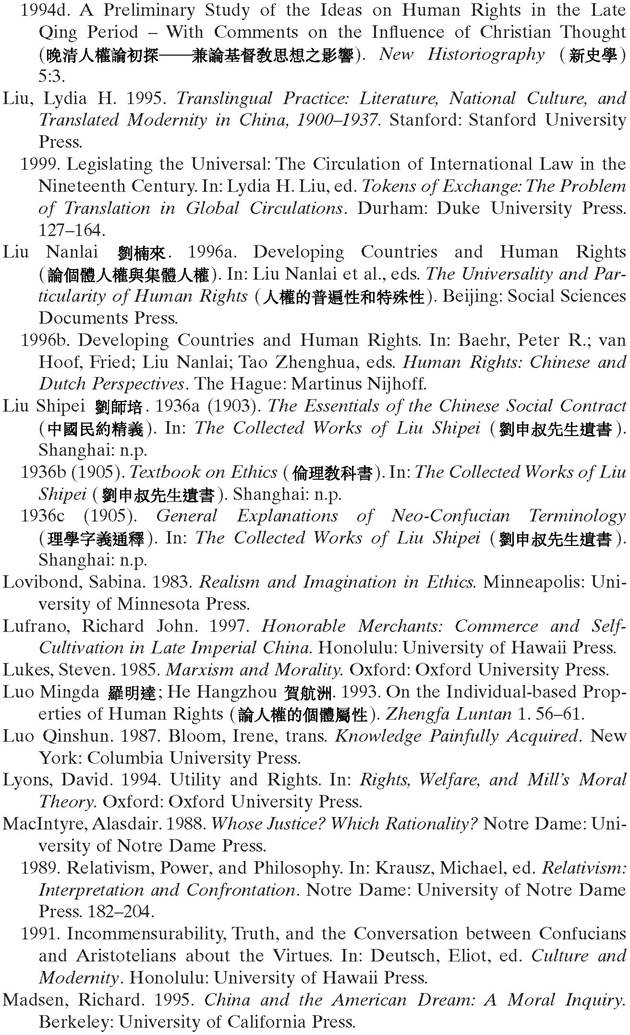
Narramore, Terry. 1983. Chinese Intellectuals and Politics: Luo Longji and Chinese Liberalism. M.A. thesis. University of Melbourne.
Nathan, Andrew J. 1985. Chinese Democracy. Berkeley: University of California Press.
1986. Sources of Chinese Rights Thinking. In: Edwards, R. Randle; Henkin, Louis; Nathan, Andrew J., eds. Human Rights in Contemporary China.
New York: Columbia University Press.Ng, Wai-ming. 1995. The Formation of Huang Tsun-hsien’s Political Thought in Japan (1877-1882). Sino-Japanese Studies 8:1. 4-21.
Ng, Wing F. 1998. To Rejuvenate an Old Civilization: Philosophical Aspects of Intellectual Change in China, 1895-1898.Wesleyan University Senior Thesis. Unpublished.
Nozick, Robert. 1974. Anarchy, State, and Utopia. New York: Basic Books.
Onogawa Hidemi. 1967. Liu Shih-p’ei and Anarchism. Acta Asiatica 12. 7099.
Parekh, Bhikhu. 1999. Non-Ethnocentric Universalism. In: Dunne,Tim;Wheeler, Nicholas J., eds. Human Rights in Global Politics. Cambridge: Cambridge University Press. 128-159.
Peerenboom, Randall. 1993. What’s Wrong with Chinese Rights? Toward a Theory of Rights with Chinese Characteristics. Harvard Human Rights Journal 6. 29-57.
1995. Rights, Interests, and the Interest in Rights in China. Stanford Journal of International Law 31. 359-386.
1998. Confucian Harmony and Freedom of Thought:The Right to Think Versus  Hangzhou Zhejiang renmin chubanshe.
Pennock, J. Roland. 1981. Rights, Natural Rights, and Human Rights - A General View. In: Pennock, J. Roland; Chapman, John W., eds. Human Rights: Nomos XXIII. New York: New York University Press.
Pettit, Philip. 1987. Rights, Constraints, and Trumps. Analysis 47. 8-14.
1988. The Consequentialist Can Recognize Rights. Philosophical Quarterly 38. 150.
Phillips, Anne. 1999.The Politicization of Difference: Does This Make for a More Intolerant Society? In: Horton, John; Mendus, Susan, eds. Toleration, Identity, and Difference. New York: St. Martin’s. 126-145.
Pleister, Wolfgang. 1982. Personlichkeit, Wille und Freiheit im Werke Jherings. Ebelsbach: Gremer.
Pong, David. 1985. The Vocabulary of Change: Reformist Ideas in the 1860s and 1870s. In: Pong, D.; Fung, E. S. K., eds. Ideal and Reality: Social and Political Change in Modern China, 1860-1949. Lanham, MD: University Press of America. 25-61.
Ramberg, Bj0rn T. 1989. Donald Davidson’s Philosophy of Language. Oxford: Basil Blackwell.
Rankin, Mary Backus. 1986. Elite Activism and Political Transformation in China: Zhejiang Province, 1865-1911. Stanford: Stanford University Press.
Rawls, John. 1993. The Law of Peoples. In: Shute, Stephen; Hurley, Susan, eds. On Human Rights: The Oxford Amnesty Lectures, 1993. New York: Basic Books. 41-82.
Raz, Joseph. 1984. On the Nature of Rights. Mind 93:215-229.
1986. The Morality of Freedom. Oxford: Clarendon Press.
1990. Practical Reason and Norms. Princeton: Princeton University Press.
1992. Rights and Individual Well-Being. Ratio Juris 5:2.127-142.
Ren Wanding. 1990. A Discussion of the Historical Tasks and Objectives of the April 1989 People’s Democracy Movement. In: Han Minzhu, ed. Cries for DemocracyWritings and Speeches from the 1989 Chinese Democracy Movement. Princeton: Princeton University Press. 121-4.
Rorty, Richard. 1989. Contingency, Irony, and Solidarity. Cambridge: Cambridge University Press.
1991. Cosmopolitanism without Emancipation: A Response to Jean-Frangois Lyotard. In: Objectivity, Relativism, and Truth. Cambridge: Cambridge University Press. 211-222.
1993. Human Rights, Rationality, and Sentimentality. In: Shute, Stephen; Hurley, Susan, eds. On Human Rights: The Oxford Amnesty Lectures, 1993. New York: Basic Books.
Rousseau, Jean-Jacques. 1987. On the Social Contract. In: Cress, Donald, trans. The Basic Political Writings. Indianapolis: Hackett.
Santoro, Michael A. 2000. Profits and Principles: Global Capitalism and Human Rights in China. Ithaca: Cornell University Press.
Schwartz, Benjamin. 1976. History and Culture in the Thought of Joseph Levenson. In: Meisner, Maurice; Murphey, Rhoads, eds. The Mozartian Historian: Essays on the Works of Joseph R. Levenson. Berkeley: University of California Press.
Sen, Amartya. 1999. Development as Freedom. New York: Anchor Books.
Seymour, James D., ed. 1980. The Fifth Modernization: China’s Human Rights Movement, 1978-1979. Stanfordville,NY:Human Rights Publishing Group.
Shek, Richard H. 1976. Some Western Influences on T’an Ssu-t’ung’s Thought. In: Cohen, Paul A.; Schrecker, John E., eds. Reform in Nineteenth-Century China. Cambridge: East Asian Research Center, Harvard University.
Shue, Henry. 1996 (1980). Basic Rights. Princeton: Princeton University Press.
Spar, Frederic J. 1992. Human Rights and Political Engagement: Luo Longji in the 1930s. In: Jeans, Roger B., ed. Roads Not Taken: The Struggle of Opposition Parties in Twentieth-Century China. Boulder: Westview Press.
Spence, Jonathan D. 1990. The Search for Modern China. New York: W. W. NTnrtnn
1 -I
271