An Outline of the Cyclical Trajectories of Egotistic and Altruistic Violence in Colombian History
Before outlining the historical record corresponding to our theoretical argument, it should be indicated that the pattern of “legitimate order crisis” derived from class/culture oppositions, here presented for the case of Colombia, is different from the Habermassian model of “legitimation crisis” (1975).
Although the two phenomena are related, the Habermas model is an endogenous one, that is, one where the internal structure of legitimate authority enters into recurrent crisis due to its own way to deal with change. The class/culture based conflict model here postulated for la violencia says nothing about internal structure of legitimate authority, and relates only to pressures from below, systemically marginal and thus external in themselves to the internal structure of the broader legitimate authority. As a matter of fact, the Colombian traditional authority elites have proven to be very adaptable and enduring as legitimate authority sources. One remarkable instance of such adaptability, already relevant to our argument, is the previously mentioned frente national agreement between the two traditional parties. This agreement contributed to a possible record of the country for the region, in terms of political democracy, as Colombia exhibits only one five-year dictatorship period through its overall twentieth century history.To facilitate the exposition, figure 1 presents the historical trajectories of both altruistic and egotistic violence for approximately the last 100 years. The rather inverse relationship between the two, in conjunction with the selected historical markers represented along the time dimension, is consistent with our moral cycle view of la violencia.
Before spelling out the contents of figure 1, it is necessary to indicate
a) The figure is to be taken only as a first step in a much more complex agenda for the empirical analysis of la violencia; it is intended mainly as a heuristic device, to help visualize the relationships involved in our argument, rather than as an operationalized way of verification of the hypothesis;
b) In order to approximate the empirical dimensions of the hypothetical paths of altruistic and egotistic violence in question, presumed levels of both kinds of violence are given.
Each point in each of the curves represents the weighted number of fatal instances imputable to “informal wars” and to “other human violent acts”;c) The trajectories in the figure are meant only as outlines, and yet hypothetical ones, representing only “educated guesses” of the actual levels; only the direction of the trends and positive and negative locations of the levels of the phenomena in relation to their continental means (that is, whether the trends are upward or downward and whether the levels are above or below the mean) in both altruistic and egotistic violence, are meant to represent specific hypotheses derived from the literature and/or from the theoretical model; future quantitative research will perhaps be able to establish the specific paths of the violent trajectories and the overall adequacy of this model;
d) In order to allow for comparability between the two curves, the levels are thought of in terms of standard deviation units from the continent’s averages for each point in time. Thus the total volume of violent deaths of each kind, for each “historical marker” (see figure 1), is taken as a reference point to measure the time-specific level of each kind of violence. The interpretation of the figure follows.
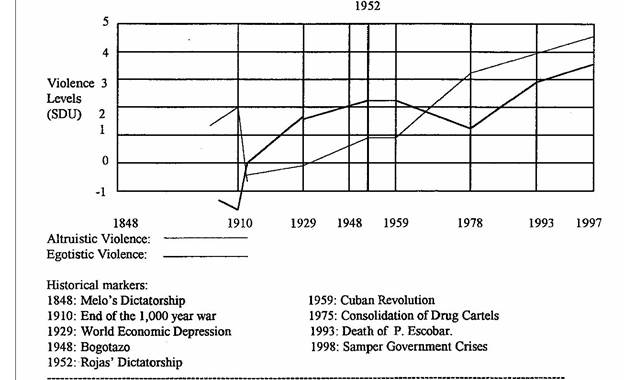
Figure 1: Hypothetical Approximate Historical Trajectories of Altruistic and Egotistic Violence Levels in Colombia from 1910 through 1997. Measures Given in Hypothetical Standard Deviation units for Latin America.
The altruistic-egotistic cycles in Colombia might be traced back even to the Comuneros revolution in the late eighteenth century, if a certain continuity in the country’s social history is hypothesized. Yet, for our present purposes, we can take the One Thousand Year War of the beginning of the nineteenth century as the first reference point. In a large measure, that war represented the confrontation between large landholders and their mercenary militias on the conservative party side, and the small farm and petty bourgeois class on the liberal one.
Of relevance here is the fact that after the end of the armed conflict, the militias from both parties were dismissed, leaving an enormous army of jobless peasants, versed in the “art” of violence. Marginalized from participation in the mainstream political and economic scenario, those groups fell into widespread violence, which, contrary to the practice in the war, had no higher social purpose, but resulted from either economic survival pressures or micro-interaction conflicts (Tellez 1987). This kind of violence corresponds to the egotistic category in Durkheim's model. Elements of anomic violence in the aftermath of the war were probably present, but their significance should be much less since, most likely, it was not primarily the lack or disappearance of social norms that triggered the violent acts, but rather the weaker ties of the ex-militias to the overall national collective consciousness. The war is here considered not a matter of conflict of norms but of social struggle and strategies. The norms continued to gravitate basically around religious values. The argument here is, then, that the most important component of the violence in question is an individualized or personal purpose, be it economic or affective, followed by a secondary component in terms of individual internal distress derived from the bankruptcy of the collective identity in the war.
The figure shows a peak of altruistic violence, and a corresponding valley for egotistical violence, at the end of the war. The latter is inferred simply from the theoretical inverse relationship between the two phenomena. That is, altruistic development in the group tends to cause a decrease in egotism. After the war, there can be clearly inferred drastic changes in direction of the two trajectories. Altruistic violence should fall somewhere below the continental mean and then begin a very slow recovery.
But recovery toward what? The answer to this question lies in a change in the organizational locus of altruistic violence, which should begin taking place somewhere in the first quarter of the twentieth century, from a liberal party affiliation to a far-left autonomous antisystem one, ending in the consolidation of Marxist communist and socialist ideologies and corresponding collective actors by the middle of the twentieth century.
On the part of the egotistic violence trajectory, the expected low levels during the war (as most violence is absorbed by altruistically organized ends) begin to grow higher very rapidly, triggered by persistently poor, or perhaps worsening, economic and overall social conditions and symbolic capital. Colombian modern bandolerismo was born. The egotistic trajectory should exhibit some de-acceleration as altruistic forces begin to make significant gains. The latter can be seen for instance in the organization of FARC (Colombian Revolutionary Armed Forces) in the 1930s, the oldest leftist guerrilla group in the continent.The 1940s and 1950s exhibit one of the most surprising transitions in Latin American modern history: from bandolerismo to Marxist guerrilla. However, this is not to say, or to agree with the view that, guerrillas are simply gangs of criminals camouflaged under ideological doctrine. Independently of what contours the process may have taken later, the transition in question is hypothesized here to have begun and be generally characterized as a genuine effort to moral (re)construction, consistent with Durkheim's law of moral gravity.
This is not just postulated on Durkheimian theoretical bases. Important empirical clues as to the historical adequacy of the model have been found. In the first place large groups of bandoleros under socially outstanding leaderships developed, including names such as San- gre Negra, Efrain Gonzales, Chispas, and many others, made famous in the country at large (Tellez 1987). They did live off their exercise of power upon, and extracted surplus from, the rural and small town communities. However, what is important about them is that their leadership did not gravitate only around egotistic criminal action, even though it might have started as just that. As it can be inferred from Tellez (1987), these leaders were also moral and charismatic figures in their communities, well beyond and ethically above their legally marginal and criminal pursuits.
However, their leadership was exercised in a very primitive fashion, that is, without legal written codes, without formal-rational bureaucratic organization, and relying on grossly simplified and ethically immature procedures.There is then here an ambivalent social position where, on the one hand the individual and his immediate followers represent the larger society's anti-values by any legal or moral standards, but yet on the other hand they remain loyal, instrumental, and authoritative (in the Weberian sense) in relation to their larger communities of social equals. These communities are marginal to the still larger legal system in terms of economic, social, and cultural capital, but are not outside the boundaries of the law, as their leaders are. Such ambivalence on the part of both the “social bandits” and their following, it should be noted, is not an exceptional and curious feature particular to Colombian social history. Rather, it is frequently observed among leaders of organized crime in many places, more noticeably today among drugdealing mafias in Colombia, Brazil, Italy, and many other places. This kind of social relationship in the case of Brazil has been reported repeatedly in the mass media of that country in relation to Rio de Janeiro's morro social-ecological spaces, controlled by the mafias and where the police gains physical presence only exceptionally, by sheer brute force.
The problem here becomes, within the Durkheimian tradition, to find out the “functional requirements” for growing out of the purely egotistic character of the group into an altruistic one. For this essay, let us just say that the transition from bandolerismo to a more encompassing moral stance—including political ideology, struggle strategies, and eventually class-culture peace dialogues and from there to the prospect for structural healing and social amalgamation—is a most pressing and challenging question not only for the Colombian case, but for the Third World as a whole.
In the second place, specific instances of the change in question on the part of group leaders have been identified, especially the case of bandolero “Chispas” (Tellez 1987). However, the transition from bandolerismo to leftist guerrillas is not meant to imply some sudden “ideological conversions” as for the Catholic baptism of Jews. As Durkheimian facts, the epistemic correlates of the two phenomena, egotism and altruism, are group characteristics, of which individuals usually participate simultaneously, although in different degrees. So, “group levels” of these characteristics can be identified for each group as a whole. At the inception of the moral ascent of a group, possibly no one there makes any moves, or even speaks or feels in any concrete way the need for a socio-moral reconstruction, nor imagines any active participation of his (her) micro social unit in such an endeavor. At such point only some of the most elementary functional requirements for group moral construction begin to be met: more stable structuration of the groups through more stable contacts, development of leadership and charisma, group definition of “crime” and outer limits, among many others. Among the various empty spaces of the theory is not knowing when and why some groups do develop an altruistic and proselytistic view of their moral values, whereas others do not. The latter is the case of “organized crime” and mafias. The process is, in any event, established by the moral forces that may or may not succeed in the long run.
The transition in question from bandolerismo to guerrilla then involves the relative weight of egotism and altruism in relation to the illegal groups, which began to pass from a predominance of the former to a predominance of the latter during the 1940s and 1950s. Of course, it will not be until later, presumably in the decade of the '60s, that the two trajectories, for the country as a whole, and in the terms here utilized, cross over each other. The trajectories do not refer to absolute numbers of violent deaths of the two kinds, but to standard deviation units from their continental means. It should not be read between lines here that the guerrilla movement had as its only or primary source the bandolero gangs. As indicated earlier, the contextual conditions may dictate the direction and intensity of these movements, and yet, the transition from egotism to altruism is the result of much broader group moral makeup, where the bandolero and the guerrilla are only tip-of-the-iceberg type expressions.
The 1948 Bogotazo is the name given to massive riots in the streets of Bogota after the assassination of J. E. Gaitan, leader of the liberal left and candidate to the presidency of the nation. Following that event—an example of the moral transition expressed in anomic explosions triggered by the disappearance of a charismatic leader—the institutional order approaches critical levels which end up with the coup d'etait of General Gustavo Rojas Pinilla in 1952. During the dictatorship that followed, it makes sense to hypothesize a decrease, and perhaps a stabilization of, the violence trajectories, because of the peace talks and agreements, especially with guerrilla leader Guadalupe Salcedo (Fluharty 1957). In this particular instance, the decrease in altruistic violence does not mean an increase the egotistic kind, but rather it should carry along a decrease in its rate of growth or even an absolute decline. This is because the climate produced by the promises of the new regime.
After the Cuban revolution—and certainly in no small measure because of it—and also because of the failure of the dictatorship to bring about any structural solutions to the ongoing conflicts, altruistic violence experienced again intense and prolonged growth. Egotistic violence on its part, can be expected to exhibit a corresponding continuous decrease after that point. Bandolerismo had virtually disappeared, and the gains of altruistic groups probably absorbed increasing portions of the egotistic violent potential in the country. The very active role of the urban-based M19 movement constitutes a key development at the time, added to the apparently still growing forces of FARC (Colombian Revolutionary Armed Forces) and ELN (National Liberation Army).
These tendencies should have climaxed, according to the historical pattern of the country and of the continent, in another institutional order crisis of surely large proportions where, for a combination of internal and external forces, the establishment would have prevailed. From Argentina to Nicaragua, passing through Uruguay, Chile, Brazil, Peru, and El Salvador, to name only the most important cases, violent confrontations between left insurrection groups and the military, behind various institutional arrangements and processes, took place. Yet, by the time of the collapse of the Soviet Union, or shortly thereafter, all of them have achieved virtual control of the insurgent groups. Colombian guerrillas, however, in spite of significant government efforts to attract guerrilla personnel to regular civil life, grew even stronger. Why?
Outside of the altruistic violent forces at stake in the country, a new and quite unique development set Colombian violence paths in their exceptional historical configuration exhibited in the last quarter of the twentieth century, characterized by rapid and monotonic increases of both altruistic and egotistic violence. I am speaking of the consolidation of the drug cartels first in Medellin—tentatively marked around 1978, and then in Cali, after the death of Pablo Escobar, around 1994. This development sets in motion two parallel processes: one, the growing war against the cartels, fueled both nationally and internationally; and two, the renewed vigor of altruistic violence derived from likely participation of the guerrillas in the drug business at the levels of production, manufacturing, and conceivably commercialization.
The specific mechanisms through which the two phenomena could reinforce each other is still a very obscure matter. However, the upward direction of both kinds of violence paths, this time, is common knowledge. With the mounting efforts—including international ones—of the war against drugs, the death of P. Escobar, and the dismantling of the Medellin cartel, a deceleration of egotistic violence should have occurred. It should be indicated that in the face of the legal authority’s failure to control such a scenario of violence, “paramilitary” mercenary armies have inundated the rural areas to protect agricultural businesses from “boleteo” (forced monetary contributions or “taxes” extracted by the guerrillas), genuinely or not. Thus, at the surface, a chaotic picture of hijackings, blackmailing, executions, and violent abuses of authority plague the nation, where ethical and unethical genuine informal war, altruistic violent strategies and counter-strategies confound with similar procedures from the egotistic side of the spectrum.
The overwhelming extent of the conflict today is widely documented by the mass media in Colombia and internationally. For our purposes it suffices to register than the report from DEA (Washington Post 1998) reveals that the guerrillas control more than 40% of the national territory, and that, at the rate of growth they have at the present time, very soon they will be in a position to defeat the national regular military forces.
References
Alexander, Jeffrey, and S. Seidman, editors. (1990). Culture and Society. New York: Cambridge University Press.
Camacho, Alvaro, A. Guzman, and others. (1997). Nuevas Visiones Sobre la Violencia en Colombia. Bogota: Fundacion Frerich Ebert de Colombia e Instituto de Estudios Politicos y. Relaciones Internales, Universidad Nacional de Colombia.
Comision de Estudios sobre la Violencia. (1987). Colombia: Violencia y Democracia. Bogota: Instituto de Estudios Politicos y Relaciones Internacionales, UNC, Col- ciencias.
Collins, Randall. (1994). Four Sociological Traditions. New York: Oxford University Press.
Costella, Maria. (1992). A Igreja Catolica e o Movimento da Encrucilhada Natalino. Porto Alegre: UFRGS.
de Janvry, Alain. (1981). The Agrarian Question and Reformism in Latin America. Baltimore: The Johns Hopkins University Press.
Durkheim, Emile. (1933). The Division of Labor in Society. New York: The Free Press.. (1951). Suicide: A Study in Sociology. Glencoe, Illinois: The Free Press. Fluharty, Vernon L. (1957). Dance of the Millions: Military Rule and Social Revolution in Colombia 1930-1956. Pittsburgh: University of Pittsburgh Press.
Habermas, Jurgen. (1975). Legitimation Crises. Boston: Beacon Press.
Hobsbawm, Eric. (1965). Primitive Rebels: Studies in Archaic Forms of Social Movement in the 19th and 20th Centuries. New York: W.W. Norton.
Johnson, Terry, Christopher Dandeker, and Clive Ashworth. (1984). The Structure of Social Theory: Dilemmas and Strategies. London: Macmillan.
Ribeiro, Darcy. (1971). The Americas and Civilization. New York: Dutton.
Sanchez, Gonzalo, and Ricardo Penaranda (editors). (1994). Pasadoy Presente de la Violencia en Colombia. Bogota: CEREC.
Tellez, Petro Claver. (1987). Cronicas de la VidaBandolera. Bogota: Planeta.
Wallerstein, Immanuel. (1975). Class formation in the capitalist World Economy. Politics and Society 5.3: 367-375.
-----. (1984). The Politics of the World Economy. Melbourne: Press Syndicate of the University of Cambridge.
Wright, Eric. (1997). Class Counts. Comparative Studies in Class Analysis. New York: Cambridge University Press.