Self-regulation of the social organism
To explain theoretically the emergence of a qualitatively new level in - deploying of the social world we can only if we prove the working hypothesis that it took the social body to send a specific function, which removes the internal contradictions of his life.
In other words, we should point out the need for domestic social organism, which is required to meet the output to a higher level of self-movement of the universum.Thus, it is logical to assume the opinion that in the social organism there is a condition for which it should be able to look aside, correcting its internal content as a system that moves itself. It is important to point out features of the system that moves itself. Based on the literature, you agree that “society is self-developing, if the processes in it quickly pass the entire cycle, typical for the above heading system. In other words, processes quickly rise from the level of the lower layer to the upper level (reflected in it) - eventually formed as the means of changes (from the supporting or denying moral or rights) and the executive - turning capabilities (equipment, material resources). These tools are beginning to adjust well to change what is happening in society, strengthening of its existence, thereby giving rise to need it for survival and development of new qualities. Thus it seeks to rise to the status of the system which develops itself [159, 171-172].
Now thinking logically, that implementing such functions it took a higher level of abstraction, where could be formed the morphological body - its real congestion.
Let’s remember that in living organisms the need of some function is the first to appear and only then the morphological organ, which provides it, forms gradually. Meanwhile, let’s underline once more that the social organism in spite of all its “illusory nature” is a rational living system.
It was even indicated by Diogenes Laertsky, who wrote: “the world is arranged by mind and foresight” and “the world is a living nature, spiritual and clever, while the leading part in it is an ether” [67, 287]. The modern scholars call this state, this social creation differently, for instance, some of them call it “the lifegiving system” (S. Byr), others - “dynamic unit” (V. Kelasyev).One of the arguments of this is even the theoretical legitimacy explanation of the social life in general. But this fact is established from theoretical side, and now let’s give evidence from the practical one. Here we have a lot of evidence that the social organism possesses collective feelings, excitable mind, memory, ability to reflect and introspect. For example, the direct signs that the social organism possesses the ability of collective reflection exist in scientific literature. It’s enough here to refer to Behterev’s work “Collective reflexology” that was published in 1921 [See: 22]. It will be recalled about the well- known O. Donchenko’s work Societal mind. In 1993 V. Kazmyrenko in the monographic research Social psychology of organizations thoroughly describes problems of formation and functioning of social- and-psychological regulation of this unit [See: 86].
The existence of all these directives and algorithms of the behavior doesn’t depend on individual intention to it. E. Durkheim (The Division of Labor in Society) writes, that these means of thinking, activity and sensitivity possess the same significant quality which exists beyond individual senses [72, 412], so they compose the specific quality of the social system.
Meanwhile, he proves that in the social organism the specific form of memory exists that keeps and gives all this every time when it is necessary for order support in the social system. This types of behavior and thinking are not merely beyond the individual, but are provided with compulsory force consequently which they are imposed on him regardless of his desire [72, 412].
Thus, the existence in this unit of such psychological qualities as collective feelings, worries, social reflexes, instincts, receptivity, reflexiveness, memory, collective or general will, mind, self-consciousness, super-consciousness, social intellect and many other spirituality elements are definitely admitted by the analysts. The problem is to conceptually explain its origin, functioning and development.In the scientific literature the aspiration for the explanation by means of theoretical analysis of the morphological organ existence necessity that would carry out the government of the social organism inner life is clearly traced. It is differently called by various authors. Here are only some of its formulations: “Social Mind”, “leading mind”, “joint mind centers”, “common-social mind”, “general combined mind”, “Global humanity mind”, “associated mind”, “public intellect”, “society reflection” etc. It is clear that the given notions are not synonyms and to separate them is the task of the special investigation, but in the meantime the scientists operate them as something that stands to reason and is intuitively realized.
The frequency of usage, for instance, of the notion “joint mind” is growing exponentially, but the attempts to define it have been made only recently. In this way, for example, Saint-Petersburg investigators write the following: “From our point of view, the joint mind should be understood as the social system ability to reflect the situation sufficiently, which emerged both in logical-scientific and in morally-estimated form” [159, 152]. Substantially the joint mind of the social organism is expressed in “some field of ideas that carry vectorial, selective character” [159, 152].
The morphology of such organ, as it follows from the literature, forms by means of submission of the main social processes and according to individual minds operating in them to single social Mind [See: 33, 776].
Thus, everything shows that there are elements in the social organism that are able to provide the process of reflection of the contradictions of its inner life vertically.
The process of beating oneself, if the certain level is reached, leads to the qualitative leap as the social organism starts to realize and behave like a reflexive person. Thus “Me” of the social organism, which will separate it from the social surrounding appears. Such recognition combines its own movements, deeds with the fact of the existing being. The new feature or the social organism that carries out such combinative function is joint selfconsciousness, self-reflection.The combination of the joint self-consciousness with the sense, generated from the Semantic Universe continuum and such that appeals as the measure of reflected behavior processes in the social organism leads not only to the fact of its own being realization by the last, but to its treatise as “good” and “bad”. Meanwhile it is understood that to any other branch except for the sense “Me” the quality “good”/”bad” can’t be addressed. But with this addressability it conveys its meaning to “Me” simultaneously. It appears that the quality “good”/”bad” mingles with “Me” that occurs, and due to this, makes it desired or not for social integrity. The combination of those two types of the systemic effects will give fundamental new quality - appraisal self-reflection. Meanwhile the element “Me”, multiplied by morally- ratable component is the core of the self-organization process, because the result of their interaction is the social person’s desire to redo or even to create something new that never existed before.
And in general, from the beginning of reflection the effect of multiplication appears snowballing in the social organism. That which we build there is only the main line of the social integrity development.
Owing to the process of reflection the differentiation of the social matter occurs. One part stays on the same level, the other tries to reach the upper. Thus its two fundamental new subsystems form - the one that reflects and the other that is reflected, specific streams of the inner information appear, the organ of government arises, that acts on this information and creates the directive data, at last, homeostasis mechanism forms.
Meanwhile the meaning of reflection process that is the sense of what happens in intersystem construction is removed and concentrated in the information that moves using the vertical communication canals; the measure of its quality is its value. The last is the more important, the more exactly the condition of reflected structures is fixed.
The reflective system sends data of the process that is reflected with the help of some signals. The signal is sent in the sign form. It carries the gnosiological image of the reflective structure - sign thing that is double-layer by structure - beside the concrete-sensitive reflection of the sign texture it includes some raising that reflects its meaning.
But meanwhile the material object or process can be the signal only if it reflects in its structure the features of the structure it has been sent by. At the same time between systems those reflect and is reflected the information is transmitted by means of many signals and if there were no reflection between them that is if there were no process of the certain structures gradual formation, so there would be no interaction of social systems. “Whatever phenomenon we examine”, - N. Kyvenko writes, - “it occurs anywhere that the deed of one system concerning the other is transmitted by means of intermediate structures that are the systems which carry this information” [91, 136].
Let’s pay special attention to the circumstance that the signals are the kind of energy-information products that carry the information about the reflected structures from one level of Universe selfmovement to another. The necessity of transitive structures (signals) is dictated by the fact that the levels, mentioned above, are unattainable to each other. In connection with this for the information transmission intermediate structures and mechanisms are used.
It is obvious that during the interaction of Universe levels with each other they don’t “endure” all the others’ problems but take into account only final result force of their influence.
The parallelogram principle for the integration of the spiritual processes or forces totality to the movement vector works here.The reflection is the response reaction of the social organism to the influence of the surroundings. The word “to reflect” means “to resist”, “to give battle”, “to hit”, “to repulse”, “to win”, “to abandon”, “to object”. It makes an integral and major part of every move (totality) and is connected with the process of structure and system function formation. “The structure”, N. Kyvenko writes, “that is the basis of any system (of the integrity), owes its appearance and character peculiarity to the move and reflection that define the system formation. The mechanism of integrity structure formation is guided directly both by the reflection process on the whole and by its features [91, 142]. Consequently, the reflection is an attributive quality of the social organism, because it is connected directly with the formation of the social integrity.
The essence of the reflection is that it includes such dependence between two processes in which the peculiarities of the first process are recreated in appropriate peculiarity of the other. It means that cause-effect dependence is established between interactive structures owing to the quality of reflection. Meanwhile with the influence of the structure placed lower on the upper one, the reflection in the last is fixed in form of the semantic signal and in the reverse influence - the upper structure changes the lower structure morphology. So the reflection that occurs in the reverse destination has the other quality. It is known in literature as government.
The signal acquires the force only in the social totality that has gained the certain level of production, that is to say, when some variety of structures exists, and when they already have even if the simplest starting configuration, that is when there are functional links between them, the violation of which has a pernicious effect upon social organism health. The existence of the structure unity in nature is connected also with the circumstance that signals which carry the data from one system to another in the process of reflection are the direct government factor of the latter.
As we have already established that the organ of government is on the upper level so this means that the reflective system reacts with the response to the data received in its own way and destination that is “stated” by the reflective system by means of information.
It is obvious that the data received from the lower levels is compared with the meanings or ideal samples taken from the Semantic Universe continuum and on the basis of differences between them the decisions are made and their implementation is obligatory for the lower level structures. This peculiarity of the proper reaction during the reflection permits to talk about the reflective system as the one that governs.
Meanwhile the system that reflects in accordance with the system that is reflected is the prior system because it sends it information that is the factor of government. As proved all the systems of material world can be characterized by the fact that they being integrated within each other and being reflected, exchange information on processes that occur inside them. This feature is general for all the types of government and witnesses the analogy of structural organization of qualitatively different objects.
The information as a specific form of connection is a measure of influence of factors of surroundings on the governed system. We cannot talk about government not taking into consideration the existence of the information exchange process within systems, and there is no sense to talk about the existence of information flow not thinking of them as of element of a certain government process [See: 91, 126].
The government process is always done on the basis of reception, storage, transmission and transformation of the data and is done by such a scheme. The information dependence occurs within the governed and the governing systems. The information that comes from the governing system to the governed one is a factor that provides the government.
The consequences the extra activity of the government system in the social organism can be seen in the work of V. Ivanov Legion and conciliarism. The crowd of people turned to featureless beings in totality “should develop the collective centers of consciousness. Like a general collective mind that surrounds itself immediately with the most complicated and the most sensitive nervous system, and become a similarity of a society animal, gifted with the greatest power and unusual reasonability of its moves of strictly minor and concentrated consistence. It will be the evolution of the part of the humanity into the Superanimal...It will be the peak of organization because the maximum organized society is nothing else but the animal” [77, 99-100].
Now when it we asre aware of the existence of the social organism as an living substance or integrity, the above mentioned fact can be commented differently. We think that the process of reflection is an information move from the lower level to the upper one, and a backward move is the process of government. These two different moves are even governed by different organs of the social organism.
It means that by the vertical move the Universe has formed the governed and the governing subsystems that for their normal intercourse desired and created the principally new type of information - the government information. The latter in its turn has divided into executive (reported) and directive. Between the governed and the governing body we can witness the subordination.
Taking into consideration the above mentioned statements we can state that here we consider not only separated processes of reflection and government, but also a more complicated and sensitive process that should have been called the social organism self-regulation as a capable of self-development system.
So, the process of self-regulation begins with the vertical move of the universe. The algorithm of the mentioned mechanism, b according to N. Kyvenko, can be imagined in such a way: every signal is such or another social process that focuses in its structure (directly or indirectly) on peculiarities of the system or organ that have sent it. Between the structure of this system and the structure of signal there is a specific accordance. Then this signal achieving the system meets the opposite influence and intercourses with it. The relation of structural accordance is formed between them. The structure of the reflected system becomes similar to the structure of the signal and through it to the structure of the influenced system. The change of the structure of this system changes in a way and a certain direction of its nature, character of its intercourse with the environment.
Since we deal with structural items that intercourse with the environment not as with the unity but by its separate parties, then we should move to the next level of abstraction. Here the change of inside connections should be considered as the move of the inside and the action - as “outside” change, its breakthrough outside, or on the contrary as “inside” of the outside influence. This aspect should be presented in a theoretical analysis, because social organism as the social subject, should be directed with its activity into outside environment, because it by its nature should intercourse with similar social units. Let’s remember that pressure on others and intercourse with others is an attributive quality of any social group. In an outside intercourse the action, led to its edge form, leaves the measures of social organism or some part of it, thsat is to say, it separates itself from roots. Here we deal with the super-consciousness of social organism.
So, the social organism as a social item is the unity of features and relations, and as existence it is the unity of change and action. In change the social organism stays by itself, but in action it surpasses itself. Emerging on the basis of reflection and government the system of self-regulation should control and direct the occurring outside connections of the social unity and its move in the outside environment.
The rationalization of behavior of the social organism in the outside environment is dictated by sense carried out by the process of reflection for the estimation of the inside connections. Now owing to the activated sense the system of self-regulation turns automatically into the government of opportunity of social organism. Sense being an element of the self-regulated system finds out the final influence on the opportunities of the social organism, confirming the primacy unity upon everything happening within its body.
The sense doesn’t aim at one item, but is a “certain trajectory of a goal, exactly a certain sense of space, that as “an attractor” canalizes, consolidates separate useful actions and intentions into one sense channel, with which there appears an opposite connection” [159, 181].
Taking into consideration such opposite influence of sense of the generated systemic effects on the opportunities of the social organism, there comes a time of its self-changes as the totality. The conscious necessity of self changes pushes the processes in an opposite direction from finding the needs to the demonstration of opportunities, the features of the system. The organ of government is chosen from existing opportunities only the one that meets the purpose of the erected sense and general situation in the system. In practice it leads to the fact that the realization of the chosen variant of the changes requires the least of the needed to satisfy actual needs of energy consumption of the social organism.
Now we can imagine the model of the social organism with the new different nature, that is to say, distinguishing in its structure between the governed and governing sub-systems (fig. 3.3).
The relative independence of the government organ of the social organism is witnessed by its own life that is created under the specific laws of informational intercourse. The support mechanism of the dynamic stability of the government system functioning of the social organism in the certain measures forms the special government structure within the government organ that got the label homeostat in the scientific literature. Homeostat is the basic functional conception of the information reprocessing mechanism. It realizes through the various material data carriers.
The model of homeostat and its features is created by U. Gorsky and performed in monographs, great amount of school-seminar in homeostat publications, at the conferences, international symposiums and congresses [See: 60, 63]. In multicellular living systems homeostat, as opposed to the material unit of life, is the informational
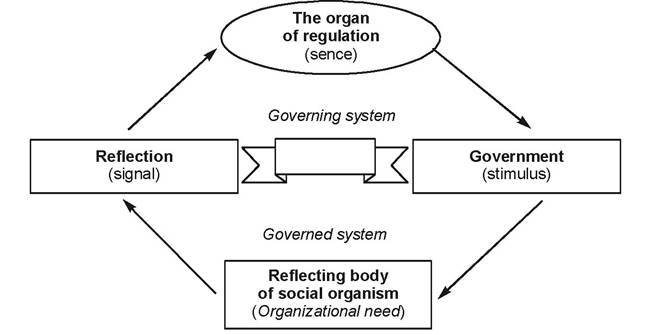
Fig. 3.3. The model of system self-regulation of the social organism
unit of life that is only due to its existence the circle of neolife is provided.
Some sources of determination are in fact typical of self-regulation system: one - on the part of the outside influences, second - on the part of of its own inner dynamics, the third - on the part of its past (memory). That’s why the behavior of the social person is too complicated to predict, because sometimes “it itself doesn’t know” how it will behave. This interesting circumstance is marked also in the literature on self-organized systems [See: 202, 37-55].
As practice proves self-regulation is the most complicated type of vertical intercourse of subjects or structures among themselves. Under the general definition of the notion “regulation” (regulative process) we understand the regulation of the social processes. Meanwhile the regulation of the process means the growth of opportunities nonequivalence of possible parameters changes of the human- made reality that is such a secondary process which, using the entropy notion, is often characterized as antientropic or as a process of entropy reduction [See: 8, 207-208; 47, 19].
The regulation as the secondary process is always made concerning some prior processes and depends substantially on the nature of these prior processes and also on the specific diversity of the kinds of regulative intercourses, typical of the certain level of organization of the universum, in this case for its social (rational) form of selfmotion. The self-regulative systems may exist in specific structural forms on all these levels, but it is suitable to consider this point in particular.
Thus the essence of the regulation in the most general case is reduced to the localization of social processes which are arranged in relation to each other in space and their cycling in time. Plus to this it is necessary to add an appraisal and reappraisal of value of the social phenomena. In such case regulation appears to be the process of relations formation not only between processes but also between those objects, the changes of which these processes will be. Due to it, when the objects, which are being regulated, are in the state of motion, its regulation performs simultaneously as the process of generation and self-organization of the reason, and as the process of organization of its products.
In other words, the process of organization of active objects is the process of regulation of their activity, and thus regulation is the integral side of organization process. The regulation of objects, their properties and relations is impossible without the regulation of the corresponding processes. At the same time, the organization is not reduced to the regulation. They coincide only in the case, when the objects of organization are already in active state. But in general, the process of organization - is not a mere regulation of the processes, which have been taking place, but also it is the stimulation of some new ones which have not taken place before. Speaking briefly, a process of organization is the unity of the processes of activation and regulation. The activation means “excitation or strengthening of activity; conversion into the active state; change from the state of rest(quiescent state) to the active state” (in the certain frame of reference) [See: 166, 23].
Consequently, organizational relations play such qualitatively new role in the self-motion of the objective universum, which a reason does or an activity in the course of human self-development of subjective image of the universum. On the surface of our life administrative information exudes, there appear new processes of self-regulation and their products.
However, it is well known, that expedience is an attribute of any social subject, the causality form, which stimulates a subject to the action and demonstration of its own essence. The functioning of the system of self-government of a social organism, which is vectored by the necessity of surmounting the contradiction, is capable to develop it. But the utterly different regimes of functioning are possible: the regime of self-preservation, irredundant, and the regime of self-development. In every case, if the effect of retention of new qualities, which are generated for the sake of achievement of necessary changes, will be notedly expressed, it will mean that a social organism is in the regime of homeorhesis.
If in the result of the functioning of the system of self-regulation the repetition of the already known operations will take place only, and nothing principally new will be produced, it will mean that a social organism is in the regime of homoeostasis.
It is possible also to talk about the regime of disintegration - ho- meoclasis; it, if the functioning of the system of self-regulation generates something, which causes a threat to the existence of the selfregulated system, makes impossible the existence of social organism as integrity.
Of these three the most typical variants of development we are, certainly, most interested in that one, according to which the system of self-regulation regulates the motion of social organism in the environment, as it is able to demonstrate its own activity.
Characteristic qualities for self-regulations system, which are intended “for itself”, and can not be observed from outside, have a character of conditional values. The activity of the given subjectivity, which is regulated by the sense of invisible for an outward observer qualities, becomes difficult -to-predict, as there are a lot of separate effects, the system has the freedom of actions, it acquires its own purpose (from the necessity of self-preservation - they are generated by senses, by prognosis possibilities of organism, interference with the environment).
For forming of inherent aims the inherent language is produced in a social organism. It is easy to illustrate this conformity by the example of the CPSU activity, which functioned as the system of selfregulation in the social organism of the USSR. J. Stalin, for example, speaking on behalf of political party, resorts to the expressions of both: of anthropomorphous (“the Party speaks its own language”) and of technicizm, even military- technicizm character (the press (the printed media) is the “strongest weapon”, “sharp weapon”) [See: 33, 282].
As an argument in behalf of such assertion, it is possible to cite factual evidence of publishing of the special dictionaries, in which a specific thesaurus is concentrated for the social development administration [See:172; 168].
The social organism is the field of active interference of two different informative streams: external and internal ones. The principle of interference here is similar to the one that functions in the system “a man versus the environment”, means that the external information actuates (excites) in an internal informative stream, what had already been contained in it before. Lately this interference of informative streams became the subject of an independent science- homeostatics. It arose on the junction of such sciences and disciplines, as cybernetics, system analysis, biology, medicine, psychology, philosophy, sociology, machine intelligence, ecology, economy, and others. Among those, who contributed significantly into the development of the mentioned science it is important to name W. Kennon, K. Bernar, R. Esh- bi, S. Bira, R. Hardy, H. Kassilya, W. Dilman, D. Sarkisova, W. No- voselseva, Y. Gorsky, W. Astafjeva, A. Stepanova etc.
The homeostatic science essence, is, according to A. Stepanova, “the study of mechanisms of hierarchical administration of the complex systems, which provide the maintenance of dynamic stability of vital functions, parameters, rhythms and trends of development” [176,7]. Its main purpose “is the study of general mechanisms of administration of homoeostatic type, revealing the role of the interference, competition and conflict, and the establishment of analogies between the systems of various nature from administrative positions” [176,7].
In addition, the effect of double existence appears in the social organism if the system of self-regulation defines the goal for it. The essence of it is that a social organism is in a state of structural tension, caused by the arisen contradiction between its present state and that state, to which it must be transformed in the future, and which is determined by the sense. But a social organism can’t be in two dimensions at the same time, i.e. to have considerable differences between morphological parameters and descriptions of functioning. The social organism begins to solve the problem of their combining, following the instructions, whether it is desirable or undesirable for it. Trying to reduce the tension, which appears, the social organism has to pass from the state of functioning to the phase of evolutional movement.
3.6.