Some Problems of Empiricism
Concepts and Experience
The empiricist view that all knowledge is acquired by experience, and that there are no innate ideas, has been called into question by developments in a number of disciplines.
Noam Chomsky, widely regarded as the founder of contemporary scientific approaches to language, has argued that the child's experience of language is far too limited and fragmentary for us to explain language acquisition in empiricist terms (see Lyons 1977). Our ability to produce an indefinite number of well-formed sentences presupposes not just an innate disposition to learn language but also innate knowledge of the ‘depth grammar' common to all languages. Much more controversially, self-styled ‘evolutionary psychologists' and sociobiologists argue that many of our basic thought processes and behaviours are expressions of our genetic inheritance (see Pinker 1997; also the criticisms of this approach in Rose and Rose 2000). However, even if we are sceptical of claims such as these, there are other sources of evidence which suggest that knowledge acquisition can't just be a matter of recognizing patterns of regularity in the flow of sensory experience. One very telling illustration is given by the case studies reported by Oliver Sacks, a neurologist whose work was concerned with helping people who suffer from various kinds of brain damage. One of his patients (‘the man who mistook his wife for a hat') was referred to him by an ophthalmologist:Dr P. was a musician of distinction, well-known for many years as a singer, and then, at the local School of Music, as a teacher. It was here, in relation to his students, that certain strange problems were first observed. Sometimes a student would present himself, and Dr P. would not recognise him; or, specifically, would not recognise his face. The moment the student spoke, he would be recognised by his voice.
Such incidents multiplied, causing embarrassment, perplexity, fear - and, sometimes, comedy. For not only did Dr P. increasingly fail to see faces, but he saw faces when there were no faces to see: genially, Magoo-like, when in the street, he might pat the heads of water-hydrants and parking meters, taking these to be the heads of children.(Sacks 1986: 7)
Sacks continued his examination: ‘His visual acuity was good: he had no difficulty seeing a pin on the floor, though sometimes he missed it if it was placed to his left. He saw all right, but what did he see?' (p. 9). Sacks's unfortunate patient was someone who, though he had good eyesight, had lost the ability to make sense of the flow of visual impressions he was undoubtedly receiving. This sort of case illustrates the complex and pre-conscious mental activity of selecting and interpreting sensory inputs which goes into ‘normal' visual experience. Our ability to identify people, recognize faces, interpret a landscape and so on is not just a matter of having sense-organs which are in good order, but it also involves active processes of conceptual ordering and interpretation of which we are mostly unaware. As the philosopher of science N. R. Hanson once put it: ‘There is more to seeing than meets the eyeball' (Hanson 1965: 7).
On this view, then, experience is a complex synthesis of sensory impressions and conceptual ordering and selection. All experience is to some extent shaped by our previously acquired conceptual map of the world. As far as scientific observation is concerned, this is even more clearly the case. For an experience to count as a scientific observation it must be put into language, as a statement which can be understood and tested by other scientists. The activity of putting an experience into language is, precisely, to give conceptual order to it. An elementary statement, such as ‘The litmus paper turned from blue to red,' implies the ability to recognize a physical object, to classify it as litmus paper and to deploy the vocabulary of colour terms.
But, of course, this only shows that any particular statement of an experience, or factual statement, must presuppose an ability to conceptually order experience. It does not demonstrate the existence of innate knowledge, in the sense of knowledge prior to and independent of all experience. It still remains an open question how we acquired the concepts through which we interpret our experiences. Given the great diversity across cultures and through historical time in ways of interpreting experience (Durkheim 1912, 1982), it seems obvious that a large part of the conceptual apparatus each of us brings to bear must be learnt.
On the other hand, some very basic capacities for conceptual ordering do seem to be presupposed for learning itself to be possible. The eighteenth-century German philosopher Immanuel Kant developed some of the most powerful arguments for this view (see Kant 1953; Korner 1990; Hoffe 1994: esp. part 2). On his account, the ordering of the flow of our sensory experience in terms of sequences through time and locations in space was necessary to the making of all ‘judgements of experience’. It is similar with the ability to judge identity and difference, to distinguish between things and their characteristics, and to think in terms of cause and effect. So, for example, we can learn from experience that touching a piece of burning wood causes pain, but the concept of ‘cause’ could not itself be derived from experience. In Kant’s view, these very basic organizing concepts (the ‘forms of intuition’ and ‘categories of the understanding’) are presupposed in all experiential judgements, and so must be considered both innate and universal to humankind. Ever since Kant, the main alternative approaches to empiricism have taken his work as their point of departure.
Scientific Laws, Testability and Interpretation
We have already explored some of the difficulties with the empiricist demand that scientific statements must be empirically testable. If this demand is made very strictly, then it would require scientists to be much more restrictive in the nature of the hypotheses they advance than they generally are.
In particular, scientific laws would have to be treated as mere summaries of observations, as empirical generalizations. But if this were done, scientific explanations would lose their explanatory power, scientific prediction would be impossible, science would be deprived of an important stimulus to further research and so on. These features of scientific statements depend on an interpretation of scientific laws such that they make claims which go beyond what is strictly implied by the existing evidence. To preserve this feature of scientific laws it is necessary to adopt a looser criterion of testability, which acknowledges that new observations may count for or against a hypothesis, but can never conclusively prove or disprove it.As we saw in Chapter 2, attempts to develop a rigorous quantitative measure of the degree to which hypotheses are supported, or confirmed, by the available evidence fall foul of the fact that any finite set of evidence will be vanishingly small compared with the indefinitely large class of possible evidence which may be relevant. In addition, the more relaxed empiricists become in loosening the requirement of testability (for example, some possible observation must be relevant to the truth or falsity of the hypothesis), the more difficult it becomes to make clear and defensible distinctions between genuine science and the non-scientific belief-systems which empiricists are generally committed to excluding.
But there is a further difficulty with testability which relates more closely to what was said above about the relationship between experience and interpretation. If every statement of experience is at the same time an interpretation, then in principle every factual statement is open to reinterpretation. As we saw in Chapter 2, with the example of the apparent evidence against the effectiveness of a complementary medical practice, whether to accept a piece of evidence as confirming or refuting our existing beliefs will always involve making judgements.
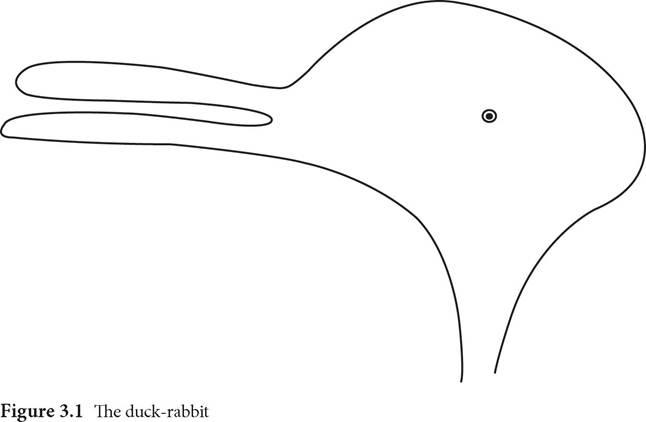
In part, these judgements will concern how to interpret both one's existing beliefs, or hypotheses, and the new piece of evidence. Ambiguous figures are the most commonly used illustration of this. The pattern in Figure 3.1, the famous ‘duck-rabbit', can be seen either as the head of a duck (facing left, the two projections forming the beak) or as the head of a rabbit (facing right, the projections representing the long ears).In such cases as this, the same patterns of markings on paper are interpreted in radically different ways by different observers, and by the same observer at different times. The possibility of different interpretations of the same body of evidence raises serious problems for the empiricist account of scientific practice. Apparently conflicting evidence can always be rendered consistent with a favourite hypothesis by reinterpreting either the hypothesis or the new evidence. Though such ‘conventionalist' tactics tend to be disapproved of by empiricists, it is hard to show that they are never justified. But the most important problem posed by ambiguity and interpretation is at the level of rivalry between major theoretical orientations. So, for example, in the controversy between the proponents of Darwinian evolutionary theory and its theologically oriented opponents, fossil evidence which favoured the view that there was historical change in organic forms was contested as a temptation laid by the devil. The remarkable adaptations of organisms to the requirements of their conditions of life, again, was interpreted as the result of design by the theological tradition, but as the result of natural selection by Darwinians. In this way, rival theories are able to offer alternative interpretations of the available evidence in such a way that whatever the evidence, each can with logical consistency maintain its own account of things.
This situation of systematic disparities of interpretation between two (or more) theoretical perspectives implies debate which is invariably at cross-purposes, and the absence of anything that will serve as a crucial experiment, or decisive testcase.
When rival theories have this sort of relation to one another they are said to be ‘incommensurable’. A great deal depends on how far this concept accurately captures situations of theoretical rivalry in science, and on how common such rivalry is. Empiricists and others who seek to defend the rationality of science will tend to regard incommensurability as rarely if ever complete, so that there is generally the possibility of resolving scientific disputes through rational argument about the evidence. Those who adopt a relativist view of science (such that science is no more and no less reliable as a source of knowledge than any other belief-system) will tend to emphasize the importance of incommensurability as a common feature of theoretical controversy in science.Theoretical Entities in Science
A very strict version of empiricism will rule out any reference to theoretical entities which cannot be directly observed. However, a great part of the explanatory work of the natural sciences involves inventing classes of entities which, if they exist and behave as described, can explain observed phenomena. In chemistry, the ways in which elements combine with others to form compounds, and the energy exchanges which take place when this happens, are explained in terms of the structure of the atoms and molecules involved. In physics, there are well-known laws governing the relationship between the temperature, the pressure and the volume of a fixed mass of a gas. These relationships can be explained in terms of the collisions between the molecules of the gas and between them and the walls of the container. As we saw in Chapter 2, Mendel explained observable patterns in the characteristics of successive generations of pea plants in terms of some unknown factor passed on in the germ cells from one generation to the next. These later were termed genes, and subsequently identified with sequences of the complex organic molecule ‘DNA.
There are several ways in which empiricists can approach this feature of science. One way is to adopt a looser criterion of observability, and to accept observations made indirectly with instruments which themselves take for granted many theoretical assumptions. In this way, claims about the existence of entities which are not observable may be held to be testable in the sense that some indirect observation or measurement may count for or against them. Again, however, these concessions on the part of empiricists make it harder for them to maintain the special and superior status of science compared with other sorts of knowledge-claims. Another empiricist approach to the problem of theoretical entities is to treat statements about them as useful fictions, which enable scientific prediction in virtue of their formal (mathematical) content. No claim as to the real, physical existence of atoms, molecules and the like need be involved. This sort of approach is called ‘instrumentalism’.
The Role of Theories in Scientific Explanation
But this rather grudging approach on the part of empiricism to the issue of theoretical entities seems at odds with the huge proliferation of new classes of entity with which modern science has filled the world as we now know it (Latour 1987: 93). From quarks, quasars and black holes, through bacilli, retroviruses and prions to protons, neutrinos and photons, the very content of scientific advance seems to consist in the progressive uncovering of hitherto unimagined complexity in the macro- and microstructures of the world we inhabit.
At issue here is the view we take of the nature and role of theories in scientific explanation. The ‘covering law' model of scientific explanation (see Chapter 2) is an attempt to show the logic of a simple explanation at the level of observable patterns of phenomena. However, if we return to our example of the simultaneous spring emergence of some species of dragonfly, this sort of explanation clearly does not exhaust the possible roles for science. Indeed, on some accounts, the gathering of evidence for observational generalizations (such as, in this case, linking emergence with temperature and day length) belongs to an early, ‘natural history' phase of science. The properly scientific work only begins when such observational generalizations have been acquired, and scientific theory is required to explain them.
There are (at least) three further sets of questions that might be asked once such observational generalizations are established. One set has to do with the part played by simultaneous emergence in the mode of life of the dragonfly species concerned. One plausible answer is that when populations have relatively short flight periods, simultaneous emergence maximizes the chances that members of the opposite sex find each other and successfully reproduce. This is recognizable as a ‘functional' explanation: it purports to tell us what part the piece of behaviour concerned plays in the wider whole constituted by the mode of life of the population and its reproduction.
The second set of questions has to do with the ‘historical narrative' whereby this pattern of dragonfly behaviour itself emerged, and became established in the population. Most biologists today would draw on some version of Darwinian natural selection to answer this set of questions, though in fact the currently most favoured version of this theory has difficulty in explaining the establishment of mutual adaptations of this kind. The third set of questions has to do with the internal structures and processes whereby external stimuli such as temperature and day length switch on metamorphic change in the dragonfly larva. This entails research into the anatomy and physiology of growth and development in the relevant species. In turn, this may lead to further questions about the interaction between the physiological processes (such as hormone secretion, cell division and differentiation) involved in growth and development, and the genetic mechanisms which regulate and are in turn regulated by them. Through this route, the genetic aspects of larval development may be linked back to the Darwinian narrative account of the evolution of the relevant population-level adaptations, and that in turn to the functional explanation. Through linkages such as these, research in answer to one sort of question can produce findings relevant to explanations proposed in response to others. This example illustrates two further features of the role of theory in science.
Reasoning and Creativity in the Invention of Theories
Theories are invented as plausible answers to questions posed by reflection on already- acquired observational generalizations. The process whereby such answers are invented involves scientific imagination and creativity. For this reason, empiricist philosophers of science tend to treat it as outside their sphere of concern, relegating it to psychology. For them, philosophy of science is concerned only with such matters as the logical structure and openness to empirical testing of scientific theories once they have been invented (the ‘context of justification'). However, it is clear that something more can be said about the logic and, more broadly, the sorts of reasoning involved in the invention of theories. For one thing, not just anything will count as a plausible candidate for an explanation. It might be proposed, for example, that our dragonfly larvae note the appropriate temperature rise, and signal to each other that it is time to get on with their metamorphosis. However, what is known about the nervous system of dragonflies, and more generally about the physiology of insect metamorphosis makes it unlikely that this sort of conscious regulation of activity is available to dragonfly larvae. In this way both background knowledge and experimental intervention can narrow down the range of plausible explanations of the phenomenon.
Moreover, even if plausible, a potential explanation would still have to satisfy a criterion of relevance. So, for example, someone might give the functional explanation of the role of simultaneous emergence of dragonflies in their reproductive activity in answer to the historical-narrative question about how this behaviour pattern became established in the population. However, this might be quite irrelevant. It could, for example, be that the particular combination of day length and temperature in the course of evolution of this population provided optimal chances for meeting nutritional needs and avoiding predation. Selective pressures operating at the level of individual dragonflies would, if this were true, be likely to result in ever-closer approximation to emergence under these conditions across the whole population over a number of generations. The observed phenomenon of simultaneous emergence would thus be a contingent outcome of the spread through the population of an individual adaptation to environmental conditions. So, there are constraints on the range of inventions that can count as plausible candidates for theoretical explanations. In particular, the proposed explanation must refer to something which, г/true, would account for the observed pattern, and something which, given background knowledge, could well be true. The philosopher N. R. Hanson has referred to the logic of this sort of creative work in science as ‘a conclusion in search of premisses': we know what the observed pattern of phenomena is, and what we are searching for is something that could have brought it about. Hanson (following Peirce) calls this sort of reasoning ‘retroduction' (as distinct from ‘induction' and ‘deduction') (Hanson 1965: 85ff.).
So, we can see a certain logical pattern and an associated set of constraints on the invention of theoretical explanations in science. Also, there are features of scientific reasoning which link it closely with creativity in other areas of life. The most discussed of these is the use of metaphor and analogy (see, especially, Hesse 1966). We are all familiar with the textbook diagrams of atoms as miniature solar systems, with a nucleus and orbiting electrons. Darwin's theory of evolution makes use of an analogy between the practices whereby the breeders of domesticated animals and plants bring about changes by ‘selective breeding', and the action of environmental conditions in ‘selecting' which variants in a population in the wild survive and reproduce. The term ‘natural selection' embodies this metaphor. The explanation of the role of DNA in the development of organisms involves thinking of the sequencing of molecular units on strings of DNA as a code carrying instructions for making different protein molecules. Much more controversially, practitioners of ‘cognitive science' commonly use the operation of computers as their model for thinking about human cognitive processes (see, for example, Pinker 1997, and the criticisms in Greenfield 1997).
This feature of scientific creativity is also difficult to square with any strict version of empiricism. An imaginative leap is required to recognize that the observed pattern of phenomena would be produced if some process analogous to one already understood in another field were at work. Since the source of the metaphor may be a mechanism or process outside science, as, for example with the idea of a genetic code, or of natural selection, the use of metaphors in the construction of scientific theories is an important link between science and the wider cultural context to which it belongs. This link is an important starting point for sociologists of science (see Chapter 4) and others (such as advocates of ‘standpoint' epistemologies - see Chapter 9) who argue that seemingly universal and objective scientific knowledge contains unacknowledged value commitments and culturally specific assumptions. This aspect of science tells against the empiricist tendency to claim that science is objective because it is exclusively the result of applying formal logical rules to factual evidence.
On the other hand, the use of metaphors in science does not necessarily justify the ‘reduction' of science to its cultural context (see, for example, Beer 1983 and the criticisms in Benton 1995b). Though it is important to recognize what other creative activities, such as the writing of fiction, have in common with scientific theorizing, it is also important to understand the different constraints involved in the development of analogical reasoning in science. To be acceptable, scientific analogies have to satisfy requirements imposed by the field of phenomena which they have been invented to explain, and the further elaboration of a metaphor as it is subjected to experimental and observational testing may take it progressively further from its original formulation (see Lopez 1999).
Types of Theoretical Explanation
Scientific theorizing may be invoked to answer a number of different kinds of question. In the case of the simultaneous emergence of dragonflies, we noted three sorts of answer which could reasonably be called ‘theoretical'. One of these is functional explanation, and it answers questions about the relationship between elements, or parts, and the wholes to which they belong. Often functional explanations will be concerned with the way in which specific properties or activities of elements enable the continued existence or reproduction of the more complex totalities, or systems, to which they belong. So, for example, the heart functions to circulate the blood round the body, and the circulation of the blood, in turn, functions to deliver oxygen and nutrients to tissues, and carbon dioxide and other waste products of metabolism to the lungs and kidneys, which, in turn, function to - and so on. Functional explanations are extensively used in both the biological and the social sciences, and remain controversial.
The second sort of explanation involving theory is historical-narrative explanation. It is frequently confused with functional explanation, but is really quite distinct. The question of how an object, class of beings, or pattern of phenomena came into being is distinct from the question of how it now sustains itself or is sustained (the functional question). The former question requires the construction of a historical narrative - the characterization of a particular sequence of events or processes through time. For this to be more than description of ‘one damn thing after another', and even for the narrative to work with criteria of what is relevant, what irrelevant to the telling of the story, some reference, implicit or explicit, has to be made to causal mechanisms. Generally, the story will make reference to numerous, interacting causal mechanisms which are at work, and come into play at different points in the narrative. Here, the role of theory is to provide accounts of the key causal mechanisms at work, and, perhaps, some characterization of typical patterns of interaction. An example here is the relationship between Darwinian evolutionary theory, on the one hand, and a genealogical account of the emergence of a particular species or lineage through time, on the other.
The third sort of theoretical explanation in science is the one foregrounded in most philosophical accounts of science, and we will devote more detailed discussion to it here, returning in the next section to a further consideration of narrative explanation in relation to the issue of explanation and prediction. This third sort of theoretical explanation begins with patterns of observable phenomena (such as the characteristics of successive generations of pea plants, or the relationships between day length, temperature and emergence in dragonflies) and proceeds to investigate the causal relations involved by analysis of the microstructure underlying the observations. In the case of these biological examples, this will involve analysis of the formation of tissues and organs, of cell division and differentiation, and, at a still more fundamental level of analysis, of the activity of genes in the cell nuclei. The basic idea here is that to find out how a thing works one should take it to pieces, and study its components. The deeper one searches for an explanation, the more one will need to divide up the pieces into their components and so on. At a certain point, of course, this will lead to the making of hypotheses about parts that are so small as to be unobservable, and we are returned to our old problem of the legitimacy of appeals to unobservable entities in science.
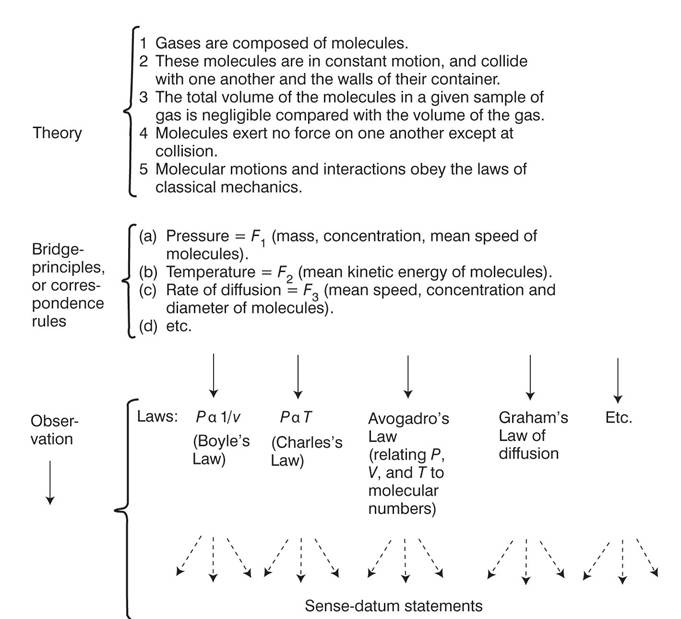
This sort of role for theory in scientific explanation is represented in the ‘hypothetico- deductive' model (see Hempel 1966). In this model, a ‘microstructure' of theoretical entities and their relationships is invented to account for observable, macrolevel patterns. The statements describing the microlevel entities and processes are the ‘hypothetical’ aspect of the theory. As we saw, empiricists tend to see the process of invention as beyond rational analysis. However, once the theoretical hypothesis has been arrived at, statements describing the phenomena to be explained by the theory can be deduced from the theoretical statements. This is the ‘deductive’ aspect of the theory. If the theory is true, then the truth of statements describing the phenomena to be explained follows with necessity. Figure 3.2, a diagram of the kinetic theory of gases, represents a simplified version of the physical theory which uses certain hypotheses about the molecular microstructure of gases to explain observed patterns in their behaviour at the macrolevel.
Key
'F' means ‘function of,, in the sense that terms so related have a definite quantitative relationship to one another such that from known values of one, corresponding values of the other can be calculated.
,P' is Shortfor ‘pressure’, ‘7’ for ‘temperature’, Vfor ‘volume’, and 'μ, for ‘is proportional to’. Arrows represent the direction of deductive inferences. Arrows drawn with broken lines indicate a further set of inferences which are insisted upon by strict positivists and Phenomenalists.
Figure 3.2 The Hypothetico-Deductive account of scientific theories: the kinetic theory of gases as an example
Source: Benton (1977, 2015: 64).
There are several points to notice about this model of how a theory works. First, some of the statements which go to make up a theory are known to be strictly speaking false, but represent an ‘idealization’, to which real entities and processes approximate more or less closely (in this case, statements 3 and 4 in the figure are of this kind). Many scientific laws are idealized abstractions of this sort, and so are a long way from the empiricist view of them as generalizations from observation. There are interesting parallels here with the abstract ‘ideal types’ employed by Max Weber, or the assumptions made about ‘rational actors’, in some theories in economics and political science (see Chapter 5). Such idealizations give rise to questions about how they are to be tested or evaluated, given that they are intended to be counterfactual.
A second point is that, on the hypothetico-deductive account, theories can be used only to deduce statements about observable patterns if definitions are provided to link the concepts in the theory with the concepts used in the description of the phenomena to be explained. In the case of our example, these include statements (a) to (d) in the figure, and they state connections between the microstructure of gases and macroproperties such as temperature and pressure. These ‘bridge principles’ can be interpreted in different ways. For strict empiricists they may be seen as merely formal rules for translating theoretical concepts into empirical ones, and which do not commit the scientist to belief in the reality of the ‘entities’ hypothesized in the theory. Alternatively, the bridge principles themselves may be understood as containing substantive knowledge-claims in their own right. The nature of the quantitative relationship between kinetic energy of molecules and temperature, for example, is something that has to be discovered - it isn’t just a matter of defining terms.
In other sorts of examples, the relationship between the macro- and the microlevel is more complex. In developmental biology, for example, there are assumed to be links between genetic constitution (genotype) and the characteristics of the developing organism (phenotype), but extremely complex interactions between these two levels of biological organization are involved, such that the representation of the links between them in terms of ‘correspondence rules’ would be inappropriate. In part, the difference between the two sorts of case is that processes at the macrolevel are active in modifying the behaviour of entities at the microlevel (that is, the genetic level), as well as vice versa. In part, the difference has to do with ‘emergent properties’ or power which living organisms have which are not possessed by genes or genomes.
In general, the relationship between theoretical statements and descriptions of the observations the theories are attempting to explain is a controversial area in the philosophy of science. What is at stake is the relationship between different levels of analysis, and therefore the status of the different disciplinary specialisms which focus on each level. Empiricists tend, as we have seen, to be resistant to any scientific theorizing which gets very far from what can be directly observed. They are thus committed to a rather flat ontology, in which the world consists essentially of the sorts of things and patterns which can be observed. In opposition to this tendency of thought are various sorts of ‘realists’ who are prepared to accept that one of the achievements of science is to discover whole categories of entities and processes not available to ordinary observation. We will return to this topic later (Chapter 8), but for now it is worth making a distinction between two sorts of realist. The first sort sees scientific explanation as moving always from the macro to the micro. Things are to be explained in terms of the parts of which they are made, and the parts in terms of their parts and so on. This suggests that there might be an ultimate stopping point when we get to the most fundamental particles and the laws governing their behaviour. In principle, the behaviour of all the higher levels of complexity in organization would be explicable in terms of these basic building blocks of the universe. This is a kind of scientific metaphysics, sometimes called ‘physicalism’, and is an example of ‘reductionism’: the attempt to ‘reduce’ phenomena of belonging to different levels to a single, fundamental level.
However, another sort of realism can accept that science does, indeed, reveal evermore fundamental layers in the physical structure of the world. But once this has been done, it does not at all follow that everything about the higher levels of organization can be explained in terms of the lower. On this view, each level has its own particular features and can be studied to some extent independently of theories about levels ‘above’ or ‘below’ it (see Rose 1997 for an example of this sort of realism in opposition to genetic reductionism in biology). So, for example, it might be argued that chemists can get a long way in studying the ratios in which different elements combine to form compounds, and the properties which result without referring much or at all to molecular and atomic theory. Similarly, students of animal behaviour can develop their science without knowing much, or anything, about the ways in which genes are involved in the regulation of behaviour.
One way of grounding this claim for the (relative) autonomy of the different sciences is to argue for the existence of emergent properties or powers which are possessed by higher levels of organization but are not deducible from the lower. So, for example, birds indulge in courtship behaviour, make nests and lay eggs. Theories about their genetic constitution may play a part in our explanations of how and why they do this, but genes themselves don’t court, make nests or mate. No amount of study of the genetic make-up of a bird would give you any idea what it was to build a nest or lay an egg unless you already knew. Such arguments are used to maintain ‘anti-reductionist’ forms of realism, which respect the specificity of each level. The dispute between reductionist and antireductionist approaches to the relationship between levels is of great importance for the social sciences. It separates sociological realists such as Durkheim and Marx from individualists such as Weber. The recurrent attempts by ultra-Darwinists to explain human social life in terms of the genetic constitution of individuals (as in sociobiology and, more recently, ‘evolutionary psychology’) are a version of reductionism designed to replace the social science disciplines altogether.
One further feature of theories can be illustrated by the hypothetico-deductive model. This is that the potential scope of the theoretical statements is far wider than the specific pattern of observations they are designed to explain. In our example, a whole series of patterns can be predicted from the statements which make up the kinetic theory. For empiricists, the explanatory power of the theory is a matter of the range of such predictions which can be deduced from it, and the theory is confirmed to the extent that these predictions turn out to be correct.
Explanation and Prediction
This takes us on to the question of the relationship between theoretical explanation and prediction. As we saw in Chapter 2, the symmetry of explanation and prediction is a tenet of the empiricist view of science. The hypothetico-deductive model of scientific theories displays this relationship very clearly. However, what is much less clear is whether this model applies to all sorts of scientific explanation. As we saw, the phenomenon of simultaneous emergence in populations of dragonflies could pose questions of a historical-narrative kind about how and why it came about in the course of the evolution of the species concerned. A relevant theory (but not the only relevant one) in this case would be some version of Darwinian evolution. Darwin's specific achievement was to arrive at a plausible hypothesis about the mechanism which brought about organic change in the direction of closer adaptation of organisms to their environments. To simplify somewhat, his theory consisted of the following statements:
1.In any population of animals or plants, there are many individual variations.
2. At least some of these are inherited from one generation to the next.
3. In any generation, many more offspring are produced than will survive to reproduce themselves.
4. Depending on the nature of the environment in which they live, some variations will be more likely to survive and reproduce than others (‘natural selection').
These four propositions, appropriately formally stated, combined with the assumption that the environment remains stable in the relevant respects, yield the conclusion that those variations which confer enhanced survival and reproductive chances on their bearers will become progressively more common in the population over a series of generations. Cumulative change over numerous generations will eventually yield sufficiently different features for the population to be designated a new species. Darwin's hypothesis is generally recognized as a theory, but it does not hypothesize any theoretical entities. Moreover, it does not lead to any specific predictions about the formation of any particular species, or what its characteristics will be. The widespread acceptance of the theory must be based on something other than successful predictions.
There are several reasons why Darwin's theory cannot be used to predict the formation of particular new species. One is that nature only ‘selects' from among the available variant forms which happen to exist in a population. The processes of genetic mutation and recombination which give rise to these variant forms are not explained in the theory, which simply works on the assumption that they are random with respect to any adaptive function which they may contingently turn out to have. Another reason is that the theory has nothing to tell us about the precise environmental pressures and affordances which may be operating on any particular population at any particular time. In several places, Darwin emphasized the immense diversity of ways in which survival chances are affected by environmental pressures, referring to the face of nature as like ‘a hundred thousand wedges’. He noted that almost nothing was known about this complexity in particular cases.
So, in the case of Darwinian evolutionism, applying the theory to the explanation of a particular case is not merely a matter of applying a law to a description of existing ‘initial conditions’ and deducing the phenomenon to be explained. In fact, all the theory does is to provide some heuristic indications to guide substantive research towards an adequate historical narrative in each case. In part, this much more modest (but still indispensable) role for theory in what might be called ‘historical sciences’ is a consequence of the fact that the mechanism specified by the theory (in this example, natural selection) is only one of a number of mechanisms (for example, mutation, recombination, predation, climate, food supply, parasitism, disease, reproductive isolation, molecular drive, genetic drift and so on), each of which may partially constitute, interact with, determine or modify the effects of natural selection. These other mechanisms may be topics for other, related sciences, requiring complex forms of interdisciplinary collaboration in relation to empirical study for the production of plausible explanatory narratives. In sciences where explanation and prediction are closely related, this is usually because particular mechanisms are naturally isolated from such interactions (as, for example, with the gravitational fields of the bodies making up the solar system) or because they can be artificially isolated by experimental practice. This is usually impossible in the case of historical natural sciences and most social sciences, which is one of the main reasons why explanation in these disciplines is not generally matched by predictive power. We will return to the problems posed by this feature of social scientific explanation in Chapter 8.
Values in Science
As we saw in Chapter 2, empiricists have two basic options for thinking about the nature of value judgements. These can be treated either as disguised factual statements, about, for example, the consequences of actions for the balance of pleasure and pain in the world, or as mere subjective expressions of feeling or preference. The latter, ‘subjectivist’, view of value judgements has been the most widespread among empiricists in the twentieth century, and empiricists accordingly tend to argue for the exclusion of value judgements from science. For them, science is a rigorous attempt to represent the world as it is, using observation, experiment and formal reasoning. The intrusion of the personal values of the scientist would clearly undermine this objective. However, as we saw above, science necessarily involves more than experiment, observation and formal logic. Active processes of conceptual interpretation are involved in all observation; theory construction is an imaginative, creative activity; and the role of metaphor in science commonly involves drawing ideas from the wider culture. If all this is so, how could science fail to incorporate value commitments? One empiricist response to this relies on distinguishing between the creative activity of inventing theories, on the one hand, and the processes of critically evaluating and empirically testing them, on the other. These latter processes are governed by formal rules of logic and methodological rigour which can be expected to iron out biases deriving from value preferences of individual scientists.
The core intuition of the empiricist view is that science should not be about how we would like the world to be. On the contrary, science can make progress only if scientists are prepared to abandon their cherished hypotheses in the face of evidence about the way things really are. Indeed, were science merely a matter of advancing our own wishes and preferences about nature, then there would be no point in doing any experimentation or observation at all.
We can distinguish three different sorts of criticism of the empiricist distinction between facts and values, one of which, however, still preserves what we have called this ‘core intuition’. One line of criticism is to dispute the ‘subjectivity’ of value judgements, and to argue that at least in some cases successful explanation implies moral values. On this view, ‘moral realism’ values are themselves independently real, like the entities and processes studied by science. A second line of criticism insists that cultural norms and values cannot be disentangled from scientific knowledge-claims. Therefore the empiricist image of science as above conflict about moral and political values is an ideology which gives science a spurious social authority. Instead of trying to make science value-free, or pretending that it already is, we should demand that scientists make their value commitments explicit, so that rival values and related knowledge-claims can be openly debated in the context of more democratic institutions for decision-making about technical matters (see Wynne 1996, and subsequent debate in the journal Social Studies of Science).
A third line of criticism, which, unlike the first two, still preserves the core intuition of empiricism, recognizes that the view of science as the pursuit of objective knowledge about the world itself implies value commitments - namely, not to misrepresent the results of experiments, to give serious consideration to arguments against one’s own views (no matter what the status of the person who advocates them), to abandon one’s prejudices when it becomes clear that that is what they are and so on. At a deeper level, many scientists are motivated by respect for and wonderment at the integrity, otherness and intrinsic beauty of the objects of their investigation. This is a dimension of scientific culture which is often missed in much of the social scientific literature on science, but is, as we will see in Chapter 4, emphasized in some feminist approaches to science.
On this third view, then, it is argued against empiricism that values are intrinsically and indispensably involved in science. However, a distinction can still be made between those norms and values which are necessary to and supportive of science, considered as a practice which aims at the production of objective knowledge of its subject-matter, and those values which either are obstructive of this aim or are simply extraneous, and so irrelevant. In the case of Darwin, for example, he was inspired in his student days by the harmonious vision of nature portrayed in the work of the theologian W. Paley. However, his growing recognition of the ‘struggle for existence’ through which natural selection operated led to his reluctant abandonment of this vision: ‘What a book a Devil’s Chaplain might write on the clumsy, wasteful, blundering low and horridly cruel works of nature!’ (quoted in Desmond and Moore 1992: 449). Clearly, Darwin would have wished living nature to have been kinder and more harmonious than it was, but it is arguable that his commitment to the values of scientific investigation required him to give up such comforting images (note that Desmond and Moore take the more conventional view that Darwin's ideas were shaped by wider Victorian cultural values).
Of course, this distinction between those values which are intrinsic to scientific practice, and those which are not is a controversial one, and it is very much an open question whether it can be applied in a defensible way when we come to consider the role of value commitments in the human social sciences.
More on the topic Some Problems of Empiricism:
- Some Problems of Empiricism
- Further Problems of Positivism
- Benton T.. Philosophy of Social Science: The Philosophical Foundations of Social Thought.Bloomsbury Academic,2023. — 329 p., 2023
- Empiricism and the Theory of Knowledge
- CONTENTS
- Positivism and Sociology
- Until the early 1960s philosophical thinking about natural science in the Englishspeaking countries was dominated by the various forms of empiricism, together with Popper's Talsificationist' approach.
- Locke's way: Justification can be less than certain
- Rules and Reason: Science
- Facts and values