4.1. The heuristic model of the (generic) state's social organism
The idea of heuristic model construction of generic social organism is reduced to the integration of a human individual into organic unity, according to our definition - a “potential social world”, and the society named before as “semantic continuum”.
For an implementation of this operation it is necessary to define the initial conditions of projectdesigner development of social organisms modeling problem.In addition, organic unity of social relations is the ontological basis of social organism, for it is already familiar to the sciense it and it doesn’t need further grounding.
As far back as in German ideology, as we remember, it was mentioned, that in the process of production “ it was necessary to enter into the mutual relations with one another, and exactly this their practical intercourse “produced and everyday reproduces existent social relations” [119, 411]. The definition considers their relations, as an immediate object.
In other words, social relations as well as economical, political, legal, etc. ones (according to Lenin, material and ideological) establish in the process of practical intercourse of people, but immediately acquire existence, independent from individuals. Underlining this dialectics, V. Lenin says, that people “enter into communication” in the process of mutual practical activity, that “there establish also” certain public relations” [110, 343], however, people themselves do not understand how these relations become subject to the character of these relations.
Between the intercourse and the social relations there is a certain interference, but it is not described in the notions “form” and “content” or “personification”, and rather in the the notions of “process” and “product”: communication is a real activity which developes in the process, and social relations are a type of tiesof its participants, which become the structure of society and, being formed in the process of practical intercourse of people, predetermines it.
According to this, “the structure” and “the function”, which called it into being, are the basic instrument of cognition of the social whole morphology.
Through them a value and consequences of all possible processes are determined for the whole system. Hegel (Science of Logic) emphasizes that the subsequent step from it is, first of all, segmentation. For this movement only some immanent principle would be needed, i.e. it was necessary to begin with the general and the concept [50, 265].
It is the realization of such approach, which is the”structural functional analysis” of the social organism. That is why for T. Parsons, for example, a structure is a starting point for a dynamic analysis, an analytical, hypothetical construction, which describes some invariant, according to which the observable complex of relations between the subjects of action (collective and individual) can be fixed and traced in all transformations.
Consequently, from the analysis of the sociological thought it becomes clear, that today there is no unity of views as to the social structure [3, 16-17]. We will present the most typical views as to the question under consideration. Some authors conceptualize the structure in the the form of theory, postulating regularities and thus assuring the orderliness of empirical observations, other authors consider a social structure to exist in external empiric reality and to be not a theory, but what is necessary to explain with the help of the theory.
From the theoretical inheritance of E. Durkheim it follows, that fruitful is the distinguishing of, at least, two aspects of the concept of structure. One of them includes structures which can be revealed in the object of research - either it is a society or it is a language or myths, either they are perceptible or material, such as the distribution of population into scale of age and morphology of city, or they are abstract and invisible, such as the language grammar. The other concerns the structures of consciousness, i.e.
the correlation between a structure and structuring. The question is, in what way we arrange reality, and in what way it arranges us. To reveal those mental or social structures, which control spiritual experience, is one of the cognition theory good prospects. E. Durkheim includes in it both: the social theoretical question, or possible well-regulated society, and the question, put by the cognition theory, how a well- organized thinking appears and tries to answer them with its own set of sociological concepts.Quite a number of authors define the structure from the point of view of status or position differences, which influence the social relations, along with the authors, defining a structure through the terms of social relations models, from which the status differences follow. From the point of view of certain scholars, the structural sociology distinguishes such merely formal aspects of social life, as quantity, differentiation and hierarchy, fully ignoring the rich in content side of the matter, while in opinion of the others, the mac- rosociological structural researches concentrate attention on the detaching features of historical social systems in the certain periods of time in the certain regions. Integration, the order and coinsidense of ideas are the determinant attributes of a social structure, which are distinguished by some authors; the differentiation, the contradiction and the conflict, are regarded by the others as the decisive factors.
However, in all these diverse views on the social structure it is possible to find out a common denominator. It consists in the fact, that the social structure is identical to the emergent properties of the complex of its constituent elements, i.e. the properties, that do not characterize separate elements, which make up a structure itself, and the complex of elements, of which structure is built. From the analytical point of view it is not the same, as the complex of structural elements is a mere automatic complex of elements, while precisely a structure, to the widest extent, is determined by the interrelations of these elements, including both: the positional relationship and the side effect of these elements, and direct relationship between them.
Not to see this difference means not to see the wood for the trees [3, 17]. Most typical here is an example with the wood, in which trees grow in disorder, and the park, in which plants are placed according to certain order.As soon as the relatively stable standards of interaction between subjects, which occupy different status positions, appear, i.e. as only the interactions “institutionalize”, from this very moment it is possible to talk about the existence of a “social system”. This term is used to denote any organized either mikro- or macroform of interaction. The ideal structural result of institutionalization expresses the complete “institutionalizational integration” described above [148, 195-196].
In order to create an image of the social organism, it is necessary to see it as a system of specific clumps (clusters) of intelligible matter - of functional organs.
From a formation process it follows clearly, that in a model it is necessary to show the individual and the society. The distribution of the social organism to subjective and objective forms we call ingredients. In other words, one part, which consists of attributive properties of the individual, is present in a social organism, and the other part consists of the properties of the society.
If a social organism appears and functions stedily as organic whole, which consists of two opposite ingredients, that was described above, then an element is to be treated as their smallest segmentation limit as a functional system.
From the above theoretical material follows also, why it is necessary to differenciate four basic types of elements here: economic, anthropological, political and ideological. The elements in their pure form are possible to be met only in the ingredients. In other words, the elements exist either in a subjectivized form, if the question concerns the structure of the individual, or in an objective form, if the question concerns the society.
It is natural, that the substance, which is in a subjectivized and objectivized state follows this law.
Then a change takes place in the morphogenesis of the social content, and we come across a perfectly new morphological unit - the component of the social organism or intraspecific form of the field life.Here it is particularly important to underline the fact, that the element of the social organism isn’t identical to a component neither for its structure nor for its functions. The component is more complex, than the element, because it contains two elements: of the subjectivized and objectivized origin.
The interference of the same elements, as far as they make two integral parts of the living social organism, generates intraspecific life in the structure of a whole. But the life exactly is the process of the substance self - motion, which exists in the form of the subjective and the objective.
Consequently, the component of a social organism is an integration of the same subjectivized and objectivized elements, interacting with each other. Such social creation, as opposed to the element of the organism, although is composed, seemingly, of the social material too, actually has a complex character, as far as the synthesis of the subjectivized and objectivized forms of the all four subspecieses of the same social relations acts in it as a basic working substance (actuating medium).
In order to get convinced of the fact, that in the real life a social organism consists of components, and those, as far as they are concerned, consist of two dissimilar halves of the same element, it is sufficient to read the works of K.K. Marx, dealing, for example, with the problem of production. Here K. Marx points out, that the productive forces, which structurally consist of the labour force (to our mind, it is a subjective economic element) and of the means of labour (i.e. an objective economic element), make the basis of the social organism.
In support of the same principle of the “eqipping” of the social organism political component, the theoretical propositions, for example, from the well-known work of Hegel The Philosophy of Law affirm convincingly.
Here Hegel actually indicates the fact, that only organic synthesis of subjectivized and objectivized forms of political material or of in proper way equipped political state and of people’s mentality, appropriate of it, provides the citizens with effective life and with the power of one or another country. The necessity in idealness is, - in Hegel’s opinion, - the development of the idea inside itself; as a subjective substantiality it is the political mentality, as an objective one it is, as opposed to the former, an organism of the state, respectively the political state and its structure [54, 291].And further he directly underlines, that the morphological substratum of the political body consists of the subjectivized and objectivized material - human mind. In particular, he (Philosophy of Law) writes that the unity of willing and known to itself freedom exists, foremost, as a necessity. The substantive here is as a subjective existence of individuals; but the other type of necessity is an organism, and it means that a spirit is a process in itself, dividing in itself, making differences in itself, trough which it realizes its circulation [54, 291].
Except for components of a social organism - functional organs - two more types of people co-operational products as residual of cultural genesi, which are rejected by people to the environment as an inheritance of older generations to the younger ones,are the subject of parametric description. One of them is of material and the other is of spiritual origin.
More detailed study of technology and science scope as the phenomena of organismal form is required, in order to get convinced of the fact, that their inclusion in the heuristic model of the social organism is not a voluntaristic decision. “The error of Lilienfeld as well as of other representatives of psychological, biological and preceding physical and mechanical schools, consists, in opinion of Greyef, is in the fact, that he partly ignored the fact, that the social organisms are themselves a complex complement of the phenomena, including the phenomena of physical scope, without taking into consideration of which, they remain fully incomprehensible” [63, 181].
In order to build the heuristic model of the social organism, it is necessary to define functions in the given organic whole for each of the mentioned before units of philosophical analysis: of the ingredient, of the element, of the component and of the products of alienation.
It is related to that fact, that a function lies deeper than a structure, it explains the genesis of the structure. T. Parsons justly pays attention to this circumstance. The sense, which can be seen in the Parson’s statement of the problem is reduced to that a “structure” covers visual, more or less easily determined social relations (for example, an official or “formal” organization of social institutes inside a “global society”), while a “function” plays the role of a heuristic stimulator, which directs the researcher’s attention beyond the surface of the “structural” phenomena, in order to search for their hidden, unnoticed before relations, inversions and side effects for both: the more extensive whole, called the “system”, and for its parts.
Due to the determination of the specific function of each of the mentioned before morphological units, it is possible to show as a dry skeleton of economy is covered with the living flesh of the socio-political forms, and afterthat - and it is the most interesting and the most exciting part of the task - of human ideas, aspirations, ideals. In other words, due to the determination of the functions of the morphological formations, we aim to show, how “it is possible to say, that a dead matter gets into the researcher’s hands, and from his hands must appear a complete life organism”.
While analysing the functions of the components one should remember, that the latter appear only in a moment of the individual’s interrelation with the society.
But this interrelation of subjectivized functional organs, existing in the structure of the individual, and objectivized functional organs that are in the structure of society, in this case results in a generation of a functional organ from the functional organs of personality and society
The function of formation (creation) is not only the force which puts together components of social organism, but above all secures its vitality. That’s why, specific action, which is delivered by any functional organism into system, should be defined correctly. In this case, the construction of such unity can be reproduced, i.e. can be transformed into the organism, even more, the mechanism of its movement can be revealed.
At the same time, it is the final step of the spadework to make heuristic model of social organism. In this case, guarantee of effective social modelling is a “join” of functions. It follows from reciprocal dependence of components in the system. As E. Durkheim writes, inside the individual organism any organ, though it is in the antagonism with others, cooperates with them [See: 71, 201].
According to T. Parsons, the structure of social system can’t be deducted directly from the system of coordinates “figure - situation”. Here the functional analysis of complications, which are brought by the interaction of many subjects of action, is needed. Therefore, heuristic model of social organism appears as though in itself, when main functions of ingredients, elements, components and products of cultural genesis are defined as parts of entity. In this connection it is worth studying each type of social formations cited above in succession, which forms the structure of the social entity.
As cited above, there are two ingredients. One of them is personality, the function of which consists of intellectual energy production for the creation of social content and combinatorial analysis within limits accessible to human intelligence. E. Durkheim (The Division of Labor in Society) indicates directly the latter writing that a person performs a special function in social organism, so the person should get used beforehand to play the role of organ. Education is needed for this purpose as well as for her/his getting used to the role of the person [See: 72, 373].
The second ingredient is society, the main function of which is the maintenance of the process of production and reproduction of a single intellect and unlimited accumulation of its total power. Studying the function of society Fr. Giddings writes that the function of society consists in the development of conscious life and in creation of personality: it actually exists for this purpose. It is conscious association of similar creatures, which develop moral nature of a person.
The whole literature and philosophy, religious consciousness and social policy are obliged to exchange ideas and feelings; the type of ientity develops under the influence of the literature and philosophy, cult and policy on every new generation’s mind. So, we can say that the function of social organization, that the sociologist must always bear in mind, consists in personal evolution through higher stages until it reaches the ideal which is called the mankind. Now functions of the elements in a structure of the entity should be pointed out. As it was mentioned above, there are four elements: economic, anthropological, political and ideological. They do not replace the components. According to the form there are two elements: subjective, i.e. which is situated in the structure of personality, and objective, i.e. a body which constitutes a society. The function of subjective elements is to include man’s personal identity in the society. The function of objective elements is, vice versa, to attach the society to the structure of personality. Therefore, when we talk about functions of subjective and objective elements, we mean that each of them is called for ensuring the effective development and operating the component of the same name.
Moreover, elements of the same name, i.e. which are in the structure of man’s personal identity or society, in another plane interact ensuring the operating and development of social organism in its fundamental entirety. Thus, functions of these elements and functions of components can’t be put together.
Functions of components differ from other social formations. As mentioned above, there are also four components: economic, anthropological, political and ideological. In order to define functions of elements we were talking about the movement between subjective and objective forms of the same type of intellectual material. So, now we have to deal with its transfer into completely another plane. It consists in transformation of intellectual material according to the chain: economic - anthropological - political - ideological. These transformations are fully described in two fundamental works of V. Barulin [See: 9, 13].
The function of each component consists in other components’ service in order to give the social organism systematic qualities, on the base of which accumulation of qualities of the social entity takes place. In addition to that, the analysis shows that components mentioned above are integrated into social organism on the strength of strict reciprocal dependence.
In this case it turned out that the main function of components is divided into internal and external subfunctions. It is strange that scientists have not paid attention yet to duality of functions of functional organs on this level. For example, internal subfunction of the component consists in transformation of economic, anthropological, political and ideological social material from subjective formation (element) into objective, and vice versa. These are sense and purpose of proper or internal life of a component as an organ of social organism. The point is that it is a transformation like: “subjective economic - objective economic”, “subjective anthropological - objective anthropological”, “subjective political - objective political”, “subjective ideological - objective ideological”. These are well-known, especially to psychological science, correlations like: “the function of workplace - social role of worker”, “need - motive”, “interests - aims”, “values - ideals”.
If we rely upon functional organs there are such internal subfunctions as: economic - transformation of workplace functions into social roles of the worker, and vice versa; anthropological - transformation of needs into motive, and vice versa; ideological - transformation of values into ideals of personality, and vice versa; political - transformation of interests into aims of personality. In further studies of above-mentioned reciprocal transitions certain contradiction can be found: social roles and functions of worker can be interchanged. But it changes nothing in general problem solution. Such specifications are important and even necessary for understanding of the point of the matter.
We proceed from indication of T. Parsons. He writes that for the majority of analytical aims the most essential unit of social structures is a role, not a person. The role is such organized sector of worker organization, which determines its participation in the process of interaction [See: 148, 191]. According to T. Parsons, the role expresses “procedural aspect”, i.e. that the worker performs in relations with others and in the context of its functional importance to social system.
External subfunction is more complicated and comes to qualitative transformation of social material, which moves in another plane. There are such transformations as: “economic - anthropological”, “anthropological - political”, “political - ideological” and the opposite chain of transformations like: “ideological - political”, “political - anthropological”, “anthropological - economic”. Such transitions have been already mentioned by scientists, and some of these transitions have been already described in philosophic and sociological literature - transformations on the side of society: needs - interests - values [See: 74]. But on the part of man’s personal identity there are other transformations, such as: ideals - aims, motive-action [See: 214].
External sub-functions of components which do not have reverse motion, as transformations have irreversible character, include:
- in subjective ingredient (structure of the person) transformations;
- according to the algorithm: ideals - aims - motives - roles, actions;
- in objective ingredient (structure of society) transformations according to the algorithm: functions of workplaces - needs - interests - values.
If it is imagined in section of separate components according to our hypothesis transformations follow the chain like:
- economical: on society side - transformations of the content of physical world into the system of workplaces’ functions; on the side of person - transformations of person’s activity into the system of worker’s social roles;
- anthropological: on society side - transformations of workplaces’
- functions into needs of person; on the side of person - transfor
mations of person’s aims into the motive of their behaviour;
- political: on society side - transformations of person’s needs into their
- interests; on the side of person - transformations of ideals in the aim of the person;
- ideological: on society side - transformations of interests into values of
- the person; on the side of person - transformations of senses, as the content of spiritual world, into ideals of the person.
In order to reproduce completely the form of social organism, in addition to functions of elements, components and ingredients, to denote the role of two above-mentioned products of cultural genesis is needed.
Products of cultural genesis, which settle as physical (material) and spiritual (semantic) formations, have rather complicated functions. They don’t have just double or triple functions, as it was with components, but at least in a sequence higher, as they also ensure the transition between phases from personality to society and back. The process of mediation exists owing to availability of special mediators. We study the latter ideas and things. In this we see the main function of products of cultural genesis.
After all, products of cultural genesis are, on the one hand, continuation of inorganic human body, on the other hand - means, which intensify social possibilities of the person. Hiderbrand affirms the complexity of understanding of structural functions of these formations. During the original analysis of similarity between the conception of F. de Saussure’s linguistic structure and the conception of K. Marx’s economic structure, Hiderbrand establishes parallelism of linguistic dualism, which denotes and means economic dualism of work and salary [See: 3, 11].
As formations of local character they, undoubtedly, have their own life. In future more than one research can be dedicated to the study of the peculiarity of this life. Nowadays philosophy of technology, which is developed by German scientists, works at it. We have grounds for attaching to physical formations, which appeared in the course of cultural genesis of substance assimilation in social organism, the function of accumulation and preservation of tools. It is not a pure organism, but its inalienable organ. In a living body the system of accumulation and preservation of fatty products plays the same role.
Here the living person disappears, leaving a space for machines. G. Hegel and K. Marx said about it well. G. Hegel (Philosophy of Law), for example, writes that general and objective in a labour consists in abstraction, that forms the specification of means and needs, and owing to it specifies production and creates division of labour. The labour of the person is simplified by division, and as a result, skills of the person in their abstract labour and an amount of products produced by them increase. Moreover, this abstraction in the field of skills and means ends up dependence and relationships of people in satisfaction of other needs, turning it into a complete necessity. Abstraction in production makes this labour more mechanical, and at last it appears that the person can give their place to the machine [54, 239].
The main function of physical formation has also subfunctions. The reason for dividing main functions into subfunctions is that the formation has features of the product and productivity as attributive characteristics. The introduction of robotic technology or other systems of machinery is a good example of manifestation of this physical formation’s life as part of social body.
When physical formation keeps characteristics of functionality or productivity it ensures transformation of the material, which is converted in the mechanism of social organism, from man’s personal identity to society. Existence of this social formation is connected with the formation and functioning of industrial relations’ system, which is instrumental means of ensuring such transformation.
All above-mentioned about the main function and subfunctions of physical formation ought to be referred to the spiritual remnant of cultural genesis. We are inclined to see its main function in the same as it was in the previous case, but with the only difference that spiritual products and processes are assimilated. We consider the beginning of informational civilization age as “ripening” of this type of social product.
As to the division of its main functions into subfunctions it should be mentioned that one of them is connected with ensuring the transition from society to personality and in the system of ideological relations it ensures instrumental means of transformation; another subfunction, as in above-mentioned case, is passive by nature and its essence consists in accumulation, preservation and utilization of spiritual products - senses which make the semantic continuum. In addition, independent existence of spiritual product can be studied in terms of artificial intellect.
When spiritual formation preserves productive characteristics it provides with transition of movement impulse and conversion of material into the mechanism of social organism in the direction from society to personality.
The existence of this social formation includes cultural relations, which according to the structure and functions in the system of spiritual production are similar to industrial relations. So, it makes sense to talk about production, exchange, distribution and use of cultural products. That’s why, the studying of the notion “ideology” by L. Althusser meant the revolution in new Marx’s feministic science. It should be said concisely that “many people joined thesis of Althusser, which said that ideology possessed the physical existence [143, 242].
Studying the formation of social organism as self-developing completeness it is very important to examine the development of regulative forms. The processes organization reaches relatively persistent structures - correlations between social relations: economic, anthropological, political and ideological.
It is connected with that “from outside” the process of social organism formation is the feature of its production or creation, but “from inside” it is the process of organization - activation and regulation of the movement of its components.
Functional organs, called components, are local social organisms. They can’t be understood without taking into consideration that each of them leads its own life. So, the functional supplement takes place. The individuality of local organisms’ life consists in their including tribal social organism in specific universal levels. There are good reasons to consider that anthropological component includes the person in the first nature, economic component - in material production, ideological - in spiritual production, and, at last, political component includes a person in the system of self-regulation of the universe.
On this basis some components, serving for other components, form brand-new connections and relations in social organism. Thus ecological, industrial, cultural and organizing connections appear. Ecological, industrial, cultural and organizing relations appear between specific social organisms.
Now social body became structurally more complicated. We should mention that components in such system must be called organs of social body. It means that, as Hegel (Aesthetics) marks, each well- organized creature will make an entity, single and closed system, all parts of which fit together and contribute to the same final activity by their correlations. None of these parts can change without changes in others; so, each of them, taken in itself, must point to others [59, 397].
Each component has reach and relatively independent inner existence within the limits of social organism, which consists in transmutation of subjective into objective and back. Formation and sense of functioning of internal organs of social organism or organo-cenos- is are built exactly on this inner organism’s transition of elements.
It is not difficult to make from above-mentioned elements, components, ingredients and means of correlative mediation - mediators the consistent system, which can operate independently and effectively. V. Barulin, describing thoroughly functional, cause and effect connections of main spheres of society, approaches the idea of heuristic model of social organism [See: 9, 202]. According to abovementioned heuristic model of social organism can be suggested (Fig. 4.1).
Such model should become an independent object of philosophic studies because it can find out a lot in the functioning of social life. But we confine ourselves to general remarks.
The objective ingredient, being at the bottom of heuristic model, plays a positive role trying to preserve a completeness of social organism. Society discovers here its conservative qualities. Subjective ingredient, being at the top of this model, plays negative role as it aims at its destruction. Personality, being a revolutionary force, tries to make this completeness lose its balance by fluctuation.
So, we obtained an ideal type of tribal social organism. According to Weber the ideal type “is theoretical construction (of the notion or the system of notions) which represents specific aspect (process, moment, connection, etc) of the social reality in individual peculiarity, logical consistence and rational accuracy, i.e. in maximal suitability for its inner “rule”, principle, etc.
The consumption of ideal type (but not the term itself) belongs to Weber, who, details with its help Rickert’s opinion that the object of historical sciences (“sciences about culture”) is constructed on a basis of attribution to the value.
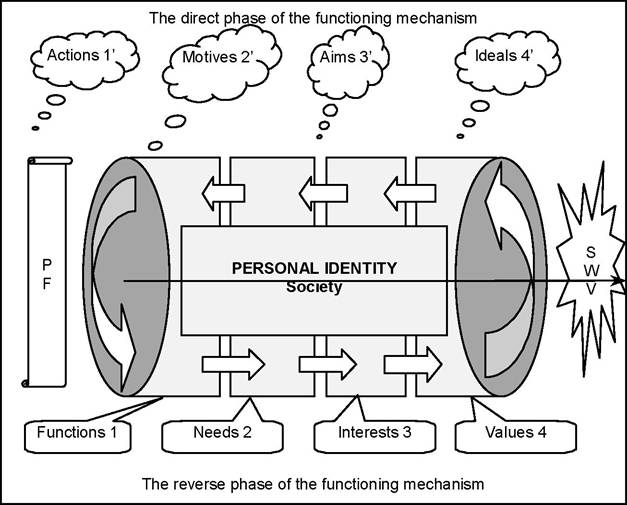
Fig. 4.1. The heuristic model of generic social organism:
1,- 1’ - economic component; 2’- 2’ - anthropological component; 3’- 3’ - political component; 4’- 4’ - ideological component; PF - productive forces; SWV - scientific world view
The aim, which is achieved with a help of ideal type, is to suggest “purely logical” model, which must be researched by social reality. On the one hand, it would help with accurate extraction (articulation) of this aspect, but on the other hand, it would serve as peculiar “standard” through comparison, from which departure measure, or vice versa, relative approach of researched empirical reality to it could be judged [See: 148, 69].
On more meaningful level the dilemma of choosing a fundamental point of view on relations between individual and society “arises as “a problem of order” which forces to choose means of conceptual transition from individual actions to organized social systems. For example, “order” can be interpreted as the result of negotiations, symbolic interaction between individuals or as direct result of collective determination, taken as independent reality (as “collective reality” of E. Durkheim), etc [See: 148, 173].
Under the existing system, behavior of the person or social connections is estimated not only on the basis of its influence on the quality of system functioning. “In assessment of functionality of system action so-called “functional systematic problems” play a crucial role. There are initially two such problems: the problem of “distribution” (of tasks, resources, valuable objects, etc) and the problem of “integration” (possible coordination of different system parts). As abovementioned functions orientations are divided into “mechanisms” - processes that stabilize the system of action), and “tendencies” - processes that break system balance and cause changes. In the development of balance idea T. Parsons was not oriented to mechanics, as Spencer, but to biology and physiology, especially to the notion of “homeostasis” of C. Bernard - W. Cannon, rich in cybernetic conception of feedback.
Just as organism can maintain duration of its internal environment in spite of provoking influence of external environment, the system of action can “extinguish” external disturbance (as long as they keep to known limits) and maintain or restore the former balance. Only after theoretical decision of balance problem on structural, functional and dynamic levels “the problem of the theory of social systems change” as “logically final” can be put (T. Parsons) [See: 148, 188-189].
In the well-known Spencer’s formula of global social evolution (social organism. - V.B.) is liable to integration and differentiation, the same as physical world and living organism. It develops from homogeneity and uncertainty of disorganized condition to heterogeneity and certainty of organized condition.
Final reason of all these changes is global balance of energy. Compte used the notion of “social statistics” in purely rhetorical meaning as the name for social order, and the term “social dynamics” as the name for progress. Spencer, remaining on scientific grounds, follows more exact physical notions. In his opinion, social statistics is an investigation of social forces in balance. Perfect balance has never been achieved in reality as a result of changes, which is the result of energy balance between society and environment. Nevertheless, the reality is that static and kinetic aspirations are equalized, and as a result of it there is unsteady equilibrium in society as in Solar system or in a living body [See: 3, 197].
So, as a part of social entity components interact, and they have specific functions towards one another. If reciprocal transition of a subjective element into an objective one produces specific form of social life, reciprocal transition of subjective elements of different names or substructure of personality and reciprocal transition of objective elements or spheres of society produce a new value: aggregate components, producing a mechanism of functioning and developing a social organism.
Formation of the social organism’s structure is the process which organizes itself as it is determinate by evidence. External conditions can facilitate its running or, on the contrary, they can prevent it. On this basis social organism should be studied partly as creation of unconscious evolution, partly as a result of a conscious plan. As an organism it can go through all phases of evolution [See: 3, 315].
During evolution social organism strives for ideal form, staying in which allows universal social phase to reach the main function in its self-movement. Dynamic function of the field “directs” the process of its self-organization. This dynamic function appears in the process of weak electromagnetic interaction between people. The field of social body deployment is as reasonable as algorithm of self-deployment of vegetative and animal organisms. Here we should deal with ideal form of social organism.
The function of ideal form relative to social life consists in ensuring the ontogenesis of social organism, i.e. ensuring valuable discovery of attributive characteristics of field or social life in existence. The notion “ideal form” is used carefully in national philosophy and science. On the one hand, we can explain it by domination of materialistic views on the world, on the other hand it can be explained by ideological negativism of ideal world as spiritual product of independent origin. In addition, there is another reason because of which we don’t perceive an ideal form. Though, in practice, it is the main reason. The main point of this reason is that modern science and philosophy fit the beginning of a search of the principle for explaining coordinated behavior of developing organism, or structure, and also coordinated action of separate parts of functional organ or the whole organism.
Now, on coming out on field life the recognition of availability of ideal form is a logical step. It means that elements of the living entity are disposed according to “force lines” of constantly changeable field.
No matter in which of these fields (and it can be the field of grace forces, cultural field, spiritual field, the field of conscience, the field of chronotopos, the Semantic Universe and noosphere) the thought about the role of ideal form materializes in the process of self-deployment of social organism it makes one and the same function - the function of spiritual formation.
B. Kuzin sees the main meaning of the field principle in its explanation of coordinated behavior of developing organism or structure, and also coordinated action of separate parts of functioning organ or the whole organism. As is generally known, biological fields are quite eternal. Objects and the character of each field, its configuration, centre and vectors can be described and showed. It should be mentioned that the personality is a functional organ derived from biological substance - a person.
In this case A. Gurvich found out that elements of developing whole seemed to strive for a particular state. As if the organ’s form is set and it exists before organ’s developing. In other words this form has virtual character. But it is fair not just for the final form of the organ, but for the form on any stage of the development. That’s why A. Gurvich named virtual form, which defines the result of the development process at any of its moment, as dynamically reformed morph. By this he introduced the element of teleology into the initial formulation of field principle.. According to A. Gurvich dynamically reformed morph is preceding image, idea, aim.
There is an important question about what functions these components of social organism have when considering them as links of the mechanism of social organism’s self-movement. V. Barulin investigated this question from two perspectives: functional, causal and consequent. For example, from the perspective of causal and consequent links of spheres he defined that “everywhere and always, on any historical stage of development the physical sphere is the main determinant of all spheres of social life” [9, 202].
The question with the main element of functional links of spheres is settled with more difficulty. It splits and taking into consideration that logic of theoretical analysis of functional links indicates that spiritual sphere must be the most important as it has the biggest potencies of functional influence on other spheres, he writes the following: “political sphere occupies the central place in functioning of social organism in class society” [9, 203]. We agree with F. Engels who considered that in mature state the spiritual sphere would become the leading one as a person before the beginning of any production would use theoretical results of this step.
Our vision of the mechanism of self-movement of state’s social organism is that we distinguish anthropological component as initial link, ideological and theoretical component as intermediary link. The role of final link plays technical and economic component, and finally political component performs as controlling link. Its “working body” is knowledge, which transforms in it from senses into the form of man of iron.
Therefore, owing to structural and functional analysis we made an image of a tribal social organism. All functional organs, which appear and operate in person’s structure as well as in the structure of society, are put in this model into organic unity. Besides, it is shown that on the stage of functioning social body reaches the effect, making new functional organs from available functional organs. They should be investigated in the course of understanding of phenomena of ontogenesis and phylogenesis of social organisms’ family. Our next step consists in studying social organisms’ family as organic unity.