4.2. The social organism as the equipotential system of functional constructions
Morphological analysis of social phenomenon showed that according to organizational conditions, which were joined according to the principle of “Russian doll”, had the form of organism.
It means that we deal with equipotential gigantic system. Using a metaphor it can be said that the person being a hologram of the Universe, arranges social organisms, in which this person participates as a reason according to the same principle. The picture becomes more promising if potential social world is studied as the product of person’s brain functioning. This hypothesis is confirmed by researches of Westlake, who proved the model of brain functioning on the basis of using the analogy with optical holographic processes. It is established that characteristics of division is inherent in only holographic processes. This characteristic, which is specific for each type of holograms (which is described in transformation of Fourier) shows that all information written on the whole hologram can be completely found in any small part of the hologram. Taking into consideration that the person uses exactly non-localized information it is clear fact. In this case holography is the only known instrument of similar realization with usage of distributive characteristics.From philosophic point of view undoubtedly interesting is that owing to its inherent division non-localized information at the same time can be reproducible in the brain of many people. Another proof in favor of our hypothesis of holography as the principle of coexistence of social organisms is availability of so-called standing auto waves in the structure of the person. Such waves bear the substance in physical component, energy - in psychic field, and information - in the brain. Owing to people’s ability to use non-localized information any of its part reproduces “unity”. The hologram of social forms, which broke out, at the same time can be on all hierarchical levels of universal organization.
There is no doubt that social life is a multistage phenomenon and it develops as a multitude of social organisms. We have already shown that social organism is of many faces. Its forms are not similar.
This thought can be proved by the well-known Lenin’s statement: “deeper analysis shows that social organisms differ from one another as animal and vegetative organisms” [109, 167].
At the same time it means that for completion of morphological analysis of social organism its levels and sublevels must be studied. It must be found out which physical substratum presents social life on each of these levels.
We’ll start with extraction of levels. There are three levels: pre- organic, organic and above-organic.
Preorganic level includes atomic, molecular and organic sublevels. We’ll characterize them concisely. We link up atomic sublevel with the person, in above-mentioned structure of whom potential social world is contained. It is needless to repeat what we have already studied while analyzing the morphology of personality [See: 21].
Molecular sublevel, which follows from our analysis and available literature, should be connected with the family. The morphology of the latter needs social investigation, but as the family is irreplaceable in the structure of anthropological component and is a generally recognized base of state constructions, to which physical and spiritual production is oriented; it means that it can be accepted as a molecule of social body.
It is important to emphasize again the topicality of K. Marx’s conclusion of a place and role of relationships between man and woman, in which “it is revealed to what extent natural behavior of the person became human behavior, or to what extent human essence became natural essence for them, and to what extent their human nature became a nature for them. From the character of this relation it follows to what extent the need of the person became human need, i.e. to what extent another person as a human being became a need for them, and to what extent this person in their individual existence is at the same time social being” [134, 115-116].
On our behalf we’ll add that family relationship defines the character and the quality the whole complex of social forms. Therefore family in a social organism plays exceptionally an important role and in itself has all its basic elements. All the point is that it owns them in another form. In large families such organism appears sufficiently clear.
Organismic level includes tissular, cellular, specific and generic sublevels. The sublevel of tissular formations consists of incorporeal social microforms, which in practice are accepted to name as social institutions. They are the instrument of social organism tissue institutionalization.
On the basis of the existing definitions of institutionalization process two directions of its understanding come forth. One of them takes behavior or particular actions of individuals as a basis; another one takes behavioral norms, values, standards or their complexes which are already the product of so-called primary institutionalization or, according to P. Berger and T. Luckman, “acquirements and typifications”. The common feature for them is that tissular social microforms functioning is interpreted as the process of arrangement, fixation, “congelation”, formation of certain constants of individual consciousness or action. Due to it, human activity and corresponding cognitive components are organized into particular established norms and formations.
However, the only significant criterion by which it is possible to distinguish between tissular microforms and other social formations is that this sphere of people interaction, including their interaction into the system of society, forms the basis of its social order. Its essence is the process of vital resources, privileges and prestige allocation, and its institutional forms will be blood relation, marriage, morals, law, power, religion, property.
The sublevel of animalcularproductive organisms comes next. It comes around as the result of particular process, which is called or- ganocenosis.
Organocenosis in a generic social organism can proceed only if there is enough source material suitable for new social formations. Therefore the microworld is such a reservoir in which elementary social micro-formations appear and function to the certain moment as mutants of whom the generic organism creates organs, species and sub-species of social material, which are adequate for the nature and external environment.It is easy to confirm this thesis relying on the existing philosophic-sociological literature. On this subject E. Durkheim (The Division of Labor in Society), for example, writes that collective activity is always too complicated to be externalized by the only organ such as state. In addition, a state is too far from individuals; it keeps too superficial and unsteady terms with them to be in a position to penetrate in individual consciousness and socialize them internally. That is why wherein it makes the common habitat in which people can prepare for co-existence practice, they unavoidably lose contact with it, separate from each other, and society disintegrates at the same time. Nation can support its existence only in case the range of secondary groups is implemented between a state and ordinary people, close enough to the individuals to involve them in the sphere of its impact, thus, involving them in the general stream of social life [See: 72, 33].
Therefore, in the generic frame of society there is the whole class of such social organisms which should be named as primary. They form a specific level in the general frame of society. They account for the function of organocenosis process maintenance in optimum mode. In any case we deal with primary social organisms, which appear to be the elementary living system capable of independent existence, reproduction and development. Such organisms are the basis of all types of social organisms’ structure and vital functions. The tissue of social organism is made of them. At the same time they exist as independent organisms, then we name them animalcular.
The analysis shows that animalcular social microorganisms as part of the whole should be distinguished by origin and functions. Production or business social organisms are the most widespread. They appear in the sphere of material and spiritual realization and meant for people demands satisfaction for certain objects or services. In time they appear earlier than any other microforms.
Inhomogenuity of animalcular social organisms did not remain unmarked by the researchers of social life. So, for example, as early as the end of XIXth century researchers separated somatic and productive cells as part of social organism [See: 63, 187]. Among the contemporary foreign authors there is O. Zinovyev, for example, who also divides social cells (according to our terminology “animalcular social microorganisms”) into two groups. He writes: “The cells that provide the whole society with food, clothes, accommodation, facilities and other means of people necessities satisfaction are related to the first group. Let’s name them as productive or business ones. The cells providing integrity and protection of social organism, public order, establishment and adherence to rules concerning people behavior and their unions are related to the second group. Let’s name them as communal ones. The difference between then is not absolute. The cells of one group sometimes partly execute some functions of the cells belonging to the other group. There are mixed cells. All of them come under the laws of both business and communal aspects, but to different extent and in different form. Nevertheless the difference takes place and plays a substantial role in social organism character determination” [75, 53].
The general theory of social cells (say, social cytology) does not exist. Therefore it is difficult to define what kind of people muster and union should be regarded as a sell of social organism. In literature the presence of authority is named as the leading feature of such formation in morphological context, and in functional one it is the specialization, i.e.
the focus on the satisfaction of particular human wants. Furthermore, it is pointed to the presence of those managing and those being lead among them, and also that people in such formations work and get reward, i.e. execute their basic vital functions and thus get means of living. This feature of social cell is determinative.Here is how O. Zinovyev covers it in his work The West: “A cell is such union of people which has certain specialization as a unit and within the framework of this specialization operates exactly as a unit. A cell has a managing body. It can be a separate person or a group of people, and there can be complex organization in bigger cells. The cell cannot exist without managing body” [75, 52].
The reason of animalcular social organisms appearance became that circumstance that human mind had got specific conditions for self-expanding and then functioning. As a rule, these were intellectual formations, more hardly pressed by circumstances. According to F. Scheling an animalcular social organism is nothing else but a diminished and as if compressed appearance of universe. And then he continues that the deeper we penetrate into organic nature, the more limited the world becomes which the organization presents, the smaller that part of Universe becomes which compresses into organization [205, 366]. We would add for ourselves that the more sophisticated- ly such microform is arranged. Up the stairs of organizations range, we discover, that senses (and we would add for ourselves and consciousness. - V.B.) gradually develop in the same order in which the world of organizations spreads due to them [205, 366-367].
Therewith F. Scheling rightly so pointed to the fact that the basic peculiarity of organization consists in that it, being as if withdrawn from a mechanism, exists not only as the reason or action, but - as it is both for itself at the same time - by itself also. Clearly, that we also relate the given thesis to social microorganisms.
Now, by principles of heuristic design we will reproduce the mechanism of self-realization of dialectical opposition between man’s personal identity and society at this level of organizational forms hierarchy. We know from practice, that enterprises, organizations and establishments, are those animalcular organisms, which make the organizational basis of economic, social, political and ideological life of country organism. Our idea consists in that at this level the opposition between man’s personal identity and society develops in organizational form that has the following exposure (fig. 4.2).
It is obvious from the given above model that the mechanism of animalcular social organism self-motion consists of two phases: linear, i.e. from society demand in products or services to inner firm value system and reverse, i.e. from inner firm value system to the product or service produced for satisfaction and thereby elimination of human wants.
Inner firm ideology is the moment of the animalcular social organism spiritual production and recreation, and motivation comes forward as the moment of material production in which the workers of enterprises, organizations or establishments, produce goods or services. Stimulation as a function of management system is aimed at maintenance of animalcular social organism vital activity process within certain scope of changes.
Due to animalcular social organisms’ presence in the structure of a country generic social organism, the continuous process of its organs production and recreation takes place.
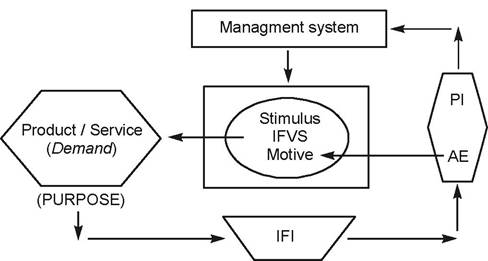
Fig. 4.2. Heuristic model of animaiculer social organizm: Where: IFI denotes inner firm ideology; IFVS denotes inner firm value system; E, A, I, P denote economic, anthropological, ideological and political values of organization that include it in the country organism
Specific social organisms appear in the process of organocenosis. We mentioned their existence while discussing the components of social organism. Then we particularly stressed that social life intraspecific form functioned in the components. And then we also specified their forms such as economic, social (in a near sense), political and ideological ones.
All actual material of the given social organisms history, i.e. their phylogeny, shows that an evolution, and morphological process, which is the most characteristic for it, generally takes place by means of organization complication. Appearance of such morphological units as specific social organisms in the generic social organism structure is a stage the value of which it is difficult to over-estimate.
Set by Milne-Edwards principle of differentiation based on the distribution of labor is the basic principle of this developing complication of social world organization. A generic social organism performing only general functions divides into parts with more special functions. Social unit is differentiated, and his parts are specialized.
Separate parts (economic, anthropological, political, and ideological) acquire their independent functions. They become autonomous. However this autonomy is expressed in their specific function segregation.
Specific social organisms appear on the basis of specific systemforming factor. As our analysis proves the interaction between personality and society in this case develops in specific organizational forms. Thereby the specific social forms serving the human necessities are not alike.
Life of any part is provided by the whole system of general functions, especially functions of interchange without which there is no life. Hence appears the role of open market for country social organism establishment. Any single-purpose part of these functions is always connected with another organism and the more it is designated into greater dependence on other parts of organism providing the whole social organism vital functions performance it falls.
However, according to F. Scheling, for example, the main feature of organization consists in its interaction with itself, i.e. it is producer and its product at the same time. Such understanding is the principle of all studies about organic nature. From this principle all subsequent definitions of organization (and inorganic nature.- V.B.) can be deduced a priori [See: 206, 369].
We will give an example of anthropological organism here. Its function within generic social organism complex consists in production and recreation of person’s identity as opposituion to contradiction under investigation. System-forming factor in this case iper- forms as the human demand. A person is the product of anthropogenic process. Naturally, in the process of anthropogenesis while remaining a generic organism, within which the life of civil society has been taking place, it changes in form remaining constant in content to some extent (See: fig. 4.3).
Due to generic social organisms’ formation, intensified development of periphery of social organism occurs, and, first of all, of communications; the development of information exchange comes to the first place.
The top of organismic level is surely the sublevel of generic social organism. We were covering it in the process of the whole research. Thereby we will only point to the fact that we can attain its better understanding by means of studying the ontogenesis process of country social organism. And it is the object of the following analysis.
Organismic level is insufficiently and even shortly covered in the literature of the past century. So, for example, A. Comte in his work The System of Positive Politics while presenting organismic level asserted that namely families are the basic social cells, social forces make
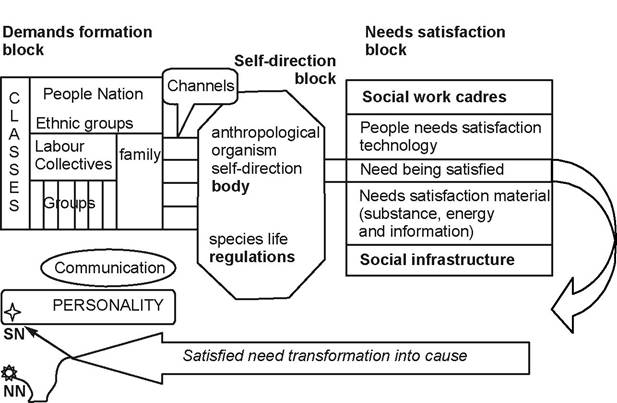
Fig. 4.3. Model of anthropological specific organism.
Where: SN - satisfied old need;
NN - new need that expands the limits of personality.
social material, a state and cities are social instutions, and the world countries are the prototypes of organisms systems in biology [See: 179, 43].
Supra-organismic level has, from our point of view, three sublevels: population, system and supra-system. We relate to population supra-level such social organisms which appear in the process of phylogenesis and cover, as a rule, large areas on the planet. Here is a rather wide variety of social forms. Today the most noticeable of them here are the continental and intercontinental social structures.
Besides, social organisms appear also in other relatively stable conditions of people interaction, for example, in territorial, and under other conditions also. We will say, it takes place in terms of language spreading, common territory, common production activity of material or spiritual character, etc. Informal social structures also appear according to the same principle, but they are less durable, and their life period is shorter consequently.
System supra-level is presented by the social formation of planetary scale. It is a noosphere social organism. Its appearance on the planetary stage is felt by everyone. It happens due to the heterochrony phenomenon, i.e. its working bodies anticipatory appearance. The last present themselves as social institutions of the world countries communities, for example, CIS, Security Council, etc. There are not points of view in modern literature denying legitimacy of the given social life supra-level existence.
Supra-system supra-level of social living is connected with the fact that human life is not limited by the planetary system. The second nature continues in the third one which extends over the limits of the planetary system. It means that in social world the family life of planetary humanity generates the brand new life-style i.e. external, which can be named as neo-life according to Teilhard de Chardin. Obviously that external intelligent life can not appear according to the laws of macro objects social evolution, as well as without them; it appears in accordance with social processes principles and at the same time going beyond the scope of their impact. The transformation of social process into external one contains contradiction, the adjustment of which results in the brand new form of universum motion which is explained by the noocosmogenesis principles.
Human being as a microcosm is a part of the Universe. The Universe must feel the same that a person feels. There exists an inherent connection between them, and as it so, this space as we know it cannot be another. Here the ideas by K. Tsiolkovsky seem attractive who wrote that “any atom of substance feels according to environment. Being attached to highly organized beings it lives their life and feels pleasant and unpleasant attaching to the inorganic world, it as if falls asleep, faints, passes to nonexistence” [199, 266]. The Universe is the organizational form of the world’s coexistence.
In this context it is possible to talk about Teilhard de Chardin’s point “Omega”, V. Kaznacheev’s forthcoming “Great noospheric explosion”, G. Hegel’s “Absolute Spirit” and other moments connected, as it appears now, with the expression of the supra-system supralevel of Space Mind organization. The sense of social form in the universum self-development process becomes clearer as a result of the research work made. Due to intelligent living substance, universum is able to have an impact on the Universe structure optimizing the evolutional changes passing in it.
Here should be said also about the necessity of other “worlds” admission, which able to create other forms of life and mind. The deep unity with “their” space is also characteristic for them. And they certainly must have an organismic form without which life is impossible. These are the organisms of intellect origin that belong to the second nature, but they are of quite another class already.
We will specify here also that social life generated by modern human being will not disappear. It only mutates substantially as its source, i.e. human being, makes progress itself. According to K. Tsi- olkovsky’s hypothesis in the structure of space organism it must undergo four known eras (birth, establishment, humanity disintegration and, finally, terminal) and then it will pass into the wave, i.e. “radiant” form of life. Having undergone all high eras humanity will pass into the radiant state again but of higher level already.
The change of these space cycles will last until the “supra-new” human being appears who due to the absolute omniscience will attain the state of the Absolute Intelligence or, as they had said before, the Absolute Consciousness which is considered to be the domain of gods. As a result the space will appear to be an entire perfection and “homo cosmicus” will be identified with the Universe. Understanding of these processes is laid today by the social world comprehension in general and its organismic form in particular. But their detailed analysis goes beyond the scope of the offered philosophical research general purpose. As a result of our research there the social world generalized picture can be offered in the form of special classification table (Table 4.1).
But let us go back to the object of our research. On the basis of the given above it is possible to draw a conclusion that we deal with the system group of organizational forms. Consequently, due to the conditions modification of intellect self-development in its formation natural process the panhuman intellect phyle fragmentation into various forms scattered according to different organizational levels took place. This way the familia of social organisms appeared.
It is possible to understand the organization and mechanism of social organisms familia vital functions only on the basis of mastering of the universal space hologram conception suggested in 70-80 of the XXth century by the American scientist D. Bohm and neuropsychologist K. Pribram and the idea of energy-informational exchange, i.e. information metabolism, based on the cultivated information or knowledge.
Only they give the idea how as a result of the quantum-wave nature of the Universe including social world the Universe will form the unique, endless in time and in space, multidimensional causal
Table 4.1. Social organism levels
| Social organism levels | Social organism snblevete | Morphological component |
| PRE- Organismic | Atomic (potential) | Personality |
| Molecular | Family, Pair of lovers, Predator-prey | |
| ORGANISMIC | Tissular | Blood relation, marriage, |
| (institutional) | Reproduction and inheritance forms Morals, law, power, religion, Property | |
| Cellular (Animalcular | Enterprises, | |
| social | Organizations, | |
| microorganisms) | Institutions | |
| Specific | Economic Anthropological Political | |
| Generic | Ideological Country | |
| Population | Regional (city) | |
| (territorial) | Religious (Islam, Christianity, Catholicism, etc.) Ethnic (horde, masonry) National (fellow-countrymen associations) Continental (common European house, Eurasian union, Balto-Black-Sea belt) Intercontinental | |
| SUPRA- Organismic | System (planetary) | Neospheric |
| Supra-system (space-based) | Universal |
energy-informational interactions network where “all interacts with everything” with different degree of intensity. One of these theory’s logical consequences is such a conclusion: every point of this energy- informational field contains all information about all other points of space and time.
At the same time realization of the general energy-informational exchange principle in the Universe necessarily requires the recognition of the fact that the Outer Space is intelligent and corresponds to the first principle of hermetism: “everything is an idea”, “we live in a mind, with the help of mind and by the way of mind”. We will remind that K. Tsiolkovsky, V. Nalimov and other researchers point to the Space Mind or world-spreading consciousness existence. It is simply impossible not to follow their ideas today.
In this case the Universe presents itself as a giant self-conscious structure in which the particular types of social organisms clustered according to different organizational levels play the role of functional organs. The Universe thinks in them, if it is correctly at all to apply such expression in this case.
If it is so, then there is the necessity and reason to acknowledge that except for four known fundamental interactions: gravitation, electromagnetic, strong and weak, there is yet the fifth type of fundamental interaction of informative origin. Exactly on the basis of the Universe fifth constant the social structures interaction is built and not only between each other, but also their inclusion into the World Mind is made.
In such case the informative fields as elements of the high world or worlds are not the fields of force in ordinary physical sense. They should to be powerless; processes of information transfer should be entropicless though with speeds which exceed the light velocity substantially. As maximum velocity of light is defined by A. Einstein for electromagnetic, but not for the informative field, that is why there is not contradiction with the modern ideas of the physical world here. The torsion fields (circular fields) can be information medium. Scientists assume that the torsion field quanta are low-energy relict neutrino, consequently high penetrable ability of torsion radiations appears to be rather natural. Both right and left rotation are peculiar for the torsion field quanta. That allows to assume the presence of both “right” and “left informational worlds.
Thereon we can end the social organism philosophical image formation of. For us it is important to include the produced ideas into the system of modern philosophical and scientific knowledge.