The social organism as the contradiction between society and personality
The content of the philosophical analysis of the social phenomenon should be an explanation of sense, which is put into the notion “the social organism”. We have some variants to formalize a social organism as a contradiction.
One variant directly follows from the material considered above. For this purpose it is enough to look at the human person and society as at self-motivated subjects of historical action.Other variants are as if variations of the first. One of them is “narrowing down” to organic system of functional products of a person and a society. Here we mean none other than the individual human personality as derivative of a person and the collective personality, as derivative of a society. Thus, it is possible to consider the subjectivized or potential and objectivized or actualized social worlds as the agents of dialectic interaction.
There is one more approach to the solving of the given problem: to address to available scientific sources and to look at this question through a prism of experience of human history, for such global contradiction could not remain unnoticed in history, at least for social philosophers and sociologists.
The analysis shows, that researchers consider being of a personality and a society. And, the mankind “noticed” this contradiction a long time ago and throughout the long historical period tries to explain it. The first mentions of it are found already in the works of philosophers and scientists of an ancient Greece who have paid attention to the change of a role of a person in the course of social development. But the unity of a person with a society, specified by Plato and Aristotle, was illusive in their epoch. In the philosophy of sophists, of Socrates and in the Greek tragedy (Sophocles) the fact of splitting of individual consciousness is reflected. The formula of sophist Protagor “the person is a measure of all things” challenged not only old gods, but also traditions of community life.
As it is known, Christianity contributed considerably in increasing of feeling of personality, and through it in formation of a social organism. The appearance of capitalism and the brake of ancient society links caused serious changes in mutual relations of a person and a society. Private entrepreneurship was impossible without the personal initiative and enterprise. The protest against the feudal type of interrelations between a person and a society gets the form of per- sonaly’s demand for freedom.
The representatives of the Enlightenment of the 17-18th centuries consider the society itself and the state as a product of agreement between individuals. Capitalism added here also the demand for freedom of private property and possession.
The presence in the structure of a social organism of two kinds of values - material and spiritual - according to the German classical idealists settled a matter on incompatibility of bourgeois social relations with the freedom of a person. Subsequent to Rousseau I. Kant has shown, that in a bourgeois society the person cannot be moral and at the same time happy, morals and well-being are alternative notions.
Basing on the empirical reality of a bourgeois society with its individualism and utility I. Kant recognises a society as the world of experience in which the person is only a tool. Hegel considered a person not as isolated monade, but as the moment of the general, genus. A person realises not subjective, but objective purposes: it is united not only with genus, but also with the entire world, because the essence of all world is the same, as the essence of a person - spirit. But even Hegel was not able to explain the connection of a person and a society. And if at that time Hegel panlogism had conservative political sense, in the scientific plane it was ingenious, as far as the reality we observe, represents the self-expression of Human Mind (Reason), or, according to Hegel it arises as “realisation of the God mind”.
The problem of integration of the individual a social group is the main question of the sociological conception of E. Durkhgeim. In F. Nietzche’s interpretation, the solving of this contradiction gained the character of nonsence as far as his “superperson” is an image of Leviathan as a monster, symbiosis of a person and a society. With the development of activity as a phenomenon in time, the division of social labour into separate functions, rejected from the person took place. On this basis, the social aim of the individual’s activity breaks off his activity and even is opposed to it as external force making the person to carry out the functions, the sense of which is lost for him.
As a result, the individual cannot identify himself with either of his roles, which are perceived by him as imposed from outside, and his self-affirmation gains forms of the conflict of a person and a society, which actually grounds on the contradictions of the social life itself.
Most correctly and scientifically accurately the given contradiction was described by K. Marx and F. Engels. Already in German Ideology they showed, that the abstract opposition of a person and a society and its ethical expression, i.e. the contradiction between egoism and altruism is just the illusory reflexion of social contradictions of a capitalist society.
“This opposition is only conceptual because one of its sides, the so-called “general”, is constantly generated by the other side - private interest, and is not at all in opposition with the last one as an independent force which has independent history” [121, 236]. Here they offered also the means of its withdrawal. They saw only one solution of this contradiction: transformation of a bourgeois “civil” society into “a human society or the socialised humanity” [121, 4].
This is what G. Greyef writes concerning the problem in consideration “Individuals and a society like cells of a human body and like whole human organism, are connected by the common (general) relations, identical interests and the certain correlation, due to which only their union represents an organism” [63, 169].
Our analysis shows, that it is necessary to agree with the fact, that a person and a society can and should be considered as the oppositions of the dialectic contradiction. On this subject we have, besides a historical view at the essence of the basic social contradiction of human history, at least, three more arguments. The first argument lies in the fact, that a person and a society are the products of the same process - formation of the social world. And the extremes, as is known, can clamp with themselves. In other words, the generic products of subjectivized and objectivized kind are capable to form integrity which should be called a generic social organism.
The second argument lies in the fact, that they have something “general”, what makes them akin more than what separates them. The problem of “general” and “individual” has been, actually, already from Plato’s times, a subject of long dispute between “nominalists” who object a reality of “general”, and “realists” who confirm it. The question on ontologic bases of a person and a society retains scrupulous attention of two trends in world philosophical thought - “individualism” and “collectivism”, which in social science are hidden by means of pure abstract philosophical terms “singularism” (“social atomism”) and “universalism”. S. Frank wrote that they try to answer the question, “either the society is none other than the name for the integrity and interaction of separate individuals, none other than the created by us artificial, i.e. the subjective, the reality epitome of separate people, or a society is some certain objective reality, an inexhaustible group of individuals, which are its constituents” [189, 38]. These two trends have been in constant conflict and have been changing each other in the history of social and philosophical thought. S. Frank, for example, solving this problem in pure theoretical regard, came to the following conclusion: a society is” a real integral reality, but not derivative associacion of separate individuals; moreover it’s the only reality within which the person is given for us exactly.
Isolatedly thought individuality is only the abstarciton; only in the sobornal being, within the unity of the society actually real is what we call the person” [189, 38]The third argument is naturally connected with the fact that both society and an individual bear specific functions of ther controversial interaction mechanisms and this interactive mediation means. This means that both concepts can easily retain each other within the given collision. Hence the concepts of chronotop in the individual structure and the habitus in the social structure are implied. Evidently, the term habitus is more identical to the Russian term “tradition” than a word-for-word “habit’” translation. Judging from functions, habitus is more identical to the Russian term “tradition”, than a literal “tradition” one. Besides, we are coming out from the definition of the notion “tradition” given by V. Volovyk as the coomperatively strict, generally accepted norms which are repeated forms, means and approaches and methods of activity, which are historicaly formed within the frames of the exact social community” [ 45, 13].
In a capsule form we’ll explain what is meant. Let’s start from the notion “chronotop’ which supports to undersatnd mutural crossings between the sensible and inteligible flash. The notion “chronotop “, as is known, was actively used in the humanities, first of all, by M. Bahtin.
The peculiarity of chronotop lyes in uniting in itself as if nonunited things e.g. space-time body limitations in the physical sense within the eternity of time and space. Thus, with the eternity and endlessness. That’s why simultaneously it comprises Physical and Semantical Universe. According to M. Kagan it’s the organ of their as if mutual interminglenes.
K. Marx, explaining the crossings like that oftenly used the sentectic categories-notions “practicaly-spiritual” comprehension of reality, “feeling and overfeeling” pertaining to the quolities of goods, “sense explaining unity of nature and society” concerning the person.
Chronotop is difficult for an imagining because of the fact that space and time found in it active-like semantic recycling. They are found in it in the recycled form up to the moment that the real movement in space is transformed into the steal time, and the last one being transformed into space which is moving on. Thus, the personality possesses the atributive possibility to enter under its initiative into the contact within society. The society itself has the mechanism of influence on the personaly. F. Giddins was writing about that fact this way: “the society is the organisation influencing its members”. Pondering over it on analogy it may be stated that it is in a way a social chronotop following which the evaluating sensible information is functioning including the values of moral consciousness printed by the imparative “to survive”.
The mechanism of such influence got in the contemporary social- philosofical literature the special name habitus. This phenomenon is the central notion in the sociological P. Burdje’s conception. The term itself is found already in G. Hegel works by which he denotes “she- dowy imagination about the whole image” of gender.
Practice is run by the social structure with the help of the habitus concept. And this governing is not performed via mechanical determination process but by means of certain initiatives and boundaries having been stuck to these contrivances long before. So the culture is not just the sense aspect of the human activity and its practical results but also sense-constitutive and sense-creation aspect act which enables any personality to perceive their social life and implement their own integrity.
All stated above, grants to us a right to say, that, thanking to the chronotop persons and traditions (socialchronotop), borders between subjective and objective the subjective do not exist. They freely pass one into another, by means of special tools, so called mediators.
Following from the availability in the society of two mediating systems of the material and intellectual (spiritual) nature, it makes sense to mention two types of mediators: spiritual and physical. In other words, we proceed from the fact, that in the social organism there are specific means for the conveing the sense from the collective person to the person and vice-versa.
The contemporary psychology reflected such products of the mediation in the concept “things-mediators” or the mediators of the spiritual (intellectual) communication [77, 311-324]. The Sign, the Word, the Symbol and the Myth are related to them. The psychologists suggest to consider them as the accumulators of the vital energy, the kind of bundles of energy. According to A.Losev, the personality is the myth. Jesus Christ in certain sense may be also identified as the Myth.
They may be considered also as the resonators, to the frequency of which the living beings tune. The last mentioned not only assimilate these frequencies, but also generate the new ones, but recharge the mediator with their energy [77, 315].
You should remember, that the procedure of the mediation in the material world is described in the works of K.Marx. We just have not looked at such methodological directions at the products of labour, to be more precise, at the consumer goods at the market, but because of this the mediating role of the last mentioned have not vanished away. Now it is well-marked, and we have to study it as a member of the social organism.
A special importance for the social organism has the availability in it of the informational and cash flows. Gradually the unitary (integrated) infrastructure for all immaterial flows: informational and cash. The making of electronic money of full value is in question - the making of the mediators (emoney), but not mere plastic card. “Even today 2,3 billions of dollars pass daily through the World Wide Web” - V. Kostiuk writes [98, 26].
Thus, we have enough grounds to consider the notion “social organism” as the dialectical contradiction between personality and society. Here it is necessary to say even more - the unity and conflict of the person and the society is the main contradiction (antagonism) of the social world.
Now, to bring the study of the given notion to the end, it is necessary to demonstrate, how these forces - personality and society - interrelate with each other as the organic whole, what solely, strictly speaking, is worth to be called a social organism? That can be done, again, due to the procedure of morphogenesis.
It means, that along with the self-generation of the special constituent in the structure of the human organism, as the basis of the social world, and the social environement (socium), the process of the self-organization of the social content does not cease, but develops in the direction of the integration of the potential world and the objective world (reality) into organic entity - the social organism. That is why the social organism at the macrolevel acts as the organic unity of the subjective and objective social relations at the moment of their dialectical interrelation between temselves.
Such definition of the social organism coinsides with the conclusion of V. Hramova, who wrote, that “the social organism represents a structural unity of the social relations (economic, social, political, cultural, family-marriage), which unite its constituents (actual people) into organic whole, which opposes both: the natural environe- ment, and similar social formations” [195, 196]. The above mentioned definition of the essence of the social organism, given by V. Hramova - is unique, because there is nothing else in the previous literature.
However, here the contact of not only the person and the society occurs. All the three generic products of the biological organism of the human, on the one hand, and all the three generic products on the side of the social environement (socium), on the other hand. But, as far as the process of the generic products production and recreation runs at the microlevel, it is invisible to us. We comprehend it due to the introduction to the social analysis of the concept of the latent functions and irrational means of kognition of the social phenomenon.
Independent functioning of the determined generic social products, rejected into the environment, leads to a leap in the social form of the universe motion. Something, that has been hidden at microlevels, becomes now visible at macrolevel. Macrolevel revives whereas the social life, arisen in microcosm bowels (depths), developes and gathers here vital force for following break on to megalevel.
So, both examples, the condition and the basis, are the same essential unity both as the content, and as the form. They turn one into another, thanks to themselves, in other words, being reflexions, they
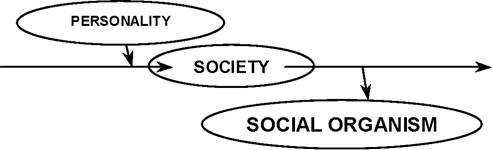
Fig. 3.1. A social organism formation
set themselves as withdrawn, correlate themselves to this objection and assume each other (See: Fig. 3.1).
Proceeding from the general understanding of the form-building process structure, it is easy to be defined with functions of its components. It is clear, that the person plays here a role of a product of the first form-building process, as far as it is the basis from which appears a second or basic form-building process, and its product is a society. And, the society in this case is understood in a most general sense of this word. We draw your attention to the fact, that the society does not generate the potential social world of the person from which it has arisen, but only is sharp and constantly it enriches objective content of other potential worlds rejected in environment. It works by a principle of the transformer which does not develop a current, but is capable to raise or reduce it. J. Toynbee has paid attention to this circumstance, as is known.
So it is necessary to point out, that with reference to the stage of functioning the person and the society, the reason and the result have changed places. The process has changed a sign. That process “has gone” in the opposite direction, that fact defines what was essential earlier, roughly speaking, the society has finally become the basis. Or- to put it simple- man’s personal identity concept has become simplified.
However, on a phase of functioning of the dialectic controversies and the estimated role of person and a society differs with researchers of a place. Some researchers consider, that a person is the basic element of a social life, while the rest of them thiks it’s a society. J. Toynbee can be considered to be the first trend supporter. He (Study of History) says that the Society is nothing else, but an intermediary link to help the individuals to co-operate and perform through interaction. The history of the world is created by personalities -not by societies [181, 254].
At the same time the other part of the scientific world is the opposite. So, for example, to E. Durkheim’s mind (The Division of Labor in Society), if the social life was only a continuation of an individual life it would not turn to the basis and would not become its nature. As far as it prevails over an individual, according to both: time and space, it is possible to fasten some ideals to an individual. We are definitely speaking of some authoritative social ideals now. And this kind of social fact pressure is a collective pressure put on each separate individual. [See: 72, 492].
Further he indicates where to look for the answer to this question. The thinker underlines, that if you remain at the side of the individual the society only remains; so the explanation of the social life one should search in the nature of the society itself. Really, as far as it infinitely prevales over the individual both in time and in space, it is able to press on it the way of acting and thinking, sanctified by its prestige. This press, being a distinguished feature of the social factors, is the pressure of all on everybody [See: 72, 492-493].
The restricted character (narrow-mindedness) of these approaches is obvious. The complexity of the analysis of man’s personal identity and society functions in the structure of the social organism is to our mind specified by the fact, that the researchers do not draw the line betwean different types of ties in the social phenomenon. Here the ties of initiation (generation) are confused with the ties of functioning. In this case the same thing happens, that happens with the evaluation of cause-effect relationship between economics and politics. The main force in this relationship distinguishes from the main force caused by the initiation of the social phenomenon. In realization of the relationship of initiation the personality plays the leading part, and at the phase of the functioning of the social organism, the other way round, the priority belongs to the society.
But in case the concept of the idea that the development of the social reality is cyclic is introduced, the given contradiction will be surmounted. Becides, the primary and the secondary between the person and the society withdraw during their dialectical interaction. Though at the ultimate causation these both parts relate to each other as acting. Their opposition is mechanical. In interrelation their mechanical motion withdraws, as far as it contains, firstly, extinction of the mentioned above initial retention of the immediate substantivation, and, secondly, the emergency of the cause and thereby the fundamental principle as mediating itself with itself contradiction. And, as K. Marx and F. Engels write, without some confusion of the cause with effect the matter won’t do, because the cause and the effect in the course of their interaction lose their distinctive features [124, 214].
As far as subjective and objective ingredients are at the same time the cause and the effect for each other, they make up an original organization of social life, which in general expresses not something existing by itself, but only a certain form of their existence, something general, conditioned by the chain of cooperating causes.
So, in a social organism the person and a society as contrasts, in struggle unite and in unity struggle. They are destined to daily and universal struggle because the decision of the given contradiction is the most social life, as secondary, that is as a result objectification the person of the internal social world, the form split in two part universum. We need to remind that the first bifurcation point has been put in a line material (in a spiritual way), when intellect has removed it, universum has got to a difficult situation of that now intellectual split in the individual and the collective. Therefore, it is exact how material and spiritual directed towards each other in the first nature, individual and collective intellectual fields search each other for reunion in the second nature.
Reunion process and, also the interactions of intellectual fields occur everywhere, where for this purpose there are formal and informal conditions. This interaction should be extended everywhere, though the social organism arises only there where finds defined receptivity to a social body. So, the magnetism reason exists everywhere, but operates only on some bodies. The magnetism stream reveals an imperceptible needle and in the open, free sea, both indoors; and there, where it finds it, it gives it a direction to a pole. And the stream social lives, whence it would not come, finds favorable bodies to it and gives to them there, where it finds them, vital activity. This intelligent design is limited in the actions only by the receptivity of the person with whom it has identified itself, and, depending on difference of this receptivity, there should be different forms of the social organisation. Thus, the social organism is microcosm, which has got life for itself, the centre of the second nature of the universum, in which all social reality has united and idealised.
Further on it is necessary to draw attention to the fact, that the social organism should be interpreted both as a social individual or a subject and as a social process. Thus, in philosophical research of a social organism it is necessary to allocate three aspects: morphological, functional (including self-regulating) and evolutionary. It means that as the normal condition universe is constant reproduction of an initial substance or continuous movement of formation a social organism a trace to consider as the subject or only as infinite activity. But as the social organism has duration it should be considered also as an object, and, so, it is possible to speak about its morphological structure [205, 197-198].
Thus, in life the most important there is a product or a social life as object and in the philosophical analysis the functional aspect or functioning and development social lives dominates. Complexity of this procedure is in the fact, that it is necessary to apply the life principles to a free power field in which it is necessary to allocate elements, bodies, structures, mechanisms etc.
In the ends, it is necessary to notice, that the thing acts as a substance of expression as a subject, a substance reflection- as a product; the subject and a product act, so, as conditions of a social thing.
3.2.