Matrix of DSL
Following these ideas, what could be the matrix of DSL? The question is easy to pose, but an answer is hard to find. If we try to grasp what, in general, DSL is in comparison with other disciplines near it, serious consideration must be given to at least the following special characteristics:
1.
The obligatory subject matter of DSL is the valid statutes of law. Thus DSL is an typical institution of the statutory law.2. The function of DSL is to interpret the rules and principles belonging to the statutory law-based legal order. The matrix should therefore include a hypothesis on the way in which DSL works compared with other disciplines also dealing with normative material.
3. The societal function of DSL is based on the division of labour between different social sciences. It reflects an interpretative, not empirical, interest as regards the law, and thus satisfies the interest in knowing the interpreted content T of a statute S at the time tl, although the doctrinal study not only interprets the statutes but also systematises the normative material.
4. DSL is a non-positivist discipline due to its dual nature. The foundation of DSL includes both an ideal and a real dimension.
5. The non-positivistic thesis, which connects law and morals, is essential as far as the legal reasoning is concerned. In hard cases, there cannot be purely value-neutral choices between the alternative meaning candidates. Therefore, the matrix of DSL includes the presumption that values (and moral principles) have a role in legal discourse.
6. The linguistic-conceptual commitments of DSL are the core of the interpretative studies, which are always based on a tradition like, in the case of DSL, ius commune. This common European legal inheritance transfers the traditions of civil law to the modern law in Europe. Ius commune is the basis of the systematic structure given to the legal order.
7. Commitments concerning the notion, role and normative status of the sources of law. The scholars as well as the judges are united by similar categories of arguments, and the degree to which they are bound to them. The sources of law are the necessary material with which the separation between law and non-law is made. If there are no acceptable sources of law to present in support of the interpretation, it is not a legal one.
8. The DSL matrix also includes commitments as regards the method of legal reasoning. DSL belongs to the family of interpretative sciences, and has a special place in that family. The task of the doctrinal study is to produce reasoning that convinces the audience; its method is therefore discursive as to its nature.
The formulation of the commitments included in the matrix is not exhaustive. For instance, the significance of the linguistic-conceptual commitments should have been described in more detail. Without linguistic-conceptual commitments there can be no talk of legal thought based on such systems. It is exactly this common conceptual basis that makes it possible to identify a legal problem, as well as to chart the possible interpretative alternatives. Because of this, it is not possible to practise credible DSL or adjudication separated from the linguistic-conceptual commitments (the system).
Let us take the next step. The DSL matrix is articulated as the theories used in the studies. Notwithstanding the substantial analysis of those theories, and without repeating what has already been said about the theories in law, the following elements can be listed:
1. Norm propositions that, first, define a rule of recognition, that is - express (often implicitly) which norms are valid - and second, that demonstrate the content of the legal order pertaining to a certain area or problem. This dual function is a consequence of theories being cognitive wholes that help to recognise the law. If a theory cannot give institutional support to those norms that are maintained to define the content of law, the theory does not have any role in the legal discourse.
2. Fact propositions define the states of affairs behind the theory. For example, the theory of private ownership presupposes that there are certain markets and means of payment, as well as other necessary preconditions, for the exchange of commodities. They provide a foundation for the political stand toward ownership adopted in society, without solving this matter in any simple way. In drawing this border, one also needs tools to prioritise different concepts - that is, one needs value statements.
3. Value statements have a status of different strengths in different theories. To put bluntly, they can either express intrinsic or instrumental values. As far as the first group is concerned, they articulate what is good for human beings in general. In this respect, they are prima facie values. In DSL, the instrumental values, not the intrinsic ones, are the normal tools of scholars and judges. The instrumental values are bound up with the question of the usability of the theory in solving certain legal problems. For example: The modern theory of property rights is good if, and only if, it guarantees the dynamics of society.
The conceptual framework, special for every case, gives the theory its structure as a theory of DSL. The theory of ownership and the theory of contract are examples of conceptual frameworks. To put it schematically, the structure of those theories is similar to the structure of any kind of scientific theory:
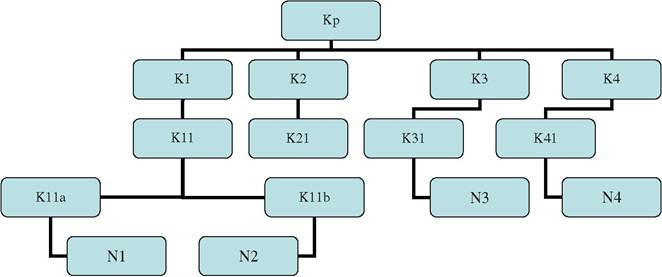
The used general concept (Kp; for example, right to property) is organised by a certain group of sub-concepts (K1-K4; the owner's primary right, competence and dynamic protection of different kinds). The sub-concepts (k11, etc.), in turn, become more accurate with the following level, and this process continues until a suitable conceptual accuracy is reached for describing the system of norms. The concepts of the lowest level in the hierarchy refer to a certain norm (N1-N4) or a group of norms, where a norm can be a rule or a principle, depending on the way the mentioned phenomena have been regulated in a given area. Following the example, the norms might deal with the owner's vindicative protection, the securing of possession, registration of title to a property, mortgage, assignment competency or different forms of protection of exchange.
The instruments sketched above make it possible for us to sum up the definition of a theory used by the doctrinal study of law:
Def: The theory used in DSL consists of a set of norms, concepts and propositions, and of value statements and moral principles, with the help of which it is possible to identify the legal problem and frame the number of legally relevant interpretation alternatives for the final interpretative choice.