MinimisingZNormalising
The interview instrument included a question about how sexual harassment made the respondent feel. There was a low response rate to this query: 45 of the 75 who did reply expressed a “serious” response.
The remaining 30 minimised. For instance, one woman explained why “it didn’t bother” her:It’s everywhere. You know, screensavers, magazines lying around in crib rooms or on the floors. I know where all the hidey places are! At the end of the day, though, I would rather them look at magazines than me, so it doesn’t bother me. (Electrical engineer, aged 30, high level rurality).
In response to a question about why people harass, two thirds (of 54) minimised. The 18 respondents who appeared to appreciate the seriousness tended to mention “power” in their reasoning. Professionals were more likely to see sexual harassment as a serious concern (5:6), as compared to 2:20 agriculturalists, 2:5 retail assistants, half of those in mining and none of the three working in administrative positions. Accordingly, a Livestock Agency Officer (female, aged 30, average level rurality) stated: “I just don’t think people take it seriously out here”, while a public servant (female, aged 26, moderate level rurality) said “It’s probably an unconscious sort of thing, but yeah, I probably treat things as a joke generally. That’s probably my personality as well. I don’t want to make a fuss of something”.
As illustrated in Table 5-3, employers were more likely to minimise the reasons for sexual harassment than employees (∕2=(1,A=54)=4.34, p=0.037); however the effect size was small, (Φ=-0.28).
Table 5-3: Do employers and employees minimise or understand the seriousness of why people sexually harass
Do people minimise or understand the seriousness of why people
sexually harass?
| Minimise | Recognise seriousness | |||
| N | % | N | % | |
| Employees | 25 | 59.5 | 17 | 40.5 |
| Employers | 11 | 92 | 1 | 8 |
The following comment from a grainary manager is illustrative of a management perspective that minimises and normalises the behaviours as part of the culture:
Yes, I have had complaints from the girls at the grain stand.
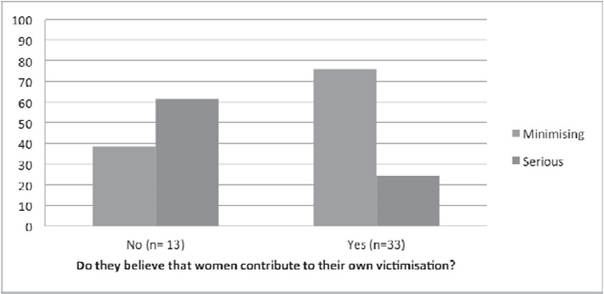
Like they might say “that truck driver has just sworn at me” and I might have to remind ‘em that they were made aware of it when they took on the role. But it is just not easy for me to change the workplace behaviour itself. That is a whole other thing and you can’t just change the behaviour like that... (Aged 26, high level rurality)Figure 5-2 indicates that participants who believed that women contribute to their own victimisation were also likely to minimise the reasons why people sexually harass (χ2=(1,Λfc46)=5.72, p=0.017 with a moderate effect size, Φ=-0.35).
Figure 5-2: Beliefs about why people sexually harass by a belief that women contribute to their own victimisation
The words of a female manager in the trucking industry reflect this combination of victim-blaming and minimising:
But if you work in rural Australia in a male dominated environment people like the drivers and farmers just think that it is normal and OK to make a dirty joke. Like, especially about your appearance... Like, if you are butch for example, you would hear lots of comments about what you get up to and what you look like. You either learn to handle it and fire it back at ‘em like me or, you don’t. I know that the guys don’t mean it as being distasteful. (Aged 28, high level rurality)
Another Manager interviewee blamed her own dress style for unwanted staring or leering:
. but that is probably my fault. You can see how I am dressed this morning. I never do my top buttons up. it is probably not being particularly careful either. But I have never dressed any different so. yeah. (Rangeland Manager, 50 years, high level rurality)
“It’s all a bloody big boy's club out here”
A part of the minimising or normalising ethos seems to be an attitude about sexual harassment that it is just “boys being boys”. Of the 70 who responded to the question “Do you regard sexual harassment as just ‘boys being boys’?” 50 (71 per cent) answered affirmatively.
There were no significant differences based on age, employer/employee, seniority, education, marital status or degree of rurality. The type of workplace, as shown in Figure 5-3, had a moderate effect (∕[467] [468]=(4,V=60)=16.10, ppornography constituted sexual harassment; this made the data highly unreliable and statistical testing problematic. Twenty of the 28 employees who did respond believed porn to be sexual harassment while only six of the 14 employer participants had that view. For example, a female employer based in Kalgoorlie running an environmental consultancy for the mines seemed to feel that topless pin-up girl posters were benignly ubiquitous stating that, “It doesn’t bother me at all”. She also asserted that she would not interfere with people clustering at desks to look at pictures unless it was taking up a lot of their time and distracting them from doing their work.All the professionals who responded to this question (n=6) replied “yes”. And, 86 per cent of those employed in mining (n=7) saw pornography as harassment in contrast to half of the agriculture/horticulture (n=16) and retail/hospitality/fast food (n=2) and 60 per cent of the five administration workers who answered.
Turning a blind eye
Either reflecting denial or contributing to it were the 85 per cent (n=72 respondents) of employees and 77 per cent of employers (n=22) who believed that it is best to ignore the behaviour.
I have experienced a man physically exposing himself to me. And not just to me — to anyone else who was around. Repeatedly. Countless times... This was an underground person who was in middle management. So when I would be underground he would often be too. There seems to be an old- school group of men who believe that women don’t belong underground. And I’ve even heard it said that women are bad luck underground. And there is a group of men who think that it is funny to try to shock you underground. Or make you feel uncomfortable.
I would ignore it! I certainly never did anything about it!. To me, if someone wants to show themselves it is more a reflection of them than a reflection of me. (Environmental Advisor in Mining, aged 36, high level rurality)In response to a question about whether she felt confident that she would be free from workplace sexual harassment in the future, one woman’s answer demonstrated that — on balance — she thought it best to ignore physical touching in the workplace and to contextualise the experience as “humorous”:
Here — yes, I am confident that I won’t be harassed. Although the boss did tell me that I wasn’t allowed to tell ya, but he pats me on the bum all the time. Which is a bit crap! (laughs). He said “Now don’t you tell that girl anything!” (Laughs again). But that’s the kind of fun that we have without being — you know — that’s what I mean by “humour”. Something like that is funny but it does have some overtones at times, I suppose. (fades thoughtfully). (Agricultural office administrator, aged 50, average-high level rurality)
Is sexual harassment an issue in rural Australia?
This was another question that tested or screened for attitudes that correlate with denial. Evidently, if looking at sexual harassment in the abstract and not in one’s own workplace, far more people see it as an issue and do not deny that sexual harassment is an issue. Three quarters of the respondents (n=89) answered affirmatively.
One respondent spoke about the perils of being employed in a position, which required working in isolated bush areas. In her response she referred to broader issues of “sexual stuff” affecting women and which she ultimately regarded as “part of life, to be honest” (Rangeland manager, aged 50, very rural).
Those working in low degree of rurality places were significantly more likely to believe that sexual harassment is a big issue in rural Australia (24:26) than those participants living in more remote areas (17:33) (Fisher's=(4,A=89)=17.63, p=0.001, with a medium effect size, Φ=0.45).
No, I don’t. Don’t get me wrong, I think there is prejudice against women, but you do have to — I don’t know — you just have to put more into your job to prove your worth, maybe? (Geotechnical engineer, aged 26, high level rurality)