Victim Blaming
I feel — you know — we hear all about sexual harassment and things like that — but I also think that the female working in a male dominated business or area or whatever the situation may be — well, I think she has to set some standards herself and not just expect the men to come up to a standard.
She has to set a standard for them to meet, if you understand what I am saying. So if she comes in all sort of “rah-di-rah” and you know, a fair bit of language, the men aren’t going to have any boundaries. You have to set those boundaries by the way you are yourself. So that is just something that I feel is quite important... I just think that it all comes down to how the girl behaves. As to how she is treated. (Office administrator, aged 50, average level rurality)That office administrator’s view of victim responsibility was not a solo voice. Sixty per cent of 62 employee respondents and 83 per cent of 18 employer respondents believed that a woman contributes to her own victimisation. The following response encapsulated this type of thinking:
Sometimes I have felt some of the things that I have talked about were my own fault. You know how it is when someone is talking in a really friendly way — and you are all getting on in a really friendly way and then the talk degenerates. Or maybe you have been part of a discussion that has been a little bit questionable in nature. Maybe you have been talking to another lady and someone comes along and assumes that it is open slather for them to be involved too. And if they are in a senior position to you and you are like me, you just try to pass it off and diffuse and finish it. The problem is, sometimes it works and sometimes it doesn’t. (Teacher, aged 48, average level ruality)
Women were perceived as blameworthy because of their provocative behaviour:
I honestly don’t know, but I think it really comes down to how you react and how you conduct yourself, as to how people are going to react to you, a lot of it.
You know, if you are going to walk around in mini skirts and you know, with half ya boobs hangin’ out in front of you know, truck drivers and things like that — and if you don’t expect to get comments from them in your dressing behaviour for example — then you’re an absolute fool! (Grainary employee, aged 52, average level rurality)This categorisation of a woman as a “fool” for conducting herself in such a way that might “invite” sexual harassment was referred to by other women in response to questions about barriers preventing women from reporting incidents of sexual harassment:
... the community might be perceived as thinking that she is a trouble maker. So people will think she bloody well asked for it. (Environmental Scientist, aged 30, high level rurality)
More than one woman also spoke about the impact of her relationship status on the perception of her blameworthiness for acts of gendered harm in a rural community:
And this is another aspect — in a rural community if you are a single mother, there is a perception that a single woman with a child is more likely to lose their moral code than just about anyone. When single mothers live in the bush they need to battle the quick assumption that “she invited it” or “watch that one”. So in terms of the rural community supporting single mothers who are vulnerable to this sort of thing, I don’t think this happens because they are seen as a threat to their own marriages. That makes life so hard and it makes you incredibly wary. (Teacher, aged 48, moderate-high level rurality)
Women working in more male dominated environments such as the grainary (less than 25 per cent of women) were significantly more likely to believe that women contribute to their own victimisation than participants in workplaces of 25-50 per cent women, (∕2(1,Λfc52)=10.19), and participants in workplaces of over 75 per cent women (∕2(1,Λγ=37)=11.16). (See Table 5-1).
Table 5-1: Proportion of women in the workplace and responses to question of whether respondent believes that women contribute to
their own victimisation
Proportion of women in the workplace
| Yes | No | |
| 75% (n=12) | 42 | 58 |
A female employer from a male dominated environment reflected on a situation, which required her to counsel a female employee about her choice of clothing — in the context of that employee having approached her with a complaint about offensive office conversation:
I do remember one occasion where I had an employee who I did have to talk to about how she dressed for work. And she had come to me a little bit offended about some conversation in the office. (Senior Mining Consultant, aged 38, high level rurality)
Some women in occupations with token females conceded, however, that it was not always the victim’s fault:
Quite often you could not take responsibility for the way that a conversation turns out, though. I think that whole creep phenomenon is really important to consider. (Senior Manager in Mining, female, aged 42, high level rurality)
The belief that women contribute to acts of sexual harassment against them was also related to the participants’ occupation (∕2=(4,V=70)=15.13, j>=0.004) as shown in Figure 5-1.
Figure 5-1: Occupation and belief that women contribute to their own victimisation
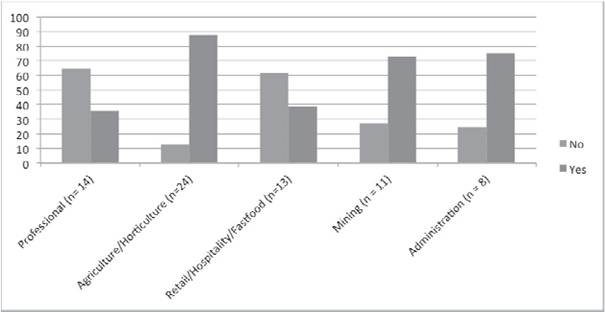
Those employed in agriculture/horticulture professions (21 of 24) were significantly more likely to believe that women contribute to their own victimisation than the five of 14 professionals (∕2(1,Y=38)=10.98) and the five of 13 in retail/hospitality/fastfood occupations (∕2=(1,Y=70)=9.71). For example, one agricultural employer would reframe harassment complaints, putting the focus on the targets’ responses:
I would say to them that they need to learn to cope with it.
You just need to be cut out for it and some girls are obviously not... Yeah, people often ask me what it is about me that makes me able to handle men. You need to be assertive but not aggressive. If you are aggressive you just hear ‘em say “Geez, she is a cranky bitch”. If you are just assertive they will take your shit and make friends with you. You just need to show ‘em you are not a weak little girl who needs looking after. (Senior Manager, Grainary, high level rurality)There was also a tendency for some women to blame themselves for finding pornography offensive. One participant was asked about how she felt about the presence of the “dick mags” that she had identified as being prevalent on the cattle station:
Oh I was usually pretty disgusted I guess. I was a pretty uptight sort of a person. Like I shouldn’t judge myself for my reaction, but I wasn’t particularly open to all that. (Jillaroo, aged 28, high level rurality)
A female senior winemaker from South Australia made a number of references to her belief that women, including herself, contribute to acts of sexual harassment. Asked about her response to receiving sexually explicit emails from a colleague, she said:
Yes, it was revolting. I suppose in the most obvious way. I would get emails all the time to my home account. I felt very inadequate because as I said, we have had all this training and I still felt that I had done something wrong in the first place. I never took it any further because I didn’t want to upset anyone in the community. This guy was married. It would have been terrible if the community had known — a married man with kids. (Aged 48, moderate-high level rurality)
This participant further defended the propensity for sexual harassment by male employees by highlighting that sometimes women are the inflictors of the behaviour:
Yes, people have complained to me about innuendo or direct sleazy jokes. In the vineyards there were some women who would talk about sex all the time, though.
And even young guys were scared of these women, too.The only other significant variable was age (∕I 2=(4,V=80)=12.18. p=0.016): Table 5-2 shows that only one of the eight respondents under the age of 20 believed that women contribute to their own victimisation.
Table 5-2: Do respondents of different ages believe that women contribute to their own victimisation
A 19 year old female sandwich maker from Western Australia spoke vehemently about the need to put a stop to sexually harassing text messages:
[1] told them to back off and all it took was the one firm message and there
was no problem at all. I was clear that the feelings were just not reciprocated. (Low-moderate level rurality)
Another 19 year old woman who worked in a hardware store spoke about how her male colleagues were “misguided” in their behaviour:
Um, looking back at it now I think it was one of those things where they really misguidedly thought that people were going to be impressed by their behaviour. (Hardware store assistant, low-moderate level rurality)
More on the topic Victim Blaming:
- Motivational Goals, Tactical Communication, and Group Profiles
- Easteal Patricia (ed.). Justice Connections. Cambridge Scholars Publishing,2014. — 322 p., 2014
- Other-Related Beliefs
- The standard commodity
- CHALLENGING THE STANDARD
- Street Children as Agents: "Choosing" the Street
- Hostile Emotions
- Bullies
- HOW DO YOU "DEMOBILIZE" THE MINDS?
- YOU CAN SEE A SCAR