The Structure of Reasoning
Let us now take a closer look at the functions of the structure of reasoning. This is also how we can get to the leaking points in the reasoning. Edna Ullman-Margalit examines two different deductive structures that she calls The Weak and the Strong Linkage Argument (Ullman-Margalit, 28).
The core of the problem concerns the possibilities to combine the textual line with the archaeological one so that they strengthen the original hypothesis and, therefore, the DSS theory. As a tool in finding the solution, Ullman-Margalit uses the concept of “linkage”. I will first discuss the weak linkage, follow it with the strong one, and finish by examining both in a conclusive way.Let us start from the hypothesis, H, (Qumran Essenes authored the scrolls), and accept two different deductive structures as two lines of reasoning (Ullman- Margalit, 41):
A (contents of the scrolls) ->B (scrolls are Essene), and
C (site of Qumran) ->D (Qumran occupants were Essene).
These two are linked together with a factual linkage - i.e., with some archaeological findings - as follows (Fig. 13.1):
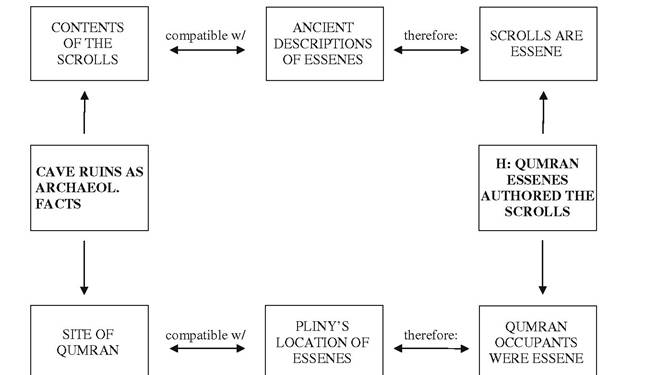
Fig. 13.1 The weak linkage
The strong linkage is otherwise similar, but the archaeological argument has been replaced by an interpretation of the archaeological fact. Then, the following diagram results from that assumption (Fig. 13.2):
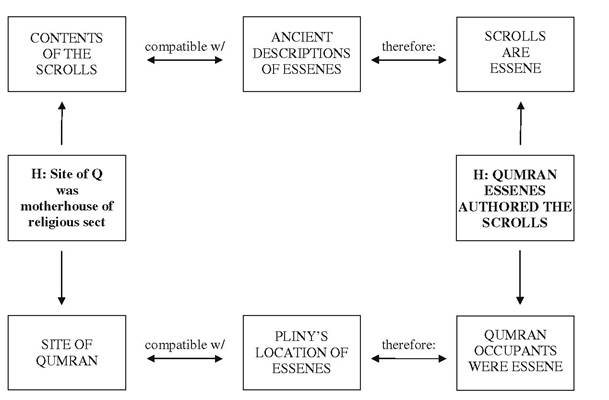
Fig. 13.2 The strong linkage
Both lines (the textual and the archaeological) are supported by contemporary descriptions. In the previous, the Ancient historians describe what the Essenes were like, and in the latter, where they lived. In both cases the strength or weakness of the chain is mostly in
1. how reliable the contemporary descriptions are as a whole when describing current events
2.
to what extent is the information they provide combined with subsequent interpretation (from our age).The first question has to do with the terms the historians used to write their own descriptions. Even though the texts provide interesting information as seen “back then”, the demands for source criticism were not the same as ours. Another question in the suspicion of the descriptions is in the lack of definition in the points of view. The choice of the point of view from which different things were presented might not open up to the modern reader. For example, the historians do not describe the other religious groups of Judea in the same detail as they do with the Essenes. Therefore, we cannot use their descriptions to deduce that there weren't any other groups, nor that they might have adopted similar norms as the Essenes. Another difficulty with texts from Ancient historians is that it is easy to slip in some information modern archaeology might have gathered about the circumstances of the described events. We are interpreting old descriptions with the sole support of our own knowledge (Ullman-Margalit, 74).
Another way of taking a critical view of the chain is by putting the interpretations of archaeological findings against one another. For example, Qumran may have been a military fortress, not a sacred place. A similarly difficult counter-argument deals with the water pools or the skeletons of women and children. The DSS theory manages to stay intact throughout these tests, but not without damage and not without any need to do some more research. Still, it is not essential to ask which theory of the origin and content of the Qumran scrolls is the right one since the real question lies in the reasoning procedure and its possible weaknesses. For this reason, we should consider some points before drawing conclusions about the applicability of Ullman-Margalit’s concept of “linkages” on legal reasoning.
First, in DSS, as in any empirical research, it is necessary to identify logically independent chains of justification.
If, and only if, they all support the same conclusion, it becomes more plausible (acceptable). As far as the DSS theory is concerned, both lines (textual and archaeological) are logically self-contained. In this regard, the basic presupposition for a sound scientific argumentation is fulfilled and the DSS theory seems to give a good example of the theory of DSL.On the other hand, the textual and the archaeological line are based on different kinds of truth theories. In the textual line, it is all about how well the different (logically independent) interpretative elements fit together. To put it briefly, the “truth” of the textual line is coherence. In this line, interpretation cannot be “compared” to any extra-textual reality (unless we’re dealing with contemporary descriptions). The text is a hermeneutic whole, in which interlocking parts strengthen each other and the result. The relationship between contemporary descriptions and the text of the scrolls is also coherent. The text (scrolls) is interpreted with the help of a text (contemporary descriptions) in a way that is circular in its nature.
The truth of the archaeological line is basically in correspondence, but this fact is not at all simple. Let’s examine the following proposition.
P: The water basins found in Qumran were pools meant for ritual baths.
The correspondence between the claim and reality is not obvious, although the pools might well have been dug up with archaeological methods. A set of other archaeological arguments are needed to support the interpretation that the structures are pools. Therefore, what is true in P is that there were pools of water in Qumran. P does not, however, claim only this. The other core element of P is that the pools were used in rituals.
In testing the validity of this claim, one has to interpret the findings through the textual information in the scrolls - i.e., to proceed from the scrolls to the findings. In addition to archaeology, there are many different pieces of a puzzle that need to be fitted together in order to achieve a coherent relationship between them.
The confirmation of the “truth” of P is, in the end, a highly complex search for a coherence that is partly non-archaeological. This does not mean that we cannot hold on to a Tarskian definition of truth when discussing P, but the definition of truth would not justify P as a true proposition.What about the combination of the two lines? Ullman-Margalit refers to the concept consilience of inductions used by W.Whewell. If two independent chains of reasoning support the same overarching hypothesis, they produce together a more reliable result than both of them alone. Sharing the same ground hypothesis, they get additional support, which they wouldn’t have got without it. Therefore, the two chains that were originally only compatible now lend support to each other as a result of the ground hypothesis. The result is more probable than it would have been if based on only one chain of arguments.
Here, Ullman-Marglit refers to the so-called Bayes' theorem, which separates prior and posterior probability (Niiniluoto 1986, 321). Let us assume the hypothesis H is probable in some sense of the term. Prior probability, P (H), concerns the probability of H before the evidence, E. It is always 0.5. Posterior probability, P(H/E), grows in strength the stronger E is. Bayes' theorem deals with the hypothesis H's posterior probability, while taking into account the evidence, E, and relating it to prior probability. Probability P numerically expresses the value of probability, such as 0.75.
Let us take an example. A room that has been assumed to be a reading chamber or hall has been found in Qumran. This shall be the evidence, E. The Qumran - Essenean hypothesis, H, required by the DSS theory is strengthened if the evidence, E, proves to be reliable while taking into account all the information that can be gathered to support it. The probability of the original hypothesis is therefore dependant on a complex and multi-layered chain of evidence. The key is in whether or not the probability, P, of the hypothesis, H, grows with the evidence, E.
The force of Bayes' theorem is in the concept of posterior probability.What makes the matter interesting in the case of Qumran is that the archaeological excavations have brought up both “negative” and “positive” findings in support and against the DSS theory. Both of these have been dealt with above - the ritual pools, the reading chambers, the skeletons, etc. I won't get back to them since it is not the aim of this piece to showcase Qumran theories, or the DSS theory or its competitors. Let us limit the focus to the reasoning.
The opposite of Bayes' theorem is a Popperian concept of science. While talking about the falsification of hypotheses and the development of science, Sir Karl Popper took off from the fact that what is significant in science is not the strengthening of its hypotheses but proving these hypotheses false (falsification, disconfirmation). Edna Ullman-Margalit claims that the DSS theoreticians were neither purely Bayesian nor Popperian. They had combined Bayesian and Popperian elements in their own concepts, especially in the DSS theory.
The DSS theory takes off (at least it did) from the strengthening (confirmation) of the Qumran-Essenean hypothesis. There were both textual and archaeological arguments stated in the support for the hypothesis. Still, Ullman-Margalit claims, making a good case, that the DSS theoreticians did not adapt the Bayesian theorem as it is. They merely set off from the presumption that their Qumran-Essenean hypothesis is correct. As the research went on, a certain scale was born, in which arguments of different strength broke down the unquestionable either/or truth.