What About the Legal Reasoning?
The question is more about weighing and balancing, to use the terminology of Robert Alexy. Ullman-Margalit aggravates her claim for this part in stating that the DSS theory simply presumed that its origins and results were true, rather than its representatives trying to find out the truth or falsity of their theory openly and by using pro & contra arguments.
In the following, the focus will be on the theory of DSL. In the system of Continental law, the legal interpretation concerns the content of statutes. In this view, the task of the legal interpretation is to give meaning to the statutory text. Thus the starting point is always the legal text. In this regard, a DSL hypothesis (proposition), P, can be put as follows:
P: Legal text L = Its phrasing S.
P has to be justified. In doing this, the legal argumentation must be structured in a similar way to the reasoning in the DSS theory. The disciplines that seem to be at a distance from each other, like archaeology and law, still follow similar structures of reasoning. The DSS theory is an articulation of a general mode of rational discourse. In this regard, DSL is not a discipline that is separated from other branches of science that use interpretative method. To put it differently, DSL is a member of the family of humanities as well as the family of (normative) social sciences. It is not an empirical science, but it is in one way or another connected with interpretation (Fig. 13.3).
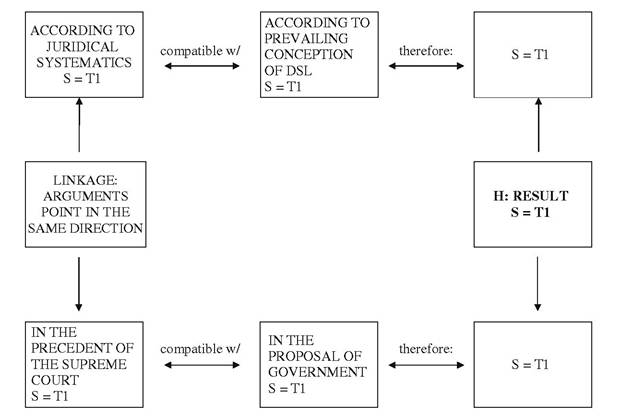
Fig. 13.3 Application to jurisprudence
This diagram presupposes that the starting is the statutory text (the wording). However, the similarity to the Qumran case is clear. It is true that the latter consists of one chain of reasoning that deals with archaeology and empirical research while the other is more about textual interpretation.
Still, the archaeological line requires interpretation too. The key in both is the internal “compatibility” and the one between the chains being coherent.Two logically independent lines of reasoning, the system argument and the preparations for the law can be joined together in the way described by Ullman-Margalit, strengthening both chains of argument. Referring to Aleksander Peczenik, there is a jump from the premises to the conclusions. Ullman-Margalit's “link of integration” means exactly the same.
There is, however, one counter-argument left. Obviously there are not necessarily only two chains of reasoning, even in more difficult cases. Let us assume that an interpretative case includes a counter-argument to the Supreme Court's preliminary ruling, according to which S is not T1 but T2. This means that the link “integrating” the two lines is not enough. As we will see later on, the reasoning must be continued, opening up other possible lines. The choice between the lines is determined by the interpretative situation (the circumstances and the context) and the adapted strategy.
This may also mean the overruling of the counter-argument. The Supreme Court decision is always final, it is valid for implementation, but not necessarily the right one. Since this is the case, it may be that the chain of reasons has to be continued.
By changing the variables we can transfer the structures of Qumran reasoning to the theory of DSL. As with the DSS theory, legal reasoning refers to chains of arguments - that is, to lines of logically independent syllogisms. We will see later on that the force of argumentation depends on, for example, how many lines of reasoning are available and how lengthy they are.
The lines of reasoning have to be linked with propositions of different strengths - just like Ullman-Margalit says. The fact that the Qumran case deals with an empirical human science, does not change the setting. Archaeological findings must also be interpreted and made parts of coherent wholes. Coherence, for its part, is the “truth theory” of DSL as well.