AETIOLOGY
APMV1 comprise a large number of viruses that differ markedly from each other in their genome organization (at least seven genotypes), pathogenicity (pathotypes velo- genic, neurotropic, mesogenic, lentogenic and avirulent- enteric), serological reactions (at least nine serotypes) and in their ability to induce immunity (immunotypes or protectotypes).
Each APMV1 virion consists of linear negative sense ssRNA genome that is not infectious(1). The genome of 15—16 kb codes for six proteins. Four genes code for internal proteins. These are the RNA-directed RNA polymerase (L), the matrix protein (M), phosphoprotein (P) and nucleoprotein (N). Two additional genes code for proteins that are expressed on the surface of virus particles. These are the haemagglutinin-neuraminidase protein (HN) and the fusion protein (F).
Morphological studies reveal variable forms of particles that differ in size and form. Most particles are round to ovoid with a diameter of 120—170 nm, and they represent the majority of virions. Filamentous forms are much longer. Protrusions (spikes) on the virion surface are prominent, with an average length of 8-10nm (Figure 3.1). Disrupted viral particles displaying herringbone-like
Infectious Diseases of Wild Mammals and Birds in Europe, First Edition. Edited by Dolores Gavier-Widen, J. Paul Duff, and Anna Meredith. © 2012 Blackwell Publishing Ltd. Published 2012 by Blackwell Publishing Ltd.
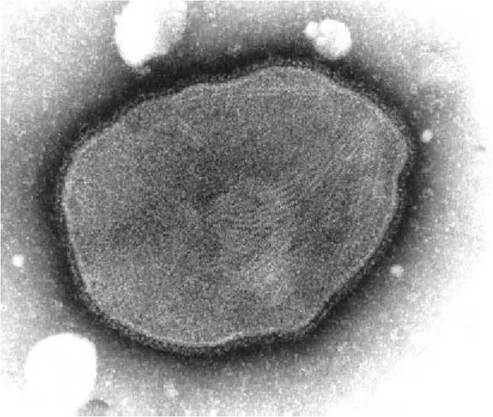
FIGURE 3.1 Morphology of an avian paramyxovirus. Note projections (spikes) on the surface of the particle and the internal herringbonelike structure of the viral RNA. Courtesy Dr Werner Herbst, University Giessen.
fragments of RNA are frequently seen and are of some help in differentiating APMV from other enveloped viruses of similar size.
All APMV are sensitive to lipid solvents such as ethanol, isopropanol, dimethyl ether, chloroform, phenol and its derivates, glutaraldehyde, quaternary ammonium compounds, bleach and other chemical disinfectants such as formic and peracetic acid. These compounds destroy the infectivity within 30 minutes at concentrations of 0.5 to 2.0% at room temperature.