Arthropod Infestations
Arthropod ectoparasites are not an important consideration in laboratory rats, although they are relatively common in wild and pet rats. Rats are host to 2 species of lice, Polyplax spinulosa (spined rat louse) and Hoplopleura pacifica (tropical rat louse), of which only the former has been described in laboratory rats.
Polyplax was once an important vector for M. haemomuris among rats. It can be associated with pruritis, irritability, and anemia, caused directly by feeding and indirectly by M. haemomuris. Fleas of several genera, including Xenopsylla, Leptopsylla, and Nosopsyllus, infest wild rats and, rarely, laboratory rats. Several different types of mites can infest rats, but all are rare in laboratory rats, except Radfordia ensifera (Myobia ratti), the fur mite, which can be common in some populations. Pruritis, hair loss, and loss of condition are associated with heavy infestations. The mite can be demonstrated in the pellage and may also be evident in tissue sections of affected skin (Fig. 2.51). Mesostigmatid mites, including Ornithonyssus bacoti (tropical rat mite),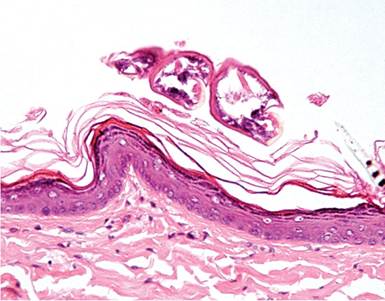
FIG. 2.51. Skin from rat with Radfordia ensifora infestation. These fur mites are present on the stratum corneum, with minimal reaction in the underlying skin.
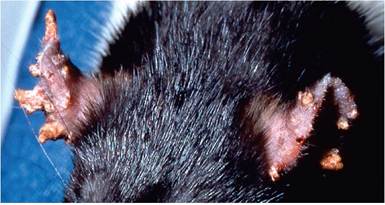
FIG. 2.52. Ear mange in a rat due to infestation with Notoedres muris. Note the disfigurement of the ears associated with proliferative dermatitis. (Source: N.J. Schoemaker, University of Utrecht, Netherlands. Reproduced with permission from N.J. Schoemaker.)
Laelaps echidnina (spiny rat mite), and Liponyssoides sp. (house mouse mite), are blood-sucking mites that are common in wild rodents, and are known to periodically infest laboratory rats.
These mites are associated with rats only while feeding. They seek refuge in the surrounding environment. Their bites are pruritic, as animal handlers can attest. Both O. bacoti and L. echidnina readily feed on humans, and O. bacoti in particular has been associated with dermatitis in humans exposed to rat-infested environments. These mites can cause anemia, debility, and infertility in rats. Rats may also be accidental hosts for a number of other mites. Other mites that reside permanently in or on the skin or fur of rats include Demodex spp., which have been found in follicles as an incidental finding in several populations of laboratory rats. Rattus norvegicus has been found to host 4 species of Demodex: D. nanus, D. ratti, D. ratticola, and D. norvegicus. The single report of Demodex infestation of laboratory rats suggested that the species was D. nanus. The prevalence of Demodex mites among laboratory rats is unknown, as these mites are generally only detected incidentally when skin sections are examined. Notoedres muris, a mange mite that burrows in the cornified epithelium of the ear and other hairless skin sites, is common among pet rats in Europe and often results in extensive proliferative lesions involving the ears and ear canal (Fig. 2.52). It has also appeared in laboratory rats following incursion of wild rats into an animal facility.