Chapter 13 Appendix V: Comments FROM THE DEPARTMENT OF HEALTH and Human Services
United States Government Accountability Office
Note: GAO comments supplementing those in the report text appear at the end of this appendix.
Lisa Shames
Director, Natural Resources and Fnvironment
U.S.
Government Accountability Office441 GStteetN-W.
Washington. DC 20548
Dear Ms. Shames:
Enclosed are comments on the U.S. Government Accountability Office's (GAO) report entitled: "Veterinitrian Workforce: Actions Are Needed to Ensure Sufficient Capacity for Protecting Public and Animal Health” (GAO-OT-178).
The Department appreciates the opportunity to review this report before its publication.
Sincerely,
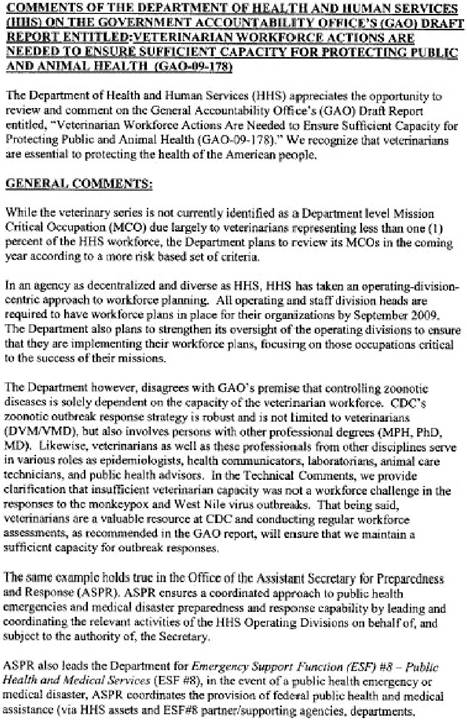
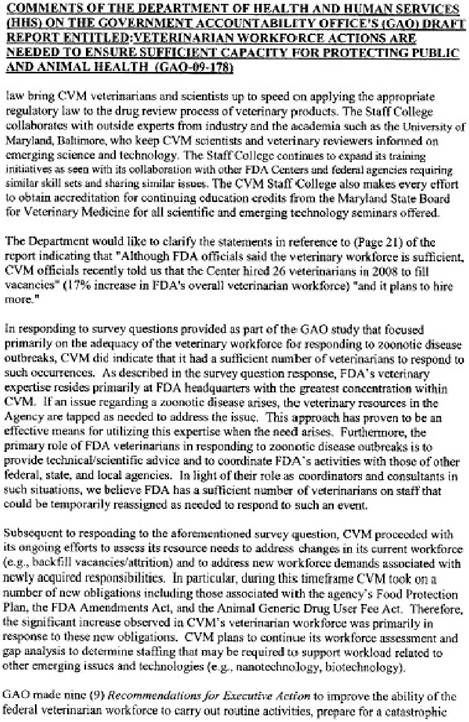
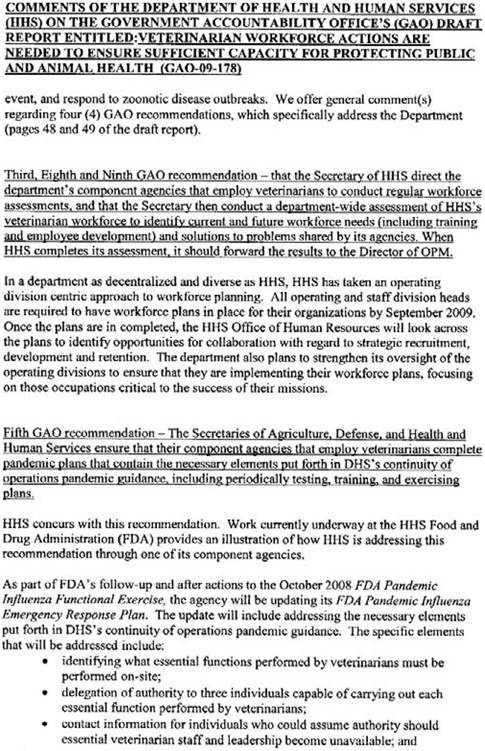
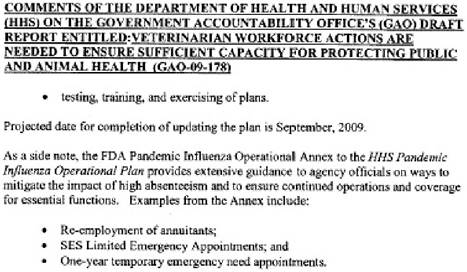
See comment 1.
See comment 2.
See comment 3.
See comment 4.
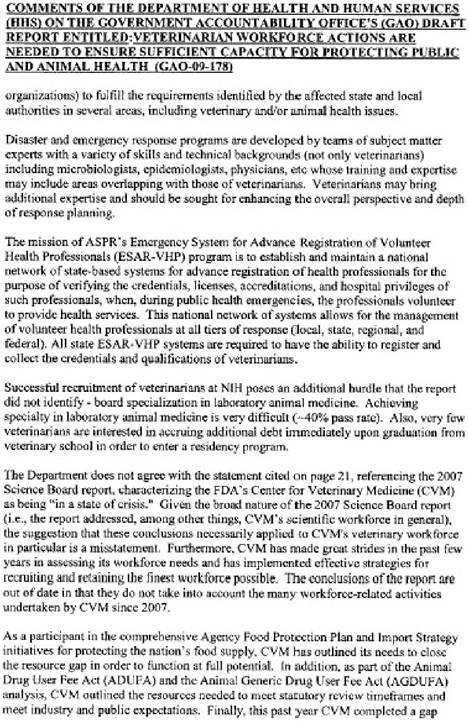
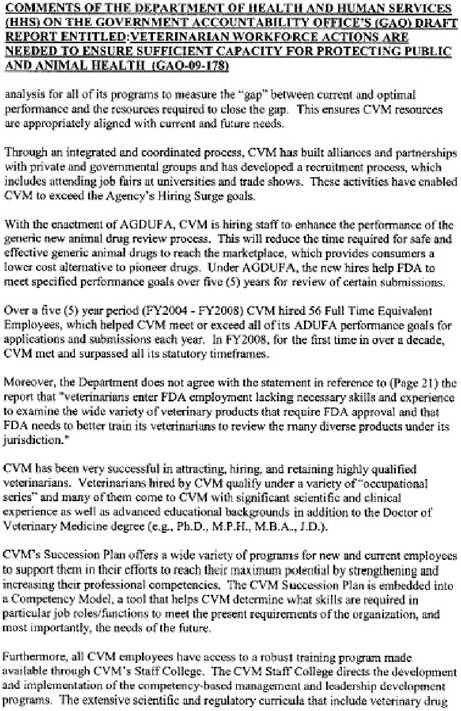
See comment 5.
The following are GAO's comments on the Department of Health and Human Services' letter dated January 14, 2009.
GAO Comments
1. HHS commented that a premise of our report is that the control of zoonotic diseases is solely dependent on the capacity of the veterinarian workforce. Our report does not state this. The scope of this report, as described in the introduction, was to review the sufficiency of the federal veterinarian workforce.
2. Our report does not identify the Centers for Disease Control and Prevention (CDC) as having too few veterinarians to control the 2003 West Nile virus outbreak while also adequately carrying out other routine activities. However, CDC officials we interviewed who were involved with the 2003 monkeypox outbreak in Wisconsin told us there were too few veterinarians during this outbreak.
3. We modified our report to reflect the new information about the difficulty the National Institutes of Health has recruiting veterinarians.
4. Our report states conclusions from the FDA Advisory Committee report: that FDA “cannot fulfill its mission” because its scientific workforce has remained static while its workload has increased, and that FDA's Center for Veterinary Medicine (CVM) is “in a state of crisis.” We discussed with an author of the Advisory Committee report how that report's findings specifically related to veterinarians. Consequently, our report also states that an author of the FDA Advisory Committee report told us that veterinarians enter FDA employment lacking necessary skills and experience to examine the wide variety of veterinary products that require FDA approval and that FDA needs to better train its veterinarians to review the many diverse products under its jurisdiction. HHS further stated that CVM has made great strides in the past few years in assessing its workforce needs and that the conclusions of the Advisory Committee report are out of date. Our report identifies several of the efforts CVM has recently undertaken, such as hiring additional veterinarians and beginning efforts to analyze the gap between current resources and needs. It also notes that, according to FDA officials, the agency is undertaking significant reforms to address fundamental concerns in the 2007 report. However, as our report states, FDA did not tell us how these efforts address the identified veterinarian skill gap specifically.
5. We modified our report to add a statement that the increase observed in CVM's veterinarian workforce was primarily in response to new obligations.