Contents
| Organization of the Nervous System | 216 | Neurophysiology | 222 |
| The Neuron | 217 | The Resting Membrane Potential | 222 |
| Cell Body | 217 | Membrane Channels | 224 |
| Dendrites | 217 | Postsynaptic Potentials | 225 |
| Axon | 218 | Generation of an Action Potential | 226 |
| Synapse | 218 | Propagation of the Action Potential | 227 |
| Classification of Neurons | 220 | Coding of Stimulus Intensity | 229 |
| Supportive Cells | 221 | Synaptic Transmission | 229 |
| Ependymal Cells | 221 | Electrical Transmission | 229 |
| Astrocytes | 221 | Chemical Transmission | 229 |
| Oligodendrocytes | 221 | Modulation of the Synaptic Signal | 230 |
| Microglia | 222 | Neurotransmitters | 231 |
| Satellite Cells and Schwann Cells | 222 | Chapter Summary | 237 |
The body must be in constant communication with both the internal and external environment.
To maintain homeostasis, the body must receive information about the environment and then must be able to respond to that information. These responses must be rapid and coordinated. The nervous system carries out these functions.The nervous system is responsible for collecting information about what is happening inside (internal environment), as well as outside (external environment), the body. It communicates with all parts of the body via electrical signals. This communication occurs in a highly coordinated and specific manner much like our older phone system in which signals were carried to and from various locations via wire that had to pass through a central switching station.
The nervous system can be viewed as having three components: sensory input, integration, and motor output (Fig. 8.1):
1. Sensory information about both the internal and external environment must be gathered. Any change in the environment can act as stimuli. Such sensory or afferent information is collected
Anatomy and Physiology of Domestic Animals, Second Edition. R. Michael Akers and D. Michael Denbow. © 2013 John Wiley & Sons, Inc. Published 2013 by John Wiley & Sons, Inc.
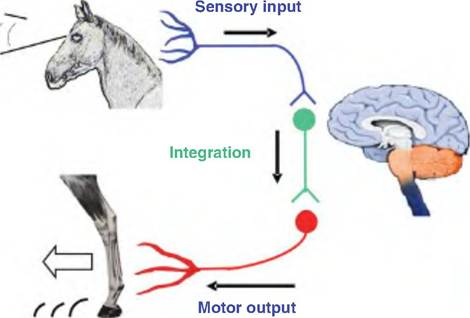
Fig. 8.1. Components of the nervous system. The nervous system has a sensory component responsible for detecting stimuli and transmitting that information to the integration center. There, the information is processed and the appropriate response is conveyed to an effector organ via the motor output.
by specialized neurons called sensory neurons and is transmitted as sensory input.
2. The processing and interpreting of sensory input is called integration.
3. Once the information has been processed, the appropriate response is elicited by sending a motor, or efferent, signal to an effector organ. As an example of this process, when an animal sees feed being placed in a feeder, the visual information is gathered by the eyes, which sends that information to the brain (sensory input). The brain processes that information (integration) and then sends a signal to the legs to enable the animal to walk to the feeder (motor output).