Contraction
Muscle is stimulated to contract when it receives a nerve impulse from the central nervous system. Each striated muscle Iibre is composed of myofibrils made of thin actin Iilaments and thick myosin filaments.
These fibres overlap in such a way that under the microscope muscle has the appearance of alternating light and dark bands or striations. These bands are separated into units called sιmvmι∙n∙s. which are the units of contraction.Duringcontraction. the actin and myosin filaments slide over one another and cross-bridges form between the heads of the myosin filaments and the heads of the actin filaments. The cross-bridges swing through an arc. pulling the thin Iilaments past the thick ones, and the sarcomere shortens. Once this movement is completed the cross-bridge detaches itself from the Ihin filament and reattaches itself further away - in other
W words, the cross-bridges between the myosin and actin filaments act as a ratchet mechanism, thus shortening the muscle (Fig. 4.11. This process requires energy input, which is provided by ATP molecules: calcium ions are also essential to the process of muscle contraction.
The nerve that stimulates the muscle to contract enters the muscle and then splits up into many fibres to innervate the bundles of muscle fibres. The number of muscle fibres supplied by one nerve fibre will vary depending on the type of movement for which the
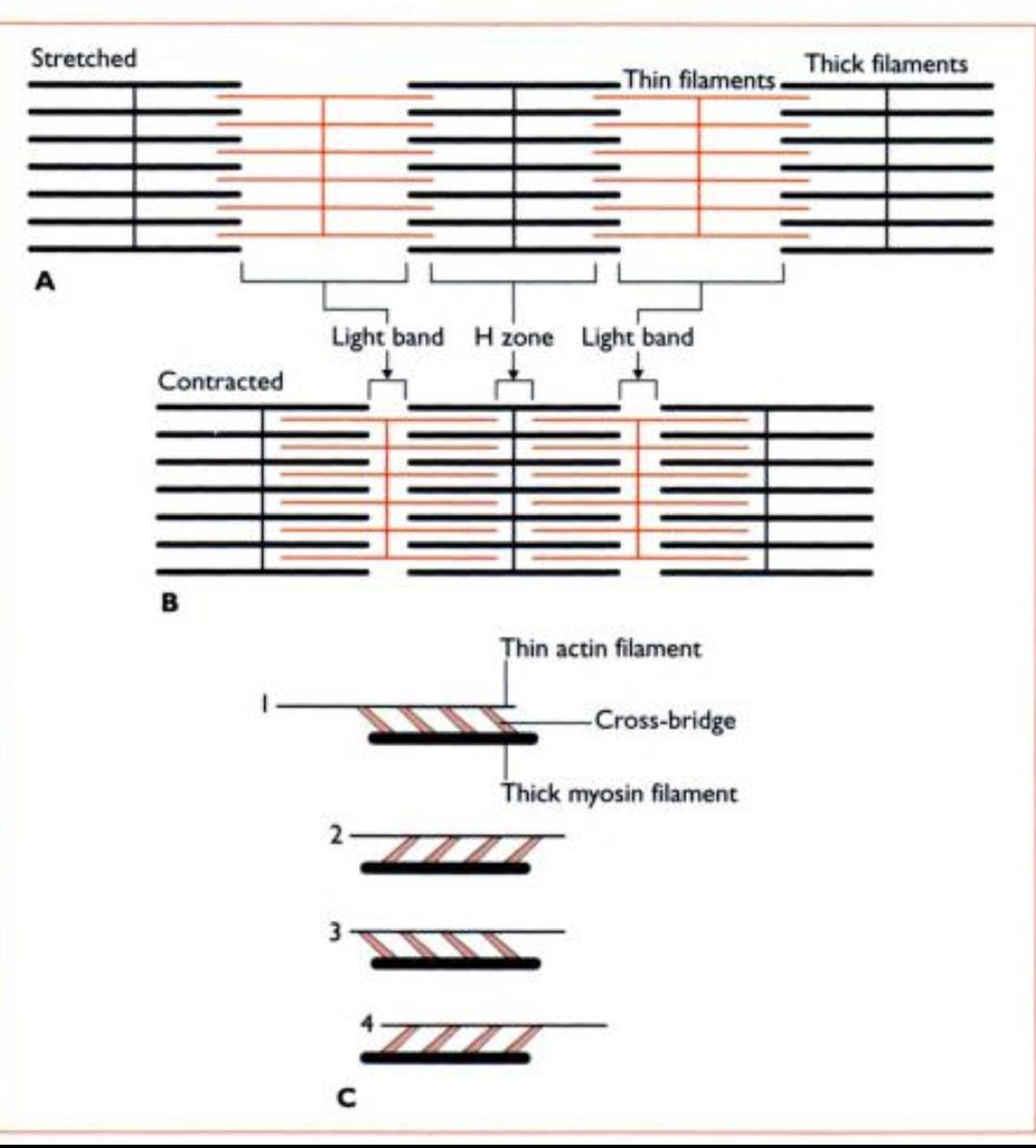
Fig. 4 J The 'ratchet mechanism' involving actn and myosin within stnated muscle fibres A Muscle before contraction (shortening). BWhcn the muscle shortens, the thick and thn filaments slide in bet ween one another The dark bands remain the same width in the shortened (contracted) muscle, but the ∣∣ght bands and 'H zones' get narrower C Oose up view of the ratchet mechanism', showing cross- b∩dges between the thin actin and thick myos∣n filaments
muscle is responsible. Il il is a delicate movement then a nerve fibre may only innervate a small number of muscle Iibres. However, in larger movements, such as those made bv the muscles of the limbs, one nerve fibre may supply 2(K) or more muscle fibres. A single nerve together with the muscle fibres that it supplies is called a motor unit.