Current Approaches of Paratuberculosis Control
21.3.1 Organization of and participation in paratuberculosis control
The data presented in this section all refer to the 22 countries with a control programme according to the recently performed survey (Whittington et al., 2019).
Coordination
A single national programme was in force in 18 countries. The Netherlands and the UK had more than one national control programme for dairy and/or beef cattle. Australia, Belgium, Canada, France, Germany, Spain and the UK had several regionally coordinated programmes, whereas programmes in the other countries were coordinated nationally. Within species, the control programmes differed between regions in some countries (Australia, Belgium, France, Germany, Canada), but were similar or identical between species in other countries (Iceland, Korea, Spain, Thailand and the UK).
Leadership
Leadership of the control programmes varied, ranging from a simple structure with just one major nominated leader in 11 of the 22 countries up to seven distinct components in Canada. In four of the single-leader programmes, leadership was provided by a private organization, whereas in seven countries the government was
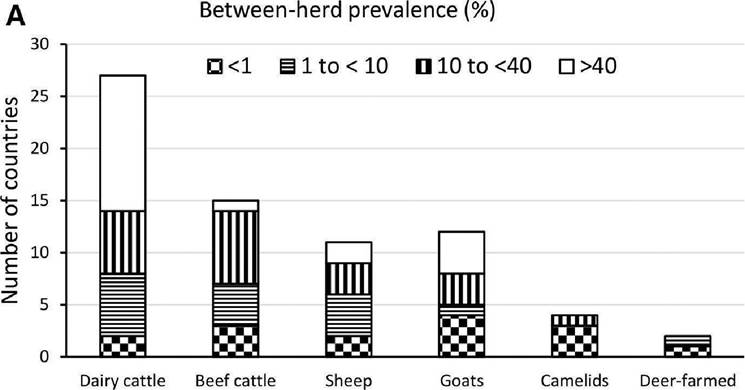
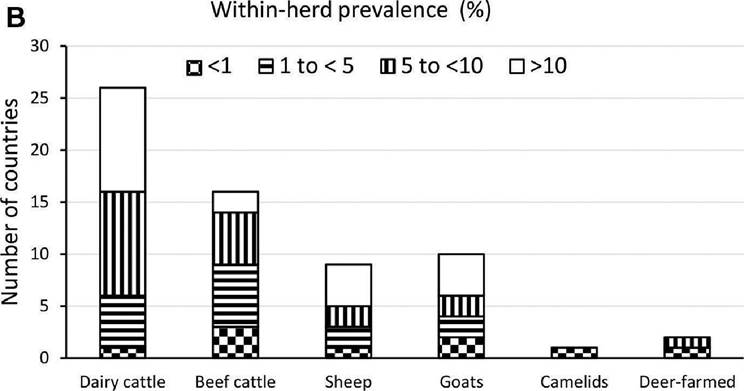
Fig. 21.2. Average between-herd prevalence (a) and within-herd prevalence (b) of paratuberculosis in countries where laboratory testing had been conducted (adopted from Whittington et al., 2019).
appointed as the leader. In the remaining 11 countries, multiple organizations were involved in leadership like government, veterinary or farmers' organizations as well as industry milk or meat associations.
Funding
Sources for funding for programme control as well as operations varied considerably between countries.
Main funding sources differed between programme leadership and operational costs (Whittington et al., 2019). Leadership was funded by the government in most countries. In eight countries, the government was the only source, whereas in another eight the government funded part of the leadership. Farmer organizations (n = 3) were the next most common financial source for programme leadership.However, programme operations were most likely to be funded partially or wholly by farmers (17 countries) compared with government alone (three countries) or by a combination of different sources.
Participation
Of the 22 countries with a control programme, participation was mandatory in nine, whereas participation was completely voluntary in the other 13 countries. Compulsory participation was legislated in Japan, Norway and a federal state of Germany. In Sweden, reporting of MAP suspicion in any species is mandatory, and if the presence of MAP is confirmed, stamping out and contact tracing is compulsory. In South Africa, animals diagnosed with MAP have to be isolated and slaughtered under the supervision of a state official, infected herds/flocks have to be placed under quarantine and in-contact animals have to be tested. Components of control that are compulsory vary from country to country according to the objectives of the programme. For example, in Austria and Switzerland the notification and elimination of clinical cases is compulsory, but on-farm measures to reduce the within-herd prevalence are voluntary. Active surveillance is mandatory in Japan while vaccination is mandatory in Iceland.
Manual
A manual or a legislative document describing the control programme in detail including the case definitions, rules and procedures was publicly available for 20 of 22 countries. Alternatively, some regions provided information for farmers online or upon request. In most cases, detailed descriptions of the methods of diagnosis/surveil- lance, control and the rules/regulations associated with control programmes as well as definitions for terms used in control programmes such as ‘infected’ and ‘diseased’ animals/herds and ‘control’ and ‘eradication’ were provided.
Incentives
Incentives for participation to enhance the enrolment of farmers in programmes were identified in 15 countries with control programmes, mostly in those with voluntary programmes.
Full or partial financial support, assistance or compensation to farmers for one or more operational aspects of the control programme was provided in 12 countries during 2012-2018. The components covered included costs of testing or conduction of risk assessments, the value of culled livestock and the cost of its culling. For example, in Austria and Switzerland, compensation is paid for clinically diseased animals that have to be culled. Sampling and testing are free of charge for cattle owners in Norway, Austria and Switzerland and partly subsidized in Belgium and Germany. Financial support may have begun or ceased due to programme review processes. For example, in Australia support was paid to beef farmers until 2015, then ceased, and in some federal states of Germany partial compensation for culled MAP shedders to cattle owners is paid.
Avoidance of penalties such as market access restrictions for non-participation can be an incentive as well because in some countries the consequences of diagnosis could mean exclusion from the market. In the Netherlands, participation of dairy cattle herds in the Milk Quality Assurance Program or the Intensive Paratuberculosis Program is part of the milk delivery conditions between herd owner and the dairy. However, in the Netherlands there are no incentives or restrictions for beef cattle, sheep and goats. Some milk processors in the UK impose an absolute requirement for farmers to engage in the control programme. Milk produced by Italian farms with clinical cases is not allowed to be sold when it is destined for dairy product exports.
Market Assurance Programs are available for Australian producers to mitigate the risk of between-herd transmission. In some regions of Germany there is a higher demand for breeding stock from farms with ‘non-suspect for paratuberculosis’ status.
In the UK, herds with low herd risk level are believed to sell more (pedigree) stock. In general, higher prices for animals from low-risk herds are expected although this has not been consistently realized. Market access is used to apply pressure on dairy farmers in some European countries.Research
Knowledge gaps constraining successful control have been reviewed recently (Barkema et al., 2018). Implemented paratuberculosis control programmes were combined with research objectives regarding aspects such as disease control, vaccination, pathophysiology, microbiology and economics in 12 out of 22 countries. The most common research objective was improving diagnostic tests and/or diagnostic test validation, followed by epidemiological research including prevalence, risk factors, transmission dynamics and environmental survival of MAP, research on farmer attitudes, food safety and animal genetics. Denmark, Japan, the Netherlands, Germany, Ireland, the UK and the USA had research programmes on paratuberculosis that were conducted independently of control programmes, but mostly paratuberculosis control and research are closely linked. In Switzerland, research on paratuberculosis was completely independent of a control programme.
21.3.2 Communication
Communication directed towards farmers and veterinarians about the disease and its causative agent are key elements. Furthermore, the importance and the background of the programme as well as consideration of farmers' attitudes towards the implementation of control measures on their farms are essential in MAP control (Benedictus et al., 2000; Roche et al., 2015; Ritter et al., 2016). An important issue that hampers the acceptance of paratuberculosis control among farmers is their perception that an ‘official' control programme aims at eradication of the disease (Lorna Citer, personal communication, 8 June 2018), which is not primarily the case in most paratuberculosis control programmes. Communication, extension or education and training activities were included in 77% of the control programmes according to the results of the recent survey (Whittington et al., 2019).
Included activities were websites, conferences and seminars, field days and newsletters, while a consistent objective was to increase awareness of the disease. The specific target audience for this activity were veterinarians (n = 12) and farmers (n = 9), whereas two countries focused on government representatives and stakeholders in general (n = 3). In more than two-thirds of the countries with a control programme the respondents reported that the control programmes benefited from an active stakeholder support consisting of farmers' organizations, government, veterinary organizations and private veterinarians. In more than half of the countries, the milk industry and individual farmers supported the programmes. Industry organizations for meat, livestock trading and food processing were supportive in one- third of the countries.21.3.3 Practices and tools
Control programmes for paratuberculosis are generally multi-component and involve many possible practices and tools. The most important factor in dairy operations is preventing calves from coming into contact with the faeces of adult cows (Dore et al., 2012). The main pillars of paratuberculosis control are a combination of animal-level and population-level measures such as culling shedding animals, applying hygienic measures aimed at reducing contamination of calves with manure from cows and vaccination. Limiting paratuberculosis control to the test-and-cull approach, i.e. the identification and elimination of either clinically diseased, MAP-shedding or subclinical infected animals will not eradicate paratuberculosis in the long run (Dorshorst et al., 2006). Actions limiting infection routes, e.g. avoiding faecal-oral transmission by improving calving area hygiene or by adequate colostrum/milk feeding management, are effective strategies to decrease MAP prevalence (Marce et al., 2010). Several field trials as well as simulation studies have shown that the most effective control strategy consists of a long-term combination of ‘test-and-cull' and increasing on-farm biosecurity (Dorshorst et al., 2006; Smith et al., 2017).
In a field study linked to the control programme in a German region with a test-and-cull strategy, the availability of a separate calving pen for MAP shedders and its hygiene were factors associated with incidence reduction (Donat et al., 2016a).Effectiveness of control measures in dairy cattle herds depends on disease prevalence among adults. In an individual-based modelling approach, the most influential measure was reduced calf exposure, followed by test frequency and the proportion of detected and culled MAP shedders (Camanes et al., 2018). Furthermore, it was identified that combining test-and-cull options with calf management should depend on herd prevalence status with improving calf management in cases of increasing prevalence. In high-prevalence herds, moderate and high shed- ders should always be culled based on annual tests. For herds with a moderate prevalence, early culling of high shedders improved the effect of control measures. Culling the progeny of known infected cows was effective in low-prevalence herds (Camanes et al., 2018) as in utero infection with MAP may occur (Whittington and Windsor, 2009). Considering the finite environmental survival of MAP, pasture and grazing management should be utilized to reduce the exposure of grazing youngstock (Whittington et al., 2004; Eppleston et al., 2014).
Biosecurity measures have to be in place to prevent the transmission between herds or the reintroduction of MAP after successful elimination and to protect MAP-unsuspected herds from new infection. The main risk factor for between-herd transmission is the purchase or movement of subclinical infected animals into the herd (Rangel et al., 2015). This risk can be effectively mitigated by reducing movements of animals and faeces between farms. Certification of a MAP-herd status that reflects the risk of MAP transmission by animals or manure originating from that herd is essential.
As a further tool, vaccination of cattle and sheep has been shown to be effective in delaying the onset of the disease, reducing clinical incidence and faecal shedding of MAP and therefore reducing economic losses and the transmission rate within a herd (Reddacliff et al., 2006; Bastida and Juste, 2011). In paratuberculosis control in cattle, vaccination is not widely used at present. The limited protective potency of the vaccine, its considerable side effects and the risk of interference between paratuberculosis vaccination and intradermal testing for bovine tuberculosis results in restricted use (Coad et al., 2013; Serrano et al., 2017). Less than one-third of the countries applied vaccination to some (never all) species; for example, only sheep were vaccinated in South Africa and only sheep and goats in the Netherlands, and in France and Germany, vaccination requires a special permit (Whittington et al., 2019). In contrast, in both the Australian and the Spanish sheep industries, vaccination contributed to a significant reduction of within- herd prevalence and has been a key element in control for decades (Dhand et al., 2016).
Table 21.3 compresses the most common practices and tools used in control programmes for paratuberculosis depending on the prevalence of paratuberculosis within the country or region and on the objectives of the programme (Whittington et al., 2019).
Table 21.3. Most common practices and tools used in control programmes for paratuberculosis in 22 countries (adopted from Whittington et al., 2019, modified).
| Tool | No. of countries | % of countries |
| Cull clinical cases | 19 | 86.4 |
| Hygienic rearing of neonates/juvenile livestock | 17 | 77.3 |
| Farm-level biosecurity to prevent introduction of infection | 17 | 77.3 |
| Test-and-cull subclinical cases | 16 | 72.7 |
| Environmental and pasture management | 14 | 63.6 |
| Communications programme | 14 | 63.6 |
| Herd/flock assurance certification | 13 | 59.1 |
| Research programme | 11 | 50.0 |
| Vaccination | 7 | 31.8 |
| Regional biosecurity to prevent introduction of infection | 5 | 22.7 |
| National biosecurity to prevent introduction of infection | 4 | 18.2 |
| Stamping out infected herds/flocks | 3 | 13.6 |
| Individual animal assurance certification | 3 | 13.6 |
‘Classical’ measures of animal disease control are applied, for example, in Switzerland: any animal traffic to and from the infected farm is forbidden, clinical cases as well as their suckling calves/lambs have to be culled, and the housing has to be cleaned and disinfected before the animal traffic ban can be lifted from the farm.
21.3.4 Diagnostic tools and their purposes
Primarily due to the chronic nature of the disease, diagnostic tests used for paratuberculosis are generally imperfect. If used properly they can be useful meeting a specific purpose such as:
• confirmation of clinical disease;
• use in a test-and-cull strategy to identify and eliminate MAP shedders from a herd;
• identify high-risk animals to apply specific management practices that contributes to control at herd level;
• establishment of animal, herd or population freedom from infection;
• surveillance;
• prevalence estimation.
Diagnostic tools should be used in order to answer specific questions and results should lead to a decision, for example, culling of clinically diseased animals or to prevent insemination of subclinical infected cows to accelerate removal of the cow from the herd.
A wide range of tests is available as tools for the above-mentioned purposes. In general, available paratuberculosis tests offer a high specificity, but unfortunately, this is combined with a low sensitivity when used to identify individual cow status. Polymerase chain reaction (PCR) or bacterial culture are used for the direct detection of the infectious agent in faecal samples and are considered a direct measure of bacterial shedding of the sampled cow. Bacterial culture is widely accepted as the gold standard. Detection of MAP-specific antibodies using enzyme-linked immunosorbent assay (ELISA) (or agar gel immunodiffusion test (AGID) and complement fixation test (CFT) in the past) for serum or milk samples are indirect measures of the infection detecting the humoral immune responses in infected animals. To prove MAP infection in individual cows, pathological examination followed by microscopic examination and bacterial culture or PCR of target tissues is necessary. If an individual test result is used in combination with the herd status or historical results, the accuracy of the test used at animal level can be increased (More et al., 2015). The status or the historical results can represent individual test results as mentioned above, or herd- or flock-level diagnostics such as culture or PCR on environmental samples (Raizman et al., 2004) or boot swabs (Donat et al., 2016b), or use of pooled faecal samples (Whittington et al., 2000). Bulk tank milk ELISA is also used in several programmes, but its low herd-level sensitivity (Sergeant et al., 2019) hampers practical application for low within-herd prevalence herds. However, the different tools for herd- or flock-level diagnostics provide a useful and economic way to identify high-prevalence herds and their results can help to convince farmers to work on risk mitigation strategies and participate within control programmes (Khol et al., 2019).
The OIE (2014) provides an overview of different tests for different purposes, but a multitude of considerations are needed to establish a useful test-strategy (see e.g. Nielsen, 2014). The choice between different tests may be related to availability, logistics or costs (Whittington et al., 2000).
Under different circumstances, additional tests might be considered. For example, the Ziehl-Nielsen (ZN) stain of faecal or tissue smears may serve as a fast diagnostic tool to confirm clinical diagnosis (Weber et al., 2009). In the past, skin testing to detect cell-mediated immune responses was also used (Kalis et al., 2003). Since its use may interfere with skin testing for Mycobacterium bovis and the availability of Johnin is limited, this method is no longer commonly used. In vitro tests for the detection of cell-mediated immune responses such as the interferon-gamma release assay may merely report exposure to MAP, and the clinical relevance has yet to be established. Recent research focuses on the identification of purified proteins for the improvement of the interferon-gamma release assay, the diagnostic value of volatile organic compounds (see e.g. Gierschner et al., 2019) or
Table 21.4. Purposes of use of the most frequently applied types of test among control programmes for cattle in 22 countries (adopted from Whittington et al., 2019, modified).
| Test | Individual animal diagnosis | Individual animal certification/assurance | Herd-level screening | Herd-level certification/ assurance |
| Serum enzyme-linked immunosorbent assay (ELISA) | 17 | 2 | 14 | 9 |
| Faecal polymerase chain reaction (PCR) - individual | 18 | 8 | 9 | 8 |
| Faecal culture - individual | 17 | 3 | 5 | 5 |
| Pathology | 15 | 1 | 1 | 2 |
| Faecal PCR - pooled | 3 | 11 | 6 | |
| Milk ELISA - individuals | 10 | 11 | 6 | |
| Faecal culture - pooled | 3 | 8 | 4 | |
| Milk ELISA - bulk milk | 6 | 1 | ||
| Environmental faecal test - | 1 | 1 | 6 | 4 |
culture or PCR
metabolomic profiling (De Buck et al., 2014) for the early identification of MAP-infected animals or low-prevalence herds.
The answer given in the survey identified that countries with a control programme for cattle most commonly used serum ELISA, faecal PCR and pathology as diagnostic tests (Whittington et al., 2019). AGID, CFT (both on blood), intradermal skin test and faecal Ziehl-Neelsen smear were least often applied (Table 21.4). Regarding the use of other tests or the testing in other species, see Whittington et al. (2019).
21.3.5 Goals, results and success of control programmes
Publicly available results of control programmes operating between 2012 and 2018 were the number of suspect and confirmed cases and farms (Austria, Japan), numbers of participating dairy farms (the Netherlands, Germany), incidence of paratuberculosis based on abattoir surveillance in sheep (Australia) and deer (New Zealand), weekly test prevalence data for dairy cattle (Denmark) or deer (New Zealand) farms, as well as lists of certified farms (Australia, the UK, regions of Germany) (Whittington et al., 2019). Nearly half of the countries had indicators to measure the success of their control programme. The most common goal was an increase of participants in the control programme followed by reductions in the number of infected animals or clinical cases detected within each testing round and meeting targets in the number of ‘low-risk’, ‘free’ or certified herds. Norway included active surveillance targets and farm-level post-eradication checks as primary objectives. Sixteen countries reported having successful control programmes, whereas 13 commented that their programme objectives had been or were being met. Some survey participants rated specific outcomes such as market access maintained, prevented clinical cases or farmer satisfaction as their goal. Four countries with successful outcomes in general acknowledged specific problems:
• voluntary continuation of the programme among producers was much lower than hoped for;
• declining numbers of farms in market assurance programmes;
• herd-level prevalence did not diminish (Belgium);
• the winding back of the national control programme (Australia);
• funding for the programme and for research dried up (Canada, Australia); only a minority of herds benefited from the programme, since most of the herds were not in the programme and therefore it is unlikely that the programme has had a significant impact on the individual animal or herd-level prevalence in the region (UK);
in six of the 22 countries, outcomes could not be assessed or it was too early to tell if success had been achieved.
21.3.6 Paratuberculosis control in low and middle income countries
Although the survey was co-authored by several authors from low and middle income countries (LMIC) only limited information about paratuberculosis control was available (Whittington et al., 2019). It was observed that the size and complexities of the animal populations at risk were extraordinary in the livestock producing countries outside the major developed economies of Europe, North America and Australia. Nine LMIC provided country-specific overviews including information about the animal population, the husbandry system and the situation regarding paratuberculosis (Whittington et al., 2019, additional files); five were from Central and South America (Argentina, Brazil, Colombia, Ecuador, Panama), three from Asia (Bangladesh, India, Iran) and two from Africa (Nigeria, Zambia). A total of about 440 million cattle, 202 million sheep, 232 million goats and 113 million buffalo were kept in these countries with the largest populations in India (cattle, sheep and buffalo) and Nigeria (goats). All countries had several types of farmed ruminants in multiple husbandry systems, in most countries up to six or seven types, in tens of thousands of individual farms per country.
Data showed that lack of resources of one kind or another were the most common reason for not implementing paratuberculosis control in LMIC countries. Simply put, there were other priorities for which resources were needed, e.g. controlling bovine tuberculosis. In most LMIC animal health and welfare was found to be still rudimentary because education, accessibility of rural areas and economic resources are missing. Veterinary advice to farmers in general tended to be missing in these countries, too. Lack of leadership at national and international level was identified as another relevant cause leading to only a little attention for paratuberculosis control in many LMIC (Whittington et al., 2019). However, cases of paratuberculosis as well as an endemic paratuberculosis situation were reported from most countries except Nigeria (no information available). Because a surveillance system was not established in most of these LMIC countries, information regarding prevalence is lacking. In Brazil and Zambia, the disease is notifiable. Although countries with a lower socio-economic status were found to often have large animal populations and arguably from a human development perspective would benefit the most from an animal health programme, official paratuberculosis control measures were not reported from any of these countries except Thailand. However, in India and in Argentina, Colombia, Ecuador and Iran, on-farm-level control activities were reported with voluntary testing, removal of test-positive animals and separation of calves.
21.4