Issues Impeding Future Control
Paratuberculosis is a common disease with considerable impact on animal health, animal welfare and economics, and it may affect public health. Without a doubt, prevalence and incidence will increase if it is not controlled (Groenendaal et al., 2002; Mitchell et al., 2008).
The practices and tools for control of paratuberculosis and their limitations have been known for decades. Culling of clinical cases, test-and- cull of subclinical cases, improving biosecurity to prevent new infections in young stock and environmental pasture management are the most important chosen approaches. Vaccination is seldom used, despite the potential appeal given the difficulty of long-term implementation of improved biosecurity measures and on-farm management processes. There are many challenges for controlling the disease, including the need to deal with different species, very large animal populations, disease presence in a large number of herds and the need to manage the programme over a long time-frame while participating farms stay economically stable. Although control of this disease seems to be important, relevant impediments exist.21.4.1 Lack of an international animal health code for paratuberculosis
Due to open markets and global animal trade and the endemic and transboundary character of the disease, leadership is required to enhance the control of paratuberculosis to a global level, commencing with an agreed international code for paratuberculosis, specifying the principles and methods of control ideally adopted by the OIE. The lack of any general guidelines, let alone international regulation for paratuberculosis control, leads to heterogeneity of control pro- gramnes in different countries and even worse to fragmentation of control activities within several countries. This creates a vacuum where animal health authorities do not know what to recommend and farmers can avoid costly measures while the disease is spreading.
An international dialogue to rationalize paratuberculosis control is needed to use available resources for animal disease control most efficiently and to harmonize public health assessments of MAP between countries.21.4.2 Lack of paratuberculosis control in LMIC
Other priorities and missing veterinary advice in general and paratuberculosis control specifically aggravates the situation in LMIC compared with HIC since these countries will suffer the greatest impact on human wealth and human health through lost production of animal protein and potential zoonotic impacts (Whittington et al., 2019). Several types of farmed ruminants in multiple, often free-ranging husbandry systems are common in LMIC in tens of thousands of individual farms per country. In this landscape, the challenges for disease control are enormous, animal diseases in general and paratuberculosis specifically can spread between farms, regions, countries and between livestock species, prior to any clinical evidence. There is a strong need to make the issues of paratuberculosis more visible worldwide, which will support the approaches for animal disease control in LMIC as well. The ‘think globally and act locally' approach should be adopted. An international consensus to approve the use of vaccination could be a helpful tool to reduce economic losses and MAP shedding especially in LMIC when bovine tuberculosis testing of cattle is not performed. In the future, the options linking paratuberculosis and tuberculosis control activities should be evaluated because both require a similar framework including on-farm work, individual animal testing and interaction with farmers.
21.4.3 Lack of data on true prevalence
The global prevalence of paratuberculosis as reported by Whittington et al. (2019) is concerning. It is estimated that in about 70% of the countries more than 10% of herds and flocks were affected, with between-herd prevalences of >40% in some HIC. The prevalence of paratuberculosis within infected herds and flocks is often ‘guestimated'.
Respondents of many countries did not know what is going on with respect to paratuberculosis in their herds and flocks, particularly in species other than cattle. Better estimates for within-herd prevalence are needed worldwide, and therefore standardized testing schemes should be defined to establish data that are comparable between countries. This information should support countries in deciding which stages of control or eradication are appropriate. At this moment, the most common objective is prevalence reduction; however, several countries already offer an option for motivated farmers to work on elimination of the disease at farm or regional level. Sweden and Norway are even considered to be in a surveillance phase after successful eradication.21.4.4 Lack of performance indicators
Albeit in most countries herd participation rates in control programmes are used as performance criteria, this may not be a good measure to determine success. It can be argued that reduction of the annual incidence of clinical cases should be used as a performance indicator, interpreting this as a successful reduction of transmission.
Nevertheless, this may lead to a false sense of security and premature cessation of strict control measures since improved animal management or a lower mean age of the herd may have a similar effect while subclinical infection rates may still be high. However, without short-term performance indicators, farmers, stakeholders, the industry and organizations funding the control programme tend to become less motivated over time. The negative aspects of available performance indicators should lead to exploration of other measures. Determination of within-herd prevalence over several years based on objective surveillance and testing seems a promising indication about a programme’s success.
21.4.5 Lack of holistic approach
All ruminant livestock industries and wildlife must be involved to prevent the development of a reservoir of MAP. Some countries have control programmes only for one type of livestock (mostly for dairy cattle) or manage the control differently between species, even though the disease is present in others.
For example, in Australia paratuberculosis control in beef cattle has been managed independently from that in sheep, despite the occurrence of co-grazing of pastures, or control in dairy cattle has been managed independently from beef cattle despite the fact that dairy calves enter beef production facilities. These compartmentalized approaches are ineffective and costly since there is evidence of spread between these sectors. Despite apparent host preferences of different strains of MAP, it is unclear whether the pathogen can persist in new niches. Evaluating spread of MAP from farmed livestock to wildlife populations and the role of potential reservoir hosts for MAP is important.21.4.6 Cessation of funding for the programme
As is the case for several endemic diseases, e.g. bovine tuberculosis, the time frame for successful control of paratuberculosis is measured in decades. In a voluntary control environment, the availability of funding for long-term control activities has been shown to be problematic in several countries. There is a strong need for sustainability of such an effort, which arguably must be determined and justified economically. Research studies to better understand consumer decisions and forecast market demands with respect to the animal welfare and public health aspects of MAP infection are warranted. Mostly in HIC, several stakeholders, non-governmental organizations and even relevant political parties presently address animal welfare and health aspects politically. All those needs may be determined by a variety of objective factors, including for example the need to ameliorate animal welfare concerns, the need to meet market access specifications or the need to reduce economic losses due to the burden of disease. Clearly, most ongoing control programmes address these needs. Encouragement of the efforts of the sector by special regulations enforced by legislation and supported by public money may be required to improve MAP control.
Without that support, control programmes are prone to be undervalued by stakeholders of the cattle industry and not sustainable, because farmer and consumer behaviour alone are unlikely to provide market changes and appropriate price signals to reward the efforts to control paratuberculosis in the long term. For example, in the USA, Canada and Australia, control programmes have expired in recent years, regardless of apparent or partial successes. In Sweden however, the compulsory activity to detect and to eradicate MAP was financially supported by the state, which is considered one of the reasons why prevention, control and eradication of MAP has been successful.21.4.7 Lack of research
Paratuberculosis control strategies should be continuously monitored and reviewed. Ongoing research developments on improved diagnostic tests, vaccines and epidemiological insights should be implemented in existing programmes. Improvement of diagnostic tests would be desirable to assist test-and-cull strategies as well as surveillance for MAP. In addition, improved tests are important to enable a broader use of existing commercial vaccines for paratuberculosis. The development of a vaccine preventing infection would be advantageous for controlling MAP in scenarios where individual testing by use of antibody
ELISAs is not meaningful or required. New methods for studying the pathology of the disease may enhance discovery of vaccine candidates.
21.4.8 Lack of adherence to movement controls and herd status certification
The guidelines of the International Association on Paratuberculosis provide a template to improve certification in international trade and are an important first step forward (Kennedy et al., 2017). They rely on the existence of areas with different MAP status, for example MAP-‘free', MAP-eradication and MAP-certification areas. Presently, eradication is rarely an objective of control programmes. However, since animal trade is common, mitigating the risk of paratuberculosis
spread from one herd to another is a strong need for successful control in every stage of a control programme.
Guidelines for movement of livestock should relay on the status of the herd of origin in combination with individual test results rather than individual test results alone. A risk status based on either individual test results interpreted at herd level or on herd-level diagnostic approaches like repeated environmental samples or bulk milk testing may be advantageous. The results of the herd-level diagnosis can be used for monitoring and prevalence estimation over time. Ideally, this monitoring should be mandatory and funded by public money. This approach represents an economical use of public funds, particularly in the framework of the new European AHL. Figure 21.3 provides a general model how this low-cost monitoring system followed by a control phase in MAP-positive herds asking more commitment of participating farmers can be integrated into a control programme. This approach is presently applied in some German and Austrian regions (Khol etal., 2019).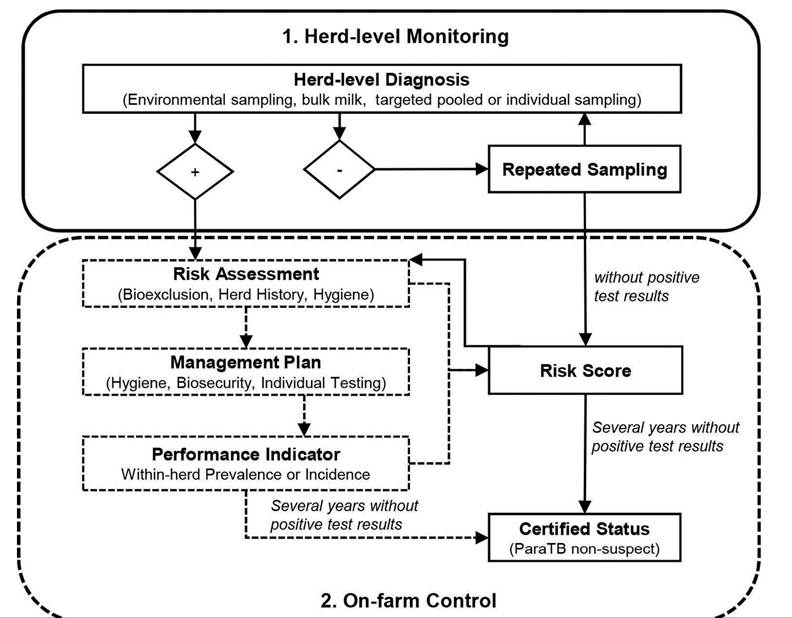
Fig. 21.3. Suggested model to integrate herd-level monitoring and on-farm control measures as a two- stage approach in paratuberculosis control (continuous lines: preferable mandatory part at regional or national level, dashed lines: preferable voluntary part at farm level).
farmers, veterinarians, national and international authorities.
21.5