Diagnosis
Several diagnostic methods are available for the detection of MAP infection in cattle, and each have their relative merits and applications. They are classically divided into two categories: (i) immune-based tests that detect the animal's immune response to MAP, and (ii) organism detection tests that detect MAP organisms or MAP bacterial DNA.
Specific diagnostic assays, including culture (see Chapter 18, this volume), PCR (see PChapter 19, this volume) and immunological assays (see Chapter 20, this volume), are considered elsewhere.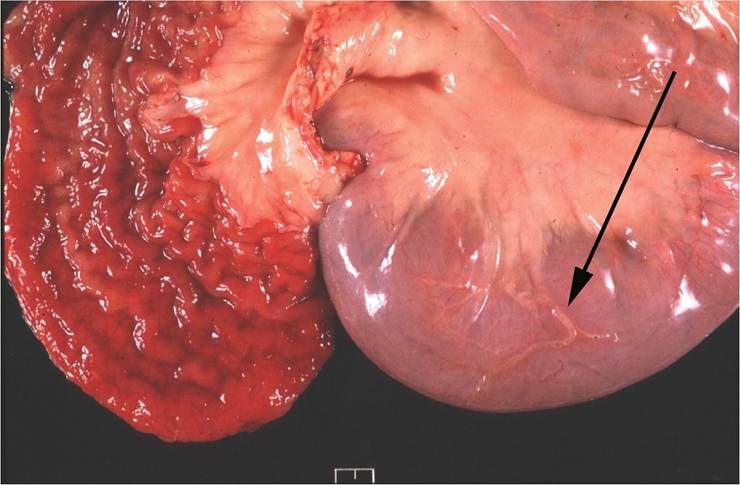
Fig. 11.2. Photograph of ileum manifesting lesions typical of paratuberculosis. To the left, the intestinal wall is thickened due to infiltration by leucocytes and epithelioid cells. To the right, there is mesenteric oedema, with a dilated mesenteric lymphatic channel, shown by the arrow. (Reproduced with the kind permission of Michael Collins.)
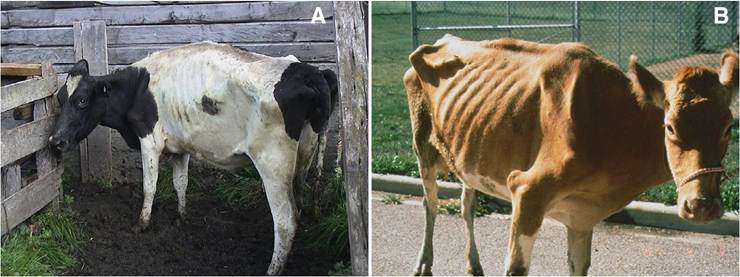
Fig. 11.3. Advanced paratuberculosis in Holstein (a) and Guernsey (b) cows. Signs of disease include weight loss, seen as marked reduction of muscle mass and visible skeletal bones such as ribs, pelvis and shoulder girdle. (Reproduced with the kind permission of Michael Collins.)
11.4.1 Testing strategies
Diagnosis of infection in cattle depends in part on whether diagnostic efforts are aimed at detecting infection in an individual animal or a herd. A consensus statement regarding testing recommendations for US cattle was published in 2006 (Collins et al., 2006). The main purpose of the report was to provide simple, practical and cost-effective recommendations for cattle herds. Those recommendations were summarized and adapted by Collins in a review chapter on the diagnosis of paratuberculosis (Collins,
2011).
Another consensus statement on paratuberculosis issued by the American College of Veterinary Internal Medicine and published in 2012 covered diagnostic test recommendations for various testing purposes (Sweeney et al.,2012).
11.4.2 Diagnostic testing in a known- infected herd
In a known-positive herd, the main goal is to decrease environmental MAP load and therefore decrease the risk of exposure to susceptible animals. Determination of individual cow's MAP infection status will facilitate cow and calf management around calving (i.e. segregation of calving areas, colostrum management), and culling of high-positive cows. In commercial herds with high prevalence (>5%), individual ELISA on milk or serum is recommended, keeping in mind to interpret results quantitatively, based on S/P ratios (Wells et al., 2002a). In low- prevalence herds (for a 1000- cow herd with high prevalence (van Schaik et al., 2003). In another study that assessed faecal pooling strategies in low-prevalence herds using a simulation analysis, the weighted mean herd probabilities of detecting a positive herd ranged between 52 and 99.3%, with the lowest probability for pools of 10 with one positive cow in the herd and the highest probability for pools of 5 with five positive cows in the herd (McKenna et al., 2018).
11.4.4 Diagnostic testing for eradication
The choice of test is dictated by herd prevalence and by how quickly and aggressively a producer wants to eradicate MAP from his herd. In general, the fastest approaches are also the most expensive to the producer. For example, wholeherd individual faecal culture or PCR followed by culling of positive animals has a better chance of quickly eradicating MAP from a seedstock herd but may be costly, while a less expensive (and less aggressive) approach might involve pooled faecal culture or serum/milk ELISA.
11.4.5 Diagnostic testing for individual animals
Diagnostic testing of an individual or group of animals that are not showing signs of paratuberculosis (pre-purchase screening) is difficult, especially in animals that are J., Steadham, E., Haynes, J., Bailey, T.
and Cheville, N. (2003) Phagosomal maturation and intracellular survival of Mycobacterium avium subspecies paratuberculosis in J774 cells. Comparative Immunology, Microbiology and Infectious Diseases 26(4), 269-283. DOI: 10.1016/ S0147-9571(02)00070-X.Jorgensen, J.B. (1982) An improved medium for culture of Mycobacterium paratuberculosis from bovine faeces. Acta Veterinaria Scandinavica 23(3), 325-335.
Kalis, C.H., Hesselink, J.W., Barkema, H.W. and Collins, M.T. (2000) Culture of strategically pooled bovine fecal samples as a method to screen herds for paratuberculosis. Journal of Veterinary Diagnostic Investigation 12(6), 547-551. DOI: 10.1177/104063870001200609.
Kirkpatrick, B.W. and Lett, B.M. (2018) Short communication: heritability of susceptibility to infection by Mycobacterium avium ssp. paratuberculosis in Holstein cattle. Journal of Dairy Science 101(12), 11165-11169. DOI: 10.3168/jds.2018-15021.
Kiser, J.N., Neupane, M., White, S.N. and Neibergs, H.L. (2018) Identification of genes associated with susceptibility to Mycobacterium avium ssp. paratuberculosis (MAP) tissue infection in Holstein cattle using gene set enrichment analysis-SNP. Mammalian Genome 29(7-8), 539-549. DOI: 10.1007/ s00335-017-9725-4.
Kruip, T.A.M., Muskens, J., van Roermund, H.J.W., Bakker, D. and Stockhofe-Zurwieden, N. (2003) Lack of association of Mycobacterium avium subsp. paratuberculosis with oocytes and embryos from moderate shedders of the pathogen. Theriogenology 59(7), 1651-1660. DOI: 10.1016/ S0093-691X(02)01208-6.
Lavers, C.J., McKenna, S.L.B., Dohoo, I.R., Barkema, H.W. and Keefe, G.P. (2013) Evaluation of environmental fecal culture for Mycobacterium avium subspecies paratuberculosis detection in dairy herds and association with apparent within-herd prevalence. The Canadian Veterinary Journal 54(11), 1053-1060.
Lombard, J.E. (2011) Epidemiology and economics of paratuberculosis. The Veterinary Clinics of North America. Food Animal Practice 27(3), 525-535.
DOI: 10.1016∕j.cvfa.2011.07.012.Lombard, J.E., Garry, F.B., McCluskey, B.J. and Wagner, B.A. (2005) Risk of removal and effects on milk production associated with paratuberculosis status in dairy cows. Journal of the American Veterinary Medical Association 227(12), 1975-1981. DOI: 10.2460∕javma.2005.227.1975.
Lombard, J.E., Wagner, B.A., Smith, R.L., McCluskey, B.J., Harris, B.N. et al. (2006) Evaluation of environmental sampling and culture to determine Mycobacterium avium subspecies paratuberculosis distribution and herd infection status on US dairy operations. Journal of Dairy Science 89(11), 4163-4171. DOI: 10.3168∕jds.S0022-0302(06)72461-4.
Lombard, J.E., Gardner, I.A., Jafarzadeh, S.R., Fossler, C.P., Harris, B. et al. (2013) Herd-level prevalence of Mycobacterium avium subsp. paratuberculosis infection in United States dairy herds in 2007. Preventive Veterinary Medicine 108(2-3), 234-238. DOI: 10.1016∕j.prevetmed.2012.08.006.
McKenna, S.L.B., Ritter, C., Dohoo, I., Keefe, G.P. and Barkema, H.W. (2018) Comparison of fecal pooling strategies for detection of Mycobacterium avium ssp. paratuberculosis in cattle. Journal of Dairy Science 101(8), 7463-7470. DOI: 10.3168∕jds.2018-14458.
Momotani, E., Whipple, D.L., Thiermann, A.B. and Cheville, N.F. (1988) Role of M cells and macrophages in the entrance of Mycobacterium paratuberculosis into domes of ileal Peyer's patches in calves. Veterinary Pathology 25(2), 131-137. DOI: 10.1177∕030098588802500205.
National Animal Health Monitoring System (2002) Part I: Reference of Dairy Health and Management in the United States. USDA-APHIS-VS, CEAH, Fort Collins, Colorado, #N400.1203. Available at: https√∕www.aphis.usda.gov∕animaLhealth∕nahms∕dairy∕downloads∕dairy07∕Dairy07-dr-PartI.pdf (accessed 6 June 2019).
National Animal Health Monitoring System Dairy (2007) Johne's disease on US dairies, 1991-2007.
USDA-APHIS-VS, CEAH, Fort Collins, Colorado, #N521.0408. Available at: https√∕www.aphis.usda. gov∕animaLhealth∕nahms∕dairy∕downloads∕dairy07∕Dairy07Js-Johnes.pdf (accessed 6 June 2019).Nielsen, S.S., Bjerre, H. and Toft, N. (2008) Colostrum and milk as risk factors for infection with Mycobacterium avium subspecies paratuberculosis in dairy cattle. Journal of Dairy Science 91(12), 4610-4615. DOI: 10.3168∕jds.2008-1272.
Osterstock, J.B., Fosgate, G.T., Cohen, N.D., Derr, J.N. and Roussel, A.J. (2008) Familial and herd-level associations with paratuberculosis enzyme-linked immunosorbent assay status in beef cattle. Journal of Animal Science 86(8), 1977-1983. DOI: 10.2527∕jas.2008-0910.
Pillars, R.B., Grooms, D.L., Woltanski, J.A. and Blair, E. (2009) Prevalence of Michigan dairy herds infected with Mycobacterium avium subspecies paratuberculosis as determined by environmental sampling. Preventive Veterinary Medicine 89(3-4), 191-196. DOI: 10.1016∕j.prevetmed.2009.02.022.
Raizman, E.A., Wells, S.J., Godden, S.M., Bey, R.F., Oakes, M.J. et al. (2004) The distribution of Mycobacterium avium ssp. paratuberculosis in the environment surrounding Minnesota dairy farms. Journal of Dairy Science 87(9), 2959-2966. DOI: 10.3168∕jds.S0022-0302(04)73427-X.
Rohde, R.F. and Shulaw, W.P. (1990) Isolation of Mycobacterium paratuberculosis from the uterine flush fluids of cows with clinical paratuberculosis. Journal of the American Veterinary Medical Association 197(11), 1482-1483.
Rossiter, C.A. and Burhans, W. (1996) Farm specific approach to paratuberculosis (Johne's disease) control. Veterinary Clinics of North America: Food Animal Practice 12, 383-415.
Roussel, A.J. (2011) Control of paratuberculosis in beef cattle. The Veterinary Clinics of North America. Food Animal Practice 27(3), 593-598. DOI: 10.1016∕j.cvfa.2011.07.005.
Roussel, A.J., Libal, M.C., Whitlock, R.L., Hairgrove, T.B., Barling, K.S.
et al. (2005) Prevalence of and risk factors for paratuberculosis in purebred beef cattle. Journal of the American Veterinary Medical Association 226(5), 773-778. DOI: 10.2460∕javma.2005.226.773.Seitz, S.E., Heider, L.E., Heuston, W.D., Bech-Nielsen, S., Rings, D.M. et al. (1989) Bovine fetal infection with Mycobacterium paratuberculosis. Journal of the American Veterinary Medical Association 194(10), 1423-1426.
Stabel, J.R., Palmer, M.V., Harris, B., Plattner, B., Hostetter, J. etal. (2009) Pathogenesis of Mycobacterium avium subsp. paratuberculosis in neonatal calves after oral or intraperitoneal experimental infection. Veterinary Microbiology 136(3-4), 306-313. DOI: 10.1016∕j.vetmic.2008.11.025.
Streeter, R.N., Hoffsis, G.F., Bech-Nielsen, S., Shulaw, W.P. and Rings, D.M. (1995) Isolation of Mycobacterium paratuberculosis from colostrum and milk of subclinically infected cows. American Journal of Veterinary Research 56(10), 1322-1324.
Sweeney, R.W. (2011) Pathogenesis of paratuberculosis. Veterinary Clinics of North America: Food Animal Practice 12, 537-546.
Sweeney, R.W., Whitlock, R.H. and Rosenberger, A.E. (1992a) Mycobacterium paratuberculosis isolated from fetuses of infected cows not manifesting signs of the disease. American Journal of Veterinary Research 53(4), 477-480.
Sweeney, R.W., Whitlock, R.H. and Rosenberger, A.E. (1992b) Mycobacterium paratuberculosis cultured from milk and supramammary lymph nodes of infected asymptomatic cows. Journal of Clinical Microbiology 30(1), 166-171. DOI: 10.1128∕JCM.30.1.166-171.1992.
Sweeney, R.W., Uzonna, J., Whitlock, R.H., Habecker, P.L., Chilton, P. et al. (2006) Tissue predilection sites and effect of dose on Mycobacterium avium subs. paratuberculosis organism recovery in a short-term bovine experimental oral infection model. Research in Veterinary Science 80(3), 253-259. DOI: 10.1016∕j.rvsc.2005.07.007.
Sweeney, R.W., Collins, M.T., Koets, A.P., McGuirk, S.M. and Roussel, A.J. (2012) Paratuberculosis (Johne's disease) in cattle and other susceptible species. Journal of Veterinary Internal Medicine 26(6), 1239-1250. DOI: 10.1111∕j.1939-1676.2012.01019.x.
van Schaik, G., Stehman, S.M., Schukken, Y.H., Rossiter, C.R. and Shin, S.J. (2003) Pooled fecal culture sampling for Mycobacterium avium subsp. paratuberculosis at different herd sizes and prevalence. Journal of Veterinary Diagnostic Investigation 15(3), 233-241. DOI: 10.1177∕104063870301500304.
Wells, S.J., Whitlock, R.H., Wagner, B.A., Collins, J., Garry, F. etal. (2002a) Sensitivity of ELISA test strategies for herd-level detection of Mycobacterium avium subsp. paratuberculosis in dairy cattle herds. Journal of the American Veterinary Medical Association 220, 1053-1057.
Wells, S.J., Whitlock, R.H., Lindeman, C.J. and Fyock, T. (2002b) Evaluation of bacteriologic culture of pooled fecal samples for detection of Mycobacterium paratuberculosis. American Journal of Veterinary Research 63(8), 1207-1211. DOI: 10.2460∕ajvr.2002.63.1207.
Wells, S.J., Godden, S.M., Lindeman, C.J. and Collins, J.E. (2003) Evaluation of bacteriologic culture of individual and pooled fecal samples for detection of Mycobacterium paratuberculosis in dairy cattle herds. Journal of the American Veterinary Medical Association 223(7), 1022-1025. DOI: 10.2460∕ javma.2003.223.1022.
Whitlock, R.H. (1992) Diarrhea in cattle. In: Anderson, N.V. (ed.) Veterinary Gastroenterology, 2nd edn. Lea & Febiger, Philadelphia, Pennsylvania, p. 783.
Whitlock, R.H. (2009) Johne's disease. In: Smith, B.P. (ed.) Large Animal Internal Medicine, 4th edn. Mosby Elsevier, St Louis, Missouri, pp. 881-887.
Whittington, R.J. and Windsor, P.A. (2009) In utero infection of cattle with Mycobacterium avium subsp. paratuberculosis: a critical review and meta-analysis. The Veterinary Journal 179(1), 60-69. DOI: 10.1016∕j.tvjl.2007.08.023.
Whittington, R.J., Fell, S., Walker, D., McAllister, S., Marsh, I. etal. (2000) Use of pooled fecal culture for sensitive and economic detection of Mycobacterium avium subsp. paratuberculosis infection in flocks of sheep. Journal of Clinical Microbiology 38(7), 2550-2556. DOI: 10.1128∕JCM.38.7.2550-2556.2000.
Windsor, P.A. and Whittington, R.J. (2010) Evidence for age susceptibility of cattle to Johne's disease. The Veterinary Journal 184(1), 37-44. DOI: 10.1016∕j.tvjl.2009.01.007.
Wu, C.W., Livesey, M., Schmoller, S.K., Manning, E.J.B., Steinberg, H. et al. (2007) Invasion and persistence of Mycobacterium avium subsp. paratuberculosis during early stages of Johne's disease in calves. Infection and Immunity 75(5), 2110-2119. DOI: 10.1128∕IAI.01739-06.
12
More on the topic Diagnosis:
- Telling about the Diagnosis
- DIAGNOSIS
- DIAGNOSIS
- Reacting to the Diagnosis
- PRENATAL DIAGNOSIS
- DIAGNOSIS
- DIAGNOSIS
- Diagnosis
- DIAGNOSIS
- Diagnosis
- DIAGNOSIS