Excretion of nitrogenous wastes
Although we have touched on the relationship between urinary excretion of ammonia and control of pH, it is worth considering this important topic in a broader context. When amino acids are Catabolized to be used as energy sources or for use as carbon skeletons to synthesis other building blocks, the amino groups (- NH2) are removed (deamination reaction).
In other cases, the amino group is salvaged for rebuilding non- essential amino acids. However, if the amino group is not transferred in this fashion, it must be eliminated from the body to prevent the buildup of toxic waste. Excessive ammonia can cause convulsions, coma, and subsequently death. This also explains the importance in removal of wastes from animal bedding and housing facilities. Animals excrete most of the excess nitrogen in the form of ammonia, urea, or uric acid. These associations with protein catabolism are outlined in Figure 16.21.Ammonia is much more toxic than either urea or uric acid, so concentrations must be kept low. Since
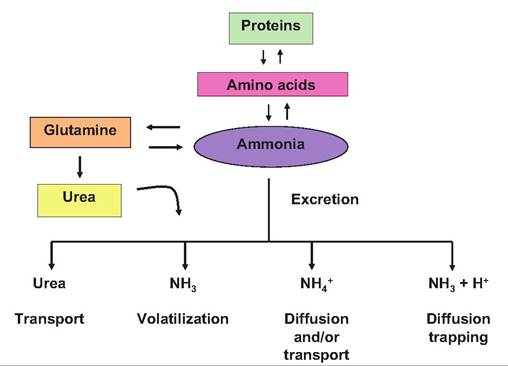
Fig. 16.21. Nitrogen excretion. Ammonia accumulates in tissue from the catabolism of proteins. It is either directly excreted, or, as in most mammals, it is converted into less toxic urea or uric acid for elimination from the body.
ammonia is freely diffusible, keeping concentrations low (to allow movements down a concentration gradient) requires large amounts of water. It is estimated that 0.5 L of water is necessary to excrete Ig of nitrogen waste in the form of ammonia. Nonetheless, some animals do excrete their nitrogenous waste primarily as ammonia. These animals are called ammonotelic. Many fishes and aquatic invertebrates are ammonotelic. There are also some animals (snails and crabs) that excrete ammonia into the air as a volatile gas.
Urea is much less toxic than ammonia and in addition only about 10% as much water is required to excrete Ig of nitrogenous waste as urea compared with ammonia. On the other hand, there is an energy cost, since ATP is required for urea synthesis. Ureotelic animals excrete most of their nitrogenous waste as urea. Two primary pathways are used for urea formation. Most animals generate urea largely in the liver via the ornithine-urea cycle as illustrated in Figure 16.22.
Uricotelic animals, which include birds and reptiles, excrete nitrogenous wastes as uric acid or the closely related compound guanine. Both of these molecules have the advantage of carrying away four nitrogen atoms in each molecule. The nitrogen groups in uric acid are derived from the breakdown of glycine, aspartate, or glutamine. These animals lack the enzyme uricase and so cannot breakdown uric acid. This means that the poorly soluble uric acid precipitates and is excreted as a semisolid material. For example, the whitish-colored material in chicken manure is largely uric acid. An advantage is that relatively little water is required for excretion.
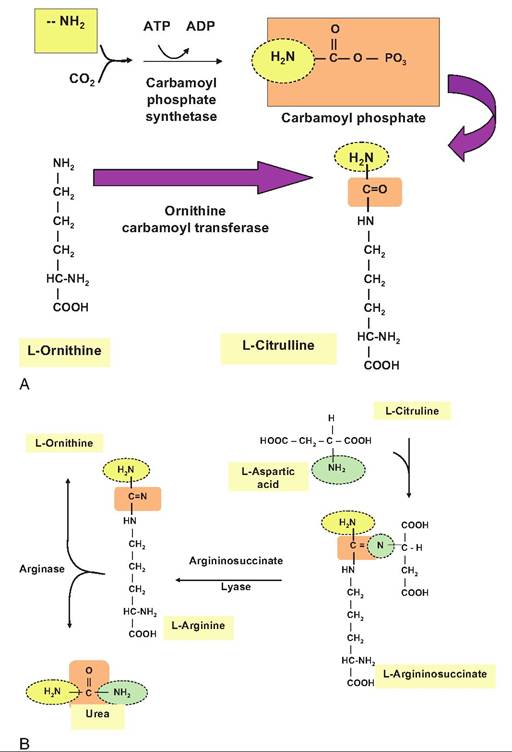
Fig. 16.22. The ornithine-urea cycle.