FISH
Fish are eetothrrnιie vertebrates that live and breathe in water and move with the aid of tins. There are over JO OOO species of Iish. which makes them the most numerous of vertebrates.
They range in size from the tiny Philippine Island goby, which measures less than 1 cm. to the whale shark, which measures up to 16 m. There are two groups of jawed Iish: the Curtikujinous fish (sharks and raysl and the bony fish, which includes all the ornamental Iish likely to be kept in captivity. Within the bony Iish are the group known as the teleosts. which comprises 20 000 species divided into the lower Teleosts. e.g. carp, salmon and cattish, and the hiyher teleosts, e.g. perch, sticklebacks and mackerel. They are found in a wide range of habitats all over the world. Many groups of Iish kept in captivity have been selectively bred. e.g. goldfish, which has led to the development of an enormous range of fins, eves, colour, tails and size. However, all teleosts have a •Fsimilar general structure.
General anatomy
Musculoskeletal system
The fusiform shape of a Iish makes it streamlined for swimming. Locomotion is facilitated by muscle blocks or myomeres arranged on either side of the axial skeleton I Fig. 15.12). This enables the body to bend laterally and generate the propulsive force to move forward. The cranium is rigid and articulates with the bones of the jaws and opercula apparatus. The number of vertebrae varies: ribs in the thoracic region articulate with the vertebrae and support the lateral walls of the body cavil v.
V
Fish possess fins, which are responsible for the lish’s ability to manoeuvre and remain stable in the waler.
to
The Iins consist of tissue stretched lu*tween rays er which may be stiff and unjointed or soft with many articulations (Fig. 15.1 J). The fins are attached to small muscles which fold or extend the Iins to produce rapid precise movements.
The shape of the CaiuIaIJin or tail provides an indication of the swimming habits of the fish. e.g. a forked tail enables the Iish to swim at continuous high speeds, while a truncated tail is seen in slow moving species and allows them to make fast dashes.Buoijuncii in (he waler is achieved by a gas-lilled swim bladder in the bodv of the fish. Iulow the verte- bra I column (Fig. 1 5.14). The specific gravity of the Icleosts is greater than that of the surrounding waler so there is a tendency Iosink if they remain stationary. By altering the volume of air in the swim bladder the Iish can rise and remain in one place - they achieve neutral buoyancy despite pressure changes in the water. The swim bladder has evolved from the primitive lung of (he lower teleosts and is a thin-walled diverticulum of the foregut. The structure varies depending on the species:
Lower teleosts - the swim bladder is linked via a pneumatic duct to the Ibrcgul and is described as being yhysostomous. rΓhis type occurs mainly in shallow freshwater species.'I he swim bladder is
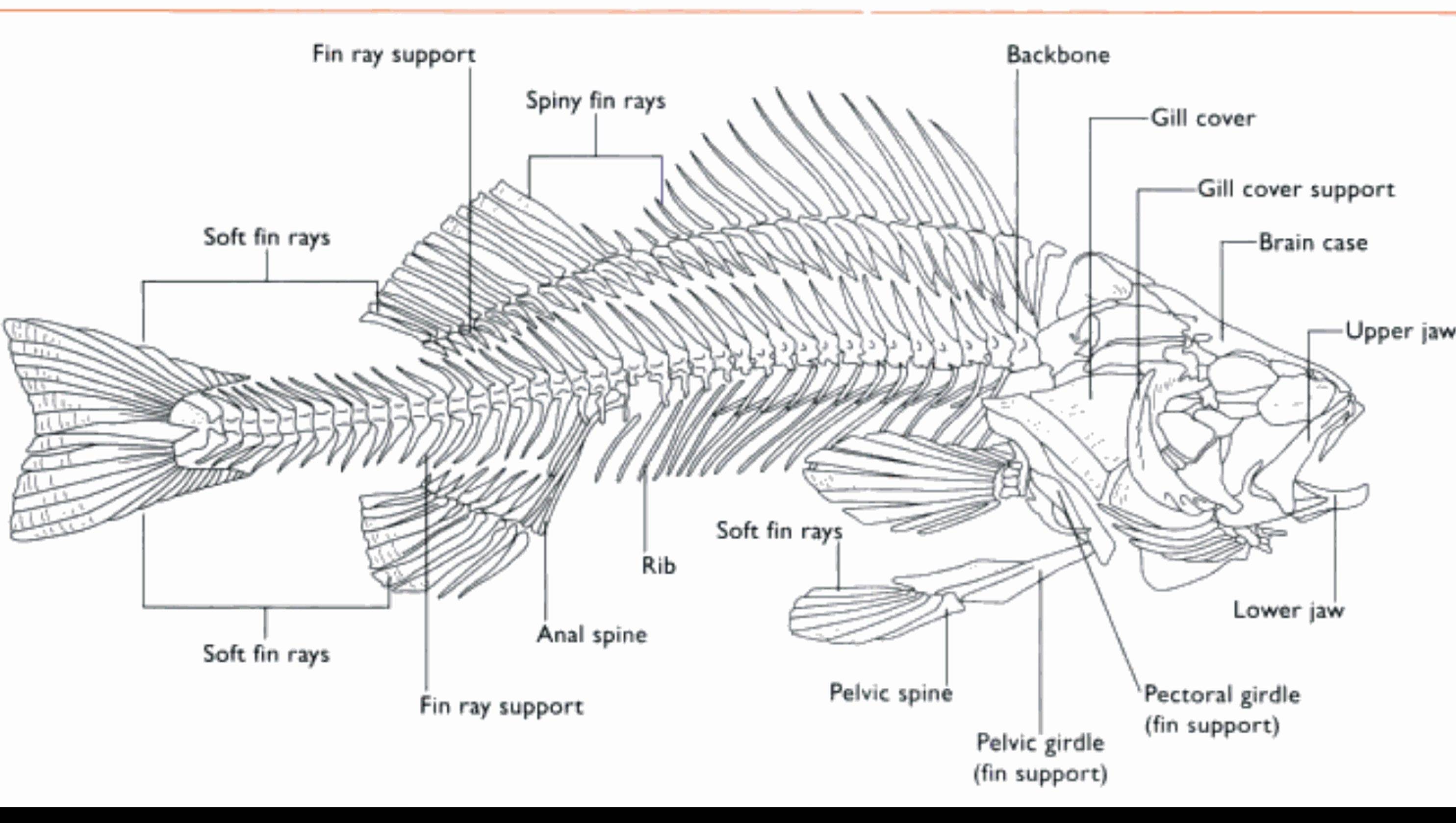
Fig. 15.12 SWeuI structure of a fish.
Integument
Fish have a scaly skin covered bv a Iaver of mucus ttf e*
which has a fungicidal and bacteriocidal function. Damage to the mucus covering can lead to skin infections and to the formation of ulcers. This Iaver is referred to as the cuticle or Iflycocalyx and it improves movement through the water by reducing frictional drag. The scales are flexible bony plates on the skin and are arranged like overlapping roof tiles.
Special senses
Tcleost Iish have the same special senses as mammals, i.e. vision, smell, taste, hearing and balance. They also have a lateral line system (Fig. 15.13). This consists of a scries of shallow channels running over the surface of the body along the lateral midiinc. At intervals along the line are small clumps of hair cells with lips that are embedded in a gelatinous cup or cupula.
If these hair cells arc moved bv outside vibrations they wr ∙rtransmit the information to the brain of the tish. which brings about the appropriate response. The function of the lateral line is to detect disturbance or vibrations in the water caused by objects such as other tish: the lateral line therefore provides a Touch at a distance’ sense. This aids the Iish in both the detection of prey in the water and in the avoidance of predators and is thought to be involved in the ability of large shoals to move simultaneously so that they almost behave as one large organism.
Respiratory system
One of the most remarkable features of Iish is their ability to breathe in waler - this is achieved using a specialised system of ι∕i∕∕s (Fig. 1 5.1 5).
The gill system involves five lateral (fill slits on each side of the pharyngeal wall. Each gill consists of a skeletal (fill arch supporting highly Vasculariscd (fill Jil- aments. Projecting from these are Iine secondary filaments or lamellae. Λl the point where the gill slits open into the pharynx are stiff elongated projections from the gill arch known as (fill rakers. These act as a screen to protect the delicate gills from particles which could damage them. The gills are covered by protective flaps called the opercula (sing, open uhtm}. Water is taken in through the mouth and passes over the gills where gaseous exchange takes place, after which the water is forced out through the opercula.
Circulatory system
The heart is a long folded organ consisting of an atrium and a ventricle. The circulation is described as being siiufle (the mammalian circulation is double! because the blood passes through the heart once per circulation. Blood leaves the ventricle and is pumped through the arteries io the gills, where it picks up oxygen. It continues around the body through the other organs where it picks up nutrients and delivers oxygen and nutrients to (he tissues. In return it collects carbon dioxide and carries this to the gills where it is eliminated.
Waste products arc also collected and excreted via the kidneys. The blood then flows to the atrium of the heart in the veins.Digestive system
The digestive system of teleost Iish varies according to the type of diet (Fig. 1 5.14). The method of ingestion depends largely upon suction facilitated by protrusion of the jaws. However, predatory Iish have teeth on the front of their jaws and the roof of the mouth and also throat teeth just in front of the oesophagus. These are used for catching and Iiolditig their prey, which is usually swallowed whole and head Iirsl. ’The (fill rakers on the inner surface of the gills prevent the food from exiting the mouth through Itie opercula. Food passes into the stomach, which is tube-like, and then into the intestine, which is a simple tube of a uniform diameter. The length and structure of the digestive tract varies greatly according to whether the species is a herbivore or carnivore: the gut is longer in herbivorous species than in carnivorous species. Waste materials arc evacuated from the rectum and anus.
Urinary system
rThe kidneys lie ventral to the spine and in some species they may sit like a saddle on the swim bladder (Fig.
1 5.14). They have a IiumlKT of functions including excretion. Iiaemopocisis and the secretion of hormones.
Osmoreifulation varies between freshwater and marine Iish. In freshwater, the surrounding waler is hypotonic so water passes into the body Iluids through the gills. The kidney compensates Tor this and prevents the Iish from ‘bursting’ by excreting large volumes of dilute urine. In the Uiarineenviromnent. the situation is reversed - the surrounding water is hypertonic, so waler is lost from the body by passive diffusion through the gills. To conserve normal amounts of water within the Ixxlv the kidnev excretes small vol-
** *
times of concentrated urine.
Nitrogenous waste is excreted by Iish in the form of ammonia. This is extremely toxic and is only produced in animals that live in a watery environment, which
WF dilutes it.
Ihe most important site of nitrogenous excretion in Iish is the gills and not the kidneys as in mammals.Reproductive system
The majority of teleosts have separate sexes, however there is Widediversity in the reproductive patterns and some species may even exhibit parthenogenesis and hermaphroditism. Fertilisation may be:
ILcicrntiI - the female lays her eggs in the water and they are fertilised by the male sperm or milt: this ritual is known as spawniny. Very large numbers of

Fig. 15.15 The g∣H system of a fish.
A Head with the operculum removed. B Structure of a sngle gill C Honzontal section to show
eggs are produced because so many are lost to predators and in the moving water. I he eggs may be scattered. deposited in nests or buried in the mud at the bottom. Mouth brooders collect the fertilised eggs in their mouth until they hatch, after which the young may use the open mouth as a refuge. Internal - this is seen in live-bearing species such as guppies, platies and swordtails. The male possesses a copulatoπ∣ organ. usually a modified anal tin. to introduce his sperm into the female, which retains the fertilised eggs in her body. The modified Iin is known as a gonopodium and is a means of identifying the male. The female stores the milt in her oviduct for several months and several broods can be produced from a single mating. The young may be nourished within her body (viviparous) or the eggs may hatch and the live young are then expelled (Oviviparous).