Foreign Material
Patients presented with ear disease may have acquired foreign material in their ears that contributes to otitis. Foreign materials that get into the ear canal can cause local irritation and may be a primary cause of ear disease.
Plant material that makes its way into the ear canal can migrate along the ear canal and even penetrate the eardrum, leading to otitis media. Small woody stems, plant awns, foxtails, and seed packets have been found in the ear canals and middle ears of dogs and cats (Figure 5-6). Plant material is often conical in shape, and the bases are smooth and round, so entrance into the ear canal is fairly easy. However, the other side of a plant awn or foxtail has a sharp, radiating crown of spikes; movement of the plant material out of the ear is prevented because the diameter of the clump of radiating spikes tends to increase with the outward directional movement. The plant awns migrate one way—deep into the ear canal—and gain access to the middle ear through a ruptured eardrum. Significant otitis media results. The ear canal may fill with a copious amount of mucus and pus, and the plant awns or foxtails are difficult to visualize through the material.Good cleaning of the ear canals aids in uncovering and identifying the presence of plant material in the ear canal. A video otoscope helps facilitate the removal of plant awns and foxtails. Such an instrument allows clear visualization and good light for identification. The grasping type of endoscopic forceps can be inserted through the working channel of the instrument so that the plant awn or the foxtail
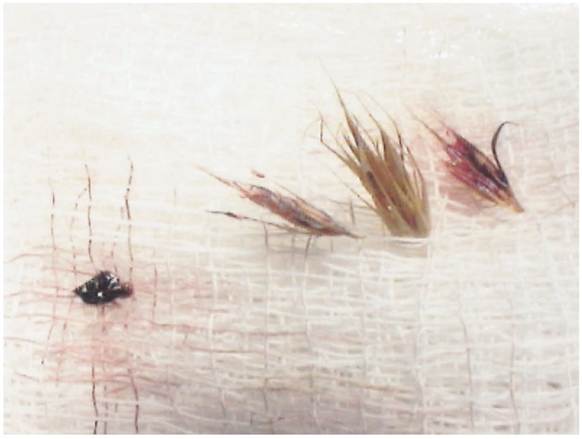
Figure 5-6
Plant awns (seed packets) retrieved from the middle ear of a Cocker Spaniel with otitis media.
can be removed. Gentle traction on the plant material collapses the radial spikes and allows its easy removal from the bulla or the ear canal.
Outdoor dogs that rub their ears into the ground may pick up sand and dirt that can fill the canal. Many medications applied into the horizontal canal can dry out, resulting in impaction. Thick ointment or cream otic formulations containing oils and particulate matter in drying agents (silicon dioxide) seem to result in more impactions when applied into the horizontal canal than do aqueous medications (Figure 5-7). These hardened concretions of medication remain in contact with the ear canal epithelium. When they are identified, these concretions can be gently flushed out of the ear canal using warmed water or warmed saline under pressure. They may also be curetted from the ear canal epithelium or removed with the use of a grasping-type endoscopic forceps to seize and remove the concretion.