GANGRENOUS ERGOTISM
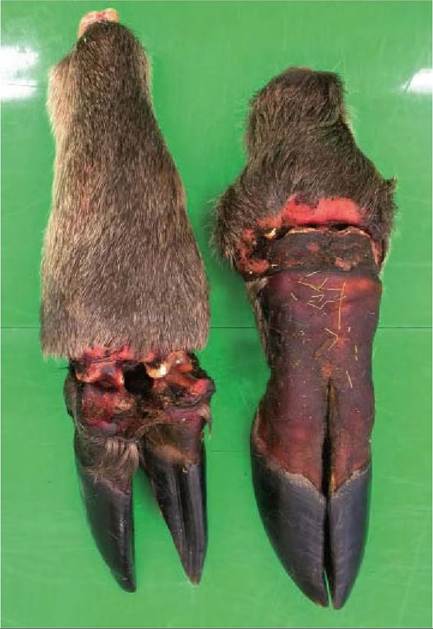
FIGURES 42.1 Limbs of a moose calf, showing gangrenous phalanges with partial sloughing through the physis of the metacarpus (right) and at the proximal interphalangeal joint (left).
Photo: Norwegian Veterinary Institute.noses such as trauma and bacterial infections. Affected animals found alive should be destroyed for animal welfare reasons.
REFERENCES
1. eur-lex. Available online at: http://eur-lex.europa.eu/LexUriServ/ LexUriServ.do?uri=0J:L:2006:364:0005:0024:EN:PDF [accessed 20 March 2012]; http://eur-lex.europa.eu/LexUriServ/LexUriServ.do?uri= 0J:L:2007:255:0014:0017:EN:PDF [accessed 20 March 2012].
2. Quist, C.F., Bounous, D.I., Kilburn, J.V, Nettles, V.F. & Wyatt, R.D. The effect of dietary aflatoxin on wild turkey poults. Journal of Wildlife Diseases. 2000;36:436-44.
3. Quist, C.F., Howerth, E.W., Fischer, J.R., Wyatt, R.D., Miller, D.M. & Nettles, V.F. Evaluation of low-level aflatoxin in the diet of white-tailed deer. Journal of Wildlife Diseases. 1997;33:112-21.
4. Richard, J.L. Some major mycotoxins and their mycotoxicoses — an overview. International Journal of Food Microbiology. 2007;119:3-10.
5. Boston, S.,Wobeser, G. &Gillespie, M. Consumptionofdeoxynivalenol- contaminated wheat by mallard ducks under experimental conditions. Journal of Wildlife Diseases. 1996;32:17-22.
6. Diaz, G.J. & Boermans, H.J. Fumonisin toxicosis in domestic animals: a review. Veterinary and Human Toxicology. 1994;36:548-55.
7. Green, P. & Rose, H. Suspected gangrenous ergotism in a wild roe deer (Capreolus capreolus). Veterinary Record. 1995;137:220-1.
8. Handeland, K. & Vikoren, T. Presumptive gangrenous ergotism in free- living moose and a roe deer. Journal of Wildlife Diseases. 2005;41: 636-42.
9. Uhlig, S., Vikoren, T., Ivanova, L. & Handeland, K. Ergot alkaloids in Norwegian wild grasses: a mass spectrometric approach. Rapid Communications in Mass Spectrometry. 2007;21:1651-60.